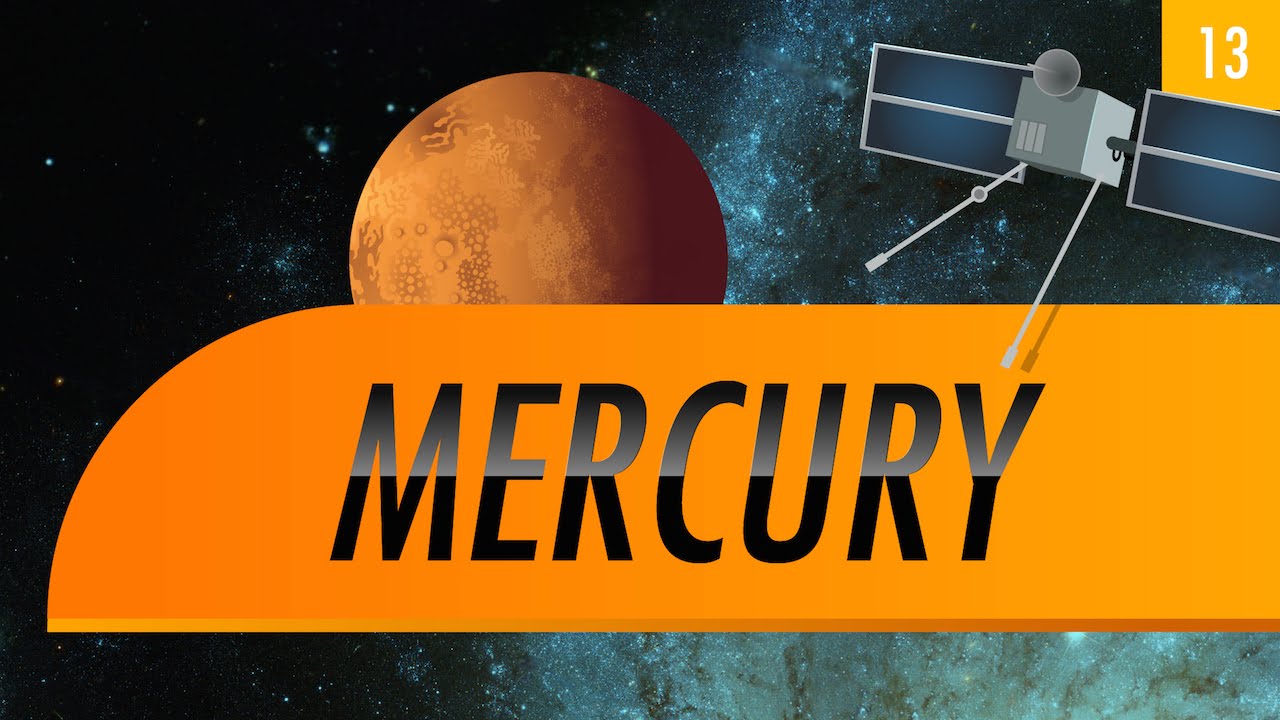
Mercury: Crash Course Astronomy #13
video description
Date: 2022-04-04
Related videos

• TED-Ed



Comments and reviews: 10
luke
Wow learned something new today. never realized or had heard that Mercury is in a 2/3 tidal lock rotation/revolution. that's really cool. I knew it had a ridiculously long day compared to its year length but never realized it was a 2/3 synchronization. This bodes well for potentially habitable planets circling red dwarf stars, like the Trappist-1 system. Potentially habitable planets around red dwarfs must orbit very close to the parent star to be within the small cool star's habitable zone, close enough that they would become tidally locked, and have year lengths of only a few Earth days (shorter than Mercury's 88 Earth days. Tidal locking is going to be -inevitable- for these planets due to their close proximity to the parent star, BUT, if they can be -tidally locked- at a fractional rotational speed other than 1/1, then that means they won't be -eyeball planets- with one side perpetually broiling in the star's light and heat, and the other side perpetually frozen in eternal night, with only a narrow band all the way around the planet from pole to pole along the -sunset zone- between the two being capable of supporting life, if that. Such a planet would undoubtedly also be lashed by a perpetual storm cooked up by the endless solar heating at the point on its surface closest to the star (particularly if there were an ocean basin there, if it were continental landmass, it would be a blazing perpetually cooked desert, and winds would blow from the hot storm around the planet to the cold and frozen night side where an eternally dark enormous ice cap would be forever present with no way of ever melting (except volcanism or impacts. Having a planet locked into a 2/3 rotational -tidal lock- would mean that the ENTIRE surface of the planet WOULD receive daylight, ameliorating the -eyeball planet- effect, and give actual days and nights, though like Mercury's they would be -strange- by Earth standards. on a planet with a 16 day orbit (which I recall reading some of the Trappist planets are in such short -year length- orbits around their star) that would mean a day length of about ten days or so, followed by about ten days of night, similar to Earth's Moon. Plant and animal life could adapt to those conditions easier than an -eyeball planet- type scenario (though there's no reason to believe life COULDN'T adapt to an eyeball planet either, just that it would be more difficult.
Later! OL J R: )
reply
Wow learned something new today. never realized or had heard that Mercury is in a 2/3 tidal lock rotation/revolution. that's really cool. I knew it had a ridiculously long day compared to its year length but never realized it was a 2/3 synchronization. This bodes well for potentially habitable planets circling red dwarf stars, like the Trappist-1 system. Potentially habitable planets around red dwarfs must orbit very close to the parent star to be within the small cool star's habitable zone, close enough that they would become tidally locked, and have year lengths of only a few Earth days (shorter than Mercury's 88 Earth days. Tidal locking is going to be -inevitable- for these planets due to their close proximity to the parent star, BUT, if they can be -tidally locked- at a fractional rotational speed other than 1/1, then that means they won't be -eyeball planets- with one side perpetually broiling in the star's light and heat, and the other side perpetually frozen in eternal night, with only a narrow band all the way around the planet from pole to pole along the -sunset zone- between the two being capable of supporting life, if that. Such a planet would undoubtedly also be lashed by a perpetual storm cooked up by the endless solar heating at the point on its surface closest to the star (particularly if there were an ocean basin there, if it were continental landmass, it would be a blazing perpetually cooked desert, and winds would blow from the hot storm around the planet to the cold and frozen night side where an eternally dark enormous ice cap would be forever present with no way of ever melting (except volcanism or impacts. Having a planet locked into a 2/3 rotational -tidal lock- would mean that the ENTIRE surface of the planet WOULD receive daylight, ameliorating the -eyeball planet- effect, and give actual days and nights, though like Mercury's they would be -strange- by Earth standards. on a planet with a 16 day orbit (which I recall reading some of the Trappist planets are in such short -year length- orbits around their star) that would mean a day length of about ten days or so, followed by about ten days of night, similar to Earth's Moon. Plant and animal life could adapt to those conditions easier than an -eyeball planet- type scenario (though there's no reason to believe life COULDN'T adapt to an eyeball planet either, just that it would be more difficult.
Later! OL J R: )
reply
Norman
Why doesn't he mention the fact that Mercury appears to not close its orbit per revolution by some eighteen miles per orbit. That is it arrives at its calculated point in space on its orbit eighteen miles behind its scheduled time. The velocity of Mercury does not speed up technically because an object in motion keeps that same motion at all times unless it is altered or changed by some other force. What is occurring is the closer you get toward the Sun, the slower time elapses as a momentum. When you calculate velocity it must be in the time sequence of its position relative to the Sun. This is also true for Earth and every other object in orbit around the Sun. At our perihelion point to the Sun, time is a tad slower than it is at our aphelion point. Our scientist choose to view this as an increase in speed rather than a slowing of time. .
reply
Why doesn't he mention the fact that Mercury appears to not close its orbit per revolution by some eighteen miles per orbit. That is it arrives at its calculated point in space on its orbit eighteen miles behind its scheduled time. The velocity of Mercury does not speed up technically because an object in motion keeps that same motion at all times unless it is altered or changed by some other force. What is occurring is the closer you get toward the Sun, the slower time elapses as a momentum. When you calculate velocity it must be in the time sequence of its position relative to the Sun. This is also true for Earth and every other object in orbit around the Sun. At our perihelion point to the Sun, time is a tad slower than it is at our aphelion point. Our scientist choose to view this as an increase in speed rather than a slowing of time. .
reply
Voicebox
Mercury is also the mostly closest planet to all planets, its true, Mercury spins the fastest and since its like that, its usually the closest to any planet, for example, Earth is on its regular day, there is a time Mars is closest, and a time Venus is closest, but since mercury is faster, at some point mars and Venus would be on the other end of their ellipse and mercury would be closest now to earth for most of the Time while mars and Venus take a lot of time to come back for earth, this literally works the same way for all planets, but don-t take my word from it, watch CGP Grey-s video on -What planet is the closest? - I-m serious my mind was blown when I heard of it.
reply
Mercury is also the mostly closest planet to all planets, its true, Mercury spins the fastest and since its like that, its usually the closest to any planet, for example, Earth is on its regular day, there is a time Mars is closest, and a time Venus is closest, but since mercury is faster, at some point mars and Venus would be on the other end of their ellipse and mercury would be closest now to earth for most of the Time while mars and Venus take a lot of time to come back for earth, this literally works the same way for all planets, but don-t take my word from it, watch CGP Grey-s video on -What planet is the closest? - I-m serious my mind was blown when I heard of it.
reply
Norman
Time on Mercury as an average is about 1. 000000313 times longer than a second on Earth. Mercury c; loses its orbit on time every time but because we are calculating it using our time value it appears not to close on time. To a Mercurian, if their was one, he would see Earth as closing ahead of its calculated position by the same distance that we see Mercury as being late using his time sequence momentum. In the case of Saturn, Uranus and Neptune, all three Planets arrive earlier than calculated for at their determined orbit closing point. While astronomy doesn't mention this in its text books except to adjust their periods every ten years or so.
reply
Time on Mercury as an average is about 1. 000000313 times longer than a second on Earth. Mercury c; loses its orbit on time every time but because we are calculating it using our time value it appears not to close on time. To a Mercurian, if their was one, he would see Earth as closing ahead of its calculated position by the same distance that we see Mercury as being late using his time sequence momentum. In the case of Saturn, Uranus and Neptune, all three Planets arrive earlier than calculated for at their determined orbit closing point. While astronomy doesn't mention this in its text books except to adjust their periods every ten years or so.
reply
Bryan
He, and many astronomy sites use -Mercury days- in two ways and it's very confusing. At 3: 25 it says Mercury's Day: 58. 65 Earth Days, and then at 4: 13 it says in the diagram that 0. 50 Mercury Days =88 Earth Days. These two cannot go together. It is either that one rotation on its axis is equal to one day, or that one -Sun cycle- is equal to one day.
reply
He, and many astronomy sites use -Mercury days- in two ways and it's very confusing. At 3: 25 it says Mercury's Day: 58. 65 Earth Days, and then at 4: 13 it says in the diagram that 0. 50 Mercury Days =88 Earth Days. These two cannot go together. It is either that one rotation on its axis is equal to one day, or that one -Sun cycle- is equal to one day.
reply
crash_course
There are places in Earth's Arctic, notably Alaska, where snow exists year round, 24/7, even though the short summers can get to room temperature and a bit more. This is just due to places where sunlight never reaches, even though the sun is up for long periods of time in the summer.
reply
There are places in Earth's Arctic, notably Alaska, where snow exists year round, 24/7, even though the short summers can get to room temperature and a bit more. This is just due to places where sunlight never reaches, even though the sun is up for long periods of time in the summer.
reply
Aegon
Cheers for this, I've been looking for -early astronomy facts- for a while now, and I think this has helped. Have you ever come across - Qanailey Riyhloe Domination - (do a search on google )? Ive heard some awesome things about it and my work buddy got amazing success with it.
reply
Cheers for this, I've been looking for -early astronomy facts- for a while now, and I think this has helped. Have you ever come across - Qanailey Riyhloe Domination - (do a search on google )? Ive heard some awesome things about it and my work buddy got amazing success with it.
reply
Jeremy
Random question: when measuring Mercury's (or any object's) distance from the Sun, do they measure from the Sun's surface or from the edge of the corona? I know it wouldn't be much of a difference, but just curious.
reply
Random question: when measuring Mercury's (or any object's) distance from the Sun, do they measure from the Sun's surface or from the edge of the corona? I know it wouldn't be much of a difference, but just curious.
reply
Dropa
Mr plait, thank you for taking time in your life to teach us about this ever expanding universe and the celestial bodies that move in it. I look forward to watch your videos to escape my depressing days
reply
Mr plait, thank you for taking time in your life to teach us about this ever expanding universe and the celestial bodies that move in it. I look forward to watch your videos to escape my depressing days
reply
victor
If we named all the other planets after ancient gods why not give the sun, earth and the moon a more fitting name like Helios, Gaea and Celine
It'd sound far more awesome in my opinion
reply
If we named all the other planets after ancient gods why not give the sun, earth and the moon a more fitting name like Helios, Gaea and Celine
It'd sound far more awesome in my opinion
reply
Add a review, comment
Other channel videos