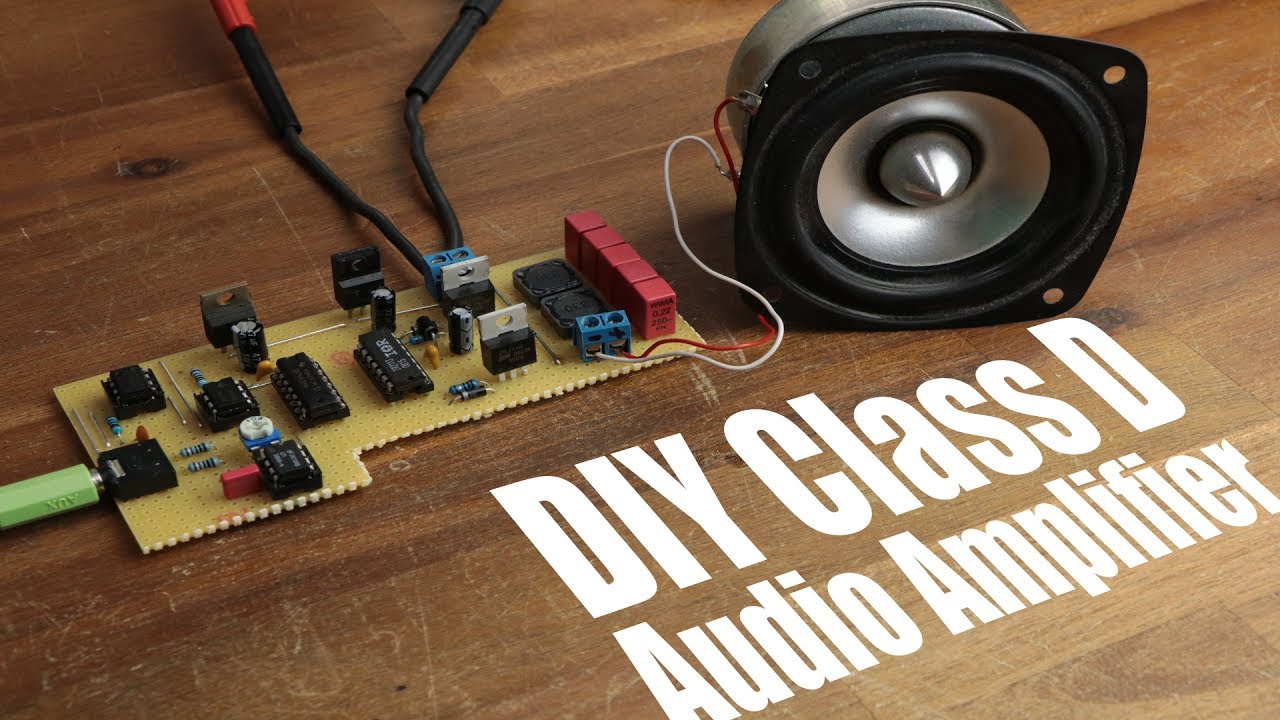
DIY Class D Audio Amplifier
video description
Date: 2020-09-05
Related videos






Comments and reviews: 9
3V0
As a DJ and an audiophile, I would love for you to attempt a Class D audio amplifier for a subwoofer in the home. Car subwoofers and amplifiers are amazing but I want to power a nice 12 for my parties. Since im not too electrically knowledged, seeing how you would make one run off of 120 or 240 volts would be amazing and would improve my audio quality without having to spend hundreds of more dollars for a big beefy system that i dont necessarily need right now.
reply
As a DJ and an audiophile, I would love for you to attempt a Class D audio amplifier for a subwoofer in the home. Car subwoofers and amplifiers are amazing but I want to power a nice 12 for my parties. Since im not too electrically knowledged, seeing how you would make one run off of 120 or 240 volts would be amazing and would improve my audio quality without having to spend hundreds of more dollars for a big beefy system that i dont necessarily need right now.
reply
Kalvinjj
A question about this amp in specific: wouldn't it require also a high pass filter? From what I understood, it swings the voltage between VCC and GND, so an audio signal would only go positive, no issue on that until we count that the speaker is referenced to ground as well, but a middle voltage (which should happen at zero input signal) would be half VCC, so it would be conducting that DC offset.
reply
A question about this amp in specific: wouldn't it require also a high pass filter? From what I understood, it swings the voltage between VCC and GND, so an audio signal would only go positive, no issue on that until we count that the speaker is referenced to ground as well, but a middle voltage (which should happen at zero input signal) would be half VCC, so it would be conducting that DC offset.
reply
Tuhinadri
Is it ok to say, that the LM386 is directly driving the speaker? Lm386 has 1w capability.
And the comparator inputs are limited to a few nanoamps.
So even with a higher voltage or amperage, it will still send approximately the same RMS signal.
Is the speaker running on LM386 feedback? (and its a class ab amp, not a discrete op-amp)
reply
Is it ok to say, that the LM386 is directly driving the speaker? Lm386 has 1w capability.
And the comparator inputs are limited to a few nanoamps.
So even with a higher voltage or amperage, it will still send approximately the same RMS signal.
Is the speaker running on LM386 feedback? (and its a class ab amp, not a discrete op-amp)
reply
Teja
You are a genius Pal, the way you've designed the circuit and the way you've explained the circuit and it's working, moreover the circuit you've drawn are simply awesome and easily understandable. Your handwriting was the best I've ever seen and your presentation was so good that it made us to concentrate on what we have to. Thumsup for you
reply
You are a genius Pal, the way you've designed the circuit and the way you've explained the circuit and it's working, moreover the circuit you've drawn are simply awesome and easily understandable. Your handwriting was the best I've ever seen and your presentation was so good that it made us to concentrate on what we have to. Thumsup for you
reply
Jason
I really like your videos. But the thing is, ok now i have the necessary information to potentially make this myself but i feel like i could never come up with the circuit myself. A video where you explain your way of going at it from scratch would be amazing. I feel like thats the best way to learn something.
reply
I really like your videos. But the thing is, ok now i have the necessary information to potentially make this myself but i feel like i could never come up with the circuit myself. A video where you explain your way of going at it from scratch would be amazing. I feel like thats the best way to learn something.
reply
Arijeet
Hello Guys, I was also building a class d amplifier as taking reference of great Scott schematic, in my circuit when I ask powering the circuit hex inverter is not inverting the PWM. can anyone help me with? I am using the MC74HC04AN hex inverter.
reply
Hello Guys, I was also building a class d amplifier as taking reference of great Scott schematic, in my circuit when I ask powering the circuit hex inverter is not inverting the PWM. can anyone help me with? I am using the MC74HC04AN hex inverter.
reply
Arijeet
Hey Scott, can you tell me why you don't use the ca coupling after generating a triangular wave. when I am generating I am getting a dc offset voltage. can you tell me the reason behind this.
reply
Hey Scott, can you tell me why you don't use the ca coupling after generating a triangular wave. when I am generating I am getting a dc offset voltage. can you tell me the reason behind this.
reply
Jeff
What about a class AB amplifier. I build a tiny amp just using the LM386 but KA386 variant for audio. I want to add a higher power stage after it while keeping it class AB. What do you think?
reply
What about a class AB amplifier. I build a tiny amp just using the LM386 but KA386 variant for audio. I want to add a higher power stage after it while keeping it class AB. What do you think?
reply
Mike
Have you tried it without the output filter? The speaker can't follow the 200kHz, so it should find the average position according to the PWM'd signal. Does the filter make a difference?
reply
Have you tried it without the output filter? The speaker can't follow the 200kHz, so it should find the average position according to the PWM'd signal. Does the filter make a difference?
reply
Add a review, comment
Other channel videos