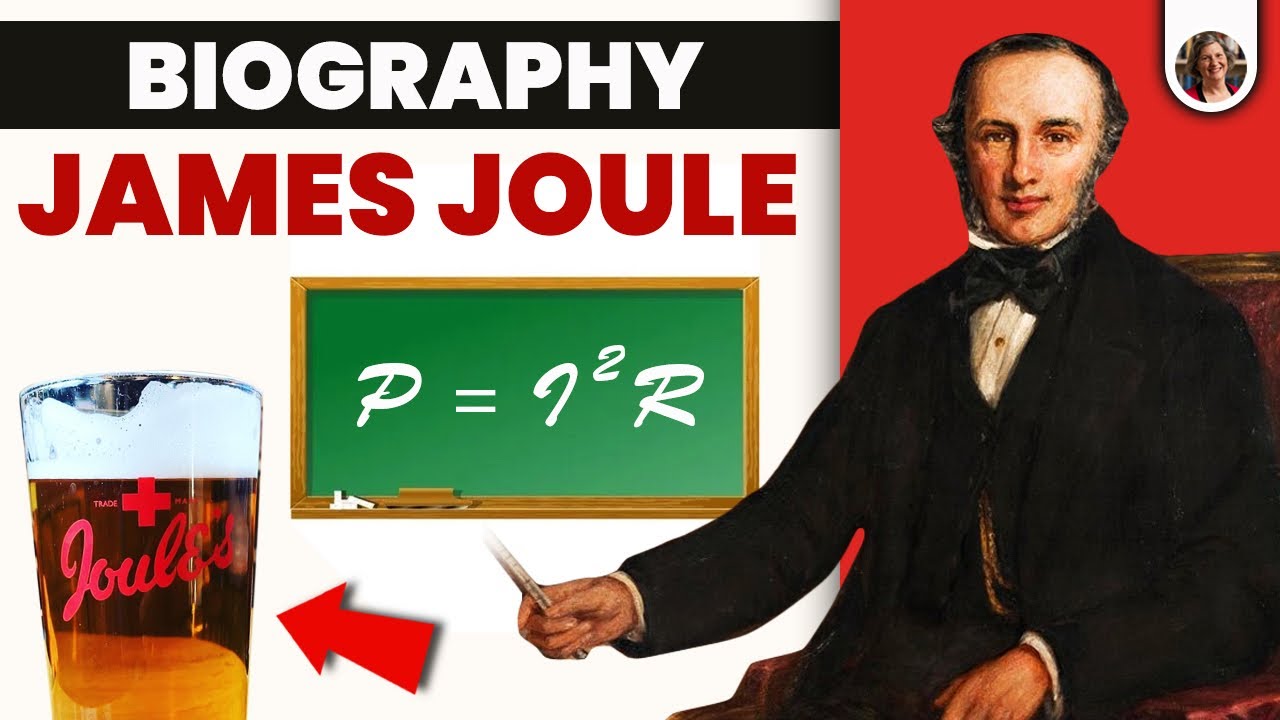
James Joule Biography: The Beer Brewer Who Changed The World
video description
Date: 2022-12-27
Related videos


Comments and reviews: 20
Muttley
I am deeply impressed by your videos.
I have loved physics history for decades. I have an extensive library of historically significant physics tomes and have devoted a lot of my time to one small corner of history, the development of the theory of quantum mechanics. I can immediately recognise your prodigious expository skill and your enormous - even infectious - affection for the subject matter.
It has long intrigued me that science history is almost unique among historically-oriented disciplines in the sense that science histories tend to be about the science and not so much the people and their personalities. In military or political history this would never suffice since a person is inseparable from their devotion to their labours, the style in which they accomplish it and the effort they do or do not put into promoting it. What I enjoy most about your histories is that you are also interested in the people.
Many heartfelt thanks for the effort you put into this work, it is all terrific fun and I can scarcely do justice to my tremendous gratitude.
I hope you will indulge two of my favourite quotes from the physical sciences. The first is from the avowed Sandemanian, Michael Faraday, and is especially sublime. I am not religious at all but I find this quote to be very beautiful.
_The beauty of electricity or of any other force is not that the power is mysterious, and unexpected, touching every sense at unawares in turn, __but that it is under law__ and that the taught intellect can even now govern it largely. The human mind is placed above, and not beneath it, and it is in such a point of view that the mental education afforded by science is rendered super-eminent in dignity, in practical application and utility; for by enabling the mind to apply the natural power through law, it conveys the gifts of god to man_
- M. Faraday. _Notes for a Friday Discourse at the Royal Institution (1858)_
The second quote is much punchier and very much summarises my own delight for the sciences. I suspect you will be able to relate.
_If you haven't found something strange during the day it hasn't been much of a day_
- Attributed to John Archibald Wheeler.
reply
I am deeply impressed by your videos.
I have loved physics history for decades. I have an extensive library of historically significant physics tomes and have devoted a lot of my time to one small corner of history, the development of the theory of quantum mechanics. I can immediately recognise your prodigious expository skill and your enormous - even infectious - affection for the subject matter.
It has long intrigued me that science history is almost unique among historically-oriented disciplines in the sense that science histories tend to be about the science and not so much the people and their personalities. In military or political history this would never suffice since a person is inseparable from their devotion to their labours, the style in which they accomplish it and the effort they do or do not put into promoting it. What I enjoy most about your histories is that you are also interested in the people.
Many heartfelt thanks for the effort you put into this work, it is all terrific fun and I can scarcely do justice to my tremendous gratitude.
I hope you will indulge two of my favourite quotes from the physical sciences. The first is from the avowed Sandemanian, Michael Faraday, and is especially sublime. I am not religious at all but I find this quote to be very beautiful.
_The beauty of electricity or of any other force is not that the power is mysterious, and unexpected, touching every sense at unawares in turn, __but that it is under law__ and that the taught intellect can even now govern it largely. The human mind is placed above, and not beneath it, and it is in such a point of view that the mental education afforded by science is rendered super-eminent in dignity, in practical application and utility; for by enabling the mind to apply the natural power through law, it conveys the gifts of god to man_
- M. Faraday. _Notes for a Friday Discourse at the Royal Institution (1858)_
The second quote is much punchier and very much summarises my own delight for the sciences. I suspect you will be able to relate.
_If you haven't found something strange during the day it hasn't been much of a day_
- Attributed to John Archibald Wheeler.
reply
Stan
Kathy- I love your approach and I share your enthusiasm for this history. I have known and used Ohm's law since my childhood- I use it without even thinking about it; it is part of my view of reality- for solving problems, and understanding systems of all kinds. It is not an exaggeration to say that it changed my life- or to say that it changed the world.
Remembering that this principle, which seems so inevitable and obvious today, was once not obvious at all, and tracing the sequence of the observations and thinking that led to the law makes it even more beautiful and intuitive. To me, this is the best way to encounter the great ideas of science.
As a practicing electrical and mechanical engineer, your work touches me deeply- you have connected so many of the beautiful ideas in my field with their discoverers and their stories.
I note in particular the common theme of drama around their validation and acceptance. It reminds me of how easily the talented and earnest can be completely wrong about what turns out to be obvious in hindsight. This is a humbling reality that is too rarely understood today. In this story, for example, internal battery resistance is a lovely example. And you include it as a key point in your story- well done. You often make me think of Kuhn and his Structure of Scientific Revolutions, BTW.
I wish I had time to rave about the rest of your videos. Your content is consistently excellent. Your lean productions let your distinctive and excellent content shine. Bravo, thank you, and encore!
reply
Kathy- I love your approach and I share your enthusiasm for this history. I have known and used Ohm's law since my childhood- I use it without even thinking about it; it is part of my view of reality- for solving problems, and understanding systems of all kinds. It is not an exaggeration to say that it changed my life- or to say that it changed the world.
Remembering that this principle, which seems so inevitable and obvious today, was once not obvious at all, and tracing the sequence of the observations and thinking that led to the law makes it even more beautiful and intuitive. To me, this is the best way to encounter the great ideas of science.
As a practicing electrical and mechanical engineer, your work touches me deeply- you have connected so many of the beautiful ideas in my field with their discoverers and their stories.
I note in particular the common theme of drama around their validation and acceptance. It reminds me of how easily the talented and earnest can be completely wrong about what turns out to be obvious in hindsight. This is a humbling reality that is too rarely understood today. In this story, for example, internal battery resistance is a lovely example. And you include it as a key point in your story- well done. You often make me think of Kuhn and his Structure of Scientific Revolutions, BTW.
I wish I had time to rave about the rest of your videos. Your content is consistently excellent. Your lean productions let your distinctive and excellent content shine. Bravo, thank you, and encore!
reply
Mark
I have to tell you a funny story. Several years ago while working for a large company I was asked to look at a site where of two air conditioning chillers, one had failed and the other was in poor condition and might fail soon. It was suggested that a temporary chiller be brought in by a contractor who specialized in such problems and used as a backup. But how large a chiller was required? Ordinarily people do heat load studies looking at all of the variables of usage and radiant heat infiltration in the summer months. Instead I asked for copies of all of the electric bills for the previous year. I took the highest load and (they are averaged in 15 minute increments by the utility) converted it into heat using Joule's law. Including the chillers themselves which were not in an air conditioned space it worked out to 129 tons. So I told management that 150 tons (the next highest standard size) would be sufficient. Then two mechanical engineers went to the site to perform their own studies. When I asked one of them what they found he told me they were arguing about whether or not it should be 250 tons or 300 tons. I congratulated them for being the first people in nearly two hundred years to disprove Joule's first law.
reply
I have to tell you a funny story. Several years ago while working for a large company I was asked to look at a site where of two air conditioning chillers, one had failed and the other was in poor condition and might fail soon. It was suggested that a temporary chiller be brought in by a contractor who specialized in such problems and used as a backup. But how large a chiller was required? Ordinarily people do heat load studies looking at all of the variables of usage and radiant heat infiltration in the summer months. Instead I asked for copies of all of the electric bills for the previous year. I took the highest load and (they are averaged in 15 minute increments by the utility) converted it into heat using Joule's law. Including the chillers themselves which were not in an air conditioned space it worked out to 129 tons. So I told management that 150 tons (the next highest standard size) would be sufficient. Then two mechanical engineers went to the site to perform their own studies. When I asked one of them what they found he told me they were arguing about whether or not it should be 250 tons or 300 tons. I congratulated them for being the first people in nearly two hundred years to disprove Joule's first law.
reply
lmiddleman
Associating themselves with the physicist is probably what the marketers at the modern/upstart Joule Brewery wanted. But the modern brewery has no connection to the historical Joule's, and even that famous brand that has been revived is distinct and separate from James Prescott Joule's family brewery.
James Prescott Joule was only distantly related to the famous and popular Joule & Sons Brewery of Stone, Staffordshire. James' great-uncle Francis Joule (1755-1837) had founded Joule's of Stone, and his father's cousin John Joule (1783-1858) had taken it over years before James Prescott Joule was even born. James' family brewery in urban Salford (SOL-furd) was under his father's name Benjamin Joule's Ale & Porter, and distinct from the far more famous Joule's, whose popular Stone Ale was named after their rather rural Staffordshire village adjacent the River Trent. Some say the Trent's waters were crucial to Stone Ale's success, and though only 40 miles from Salford, was in terms of ale, worlds apart.
reply
Associating themselves with the physicist is probably what the marketers at the modern/upstart Joule Brewery wanted. But the modern brewery has no connection to the historical Joule's, and even that famous brand that has been revived is distinct and separate from James Prescott Joule's family brewery.
James Prescott Joule was only distantly related to the famous and popular Joule & Sons Brewery of Stone, Staffordshire. James' great-uncle Francis Joule (1755-1837) had founded Joule's of Stone, and his father's cousin John Joule (1783-1858) had taken it over years before James Prescott Joule was even born. James' family brewery in urban Salford (SOL-furd) was under his father's name Benjamin Joule's Ale & Porter, and distinct from the far more famous Joule's, whose popular Stone Ale was named after their rather rural Staffordshire village adjacent the River Trent. Some say the Trent's waters were crucial to Stone Ale's success, and though only 40 miles from Salford, was in terms of ale, worlds apart.
reply
Victor
Great video as ever. A couple of points.
1 William Thomson was knighted in 1866 for his work on the trans-Atlantic telegraph, he then became Sir William Thomson. He was made a lord, 1st Baron Kelvin in 1892. Being knighted makes one a 'Sir' not a 'Lord'. Although Thomson was Professor at Glasgow University for most of his life, he was born in Belfast, Ireland.
2 The picture of Joule's apparatus is of the model he used to demonstrate the principle. He did his experiments in the brewery on a much larger scale. His motivation was to mechanize his brewery with electric motors. The demonstration unit is in the possession of the Manchester Science Museum. The Science Museum in London has a replica.
BTW, I've seen Joule's actual display model and I've eaten a meal in the Joule House!
reply
Great video as ever. A couple of points.
1 William Thomson was knighted in 1866 for his work on the trans-Atlantic telegraph, he then became Sir William Thomson. He was made a lord, 1st Baron Kelvin in 1892. Being knighted makes one a 'Sir' not a 'Lord'. Although Thomson was Professor at Glasgow University for most of his life, he was born in Belfast, Ireland.
2 The picture of Joule's apparatus is of the model he used to demonstrate the principle. He did his experiments in the brewery on a much larger scale. His motivation was to mechanize his brewery with electric motors. The demonstration unit is in the possession of the Manchester Science Museum. The Science Museum in London has a replica.
BTW, I've seen Joule's actual display model and I've eaten a meal in the Joule House!
reply
Smarty
I love the way that the Scientific Method keeps on inspiring the minds of smart people. A paper is written or a theory is postulated, This cannot be correct, Pull the theory or paper to pieces, Set up experiments to prove or disprove, Set it to Mathematics, Write an opposing paper, justify the thinking, have that shredded and then real discoveries are made that can be replicated and substantiated. WONDROUS. Intelligent people were thrown to the wolves, intellectually speaking, all the time. In this woke world we live in now, say the wrong thing you get canceled, everyone is so worried about offending someone or hurting some blokes feelings. Get on with it and embrace the TRUTH. Keep the battle raging.
reply
I love the way that the Scientific Method keeps on inspiring the minds of smart people. A paper is written or a theory is postulated, This cannot be correct, Pull the theory or paper to pieces, Set up experiments to prove or disprove, Set it to Mathematics, Write an opposing paper, justify the thinking, have that shredded and then real discoveries are made that can be replicated and substantiated. WONDROUS. Intelligent people were thrown to the wolves, intellectually speaking, all the time. In this woke world we live in now, say the wrong thing you get canceled, everyone is so worried about offending someone or hurting some blokes feelings. Get on with it and embrace the TRUTH. Keep the battle raging.
reply
VarahaMihira
Wonderful video, as usual. I am amazed at the level of effort you put in to investigate who said or wrote what, to whom and when, and collate and present all these in such a lucid, cogent way.
I am also impressed how often they read translations of researches in each others' languages, so they didnt feel the impact of losing Latin as a link language.
Also astounding is how willing they were to give credit to each other. Something almost totally missing in todays academic environment
reply
Wonderful video, as usual. I am amazed at the level of effort you put in to investigate who said or wrote what, to whom and when, and collate and present all these in such a lucid, cogent way.
I am also impressed how often they read translations of researches in each others' languages, so they didnt feel the impact of losing Latin as a link language.
Also astounding is how willing they were to give credit to each other. Something almost totally missing in todays academic environment
reply
fuzzylon
Goosebumps time.
I studied electronic communication at Salford University just across the road from where Joule lived and worked.
I don't know if I knew and then forgot or I just assumed the building was named after him not realising it really was his house.
This is alongside all the feelings your videos stir up, reminding me how fascinating I found all this, but then never got to use what I learnt during my career.
reply
Goosebumps time.
I studied electronic communication at Salford University just across the road from where Joule lived and worked.
I don't know if I knew and then forgot or I just assumed the building was named after him not realising it really was his house.
This is alongside all the feelings your videos stir up, reminding me how fascinating I found all this, but then never got to use what I learnt during my career.
reply
Frank
Thank you so much for your excellent research historical work on science, especially on electricity. Your candid personality and subject knowledge allows your work to be understood at layman levels for all science enthusiasts. Your work is a treasure of knowledge for curious minds that may be giving their 1st steps into understanding the who, why, how and when of so many great scientific achievements. Keep up the great work!
reply
Thank you so much for your excellent research historical work on science, especially on electricity. Your candid personality and subject knowledge allows your work to be understood at layman levels for all science enthusiasts. Your work is a treasure of knowledge for curious minds that may be giving their 1st steps into understanding the who, why, how and when of so many great scientific achievements. Keep up the great work!
reply
joseph
Hello Kathy,
Great work. as always.
I have been looking up how Joule was able to calculate the chemical energy from the battery. but no luck.
Context: Joule was able to prove that I2r dissipated across the resistor was equal to the chemical energy dissipated from the battery.
For I2r across current carrying resistor, i guess he used a calorimeter. correct me if i am wrong
reply
Hello Kathy,
Great work. as always.
I have been looking up how Joule was able to calculate the chemical energy from the battery. but no luck.
Context: Joule was able to prove that I2r dissipated across the resistor was equal to the chemical energy dissipated from the battery.
For I2r across current carrying resistor, i guess he used a calorimeter. correct me if i am wrong
reply
David
With respect to heat generation, this (Work is proportional to the heat generated; heat is a form of energy) was shown by Benjamin Thompson (Count Rumford [a traitor to America during the Revolution], by his Cannon Bore experiment in the late 18th century. Though, it was Joule who quantified it and showed other forms can be converted to heat.
reply
With respect to heat generation, this (Work is proportional to the heat generated; heat is a form of energy) was shown by Benjamin Thompson (Count Rumford [a traitor to America during the Revolution], by his Cannon Bore experiment in the late 18th century. Though, it was Joule who quantified it and showed other forms can be converted to heat.
reply
Richard
I like your videos, a recent discovery for me. A note about British Practice. The elevation of William Thompson to the Peerage (to become Lord Kelvin) is a different process from being knighted. Thomson was knighted in 1866 to become Sir William Thomson. He was elevated to the peerage in 1892. This is when he became Lord Kelvin.
reply
I like your videos, a recent discovery for me. A note about British Practice. The elevation of William Thompson to the Peerage (to become Lord Kelvin) is a different process from being knighted. Thomson was knighted in 1866 to become Sir William Thomson. He was elevated to the peerage in 1892. This is when he became Lord Kelvin.
reply
thewaytruthandlife
Non the less sturgeon was a visionairy and he was correct in his futuristic perspective in electro motor run the society. maybe not on his motors but the future for eletcric motors as we know them now was just been born so. in its total infancy. we know better now how visionairy sturgeon was in his days.
reply
Non the less sturgeon was a visionairy and he was correct in his futuristic perspective in electro motor run the society. maybe not on his motors but the future for eletcric motors as we know them now was just been born so. in its total infancy. we know better now how visionairy sturgeon was in his days.
reply
willis
Besides your thorough knowledge and your method of expression, its your enunciation, diction, cadence and pace that almost transfix ones attention. Seriously.
In one video you spoke of a young mans smallpox death and I literally said aloud, ah man, no! I kid you not.
A joy you are to listen to. Thanks
reply
Besides your thorough knowledge and your method of expression, its your enunciation, diction, cadence and pace that almost transfix ones attention. Seriously.
In one video you spoke of a young mans smallpox death and I literally said aloud, ah man, no! I kid you not.
A joy you are to listen to. Thanks
reply
Mark
It sounds like he said many things that contradicted the concensus. Fortunately, he was not canceled for spreading misinformation. Even his prediction that the electromagnetic motor will become better than the steam engine. Even railroad engines and the largest machines use the electric motor.
reply
It sounds like he said many things that contradicted the concensus. Fortunately, he was not canceled for spreading misinformation. Even his prediction that the electromagnetic motor will become better than the steam engine. Even railroad engines and the largest machines use the electric motor.
reply
Stroys
This series could be titled the evolution of physics. I studied physics, chemistry and mathematics as an undergraduate (later went into business) so Im very familiar with the terminology. Whats interesting in this series is the back stories of the people that contributed to science.
reply
This series could be titled the evolution of physics. I studied physics, chemistry and mathematics as an undergraduate (later went into business) so Im very familiar with the terminology. Whats interesting in this series is the back stories of the people that contributed to science.
reply
John
Two things to pick up upon: Thomson was Irish! and there is no such thing as just a beer brewer. Apart from that, thanks for the video.
I can scarcely doubt that electromagnetism will eventually be substituted for steam in propelling machinery - understatement of the 19th Century.
reply
Two things to pick up upon: Thomson was Irish! and there is no such thing as just a beer brewer. Apart from that, thanks for the video.
I can scarcely doubt that electromagnetism will eventually be substituted for steam in propelling machinery - understatement of the 19th Century.
reply
Paul
Fascinating video lecture - of how these guys, using makeshift equipment out of stuff one might find in a kitchen, basically hit on a fundamental law of physics, which is arguably the most influential law of all time! Thanks so much for these lectures - I love them: -)
reply
Fascinating video lecture - of how these guys, using makeshift equipment out of stuff one might find in a kitchen, basically hit on a fundamental law of physics, which is arguably the most influential law of all time! Thanks so much for these lectures - I love them: -)
reply
Dave
One doesn't become a lord by being knighted. One becomes a lord by being appointed to the House of Lords by the sovereign (or through inheritance, marriage, or by purchasing a Lord's estate. If William Thomson were knighted, he'd have been Sir William.
reply
One doesn't become a lord by being knighted. One becomes a lord by being appointed to the House of Lords by the sovereign (or through inheritance, marriage, or by purchasing a Lord's estate. If William Thomson were knighted, he'd have been Sir William.
reply
SerunaXI
It's amazing how much information came to be understood in the 1800s, and yet without any real understanding of the atom, we still had a long way to go. Who knew one smart boi looking at pollen could change the world.
reply
It's amazing how much information came to be understood in the 1800s, and yet without any real understanding of the atom, we still had a long way to go. Who knew one smart boi looking at pollen could change the world.
reply
Add a review, comment
Other channel videos