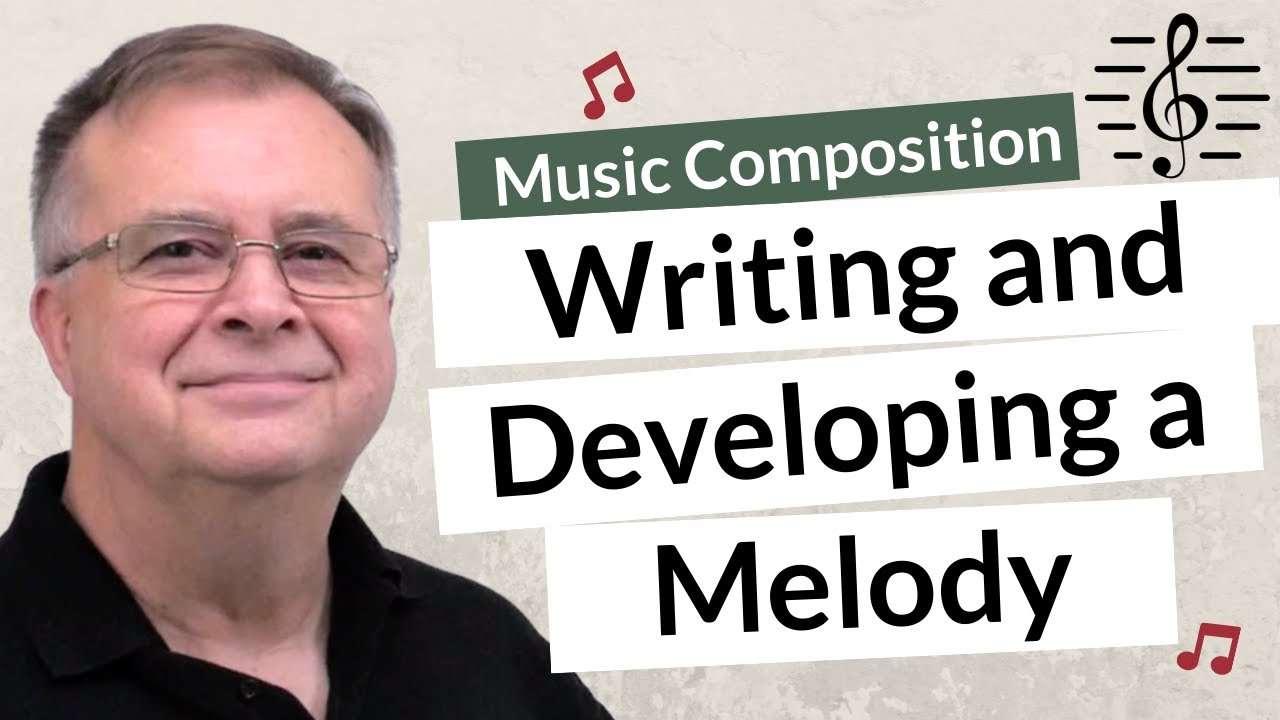
Writing & Developing a Melody Line - Music Composition
video description
Date: 2022-03-28
Related videos






Comments and reviews: 8
Michel
Thank you very much for this great lesson, Sir.
I am fairly new to music theory, but I was wondering if it was possible to analyze what is going on in your second line in a different way.
You explain that we modulate here from D major to G major, then from G major to A major and back to D major on the third line.
Now, when we look at the chords you chose here, we have a D followed by a G in the first 2 bars, then an E followed by an A.
The D to G progression could be analysed as a simple I to IV progression in the key of D, couldn't it be? I know that you introduced a C natural in the melody at the end of the first phrase, but it could still be considered an appoggiatura before the B while playing the G chord in the key of D, or am I wrong?
Then, we do have an E chord preceding an A chord. The E chord is definitely not part of the key of D. But couldn't it be considered a mere secondary dominant to the A chord coming just next? If that's true, then your entire piece of music here could be analysed as 100% being in the key of D major with no modulation whatsoever, couldn't it be?
Is my little analysis a silly, or a valid one?
Thanks again, you are a great teacher.
reply
Thank you very much for this great lesson, Sir.
I am fairly new to music theory, but I was wondering if it was possible to analyze what is going on in your second line in a different way.
You explain that we modulate here from D major to G major, then from G major to A major and back to D major on the third line.
Now, when we look at the chords you chose here, we have a D followed by a G in the first 2 bars, then an E followed by an A.
The D to G progression could be analysed as a simple I to IV progression in the key of D, couldn't it be? I know that you introduced a C natural in the melody at the end of the first phrase, but it could still be considered an appoggiatura before the B while playing the G chord in the key of D, or am I wrong?
Then, we do have an E chord preceding an A chord. The E chord is definitely not part of the key of D. But couldn't it be considered a mere secondary dominant to the A chord coming just next? If that's true, then your entire piece of music here could be analysed as 100% being in the key of D major with no modulation whatsoever, couldn't it be?
Is my little analysis a silly, or a valid one?
Thanks again, you are a great teacher.
reply
Stephen
Hi Gareth - again another helpful video presented in a very accessible manner. It would be really useful to see a Stage 2 of this piece where you develop the harmony. I have two Arnold Schoenberg's books (composition and harmony) - they are hard going. It would be again useful if you were to make links to some of Schoenberg's (or Hindemith's) written texts; it would help me consolidate ideas in to a one whole - at present I have fragments of understanding and a bit of cementing together would help.
reply
Hi Gareth - again another helpful video presented in a very accessible manner. It would be really useful to see a Stage 2 of this piece where you develop the harmony. I have two Arnold Schoenberg's books (composition and harmony) - they are hard going. It would be again useful if you were to make links to some of Schoenberg's (or Hindemith's) written texts; it would help me consolidate ideas in to a one whole - at present I have fragments of understanding and a bit of cementing together would help.
reply
Aruna
Wow this is really great. So effective to use the triplets. I got lost with the dominant 7th terminology! Will have to go back to my grade 5 ,theory. I have lots of little snippets of tunes I have come up with and thus is so inspiring. Thanks
reply
Wow this is really great. So effective to use the triplets. I got lost with the dominant 7th terminology! Will have to go back to my grade 5 ,theory. I have lots of little snippets of tunes I have come up with and thus is so inspiring. Thanks
reply
Juan
Thanks. I compose using some of your methods explained. Very easy to understand. I'm currently stuck on 4 part writing for chorus using different rhythms in all voices. Any suggestions would be appreciated. -
reply
Thanks. I compose using some of your methods explained. Very easy to understand. I'm currently stuck on 4 part writing for chorus using different rhythms in all voices. Any suggestions would be appreciated. -
reply
AshiaSub
So beautiful melody you wrote! I love your explanation, very clear.
I'm studying at Liceu conservatory here in Barcelona. You helped me so much.
Thank you!!
reply
So beautiful melody you wrote! I love your explanation, very clear.
I'm studying at Liceu conservatory here in Barcelona. You helped me so much.
Thank you!!
reply
qdubbs
Sir. Thank you so much for handing me the missing pieces (for me). Your teaching style is a work of art. You should teach educators how to teach as well, IMHO.
reply
Sir. Thank you so much for handing me the missing pieces (for me). Your teaching style is a work of art. You should teach educators how to teach as well, IMHO.
reply
Allen
A lot of good music videos are highly complimented. I have no compliment, whatsoever. But here are a few words. This I consider worth watching.
reply
A lot of good music videos are highly complimented. I have no compliment, whatsoever. But here are a few words. This I consider worth watching.
reply
Morgan
Outstanding! Thank you very much for your clear explanation of concepts which are often difficult to put ones finger on. Excellent job!
reply
Outstanding! Thank you very much for your clear explanation of concepts which are often difficult to put ones finger on. Excellent job!
reply
Add a review, comment
Other channel videos