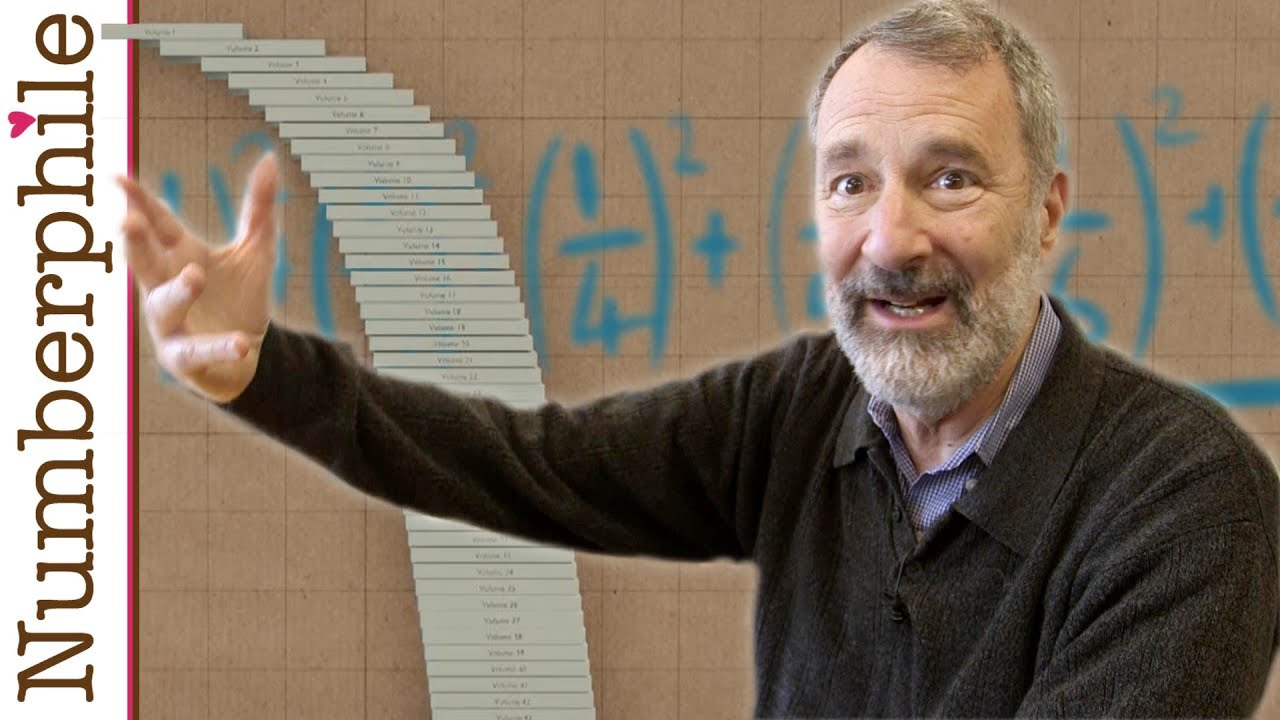
Infinite Series - Numberphile
video description
2 1. 5-
4 1. 75-
8 1. 875-
16 1. 9375-
32 1. 96875-
64 1. 984375-
128 1. 9921875-
256 1. 99609375-
512 1. 998046875-
1024 1. 9990234375-
2048 1. 99951171875-
4096 1. 999755859375-
8192 1. 9998779296875-
16384 1. 99993896484375-
32768 1. 999969482421875-
65536 1. 9999847412109375-
131072 1. 9999923706054688-
262144 1. 9999961853027344-
524288 1. 9999980926513672-
1048576 1. 9999990463256836-
2097152 1. 9999995231628418-
4194304 1. 999999761581421-
8388608 1. 9999998807907104-
16777216 1. 9999999403953552-
33554432 1. 9999999701976776-
67108864 1. 9999999850988388-
134217728 1. 9999999925494194-
268435456 1. 9999999962747097-
536870912 1. 9999999981373549-
1073741824 1. 9999999990686774-
2147483648 1. 9999999995343387-
4294967296 1. 9999999997671694-
8589934592 1. 9999999998835847-
17179869184 1. 9999999999417923-
34359738368 1. 9999999999708962-
68719476736 1. 999999999985448-
137438953472 1. 999999999992724-
274877906944 1. 999999999996362-
549755813888 1. 999999999998181-
1099511627776 1. 9999999999990905-
2199023255552 1. 9999999999995453-
4398046511104 1. 9999999999997726-
8796093022208 1. 9999999999998863-
17592186044416 1. 9999999999999432-
35184372088832 1. 9999999999999716-
70368744177664 1. 9999999999999858-
140737488355328 1. 999999999999993-
281474976710656 1. 9999999999999964-
562949953421312 1. 9999999999999982-
1125899906842624 1. 9999999999999991-
2251799813685248 1. 9999999999999996-
4503599627370496 1. 9999999999999998-
9007199254740992 2. 0
Date: 2022-04-09
Related videos



Comments and reviews: 9
the
IMO it would be a more beautiful equation, instead of saying the series converges to pi squared over 6, to rearrange it to the square root of [(3(1+ 1/4 + 1/9 + 1/16 + 1/25)] = pi. Then you've got a formula that, like the famous e-i-pi formula, incorporates several notable mathematical concepts including addition, fractions, square roots, and factorials. 3! is arguably the first non-trivial factorial, which makes that interesting. Or, you could just call it 6 and be satisfied that it is the least composite number with two distinct prime factors.
reply
IMO it would be a more beautiful equation, instead of saying the series converges to pi squared over 6, to rearrange it to the square root of [(3(1+ 1/4 + 1/9 + 1/16 + 1/25)] = pi. Then you've got a formula that, like the famous e-i-pi formula, incorporates several notable mathematical concepts including addition, fractions, square roots, and factorials. 3! is arguably the first non-trivial factorial, which makes that interesting. Or, you could just call it 6 and be satisfied that it is the least composite number with two distinct prime factors.
reply
Zachary
2: 00 i wrote some code to see how long it would take to get to a number. I am not going to do 50 trillion as that would take a way too long, so I will do 20. You might be thinking I'm making it to easy but I tried other numbers and they were just taking too long. To get to 20 you would need the denominator to get to 272, 400, 601. That took 27 seconds to computer. For comparison, it took half a second to calculate 16, and it took 76 seconds to calculate 21. 740, 461, 602 is the denominator you have to get to to reach 21 btw.
reply
2: 00 i wrote some code to see how long it would take to get to a number. I am not going to do 50 trillion as that would take a way too long, so I will do 20. You might be thinking I'm making it to easy but I tried other numbers and they were just taking too long. To get to 20 you would need the denominator to get to 272, 400, 601. That took 27 seconds to computer. For comparison, it took half a second to calculate 16, and it took 76 seconds to calculate 21. 740, 461, 602 is the denominator you have to get to to reach 21 btw.
reply
JCGucci
The beginning is all wrong. The problem of Achilles and the tortoise is based on the fact that the tortoise keeps moving. Achilles walks the distance of 1 and the tortoise walks the distance of 1/2. Whel Achilles walks the distance of 1/2, the tortoise walks the distance of 1/4. And so on. When will Achilles meet the toroise? At the distance of 2. The way you explained it in the video Achilles is walking, the tortoise is in one spot and the distance is just an artbitrary number.
reply
The beginning is all wrong. The problem of Achilles and the tortoise is based on the fact that the tortoise keeps moving. Achilles walks the distance of 1 and the tortoise walks the distance of 1/2. Whel Achilles walks the distance of 1/2, the tortoise walks the distance of 1/4. And so on. When will Achilles meet the toroise? At the distance of 2. The way you explained it in the video Achilles is walking, the tortoise is in one spot and the distance is just an artbitrary number.
reply
Captain
That's a surprisingly bad misrepresentation of Zeno's Paradox. He totally leaves out the fact that the tortoises -also- moves in the time that Achilles moves, and that -that- is why Achilles supposedly will never catch the tortoise. It has nothing to do with this endless series being 2; the tortoise isn't at distance 2 any more by that point, so if that were the explanation then Achilles would have in fact not caught the tortoise.
reply
That's a surprisingly bad misrepresentation of Zeno's Paradox. He totally leaves out the fact that the tortoises -also- moves in the time that Achilles moves, and that -that- is why Achilles supposedly will never catch the tortoise. It has nothing to do with this endless series being 2; the tortoise isn't at distance 2 any more by that point, so if that were the explanation then Achilles would have in fact not caught the tortoise.
reply
David
But what does it actually mean to add up an infinite number of numbers? There is some hand waving here (which is fine, considering the scope of this video, but I'd like to see a Numberphile that gets into the standard definition, in terms of the limit (if it exists) of the sequence of finite sums of a series. Then you could link back to this proposed video for viewers who want to know more.
reply
But what does it actually mean to add up an infinite number of numbers? There is some hand waving here (which is fine, considering the scope of this video, but I'd like to see a Numberphile that gets into the standard definition, in terms of the limit (if it exists) of the sequence of finite sums of a series. Then you could link back to this proposed video for viewers who want to know more.
reply
My
So if
A = 1 +1/2 +1/4 +1/8. = 2
Then A-1 = 1
And if
B = 1 +1/2 +1/3 +1/4 +1/5. apporaches Infinity as explained in video, then doesn't B also equal
C = 1 + (1 +1/3 +1/5 +1/7) =? B
And so the series
C-1 = (1 +1/3 +1/5 +1/7) also is divergent and approaches infinity?
Odd that 1+ odd fraction infinite sum is infinity, but 1+ even fraction infinite sum is 2.
?
reply
So if
A = 1 +1/2 +1/4 +1/8. = 2
Then A-1 = 1
And if
B = 1 +1/2 +1/3 +1/4 +1/5. apporaches Infinity as explained in video, then doesn't B also equal
C = 1 + (1 +1/3 +1/5 +1/7) =? B
And so the series
C-1 = (1 +1/3 +1/5 +1/7) also is divergent and approaches infinity?
Odd that 1+ odd fraction infinite sum is infinity, but 1+ even fraction infinite sum is 2.
?
reply
David
An infinite number of mathematicians enter a bar. The first one orders one beer, the second one orders half a beer, the third orders a quarter of a beer, the fourth orders an eighth of a beer, and so on. After taking orders for a while, the bartender sighs exasperatedly, says, -You guys need to know your limits, - and pours two beers for the whole group.
reply
An infinite number of mathematicians enter a bar. The first one orders one beer, the second one orders half a beer, the third orders a quarter of a beer, the fourth orders an eighth of a beer, and so on. After taking orders for a while, the bartender sighs exasperatedly, says, -You guys need to know your limits, - and pours two beers for the whole group.
reply
Luc
The lower bound used to show the harmonic series diverge is a pleasant trick but it does not tell us how fast the series diverge: the sum of the first n terms goes as the logarithm of n. We can even go further: it goes like log n plus the Euler constant plus a term behaving as 1/n. But that requires methods beyond mere arithmetic.
reply
The lower bound used to show the harmonic series diverge is a pleasant trick but it does not tell us how fast the series diverge: the sum of the first n terms goes as the logarithm of n. We can even go further: it goes like log n plus the Euler constant plus a term behaving as 1/n. But that requires methods beyond mere arithmetic.
reply
Adnan
The pile of cards with harmonic series is depicted in a math book. I've been searching for that book since a few years. I downloaded and read some part of it back in 2017. I lost it somehow and now I don't remember the name of the book. Is there anyone who knows the name of that book? Thanks!
reply
The pile of cards with harmonic series is depicted in a math book. I've been searching for that book since a few years. I downloaded and read some part of it back in 2017. I lost it somehow and now I don't remember the name of the book. Is there anyone who knows the name of that book? Thanks!
reply
Add a review, comment
Other channel videos