Floating Balls and Lift - Numberphile
video description
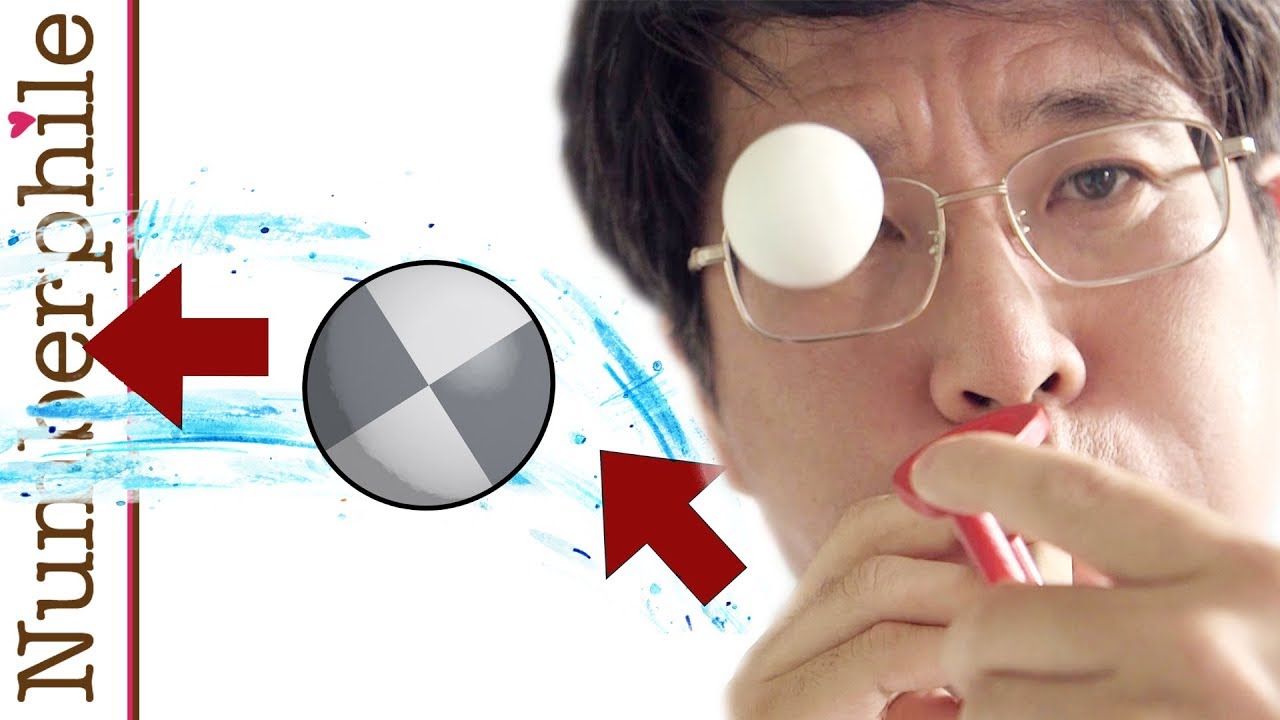
How far can you tilt before the ball falls out of the airstream, and why does this critical angle have the value it does?
During off-vertical -flight-, what direction does the lift vector point? In airplane flying textbooks, the balance of forces is typically shown as horizontal drag being balanced by horizontal thrust, and vertical gravity balanced by vertical lift. How does this picture relate to what's happening with the ball?
In the on-the-vertical situation, it seems to me that there is only the lift vector balancing the gravity vector and there's no drag. But this cannot be correct. The ball wanders around in the airstream chaotically here, whereas in off-the-vertical flight, the ball is far more stable in a fixed position. My intuition is that when the ball wanders away from the center of the airstream in the on-the-vertical situation, simultaneously the lift vector is bent off-vertical in a direction opposite to that which the ball had displaced. The horizontal component of this new lift vector acts to return the ball to the center of the airstream. So while it's chaotically wandering all the time away from center, the overall tendency is for the ball to return to center.
What's actually happening?
I'm eager for a followup video!
Date: 2022-04-09
Related videos


Comments and reviews: 9
bill
the spoon/water analogy is a great visualization but a couple things are nagging at me. 1) in one case a stream of fluid is free to move through and deflect more or less in free space (i. e. the surrounding air is static) which is different than a wing moving through a volume of static air. It's hard to imagine the entire volume of air behind a wing is getting pushed down. 2) the spoon handle. holding the spoon by the end you are allowing it to rotate, which is expressly prevented in aerodynamics (why horizontal stabilizers exist on aircraft. Blowing on one side of a strip of paper seems like a better model; holding one end is analogous to a plane wing's momentum or thrust, there is clearly a pressure differential / lift, and no air is being forced downward behind the paper (it actually looks the opposite, but that's just because the paper bends towards the low pressure. speaking of, it makes way more intuitive sense to me to say the faster, low-pressure air on top of a wing pulls upward than to say the bottom pushes; to me the bottom is pulling downward too, right? just with a pressure much less than the top because the bottom surface is flat
reply
the spoon/water analogy is a great visualization but a couple things are nagging at me. 1) in one case a stream of fluid is free to move through and deflect more or less in free space (i. e. the surrounding air is static) which is different than a wing moving through a volume of static air. It's hard to imagine the entire volume of air behind a wing is getting pushed down. 2) the spoon handle. holding the spoon by the end you are allowing it to rotate, which is expressly prevented in aerodynamics (why horizontal stabilizers exist on aircraft. Blowing on one side of a strip of paper seems like a better model; holding one end is analogous to a plane wing's momentum or thrust, there is clearly a pressure differential / lift, and no air is being forced downward behind the paper (it actually looks the opposite, but that's just because the paper bends towards the low pressure. speaking of, it makes way more intuitive sense to me to say the faster, low-pressure air on top of a wing pulls upward than to say the bottom pushes; to me the bottom is pulling downward too, right? just with a pressure much less than the top because the bottom surface is flat
reply
Lynk
3: 04
Can someone please explain how a single, 3-D airflow stream leaving the pipe should longer be considered as a single stream just because there is an object in the middle of the stream? When I have a stream of water travelling on a path, putting an object in the middle of it does not divide it into separate streams, the single stream simply curves around the object in all three dimensions.
Even aside from that, the Bernoulli Principle can be used to talk about two entirely different streams, that is how vacuum pumps work.
reply
3: 04
Can someone please explain how a single, 3-D airflow stream leaving the pipe should longer be considered as a single stream just because there is an object in the middle of the stream? When I have a stream of water travelling on a path, putting an object in the middle of it does not divide it into separate streams, the single stream simply curves around the object in all three dimensions.
Even aside from that, the Bernoulli Principle can be used to talk about two entirely different streams, that is how vacuum pumps work.
reply
Rene
Numberphile is usually fun to watch and highly accurate, but this time you made some mistakes. Air molecules pulling on each other? No, not noticeable. Air pulling the wing up? No, there is a force up because of the pressure difference, that is: the air molecules are pushing less on the top side than on the bottom side. And the water / spoon is due to a _different_ effect - the cohesion between water molecules and the metal of the spoon. That is, in that case there _is_ actually a pulling force.
reply
Numberphile is usually fun to watch and highly accurate, but this time you made some mistakes. Air molecules pulling on each other? No, not noticeable. Air pulling the wing up? No, there is a force up because of the pressure difference, that is: the air molecules are pushing less on the top side than on the bottom side. And the water / spoon is due to a _different_ effect - the cohesion between water molecules and the metal of the spoon. That is, in that case there _is_ actually a pulling force.
reply
David
Great video! But the explanation works only if the air goes over the top and bends downwards, giving an opposing force upwards. I wonder why the air isn't going underneath and bending upwards to give a downward force, given the ball is symmetrical? I'd have thought that both were equally likely. Or do you have to look at which way the ball is rotating to choose which way you tilt the pipe for the -trick- to work? Or I am missing something - quite possibly something obvious: -)?
reply
Great video! But the explanation works only if the air goes over the top and bends downwards, giving an opposing force upwards. I wonder why the air isn't going underneath and bending upwards to give a downward force, given the ball is symmetrical? I'd have thought that both were equally likely. Or do you have to look at which way the ball is rotating to choose which way you tilt the pipe for the -trick- to work? Or I am missing something - quite possibly something obvious: -)?
reply
Din
Asking whether the wings of the airplane are being pulled up by air or pushed up by air is nonsensical.
The lift can only be generated if there is a difference in pressure between top and bottom of wing.
If the pressure is the same in both ends. then nothing happens. it is all balanced.
This is like asking a question. -If two numbers that are not equal, are they not equal because one number is larger or are they not equal because one number is smaller! -
reply
Asking whether the wings of the airplane are being pulled up by air or pushed up by air is nonsensical.
The lift can only be generated if there is a difference in pressure between top and bottom of wing.
If the pressure is the same in both ends. then nothing happens. it is all balanced.
This is like asking a question. -If two numbers that are not equal, are they not equal because one number is larger or are they not equal because one number is smaller! -
reply
what
I like the spoon demo better for this explanation because you can also show that what happens on either sides of the spoon would be working in concert in a homogeneous fluid except that you can show the two effects separately. Turn the spoon over and deflect the stream the other way and you can also feel the force in the other direction. You can also pull a spoon lengthwise through a pool of water and see and feel both at once.
reply
I like the spoon demo better for this explanation because you can also show that what happens on either sides of the spoon would be working in concert in a homogeneous fluid except that you can show the two effects separately. Turn the spoon over and deflect the stream the other way and you can also feel the force in the other direction. You can also pull a spoon lengthwise through a pool of water and see and feel both at once.
reply
Spongman
is the professor suggesting that van der Waals forces are what keeps airplanes in the air? or is there some other weird attractive force between uncharged molecules? if not, the animation of the 'spring' forces between molecules should be removed - it's complete nonsense. i think it's really dangerous to use figurative (imaginary) concepts like 'vacuum pulling' as explanations as if they were real phenomena.
reply
is the professor suggesting that van der Waals forces are what keeps airplanes in the air? or is there some other weird attractive force between uncharged molecules? if not, the animation of the 'spring' forces between molecules should be removed - it's complete nonsense. i think it's really dangerous to use figurative (imaginary) concepts like 'vacuum pulling' as explanations as if they were real phenomena.
reply
Kenny
so, the way that we look at high and low pressure regions in meteorology could be considerably improved if we were to look at the pressure gradients over altitude as well. the pressure differences rising up through the altitude would probably tell a much more complete story than just normalising all pressure be be that of sea-level and showing only the lateral gradients.
reply
so, the way that we look at high and low pressure regions in meteorology could be considerably improved if we were to look at the pressure gradients over altitude as well. the pressure differences rising up through the altitude would probably tell a much more complete story than just normalising all pressure be be that of sea-level and showing only the lateral gradients.
reply
geetarwanabe
The 'coherence is called the Coanda effect and it is most certainly the reaction of that deflected airflow that produces most of the lift of an aircraft. The resultant pressure gradient can be optimised to reduce drag. If the pressure gradient gets too large and exceeds the coherence to the solid then the flow separates and turbulence boundary layers form.
reply
The 'coherence is called the Coanda effect and it is most certainly the reaction of that deflected airflow that produces most of the lift of an aircraft. The resultant pressure gradient can be optimised to reduce drag. If the pressure gradient gets too large and exceeds the coherence to the solid then the flow separates and turbulence boundary layers form.
reply
Add a review, comment
Other channel videos