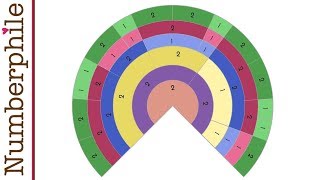
A Video about the Number 10 - Numberphile
video description
If you were to do this with the 'proper' divisors, e. g. ignore n in the sum of divisors of n, all the indices would decrease by 1, so that wouldn't matter for these classifications.
However, if you ignore the other trivial divisor (1, I guess you could call them the non-empty divisors since 1 is the empty product, suddenly the primes form an infinite family with indices all equal to 1, and many previously friendly numbers become solitary by way of irreducible indices, such as 6 with an index of 11/6, 24 with 59/24, and 42 with 95/42. Twelve's index still does reduce and yields 9/4, as does 18's, but to 19/9.
Honestly it makes sense to me if all the numbers with no non-trivial divisors (except 1 itself, index 0) have the same index, while other numbers with varied divisibility properties have distinct indices.
Date: 2022-04-09
Related videos



Comments and reviews: 9
puzzzl
The timing couldn't be better! This video, coincidentally, is an in-depth explanation of the problem given in last week's -The Riddler- on Five Thirty Eight, in which we are told that the sum of the factors of 36 is 91, which is the value you'd get if you converted 36 from inches to centimeters, using the ratio 2. 54. The question is to find another number which has that same ratio. That's a case of the friendly number problem! The big difference is that in the Riddler problem, you can round to the hundreth, so while Numberphile tells us today that 36 is a solitary number, if we allow rounding then it has a friend.
reply
The timing couldn't be better! This video, coincidentally, is an in-depth explanation of the problem given in last week's -The Riddler- on Five Thirty Eight, in which we are told that the sum of the factors of 36 is 91, which is the value you'd get if you converted 36 from inches to centimeters, using the ratio 2. 54. The question is to find another number which has that same ratio. That's a case of the friendly number problem! The big difference is that in the Riddler problem, you can round to the hundreth, so while Numberphile tells us today that 36 is a solitary number, if we allow rounding then it has a friend.
reply
Nerketur
So if 10 has an index of 1. 8, 18/10, or 9/5, we would need a number that reduces to that same index.
We automatically know a few facts about this number:
The number must have a factor of 5 (because of the remaining 5 in the denominator); the number must have few factors compared to the original (they add up to less than the number); if the friend is even, it must be a multiple of 10.
My guess is that it doesn't have a friend, sadly enough. However, I'm not convinced that I'm right, it's just a conjecture.
reply
So if 10 has an index of 1. 8, 18/10, or 9/5, we would need a number that reduces to that same index.
We automatically know a few facts about this number:
The number must have a factor of 5 (because of the remaining 5 in the denominator); the number must have few factors compared to the original (they add up to less than the number); if the friend is even, it must be a multiple of 10.
My guess is that it doesn't have a friend, sadly enough. However, I'm not convinced that I'm right, it's just a conjecture.
reply
Thomas
Well my next question is, is there a way to look at any rational number and tell if it is the index of some number? Or another closely related question: is every rational number the index of some number?
By the existance of solitary numbers, we obviously know that some rationals are the index of only one number, but are there rationals that aren't the index of any integer?
reply
Well my next question is, is there a way to look at any rational number and tell if it is the index of some number? Or another closely related question: is every rational number the index of some number?
By the existance of solitary numbers, we obviously know that some rationals are the index of only one number, but are there rationals that aren't the index of any integer?
reply
Dan
One of the things I like about this bit of maths is that it has no dependency on a specific base system to work. It's about the raw numbers (their values) not the numerals (the system used to represent them. 10 truly is special in this case purely on the basis of its factors, and not just because we primarily use a base 10 number system.
reply
One of the things I like about this bit of maths is that it has no dependency on a specific base system to work. It's about the raw numbers (their values) not the numerals (the system used to represent them. 10 truly is special in this case purely on the basis of its factors, and not just because we primarily use a base 10 number system.
reply
The
I love Numberphile.
It's always nice to think about numbers, the videos help me to focus about things later, interestingly.
What I mean: when I feel like I have problems focusing then I watch 1 or 2 videos and then return to what I was doing: bamm, ability to focus restored.
reply
I love Numberphile.
It's always nice to think about numbers, the videos help me to focus about things later, interestingly.
What I mean: when I feel like I have problems focusing then I watch 1 or 2 videos and then return to what I was doing: bamm, ability to focus restored.
reply
Trakks
Does friendship between numbers have applications? I mean, this is an equivalence relation for integers, maybe this is used somewhere in the study of euclidean rings? I'm curious. If anyone knowing could answer me, I'd be grateful.
reply
Does friendship between numbers have applications? I mean, this is an equivalence relation for integers, maybe this is used somewhere in the study of euclidean rings? I'm curious. If anyone knowing could answer me, I'd be grateful.
reply
Aonoymous
This should have been celebrated at the anniversary of the 10th year 10th month, 10th day, 10th hour, 10th min, 10th sec, with 10 milliseconds and 10 nanoseconds. Only then it would be a valid tribute to the number 10
reply
This should have been celebrated at the anniversary of the 10th year 10th month, 10th day, 10th hour, 10th min, 10th sec, with 10 milliseconds and 10 nanoseconds. Only then it would be a valid tribute to the number 10
reply
Jamirimaj
Nice to go back to the original Numberphile videos of discussing numbers as topics, and obviously 10 is the only number we should talk about in a 10th anniversary. Here's to a video about the number 20 in the future!
reply
Nice to go back to the original Numberphile videos of discussing numbers as topics, and obviously 10 is the only number we should talk about in a 10th anniversary. Here's to a video about the number 20 in the future!
reply
Anthony
I really thought this was going to be about why we use 10 as the standard base system of numbering, but I still want disappointed because these videos are always interesting. Congrats on 10 years!
reply
I really thought this was going to be about why we use 10 as the standard base system of numbering, but I still want disappointed because these videos are always interesting. Congrats on 10 years!
reply
Add a review, comment
Other channel videos