
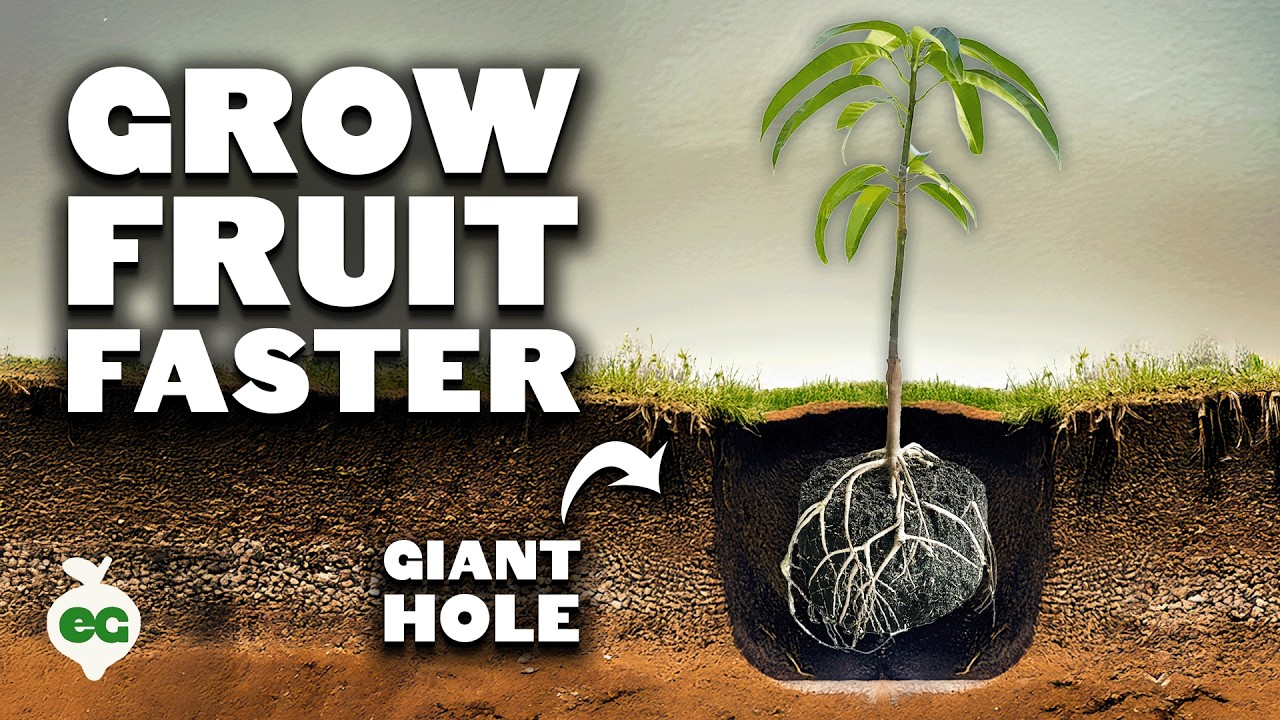
Grow Fruit Trees FASTER With The Multi-Year Hole
video description
Date: 2025-02-27
Related videos



Comments and reviews: 20
ddebernardy
This is missing an extra two tips.
Since you've gone through the trouble of digging a hole that deep, lay sand and pebbles at the bottom, and place a pipe (wide bamboo ideally, metal or pvc are fine too) that will stick out of the final hole diagonally. Toss in a mix of nutrients, compost, and subsoil. Then do as the video says. Fill the pipe with pebbles and sand so it doesn't clog too fast. This essentially creates a wicking bed.
Water normally for the first month. Then progressively switch to bottom watering using the pipe in 10% increments. Go for 10%/90% for two weeks, then 20%/80% for the next two, and so on until you're watering the surface only enough to keep the microbiology happy.
The growing water scarcity at the surface will suppress weeds and invite the tree to spread its roots deeper to get water. That will speed up the tree growth further. This works especially well in areas where the water table is high.
Further, since you've dug a hole that wide, you might as well plant more than one tree in it. These extra trees are support trees. Place at least 6 such trees in a circle around the main tree. You ideally (but not necessarily) want them diverse with a nitrogen fixer or two in the mix. Be wary that trees don't all play well with close neighbors, so look them up beforehand (avoid e. g. conifers, black walnuts, and mimosas. Use seeds or cuttings from your garden to start them ahead of time to keep things cheap.
Trees that are close to one another compete for light and nutrients so grow faster. Prune the support trees as needed for mulch when they get in the way of the main tree. Pollard them for mulch when they flower - you want them making biomass, not seeds. Coppice them until they give up and die when you no longer want them.
reply
This is missing an extra two tips.
Since you've gone through the trouble of digging a hole that deep, lay sand and pebbles at the bottom, and place a pipe (wide bamboo ideally, metal or pvc are fine too) that will stick out of the final hole diagonally. Toss in a mix of nutrients, compost, and subsoil. Then do as the video says. Fill the pipe with pebbles and sand so it doesn't clog too fast. This essentially creates a wicking bed.
Water normally for the first month. Then progressively switch to bottom watering using the pipe in 10% increments. Go for 10%/90% for two weeks, then 20%/80% for the next two, and so on until you're watering the surface only enough to keep the microbiology happy.
The growing water scarcity at the surface will suppress weeds and invite the tree to spread its roots deeper to get water. That will speed up the tree growth further. This works especially well in areas where the water table is high.
Further, since you've dug a hole that wide, you might as well plant more than one tree in it. These extra trees are support trees. Place at least 6 such trees in a circle around the main tree. You ideally (but not necessarily) want them diverse with a nitrogen fixer or two in the mix. Be wary that trees don't all play well with close neighbors, so look them up beforehand (avoid e. g. conifers, black walnuts, and mimosas. Use seeds or cuttings from your garden to start them ahead of time to keep things cheap.
Trees that are close to one another compete for light and nutrients so grow faster. Prune the support trees as needed for mulch when they get in the way of the main tree. Pollard them for mulch when they flower - you want them making biomass, not seeds. Coppice them until they give up and die when you no longer want them.
reply
epic_gardening
My biology professor made fun of ignorant rich people as he called them who regularly water their trees. Because their trees when any strong gusty thunderstorm comes through are the trees that fall over because the roots remain shallow because they’re being watered from the surface so they have no reason to go down deep which is what keeps them in place during a very windy storm. And if you look and see from this point on, after those violent thunderstorms in other parts of the country, you’ll see that the whole root system is usually localized to the top soil like you’re describingthat’s not what you want usually. You want a tree that’s drought tolerant whose roots will extend deep into the soil and won’t become a hazard to anybody in the future.
Question: Do you have any sub irrigation or watering methods for the trees in particular I’ve been wondering about this for sometime How, if, and where this irrigation method could and should occur. Also, I don’t know what it’s called, but I’m just describing something that’s in my head so it’s not like I can really look up what I wanna learn about very easily because that sort of method would give the trees a reason to reach down to get the water and become stronger and more resilient in storms, but eventually I think the tree roots might damage the irrigation system I really am not sure I really don’t even know if such an irrigation system specifically for trees exists yet.
reply
My biology professor made fun of ignorant rich people as he called them who regularly water their trees. Because their trees when any strong gusty thunderstorm comes through are the trees that fall over because the roots remain shallow because they’re being watered from the surface so they have no reason to go down deep which is what keeps them in place during a very windy storm. And if you look and see from this point on, after those violent thunderstorms in other parts of the country, you’ll see that the whole root system is usually localized to the top soil like you’re describingthat’s not what you want usually. You want a tree that’s drought tolerant whose roots will extend deep into the soil and won’t become a hazard to anybody in the future.
Question: Do you have any sub irrigation or watering methods for the trees in particular I’ve been wondering about this for sometime How, if, and where this irrigation method could and should occur. Also, I don’t know what it’s called, but I’m just describing something that’s in my head so it’s not like I can really look up what I wanna learn about very easily because that sort of method would give the trees a reason to reach down to get the water and become stronger and more resilient in storms, but eventually I think the tree roots might damage the irrigation system I really am not sure I really don’t even know if such an irrigation system specifically for trees exists yet.
reply
Tahir-u3l8m
My dear gardeners l loved yours fruit trees planting video I wish I can meat you personally me and my wife loved to grow fruits trees and recently we bought apple, plum, peach and pear we couldn’t plant because of too much cold and last two week before lots of snow falls in Houston, my wife and me both enjoyed yours this video and watching many time and keeping safe when we are going to Home Depot to show them to buy these fertilizers I have one request to you please tell me we should go to the Home Depot or some nursery to get these fertilizers, we are v much interested to buy good quality mangoes trees I wish you have Pakistani or Indian mango trees believe me Pakistani and Indian mangoes are super marvelous quality and taste I wish you can taste and then you can figure out easily, we like to contact you and getting some knowledge from you about fruit trees we have already guava, lechi, pomegranate, lemon, avocado, my plum tree flowers coming and no fruits coming all flowers fell down pl let me know what is the reason why I m not getting plums from this tree,
You both looks v happy and friendly I like to watch yours videos to get knowledge about gardening,
Wish you all the best,
Regards,
Tahir Khan from Houston Tx
reply
My dear gardeners l loved yours fruit trees planting video I wish I can meat you personally me and my wife loved to grow fruits trees and recently we bought apple, plum, peach and pear we couldn’t plant because of too much cold and last two week before lots of snow falls in Houston, my wife and me both enjoyed yours this video and watching many time and keeping safe when we are going to Home Depot to show them to buy these fertilizers I have one request to you please tell me we should go to the Home Depot or some nursery to get these fertilizers, we are v much interested to buy good quality mangoes trees I wish you have Pakistani or Indian mango trees believe me Pakistani and Indian mangoes are super marvelous quality and taste I wish you can taste and then you can figure out easily, we like to contact you and getting some knowledge from you about fruit trees we have already guava, lechi, pomegranate, lemon, avocado, my plum tree flowers coming and no fruits coming all flowers fell down pl let me know what is the reason why I m not getting plums from this tree,
You both looks v happy and friendly I like to watch yours videos to get knowledge about gardening,
Wish you all the best,
Regards,
Tahir Khan from Houston Tx
reply
RichsMangoGarden
I love the Epic garden guys and enjoy all their veggies garden videos. Unfortunately, for fruit trees and long live plants adding wood/compost into the soil into the underground rootzone is a big no no. This is different than shortlive vegetables. Most subtropicals and tropicals are very highly sensitive to decaying material in the soil and it is not the soil compaction but the rotting of the compost that will lead to root rots. Do this with an avocado or mango and the tree will be dead in a few years. Certain more vigorous growing trees like stone fruits or apples will tolerate wood/compost better but not something I would still recommend. Adding compost/wood material is very outdated info and is decades old about what we know these days of long live plants. All this compost should only remain on the top layer of the soil to breakdown properly vs underground that will lead to anaerobic condition and rootrot. Goodluck and hope the extra info helps some of the mango growers out there as mangos are a passion project of mine and I would love to see mango trees spread like avocados trees in California.
reply
I love the Epic garden guys and enjoy all their veggies garden videos. Unfortunately, for fruit trees and long live plants adding wood/compost into the soil into the underground rootzone is a big no no. This is different than shortlive vegetables. Most subtropicals and tropicals are very highly sensitive to decaying material in the soil and it is not the soil compaction but the rotting of the compost that will lead to root rots. Do this with an avocado or mango and the tree will be dead in a few years. Certain more vigorous growing trees like stone fruits or apples will tolerate wood/compost better but not something I would still recommend. Adding compost/wood material is very outdated info and is decades old about what we know these days of long live plants. All this compost should only remain on the top layer of the soil to breakdown properly vs underground that will lead to anaerobic condition and rootrot. Goodluck and hope the extra info helps some of the mango growers out there as mangos are a passion project of mine and I would love to see mango trees spread like avocados trees in California.
reply
nebsun
I always plant my trees much higher than the surrounding ground - roots can always grow down where needed.
Light amount of organic slow release fertilizer spread on the edge of the root ball, and heavier on the surrounding soil. Hole at least twice the diameter of the container it was in, but only to the same depth (fill with compost and soil to raise it higher. Layer of compost on top, followed by 3 inch of bark mulch.
Doing this:
Roots are encouraged to spread into the surrounding soil by the fertiliser (instead of coiling back inwards and encircling the trunk) - this is one of the main reasons for circling roots, make sure not to fertilise heavily in the root ball otherwise the roots will circle back inwards in search of food
Water will run away from the trunk and prevent root / trunk rot (planted higher)
Plenty of space and food for the roots to grow by digging the hole wider
Compost will break down over time, feeding over a long time
Bark mulch will keep moisture consistent, prevent washout, prevent smaller animals from digging too much and will eventually also break down
reply
I always plant my trees much higher than the surrounding ground - roots can always grow down where needed.
Light amount of organic slow release fertilizer spread on the edge of the root ball, and heavier on the surrounding soil. Hole at least twice the diameter of the container it was in, but only to the same depth (fill with compost and soil to raise it higher. Layer of compost on top, followed by 3 inch of bark mulch.
Doing this:
Roots are encouraged to spread into the surrounding soil by the fertiliser (instead of coiling back inwards and encircling the trunk) - this is one of the main reasons for circling roots, make sure not to fertilise heavily in the root ball otherwise the roots will circle back inwards in search of food
Water will run away from the trunk and prevent root / trunk rot (planted higher)
Plenty of space and food for the roots to grow by digging the hole wider
Compost will break down over time, feeding over a long time
Bark mulch will keep moisture consistent, prevent washout, prevent smaller animals from digging too much and will eventually also break down
reply
danrubin3936
I am a gardener and author with 27 bearing fruit trees. So sorry guys, but this method of planting fruit trees is not a good idea, according to expert permaculture orchardist Stefan Sobkowiak. You should NOT surround your new roots with rich amended soil because it tells the tree that p it’s roots do not need to grow out beyond the edge of the hole. Instead you should plant (in large hole, that part is right) and then fill with the same unamended soil that you dug out of the hole. You can later use top dressing with compost on top of ground to add amendments. Watering will send those nutrients down into surrounding soil using what the call a compost donut. As the tree grows larger, always fertilize below the drip line, that means right below the outer edge of branches. You want the tree’s roots to keep expanding, but a hole filled with rich soil will discourage that. Perhaps in Souther California you can get away with this, but not in Northern climates or in compacted soils. But the square hole idea is sound to keep tree from becoming root bound. Always learning, right guys
reply
I am a gardener and author with 27 bearing fruit trees. So sorry guys, but this method of planting fruit trees is not a good idea, according to expert permaculture orchardist Stefan Sobkowiak. You should NOT surround your new roots with rich amended soil because it tells the tree that p it’s roots do not need to grow out beyond the edge of the hole. Instead you should plant (in large hole, that part is right) and then fill with the same unamended soil that you dug out of the hole. You can later use top dressing with compost on top of ground to add amendments. Watering will send those nutrients down into surrounding soil using what the call a compost donut. As the tree grows larger, always fertilize below the drip line, that means right below the outer edge of branches. You want the tree’s roots to keep expanding, but a hole filled with rich soil will discourage that. Perhaps in Souther California you can get away with this, but not in Northern climates or in compacted soils. But the square hole idea is sound to keep tree from becoming root bound. Always learning, right guys
reply
frictionhitch
This is really a great way to plant a tree that won't last more than 10 years. Your dumb compost volcano will promote root girdling of the tree and root rot. Why doesn't anyone trust an arborist We are the ones you have to come back and fix this crap. Get yourself a cordless drill with a small auger bit. Use it in the center of the hole and around to aerate the soil. Absolutely do not Mount up soil around the root flair of the tree. Go to a forest that is not how they grow in nature! The root flair should be the highest point of the soil. Concentrating water at the root flair promotes root rot and damage to the soil level cambium. The tree wants to get most of its moisture from the area encircling its canopy. The water needs to run off from the base of the tree (eoot flair) toward the intricate system of absorbing roots that extends beyond the trees canopy. I repeat do not plant a tree like this. Or do and you can call an arborist in 10 years and ask why your tree is dying and he will explain all of this to you.
reply
This is really a great way to plant a tree that won't last more than 10 years. Your dumb compost volcano will promote root girdling of the tree and root rot. Why doesn't anyone trust an arborist We are the ones you have to come back and fix this crap. Get yourself a cordless drill with a small auger bit. Use it in the center of the hole and around to aerate the soil. Absolutely do not Mount up soil around the root flair of the tree. Go to a forest that is not how they grow in nature! The root flair should be the highest point of the soil. Concentrating water at the root flair promotes root rot and damage to the soil level cambium. The tree wants to get most of its moisture from the area encircling its canopy. The water needs to run off from the base of the tree (eoot flair) toward the intricate system of absorbing roots that extends beyond the trees canopy. I repeat do not plant a tree like this. Or do and you can call an arborist in 10 years and ask why your tree is dying and he will explain all of this to you.
reply
epic_gardening
I gave my friend a 5 gallon bunya pine(araucaria bidwillii) that I grew from seed and he dug the biggest hole that I have ever seen someone dig for a small tree and also used really good soil. I came back to check it out a few years later and it was already 10-12 feet tall. It almost didn't seem realistic how big it had gotten. I have planted a huge amount of bidwilliis before and around the same time and dug smaller holes and they are about 5-6 feet tall. It's definitely worth the extra work. The one thing I learned the hard way with my bunyas was that gophers destroy them very fast and I had never lost any plants to gophers before this so I have been using the wire mesh. I am still grieving from the loss of many beautiful trees that I planted due to gophers. I just trapped a few at one of my trees which I wish I had been doing all along but learned later in the process unfortunately.
reply
I gave my friend a 5 gallon bunya pine(araucaria bidwillii) that I grew from seed and he dug the biggest hole that I have ever seen someone dig for a small tree and also used really good soil. I came back to check it out a few years later and it was already 10-12 feet tall. It almost didn't seem realistic how big it had gotten. I have planted a huge amount of bidwilliis before and around the same time and dug smaller holes and they are about 5-6 feet tall. It's definitely worth the extra work. The one thing I learned the hard way with my bunyas was that gophers destroy them very fast and I had never lost any plants to gophers before this so I have been using the wire mesh. I am still grieving from the loss of many beautiful trees that I planted due to gophers. I just trapped a few at one of my trees which I wish I had been doing all along but learned later in the process unfortunately.
reply
haroldgreen1425
Twenty years ago I went to visit a peach orchard just down the road from my home and spent some time talking to the local extension service. Basically, there are two main planting methods. The $50 hole for a $5 tree method or the it's got to grow in the native soil at some stage hole. The peach orchard used the basic it's got to grow in the soil someday method. Small hole, tree put in hole and filled with dirt and tamped down. Then the young tree got cut back by at least one third. I used the same method with very good success. The $50 hole has some drawbacks. One, most of us don't have the money or time to plant many trees that take that much effort. Two, in less draining soils the soil filling the larger hole will often fill with water and remain wet and undraining rotting the new tree roots. Always make certain that your soil is going to drain properly.
reply
Twenty years ago I went to visit a peach orchard just down the road from my home and spent some time talking to the local extension service. Basically, there are two main planting methods. The $50 hole for a $5 tree method or the it's got to grow in the native soil at some stage hole. The peach orchard used the basic it's got to grow in the soil someday method. Small hole, tree put in hole and filled with dirt and tamped down. Then the young tree got cut back by at least one third. I used the same method with very good success. The $50 hole has some drawbacks. One, most of us don't have the money or time to plant many trees that take that much effort. Two, in less draining soils the soil filling the larger hole will often fill with water and remain wet and undraining rotting the new tree roots. Always make certain that your soil is going to drain properly.
reply
Dr_V
I don't mean to be rude, but you're just rediscovering a basic commercial orchard technique (with minor variations.
I've been growing fruit trees for more than 30 years, mostly as a hobby but also selling the excess yield to cover my expenses. I use square holes, usually 40/40/60cm (that's roughly 1/1/2 ft, with top soil on the bottom (plus root muddling with a manure based mixture) and compost mixed in the top layer so additional nutrients trickle down gradually with rain water. Hole size depends on the tree species (more vigorous trees require bigger holes, but also the native soil quality/composition, I've dug planting holes as large as 80/80/120cm (2/2/4ft) in water clogged or highly degraded soils, with more complex multi layered filling to insure proper root development.
reply
I don't mean to be rude, but you're just rediscovering a basic commercial orchard technique (with minor variations.
I've been growing fruit trees for more than 30 years, mostly as a hobby but also selling the excess yield to cover my expenses. I use square holes, usually 40/40/60cm (that's roughly 1/1/2 ft, with top soil on the bottom (plus root muddling with a manure based mixture) and compost mixed in the top layer so additional nutrients trickle down gradually with rain water. Hole size depends on the tree species (more vigorous trees require bigger holes, but also the native soil quality/composition, I've dug planting holes as large as 80/80/120cm (2/2/4ft) in water clogged or highly degraded soils, with more complex multi layered filling to insure proper root development.
reply
pawelkapica5363
Very surprised you didn't mix any mykhorizal fungi for that specific tree species into the soil mix. That would have helped with nutrient absorbtion as well as increasing the root surface area for water absorbtion and retention a great deal. The important bit is getting the right species of fungi for your tree species.
Another important point would have been to losen or even prune some of the roots from the potted tree so it doesn't get root bound. Most plants in pots are root bound because the roots don't have anywhere to go they start to grow in a circular pattern. By pruning them back and spreading them out you help them grow outwards in a natural pattern which will greatly improve nutrient and water uptake.
reply
Very surprised you didn't mix any mykhorizal fungi for that specific tree species into the soil mix. That would have helped with nutrient absorbtion as well as increasing the root surface area for water absorbtion and retention a great deal. The important bit is getting the right species of fungi for your tree species.
Another important point would have been to losen or even prune some of the roots from the potted tree so it doesn't get root bound. Most plants in pots are root bound because the roots don't have anywhere to go they start to grow in a circular pattern. By pruning them back and spreading them out you help them grow outwards in a natural pattern which will greatly improve nutrient and water uptake.
reply
epic_gardening
That's how I have been doing it for a long time, but we make the hole rectangle and fairly deep, simply as an excavator is used,
Then fill back with the loose excavated sand(as here is good soil but it is very compacted, then we fill with compost, humus and a mushroom compost(we also grow mushrooms and use the spent composted mushroom blocks and some coffee grounds and a little bit of fertiliser very little, then stil around and top of tree roots the compost mix, then pack the original soil back and water very well, the tree roots is then actually 100mm deeper down than normal.
Then it is way better in windy areas when the tree is still small too. We also loosen the roots and wet it before planting
reply
That's how I have been doing it for a long time, but we make the hole rectangle and fairly deep, simply as an excavator is used,
Then fill back with the loose excavated sand(as here is good soil but it is very compacted, then we fill with compost, humus and a mushroom compost(we also grow mushrooms and use the spent composted mushroom blocks and some coffee grounds and a little bit of fertiliser very little, then stil around and top of tree roots the compost mix, then pack the original soil back and water very well, the tree roots is then actually 100mm deeper down than normal.
Then it is way better in windy areas when the tree is still small too. We also loosen the roots and wet it before planting
reply
rlmccoy252
I planted a pecan tree 5 years ago. I made the hole twice as wide and twice as deep as the root structure, and made sure I pulled out all the rocks. Next I mixed all the native soil layers from the hole together as thoroughly as possible into a homogenous blend. Then I mixed a large bag of Miracle Grow yellow bag with the native soil mix, and mixed all that together as thoroughly as possible, then tossed it all back in the hole, making sure my tree was centered in the new soil mixture, top to bottom and side to side. It's grown a foot per year in the blazing San Antonio heat. Keep an eye on the leaf color though because it needs constant watering.
reply
I planted a pecan tree 5 years ago. I made the hole twice as wide and twice as deep as the root structure, and made sure I pulled out all the rocks. Next I mixed all the native soil layers from the hole together as thoroughly as possible into a homogenous blend. Then I mixed a large bag of Miracle Grow yellow bag with the native soil mix, and mixed all that together as thoroughly as possible, then tossed it all back in the hole, making sure my tree was centered in the new soil mixture, top to bottom and side to side. It's grown a foot per year in the blazing San Antonio heat. Keep an eye on the leaf color though because it needs constant watering.
reply
elwood212
My husband is a landscape architect and arborist. He taught me this method, which I’ve used on EVERY tree we have planted on our property, around 1500 trees so far. Even the tube stock are put in huge backfilled and broken up holes. I’ve added GYPSUM and elements and mineral powder w water granules. Our pointsiannas (from seed) reached 3m in 2 years. I use the backhoe on the compact tractor and hubby uses the Jack hammer like tool that’s a lot lighter where he can run a line the growth and knowing how secure yr roots are gives me comfort in big storms knowing these babies won’t be blown over or flooded out easily.
reply
My husband is a landscape architect and arborist. He taught me this method, which I’ve used on EVERY tree we have planted on our property, around 1500 trees so far. Even the tube stock are put in huge backfilled and broken up holes. I’ve added GYPSUM and elements and mineral powder w water granules. Our pointsiannas (from seed) reached 3m in 2 years. I use the backhoe on the compact tractor and hubby uses the Jack hammer like tool that’s a lot lighter where he can run a line the growth and knowing how secure yr roots are gives me comfort in big storms knowing these babies won’t be blown over or flooded out easily.
reply
rrad8106
I wish I would have had this video last year! I live in Rhode Island and last Summer, planted three hardy citrus in a protected area of my yard. This method would certainly have helped them get established.
Right now (coming out of the depths of winter, they are looking pretty ragged, though still with green on the limbs.
Wondering how much shock the plants would experience if, once we get past the last freezes of the season and the ground warms up, I were to heave them and re-do the holes as you have shown
reply
I wish I would have had this video last year! I live in Rhode Island and last Summer, planted three hardy citrus in a protected area of my yard. This method would certainly have helped them get established.
Right now (coming out of the depths of winter, they are looking pretty ragged, though still with green on the limbs.
Wondering how much shock the plants would experience if, once we get past the last freezes of the season and the ground warms up, I were to heave them and re-do the holes as you have shown
reply
justinmcdaniel415
Be careful with grafted mangoes especially those grafted in Florida on turpentine rootstock. They have dieback and floppy growth issues when grown in California. They also flower very aggressively due to our relatively colder winters and will flower themselves to death at a young age! The method I learned was to grow out ataulfo mango seedlings as they're more suited to our climate and graft onto them, or to buy trees grafted in California onto ataulfo rootstock. Cheers and good luck with your mango!
reply
Be careful with grafted mangoes especially those grafted in Florida on turpentine rootstock. They have dieback and floppy growth issues when grown in California. They also flower very aggressively due to our relatively colder winters and will flower themselves to death at a young age! The method I learned was to grow out ataulfo mango seedlings as they're more suited to our climate and graft onto them, or to buy trees grafted in California onto ataulfo rootstock. Cheers and good luck with your mango!
reply
frictionhitch
3: 00 you shouldn't have used a pitchfork. That was mostly useless. To achieve what you wanted you should have used a shovel. You place your shovel into the side of the pit and kick it in deep. Then rather than pulling the dirt out you just pry down lifting the soil around your new tree. Other than that you guys are doing a great job so far. I'm hoping that you will drill a small hole for a Taproot but that is really extra mile stuff so I kind of doubt it. I will keep watching.
reply
3: 00 you shouldn't have used a pitchfork. That was mostly useless. To achieve what you wanted you should have used a shovel. You place your shovel into the side of the pit and kick it in deep. Then rather than pulling the dirt out you just pry down lifting the soil around your new tree. Other than that you guys are doing a great job so far. I'm hoping that you will drill a small hole for a Taproot but that is really extra mile stuff so I kind of doubt it. I will keep watching.
reply
marksargent1431
As A child, growing up impoverished in the mid sixties. I can remember my grandfather have me and my two older brothers dig as hole 5 feet square by 6 feet deep. Then over the course of several years fill it with anything and everything organic from around the neighborhood. We did that repeatedly till we had 1 pomegranate, 2 peach, 2 pear, 2 apple, 2 apricot, and 6 pecan trees, which still stand and produce today. That old fart taught me how to grow anything!
reply
As A child, growing up impoverished in the mid sixties. I can remember my grandfather have me and my two older brothers dig as hole 5 feet square by 6 feet deep. Then over the course of several years fill it with anything and everything organic from around the neighborhood. We did that repeatedly till we had 1 pomegranate, 2 peach, 2 pear, 2 apple, 2 apricot, and 6 pecan trees, which still stand and produce today. That old fart taught me how to grow anything!
reply
Utahgarden
Off topic a little on this video, I am new to gardening and thinking about started composting. You’ve made videos on the 3x3 compost box, have you thought about selling them as kits Some of us are not mechanically inclined or have tools to build stuff from scratch. But buying and put it together wouldn’t be hard. Birdies sell for $100’s so a couple hundred for a beginner good sized compost bin would be great.
reply
Off topic a little on this video, I am new to gardening and thinking about started composting. You’ve made videos on the 3x3 compost box, have you thought about selling them as kits Some of us are not mechanically inclined or have tools to build stuff from scratch. But buying and put it together wouldn’t be hard. Birdies sell for $100’s so a couple hundred for a beginner good sized compost bin would be great.
reply
urkiddingme6254
I wonder if the Dollar Tree wire baskets would be tough enough to stoppocket gophers, or would they chew right through the plastic coated wire Gonna try it anyway -- for $1. 25, and it's easier on the skin than hardware cloth. I have a pocket gopher problem, and have lost two or three much babied trees from the little b's. One was a 6 foot Ponderosa pine that was as perfect as a pine tree can be.
reply
I wonder if the Dollar Tree wire baskets would be tough enough to stoppocket gophers, or would they chew right through the plastic coated wire Gonna try it anyway -- for $1. 25, and it's easier on the skin than hardware cloth. I have a pocket gopher problem, and have lost two or three much babied trees from the little b's. One was a 6 foot Ponderosa pine that was as perfect as a pine tree can be.
reply
Add a review, comment
Other channel videos


