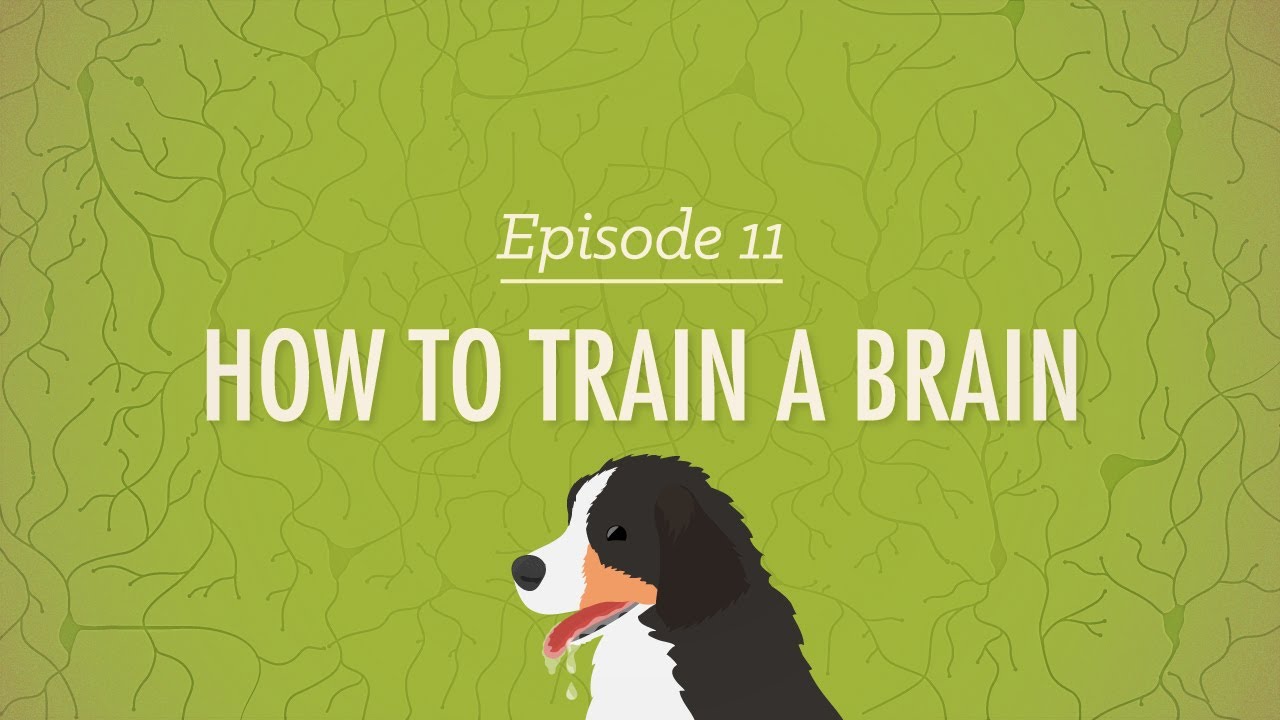
How to Train a Brain: Crash Course Psychology #11
video description
Date: 2022-04-04
Related videos



Comments and reviews: 10
Henry
For my psych class assignment, I have to leave a comment, I sure hope you see it professor.
I have one thought on classical conditioning, if the food makes the dog drool, and the dog can be conditioned to drool from the bell, then does that mean that the drool from the dog may caused because the dog is actually hungry to eat the food? Or is the dog just drooling because it was conditioned to from the food, did the dog drool when it was first presented with the meat powder food? I guess basically what I'm curious is does the original stimulus itself become a condition at some point? Another such as negative reinforcement (where a person has to do something to remove something that negatively effects them) is also a curious case. In my personal experience, having to do something to avoid discomfort is not very rewarding because it implies I must experience something negative whenever I don't fulfill desired behavior and most of the time, I didn't wanna do it anyway
reply
For my psych class assignment, I have to leave a comment, I sure hope you see it professor.
I have one thought on classical conditioning, if the food makes the dog drool, and the dog can be conditioned to drool from the bell, then does that mean that the drool from the dog may caused because the dog is actually hungry to eat the food? Or is the dog just drooling because it was conditioned to from the food, did the dog drool when it was first presented with the meat powder food? I guess basically what I'm curious is does the original stimulus itself become a condition at some point? Another such as negative reinforcement (where a person has to do something to remove something that negatively effects them) is also a curious case. In my personal experience, having to do something to avoid discomfort is not very rewarding because it implies I must experience something negative whenever I don't fulfill desired behavior and most of the time, I didn't wanna do it anyway
reply
Moss
Another example of classical conditioning in humans I can think of: People who reframe from eating meat can sometimes get discussed at the concept that people eat meat. This sometimes makes it so that when they withness somebody eating meat, they get discussed. After a while, they get discussed at the concept of coming near somewhere that serves meat.
reply
Another example of classical conditioning in humans I can think of: People who reframe from eating meat can sometimes get discussed at the concept that people eat meat. This sometimes makes it so that when they withness somebody eating meat, they get discussed. After a while, they get discussed at the concept of coming near somewhere that serves meat.
reply
Gabriela
05: 35
did Hank or the crash course team link a source that I failed to find somewhere?
because a quick google search revealed to me that -Little Albert- did not die soon after the experiment but in fact lived to old age.
if anyone has a source that strongly proved otherwise, please share: D
thanks!
reply
05: 35
did Hank or the crash course team link a source that I failed to find somewhere?
because a quick google search revealed to me that -Little Albert- did not die soon after the experiment but in fact lived to old age.
if anyone has a source that strongly proved otherwise, please share: D
thanks!
reply
Emma
Psych CrashCoursers: Are you watching this through the Learning Playlist? What do you think of that format? I really appreciate the features of the Learning Playlist that these have been put it. It is easier for me to pick up where I left off and I avoid the distractions of the recommendations sidebar.
reply
Psych CrashCoursers: Are you watching this through the Learning Playlist? What do you think of that format? I really appreciate the features of the Learning Playlist that these have been put it. It is easier for me to pick up where I left off and I avoid the distractions of the recommendations sidebar.
reply
TheFandomFish
this is why, if you are ever in the hospital for an extended time, DO NOT HAVE PEOPLE BRING YOU YOUR FAVORITE FOODS! you-ll start associating them with being in pain in an uncomfortable icky antiseptic smelling hospital and suddenly you won-t like any of your favorite foods anymore.
reply
this is why, if you are ever in the hospital for an extended time, DO NOT HAVE PEOPLE BRING YOU YOUR FAVORITE FOODS! you-ll start associating them with being in pain in an uncomfortable icky antiseptic smelling hospital and suddenly you won-t like any of your favorite foods anymore.
reply
Matthew
Dear Crash Course,
Thank you for making this quick, thoroughly informative, and entertaining video about the crazy world of classical and operant conditioning. Now I feel much more prepared for my exam!
reply
Dear Crash Course,
Thank you for making this quick, thoroughly informative, and entertaining video about the crazy world of classical and operant conditioning. Now I feel much more prepared for my exam!
reply
Jamie
I have a Pavlov's cat. She brings one of her toys to one of a few places and we give her a treat. She'll sometimes meow excitedly when one of us bends over (since we bend over to pick up the toy)
reply
I have a Pavlov's cat. She brings one of her toys to one of a few places and we give her a treat. She'll sometimes meow excitedly when one of us bends over (since we bend over to pick up the toy)
reply
Andrew
0: 00 -- -So if the name of Ivan Pavlov rings a bell, it's because. - -- at this point, I was immediately conscious of the salivation happening in my mouth.
reply
0: 00 -- -So if the name of Ivan Pavlov rings a bell, it's because. - -- at this point, I was immediately conscious of the salivation happening in my mouth.
reply
Annonimoose
Someone once said that Pavlov probably associated the sound of a bell with feeding the dogs and I haven-t been the same since
reply
Someone once said that Pavlov probably associated the sound of a bell with feeding the dogs and I haven-t been the same since
reply
nour
You look and sound like James from the oddonesout! And when you talked about seat belts i couldnt resist dropping this comment.
reply
You look and sound like James from the oddonesout! And when you talked about seat belts i couldnt resist dropping this comment.
reply
Add a review, comment
Other channel videos