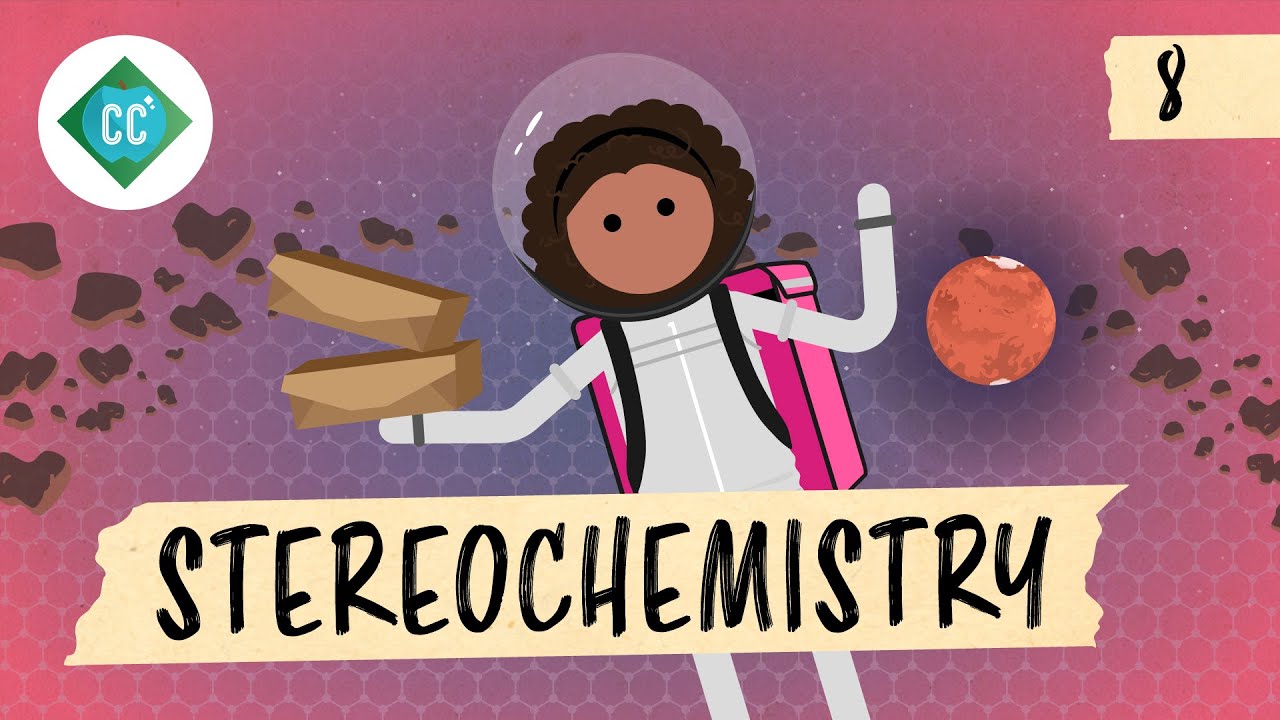
Stereochemistry: Crash Course Organic Chemistry #8
video description
Date: 2022-04-04
Related videos





Comments and reviews: 10
s3cr3tpassword
This reminds me of a Philips K Dick short story. Physicist were studying extra dimensions, while the machine was on, a janitor walked into it and they thought he died. But it turns out the janitor was unharmed. They decided to keep a close eye on him. When the next day's newspaper came in, the janitor exclaimed that he couldn't read the paper, the letters and printed in mirror image. He also had a notebook on him, all the letters were also mirror-inverted. As far as doctors could tell, he was healthy. Throughout the months he was well fed but losing weight and becoming malnourished. The scientist realized the machine chirally flipped his entire body. Meaning he couldn't process normal food. They also figured it would be too expensive to pass food through the machine to feed one person and they arent sure if the janitor could survive another trip through the machine.
Good read, would recommend.
reply
This reminds me of a Philips K Dick short story. Physicist were studying extra dimensions, while the machine was on, a janitor walked into it and they thought he died. But it turns out the janitor was unharmed. They decided to keep a close eye on him. When the next day's newspaper came in, the janitor exclaimed that he couldn't read the paper, the letters and printed in mirror image. He also had a notebook on him, all the letters were also mirror-inverted. As far as doctors could tell, he was healthy. Throughout the months he was well fed but losing weight and becoming malnourished. The scientist realized the machine chirally flipped his entire body. Meaning he couldn't process normal food. They also figured it would be too expensive to pass food through the machine to feed one person and they arent sure if the janitor could survive another trip through the machine.
Good read, would recommend.
reply
vdkmdd
I searched chiral on wikipedia and read the first paragraph after watching this video and not understanding a word, Now that was some very complicated way of saying: can I rotate a mirrored molecule back to the original molecule. If yes achiral, otherwise chiral. I also still don't understand the S and R thing. When viewing clockwise and starting at 1. I can have the following sequences 1, 2, 3, 4 and 1, 4, 3, 2, so those are S and R but I can also have 1, 2, 4, 3 which is then something? Or is there a reason why 1, 2, 4, 3 is not possible?
reply
I searched chiral on wikipedia and read the first paragraph after watching this video and not understanding a word, Now that was some very complicated way of saying: can I rotate a mirrored molecule back to the original molecule. If yes achiral, otherwise chiral. I also still don't understand the S and R thing. When viewing clockwise and starting at 1. I can have the following sequences 1, 2, 3, 4 and 1, 4, 3, 2, so those are S and R but I can also have 1, 2, 4, 3 which is then something? Or is there a reason why 1, 2, 4, 3 is not possible?
reply
Nafrost
13: 31 I'm assuming that the 2 chiral centers you are referring to are the two carbons who are bonded to chloride.
But I thought that the definition of a chiral center, is a carbon which is bonded to 4 different groups, and those carbons are bonded to 4 groups, but 2 of them are carbons, so they are bonded to 3 different groups in total.
So what is the definition of a chiral center? Is it a carbon that doesn't have a superimposable mirror image?
reply
13: 31 I'm assuming that the 2 chiral centers you are referring to are the two carbons who are bonded to chloride.
But I thought that the definition of a chiral center, is a carbon which is bonded to 4 different groups, and those carbons are bonded to 4 groups, but 2 of them are carbons, so they are bonded to 3 different groups in total.
So what is the definition of a chiral center? Is it a carbon that doesn't have a superimposable mirror image?
reply
Anne
For the R/S nomenclature, there's a rule of thumb. Point your thumb in the direction of the constituent with the lowest priority (#4. Then, wrap your hand around rotating along the axis of your thumb starting with the constituent with the highest priority (#1) following with #2 and #3. Your wrist should hit #1, your palm should hit #2 and your fingers #3. If you use your right hand it's a R isomer and if you use your left hand it's a S isomer.
reply
For the R/S nomenclature, there's a rule of thumb. Point your thumb in the direction of the constituent with the lowest priority (#4. Then, wrap your hand around rotating along the axis of your thumb starting with the constituent with the highest priority (#1) following with #2 and #3. Your wrist should hit #1, your palm should hit #2 and your fingers #3. If you use your right hand it's a R isomer and if you use your left hand it's a S isomer.
reply
Michael
The flowchart at 12: 58 doesn't work for methylcyclopentane. It doesn't have more than one chiral center, so the chart would call it chiral when it's actually achiral because of its plane of symmetry.
reply
The flowchart at 12: 58 doesn't work for methylcyclopentane. It doesn't have more than one chiral center, so the chart would call it chiral when it's actually achiral because of its plane of symmetry.
reply
NekuraCa
Does the method of determining the R/S naming correspond to the optical activity of the enantiomers? So all R compounds rotate polarized light in the same direction, and all S's the other?
reply
Does the method of determining the R/S naming correspond to the optical activity of the enantiomers? So all R compounds rotate polarized light in the same direction, and all S's the other?
reply
#abhay
Mam I watched all episodes. I understand some topics. This is very useful. This is good for revision.
Mam I have a question for you.
You are Indian?
reply
Mam I watched all episodes. I understand some topics. This is very useful. This is good for revision.
Mam I have a question for you.
You are Indian?
reply
HorzaPanda
According to your flow chart at 12: 55 methylcyclopentane is chiral? There's a chiral centre, there is only one, so that takes us to chiral?
reply
According to your flow chart at 12: 55 methylcyclopentane is chiral? There's a chiral centre, there is only one, so that takes us to chiral?
reply
James
There might be a mistake at 7: 44. She says -2(R)-butan-2-ol- but the visual just says -(R)-butan-2-ol-. Same with the other enantiomer
reply
There might be a mistake at 7: 44. She says -2(R)-butan-2-ol- but the visual just says -(R)-butan-2-ol-. Same with the other enantiomer
reply
PAPA
Thanks! Madam, Requesting kindly make more n more videos on POWERBI. Or AZURE DATAFACTORY.
We all waiting for you new videos
reply
Thanks! Madam, Requesting kindly make more n more videos on POWERBI. Or AZURE DATAFACTORY.
We all waiting for you new videos
reply
Add a review, comment
Other channel videos