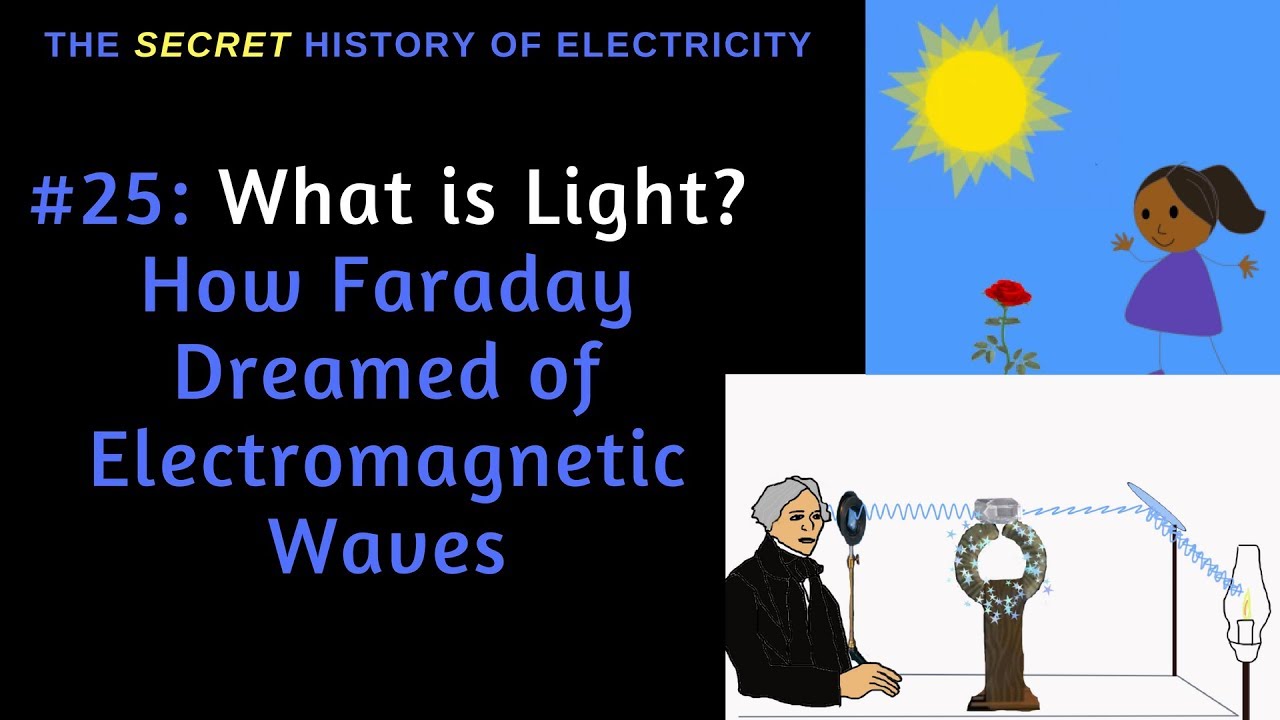
What is Light? How Faraday Dreamed of Electromagnetic Waves!
video description
Date: 2022-12-27
Related videos






Comments and reviews: 19
Frederick
Kathy, you may not have any better answers than my retinologist or other experts Ive asked but. How common is it for human beings to be able to see up into the ultraviolet portion of the light spectrum?
I can see the UV image that butterflies see on the flowers of our butterflybush. (I have no way of measuring how far but the UV image is refracted nearly the full width of the flower off tp one side)
PS this is not the only anomaly with my sensory system. I have been tested to hear up past 26Khx (I can hear several species of bats - both the audio and the PRF) and I can feel the vibration of the metal particles on touching the chassis an electronic device and tell when it is turned on and off
No one so far has been able to understand the results of any their tests. ?
reply
Kathy, you may not have any better answers than my retinologist or other experts Ive asked but. How common is it for human beings to be able to see up into the ultraviolet portion of the light spectrum?
I can see the UV image that butterflies see on the flowers of our butterflybush. (I have no way of measuring how far but the UV image is refracted nearly the full width of the flower off tp one side)
PS this is not the only anomaly with my sensory system. I have been tested to hear up past 26Khx (I can hear several species of bats - both the audio and the PRF) and I can feel the vibration of the metal particles on touching the chassis an electronic device and tell when it is turned on and off
No one so far has been able to understand the results of any their tests. ?
reply
Charlie
Love the video but just think something should be clarified. Only reflective glare is from brewsters light but glare looking through a transparent material isnt from low angle reflection light. Glare while looking through a transparent material is from the thickness of material creating double bounces and reflections from the inside that superimpose on top of each other, constructively interfering, adding up to bright lines. Anti glare film is made a special thickness thats a multiple/submultiple of the wavelengths of light passing through, such that the light double bounces inside the film, first, to then go into the transparent material after in a way that the waves deconstructively interfere with the glare to cancel it out.
reply
Love the video but just think something should be clarified. Only reflective glare is from brewsters light but glare looking through a transparent material isnt from low angle reflection light. Glare while looking through a transparent material is from the thickness of material creating double bounces and reflections from the inside that superimpose on top of each other, constructively interfering, adding up to bright lines. Anti glare film is made a special thickness thats a multiple/submultiple of the wavelengths of light passing through, such that the light double bounces inside the film, first, to then go into the transparent material after in a way that the waves deconstructively interfere with the glare to cancel it out.
reply
holger
What is Light?
'The Secret of Light' - Walter Russell
W. R. is the first Real Scientist,
because, he was able explain the nature of the Stuff-side, (physics) in a Eternal Perspective.
Science can Only be Science if it is in 100% order and harmony with the Laws of the Eternal Life.
Well, W. R. is not at all, commonly understod, and seems to be ignored by mainstream researchers,
it would be interesting to see what You (Kathy) think about W. R. and his work.
Tesla told Walter, 'You better wait thousand years, before You expose your knowledge'.
so I keep my expectations low, but is interesting anyway.
reply
What is Light?
'The Secret of Light' - Walter Russell
W. R. is the first Real Scientist,
because, he was able explain the nature of the Stuff-side, (physics) in a Eternal Perspective.
Science can Only be Science if it is in 100% order and harmony with the Laws of the Eternal Life.
Well, W. R. is not at all, commonly understod, and seems to be ignored by mainstream researchers,
it would be interesting to see what You (Kathy) think about W. R. and his work.
Tesla told Walter, 'You better wait thousand years, before You expose your knowledge'.
so I keep my expectations low, but is interesting anyway.
reply
Bill
10: 00 Kathy hi, like your videos a lot. At around the marked time, you ponder if it is possible to move a magnet with light. Well, it is possible to put a conductor and make it act as an antenna! That conductor would need to be at half the size of your wavelength, and make a diode using geometry. You can find these kind of direct solar antennas referred to as a optical rectenna (optical rectifying antenna. It is nice for students to know their existence, especially for light, as it makes it clear in their minds that we are talking about the same phenomenon, electromagnetic waves, just at different sizes.
reply
10: 00 Kathy hi, like your videos a lot. At around the marked time, you ponder if it is possible to move a magnet with light. Well, it is possible to put a conductor and make it act as an antenna! That conductor would need to be at half the size of your wavelength, and make a diode using geometry. You can find these kind of direct solar antennas referred to as a optical rectenna (optical rectifying antenna. It is nice for students to know their existence, especially for light, as it makes it clear in their minds that we are talking about the same phenomenon, electromagnetic waves, just at different sizes.
reply
Nithish
Hello Kathy!
I have been watching your history of science videos and for me, each one is a gem. Particularly this one on the electromagnetic waves. I really could not imagine this. I was always confused as to how could light have a magnetic component. The cloud of confusion cleared a bit when you gave the example of one oscillating charge making another charge oscillate at a distance and by extending the idea to how we see the red color of the rose. Thanks a lot!
reply
Hello Kathy!
I have been watching your history of science videos and for me, each one is a gem. Particularly this one on the electromagnetic waves. I really could not imagine this. I was always confused as to how could light have a magnetic component. The cloud of confusion cleared a bit when you gave the example of one oscillating charge making another charge oscillate at a distance and by extending the idea to how we see the red color of the rose. Thanks a lot!
reply
Ikpe
hey Kathy. 1) where does the packed punch of Voltage Power 'reside' before it '' pushes '' the electrons to flow. 2) How did Coulomb count and measure a single charge of electrons to minus1. 610 minus18, and eventually positive 6. 251018 electrons per second. What instrument did he use to count the number of electrons flow per second. How about the Constant: 1/4pai, excelon zero. Please kindly work us thro as to a 10 years old curious kid. We appreciate you.
reply
hey Kathy. 1) where does the packed punch of Voltage Power 'reside' before it '' pushes '' the electrons to flow. 2) How did Coulomb count and measure a single charge of electrons to minus1. 610 minus18, and eventually positive 6. 251018 electrons per second. What instrument did he use to count the number of electrons flow per second. How about the Constant: 1/4pai, excelon zero. Please kindly work us thro as to a 10 years old curious kid. We appreciate you.
reply
Charles
What an interesting interplay between theoretical science and the on-going development of the application of the discoveries. I always thought the Zeeman effect was the primary demonstration of the interconnectedness of electromagnetism and light, but now reflecting on it. I think it's a clearer demonstration of the quantum nature of the interaction. In any case what a great presentation on the interrelated nature of light and electricity. Thanks!
reply
What an interesting interplay between theoretical science and the on-going development of the application of the discoveries. I always thought the Zeeman effect was the primary demonstration of the interconnectedness of electromagnetism and light, but now reflecting on it. I think it's a clearer demonstration of the quantum nature of the interaction. In any case what a great presentation on the interrelated nature of light and electricity. Thanks!
reply
TheMrgoodmanners
I think what truly fascinates about this period was just the fantastic degree of scientific research. People pursued topics simply out of interest and curiosity rather than research funding as it is now. We don't see this level of inquisitiveness nowadays. That someone could just sit down and out of sheer curiosity work to invent vector calculus or postulate polarization and actively experiment on it. Really fascinating
reply
I think what truly fascinates about this period was just the fantastic degree of scientific research. People pursued topics simply out of interest and curiosity rather than research funding as it is now. We don't see this level of inquisitiveness nowadays. That someone could just sit down and out of sheer curiosity work to invent vector calculus or postulate polarization and actively experiment on it. Really fascinating
reply
Ralph
Kathy, this one is superb. I believe you are making a significant contribution to technical education.
I begin to think undergraduate physics ought to be taught in parallel with a series of lectures like these. They add a lot of depth.
At age 71, looking back over a lifetime of interest in electricity and physics, I realize I missed a great deal because this kind of content was seldom available.
reply
Kathy, this one is superb. I believe you are making a significant contribution to technical education.
I begin to think undergraduate physics ought to be taught in parallel with a series of lectures like these. They add a lot of depth.
At age 71, looking back over a lifetime of interest in electricity and physics, I realize I missed a great deal because this kind of content was seldom available.
reply
EdMcF1
Summerville should have taken heart from the fact that being 'wrong' can lead to someone being right later on by disproving your hypothesis. Like the 'Plum Pudding' model of the atom, wrong, but showing it was wrong was a step on the way to conceptualising the nucleus. Hence attributed. to Wolfgang Pauli 'Not even wrong' 'nicht einmal falsch' is far worse than being plain 'wrong'.
reply
Summerville should have taken heart from the fact that being 'wrong' can lead to someone being right later on by disproving your hypothesis. Like the 'Plum Pudding' model of the atom, wrong, but showing it was wrong was a step on the way to conceptualising the nucleus. Hence attributed. to Wolfgang Pauli 'Not even wrong' 'nicht einmal falsch' is far worse than being plain 'wrong'.
reply
Matthew
I think the way my physics teacher went over it briefly is more like: When an electron changes velocity, it either absorbs or emits an electric field and thus a magnetic one since they are interlinked. So when you are talking about electrons in electricity, you are generally talking about moving electrons, but they can be moved by absorbing light.
reply
I think the way my physics teacher went over it briefly is more like: When an electron changes velocity, it either absorbs or emits an electric field and thus a magnetic one since they are interlinked. So when you are talking about electrons in electricity, you are generally talking about moving electrons, but they can be moved by absorbing light.
reply
Zes
You are the greatest. Wow. My curiosity mind was so ecstatic to see a clear picture of what electromagnetic wave means. These videos are magnitudes better than 99%+ current university classes in combing through the logic and intuition.
You remind me of the woman you talked about who wrote the chemistry book that taught Faraday.
reply
You are the greatest. Wow. My curiosity mind was so ecstatic to see a clear picture of what electromagnetic wave means. These videos are magnitudes better than 99%+ current university classes in combing through the logic and intuition.
You remind me of the woman you talked about who wrote the chemistry book that taught Faraday.
reply
Norman
Kathy, I just discovered your video series on physics and the history of physics. Wow! Great stuff and much appreciated. As a retired college teacher and currently a corporate technical trainer, I am also a physics and technology history buff. Your videos are adding to my own accumulation of the history of science. Thank You!
reply
Kathy, I just discovered your video series on physics and the history of physics. Wow! Great stuff and much appreciated. As a retired college teacher and currently a corporate technical trainer, I am also a physics and technology history buff. Your videos are adding to my own accumulation of the history of science. Thank You!
reply
Dennis
I never knew that polarization was the link of understanding between light, magnetization and electricity. I almost sang with the outro ladies, haha. Maybe I'll even perform that experiment! It would be cool to make an audio transceiver using that effect.
reply
I never knew that polarization was the link of understanding between light, magnetization and electricity. I almost sang with the outro ladies, haha. Maybe I'll even perform that experiment! It would be cool to make an audio transceiver using that effect.
reply
Shyam
Thank you so much! I always wanted to know the journey that physicists took. How did they tackle the problem? How did they come up with new concepts. Textbooks are generally dry and they take away this element. Lots of respect from Nepal.
reply
Thank you so much! I always wanted to know the journey that physicists took. How did they tackle the problem? How did they come up with new concepts. Textbooks are generally dry and they take away this element. Lots of respect from Nepal.
reply
zh84
Another very good video. I read about Faraday's experiment with polarised light in James Hamilton's excellent biography of him, but the book doesn't explain how the experiment worked. Your explanation makes perfect sense; thank you.
reply
Another very good video. I read about Faraday's experiment with polarised light in James Hamilton's excellent biography of him, but the book doesn't explain how the experiment worked. Your explanation makes perfect sense; thank you.
reply
shashwat
Thank you so much for bringing all this in a chronological way. Know most uncovered things are getting clear to me. . doing a great job. Worth 100s of like. I was so long finding something like this. Once again thank you
reply
Thank you so much for bringing all this in a chronological way. Know most uncovered things are getting clear to me. . doing a great job. Worth 100s of like. I was so long finding something like this. Once again thank you
reply
Allan
Hi Kathy great video. Just a minor correction though. Its Lord Kelvin NOT Lord Calvin. Its the same guy who invented the Kelvin Temperature scale - and one of Scotlands many great scientists. Thanks for the video though.
reply
Hi Kathy great video. Just a minor correction though. Its Lord Kelvin NOT Lord Calvin. Its the same guy who invented the Kelvin Temperature scale - and one of Scotlands many great scientists. Thanks for the video though.
reply
Daemon
Even gravity has its own gravity field.
Except that unlike electric fields and magnetic fields, gravity fields are undetectable. If gravity is a real force, why don't we have devices that can detect it?
reply
Even gravity has its own gravity field.
Except that unlike electric fields and magnetic fields, gravity fields are undetectable. If gravity is a real force, why don't we have devices that can detect it?
reply
Add a review, comment
Other channel videos