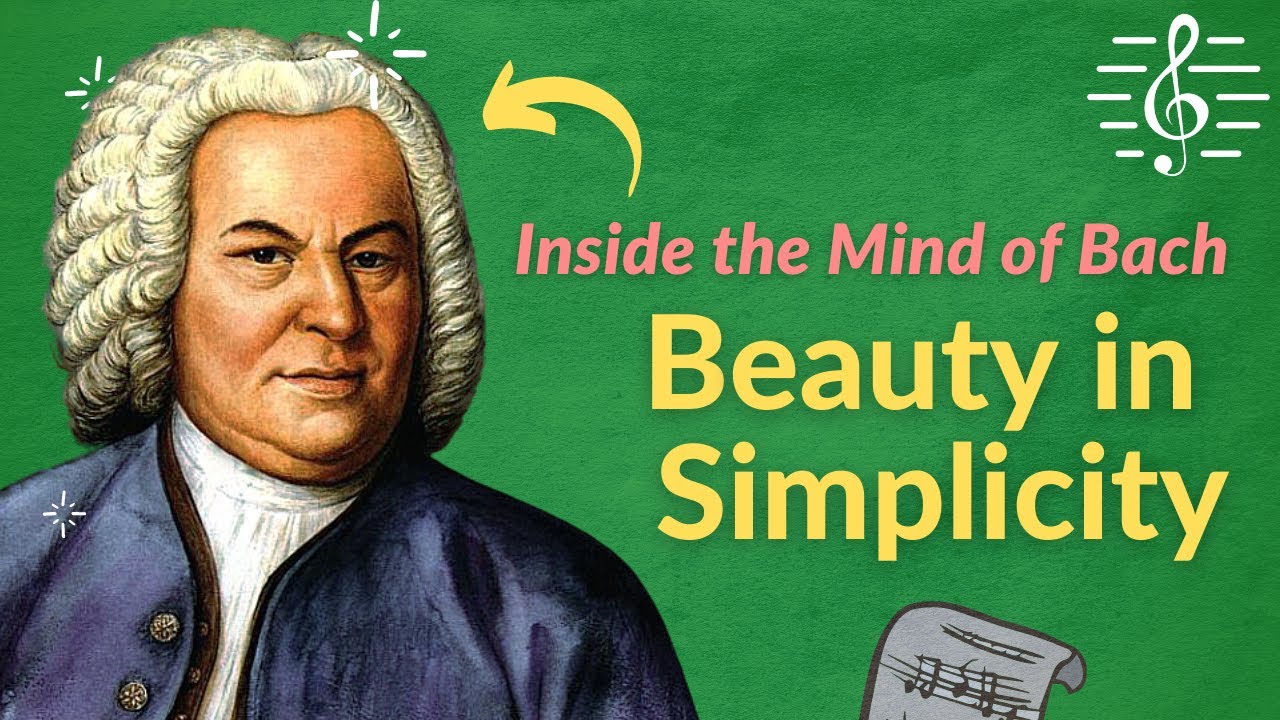
Beauty in Simplicity - Inside the Mind of Bach
video description
Date: 2022-03-28
Related videos





Comments and reviews: 10
riverstun
As to why he tripled the root on that last chord (and indeed why he did almost the same on the second note of the phrase (BBDD)), I think its because of the hollow, empty sound that it creates.. a sense of emptiness, loss (the hollow feeling in your stomach). This feeling is pretty much throughout phrase 2; because of the rising bass, beat 2 (which has a full chord) sounds kinda like a passing note to beat three, which once again moves to FBFB, another hollow chord (although there is an accented passing note on the C in the soprano. So which is the non-chord tone here, the C as a passing note or the following B as a lower neighbor? Not really important, but we have again that hollow sounding empty, forlorn sound. So that's 3 times in that phrase we have a 2-note chord with the 5th omitted, giving a clear -affekt- - or at least, that's how I hear it.
reply
As to why he tripled the root on that last chord (and indeed why he did almost the same on the second note of the phrase (BBDD)), I think its because of the hollow, empty sound that it creates.. a sense of emptiness, loss (the hollow feeling in your stomach). This feeling is pretty much throughout phrase 2; because of the rising bass, beat 2 (which has a full chord) sounds kinda like a passing note to beat three, which once again moves to FBFB, another hollow chord (although there is an accented passing note on the C in the soprano. So which is the non-chord tone here, the C as a passing note or the following B as a lower neighbor? Not really important, but we have again that hollow sounding empty, forlorn sound. So that's 3 times in that phrase we have a 2-note chord with the 5th omitted, giving a clear -affekt- - or at least, that's how I hear it.
reply
Linda
G'day, Mr. Greene! I have managed to print out the 1st 4 bars of -O Haupt voll Blut und Wunden- as you have elaborated on here in this video. I am by no means a pianist but I practice those few measures on my piano and wonder if there is a way to get the rest of that chorale in the same key as is presented in this video. I would very much like to learn the entire chorale. It is so beautiful and moving as I think about its subject, the Passion of our Lord.
Thank you for your videos. They are very interesting and informative. I especially enjoy -Name the Composer- quizzes also.
reply
G'day, Mr. Greene! I have managed to print out the 1st 4 bars of -O Haupt voll Blut und Wunden- as you have elaborated on here in this video. I am by no means a pianist but I practice those few measures on my piano and wonder if there is a way to get the rest of that chorale in the same key as is presented in this video. I would very much like to learn the entire chorale. It is so beautiful and moving as I think about its subject, the Passion of our Lord.
Thank you for your videos. They are very interesting and informative. I especially enjoy -Name the Composer- quizzes also.
reply
Larry
IMO the reason why the second phrase ends in a chord that lacks a third has to do with the lyrics. The -empty- cord conveys the emptiness of -Voll Schmerz und voller Hohn- -- in English, -full of pain and full of scorn- (via Google Translate). You see a lot of this in Bach, where the music conveys the meaning of the words in ways that we in the 21st century are not always attuned to.
reply
IMO the reason why the second phrase ends in a chord that lacks a third has to do with the lyrics. The -empty- cord conveys the emptiness of -Voll Schmerz und voller Hohn- -- in English, -full of pain and full of scorn- (via Google Translate). You see a lot of this in Bach, where the music conveys the meaning of the words in ways that we in the 21st century are not always attuned to.
reply
YourFavouriteColor
Just a question. The chord that opens the second phrase, that you're calling an inverted vii, I would definitely interpret that as a second inversion F# dominant. would that be considered incorrect? I know fully diminished sevenths and inverted dominants are kind of interchangeable, but is there any reason to use one over the other in this case?
reply
Just a question. The chord that opens the second phrase, that you're calling an inverted vii, I would definitely interpret that as a second inversion F# dominant. would that be considered incorrect? I know fully diminished sevenths and inverted dominants are kind of interchangeable, but is there any reason to use one over the other in this case?
reply
Kalman
It is very helpful to not only look at the harmonic functions but also the melodic sense of each voice separately. First the soprano, then the bass, then the alto and finally the tenor. As with all of Bach's music you'll find that each voice presents a legitimate melody in its own right, even if sometimes only very modest melodies in the inner voices.
reply
It is very helpful to not only look at the harmonic functions but also the melodic sense of each voice separately. First the soprano, then the bass, then the alto and finally the tenor. As with all of Bach's music you'll find that each voice presents a legitimate melody in its own right, even if sometimes only very modest melodies in the inner voices.
reply
Evan
Those simpler chords accentuate how we hear and feel the emotion. Is this because I knew it was J.S.B.? I don't think so, the music communicates so naturally (given his subject is already profound). Could it be he leaves out a third to find what that feels like? These episodes are brilliant, Gareth, I get so much from them.
reply
Those simpler chords accentuate how we hear and feel the emotion. Is this because I knew it was J.S.B.? I don't think so, the music communicates so naturally (given his subject is already profound). Could it be he leaves out a third to find what that feels like? These episodes are brilliant, Gareth, I get so much from them.
reply
Ilovetosingem
Hi Gareth
I couldn't work out the V7b as there was no 7th, and then I saw that you held the G from the IV and veolia! I've been watching this for about 3 hours, taking it all in hopefully. The time just flew by. When you say 9 8 above bass, isn't it really above the root note. Thanks great as usual.
reply
Hi Gareth
I couldn't work out the V7b as there was no 7th, and then I saw that you held the G from the IV and veolia! I've been watching this for about 3 hours, taking it all in hopefully. The time just flew by. When you say 9 8 above bass, isn't it really above the root note. Thanks great as usual.
reply
G-rald
Thank you Gareth! These are true gems. I enjoy these videos immensely.
I was thinking, if repeated this phrase, taking the tenor from a# to f# would create parallels between tenor and bass going to th anacrusis (b-f# -> d-a) or is this irrelevant? Or could this be the reason for going with triple roots?
reply
Thank you Gareth! These are true gems. I enjoy these videos immensely.
I was thinking, if repeated this phrase, taking the tenor from a# to f# would create parallels between tenor and bass going to th anacrusis (b-f# -> d-a) or is this irrelevant? Or could this be the reason for going with triple roots?
reply
Panos
Nice video sir.
With chord symbols, I think it is easier to understand the patterns that are used in any composition, no matter if it is classical or pop or any other kind of music in any mode.
Without patterns that our brain can recognize and have heard before, a composition will sound rather weird.
reply
Nice video sir.
With chord symbols, I think it is easier to understand the patterns that are used in any composition, no matter if it is classical or pop or any other kind of music in any mode.
Without patterns that our brain can recognize and have heard before, a composition will sound rather weird.
reply
Данил
Hello! Why not consider the harmony in the third beat of the penultimate bar - as a dominant with suspention in a tenor ? Maybe it would be more logical. And the appearance of a passing note of B in the right hand later - could be explained by the softening of the dissonance.
reply
Hello! Why not consider the harmony in the third beat of the penultimate bar - as a dominant with suspention in a tenor ? Maybe it would be more logical. And the appearance of a passing note of B in the right hand later - could be explained by the softening of the dissonance.
reply
Add a review, comment
Other channel videos