How many ways can circles overlap? - Numberphile
video description
Date: 2022-04-09
Related videos






Comments and reviews: 9
Brie
I submit the unhelpful upper bound for the arrangements of n circles as the number of arrangements of possible combinations of up to n elements: 2-(2-n)
This can be trivially narrowed further such as by removing all combinations that do not contain all n elements, but should provide a rough sense of scale for any attempt at brute forcing solutions for a given n.
This gives an upper bound for 6 of 2-(2-6)=2-64 -= 10-19 or roughly an exobyte of data.
reply
I submit the unhelpful upper bound for the arrangements of n circles as the number of arrangements of possible combinations of up to n elements: 2-(2-n)
This can be trivially narrowed further such as by removing all combinations that do not contain all n elements, but should provide a rough sense of scale for any attempt at brute forcing solutions for a given n.
This gives an upper bound for 6 of 2-(2-6)=2-64 -= 10-19 or roughly an exobyte of data.
reply
MarcoMate87
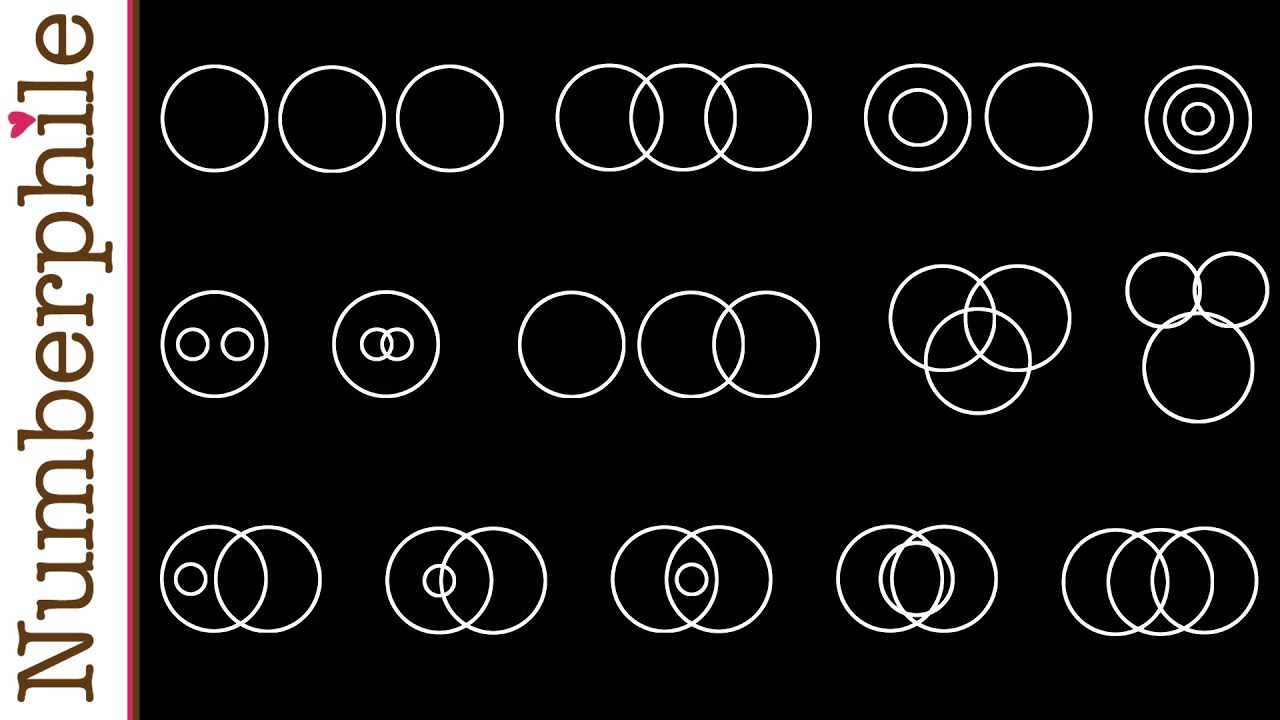
I have a question related to 4 circles configuration: does exist a configuration with 4 circles, not necessarily congruent, that replies the Venn Diagram, as it happens in case n = 3 at 2: 20? I mean, I would find a configuration with 4 circles, even different in size, in which all kinds of intersections appear. Currently, I'm not finding such a configuration. Could it be impossible?
reply
I have a question related to 4 circles configuration: does exist a configuration with 4 circles, not necessarily congruent, that replies the Venn Diagram, as it happens in case n = 3 at 2: 20? I mean, I would find a configuration with 4 circles, even different in size, in which all kinds of intersections appear. Currently, I'm not finding such a configuration. Could it be impossible?
reply
Andrew
Actually, we do have a lower bound for 6 circles. It is twice that of the 5 case. This is due to the fact that we can either put a 6th circle next to all the cases for 5, and get 16, 000+ ways to draw 6 circles. You can also draw a 6th circle next to every possible way to draw 5. This will also give you 16, 000+ ways. So this must be at least twice the ways to draw 5.
reply
Actually, we do have a lower bound for 6 circles. It is twice that of the 5 case. This is due to the fact that we can either put a 6th circle next to all the cases for 5, and get 16, 000+ ways to draw 6 circles. You can also draw a 6th circle next to every possible way to draw 5. This will also give you 16, 000+ ways. So this must be at least twice the ways to draw 5.
reply
Avery
Surely the lower bound for 6 circles is at least 16, 951x3 no. So 50, 853. Since you could conceive of an arrangement of circles that is just the previous total arrangements plus on extra circle either seperate, crossing, or nested in some capacity.
Obviously the true answer is gonna be much higher than that but at least there's something
reply
Surely the lower bound for 6 circles is at least 16, 951x3 no. So 50, 853. Since you could conceive of an arrangement of circles that is just the previous total arrangements plus on extra circle either seperate, crossing, or nested in some capacity.
Obviously the true answer is gonna be much higher than that but at least there's something
reply
Horsepower
You can overlap two shapes by making a pair of sides(one from each circle) go through each other. A circle has an infinite amount of sides. That means that you can overlap two circles with an infinite amount of ways to choose from. It doesn't matter how big or small or where the circles are located as long as the circles overlap.
reply
You can overlap two shapes by making a pair of sides(one from each circle) go through each other. A circle has an infinite amount of sides. That means that you can overlap two circles with an infinite amount of ways to choose from. It doesn't matter how big or small or where the circles are located as long as the circles overlap.
reply
Alexander
coming from a math fan who is not a mathematician, the graphic of the 4 circles with the 5th ellipse, it almost looks like a 3 dimensional representation of rings, and how the 5th -ring- would sit tangentially on top of a sphere. would this perspective shift, and view in 3 dimensions provide any special insight to this issue?
reply
coming from a math fan who is not a mathematician, the graphic of the 4 circles with the 5th ellipse, it almost looks like a 3 dimensional representation of rings, and how the 5th -ring- would sit tangentially on top of a sphere. would this perspective shift, and view in 3 dimensions provide any special insight to this issue?
reply
Jarle
Very interesting. Two questions I am left with:
Is this solved for triangles? I am genuinely unsure if it actually makes a difference, although I would imagine so.
Seeing as -touches- is not acknowledged as a separate state, does that mean that this is approached as a geometrical problem and not a topological one?
reply
Very interesting. Two questions I am left with:
Is this solved for triangles? I am genuinely unsure if it actually makes a difference, although I would imagine so.
Seeing as -touches- is not acknowledged as a separate state, does that mean that this is approached as a geometrical problem and not a topological one?
reply
TunaAlert
It was said that we don't have an upper bound for the numbers of patterns above 5 circles, but wouldn't that be 2-2-n based on the table at the end? The table contains patterns that are impossible and also duplicates, so there's less patterns for the circles than in the table.
reply
It was said that we don't have an upper bound for the numbers of patterns above 5 circles, but wouldn't that be 2-2-n based on the table at the end? The table contains patterns that are impossible and also duplicates, so there's less patterns for the circles than in the table.
reply
Jek
This is really cool. I think the first step to figuring out how to take this further is to simplify what we know as far as possible. That chart of the configurations of four circles is painfully asymmetrical and makes random choices for the sake of visuals rather than uniform ones
reply
This is really cool. I think the first step to figuring out how to take this further is to simplify what we know as far as possible. That chart of the configurations of four circles is painfully asymmetrical and makes random choices for the sake of visuals rather than uniform ones
reply
Add a review, comment
Other channel videos