The Forgotten Flexagon - Numberphile
video description
Date: 2022-04-09
Related videos


Comments and reviews: 9
Entraya
i thought the title referred to how flexagons were being forgotten and i thought back to way long ago where i first found viharts flexagon videos and was sad for a moment that i'd forgotten. i never did make my own flexagon. what if i died without having made on? terrible. i think theres a certain charm to a square flexagon, you dont think of squares as being flexy. i'll try and make one
reply
i thought the title referred to how flexagons were being forgotten and i thought back to way long ago where i first found viharts flexagon videos and was sad for a moment that i'd forgotten. i never did make my own flexagon. what if i died without having made on? terrible. i think theres a certain charm to a square flexagon, you dont think of squares as being flexy. i'll try and make one
reply
Eric
Not to flex on anyone, but I made a 93? /48 sided octatetracontahexaflexagon with 5 levels (48 unique sides, 93? (I don't remember the exact number) unique traversable orientations (some of the 48 sides are inverted in two different ways (because triangles have three sides) I still have it, its pretty cool. It's shaped like a regular hexaflexagon, just really thick.
reply
Not to flex on anyone, but I made a 93? /48 sided octatetracontahexaflexagon with 5 levels (48 unique sides, 93? (I don't remember the exact number) unique traversable orientations (some of the 48 sides are inverted in two different ways (because triangles have three sides) I still have it, its pretty cool. It's shaped like a regular hexaflexagon, just really thick.
reply
beeble2003
-Fold it in half. Whichever way you want -- they're both the same. - Well, that's a bad start.
There are eight ways to fold a square of paper in half. Two parallel to the edges, two diagonals each either ridge folded or valley folded. Alternatively, if you ignore symmetries, there are two ways but they're not both the same: parallel or diagonal.
reply
-Fold it in half. Whichever way you want -- they're both the same. - Well, that's a bad start.
There are eight ways to fold a square of paper in half. Two parallel to the edges, two diagonals each either ridge folded or valley folded. Alternatively, if you ignore symmetries, there are two ways but they're not both the same: parallel or diagonal.
reply
TheMadRatter
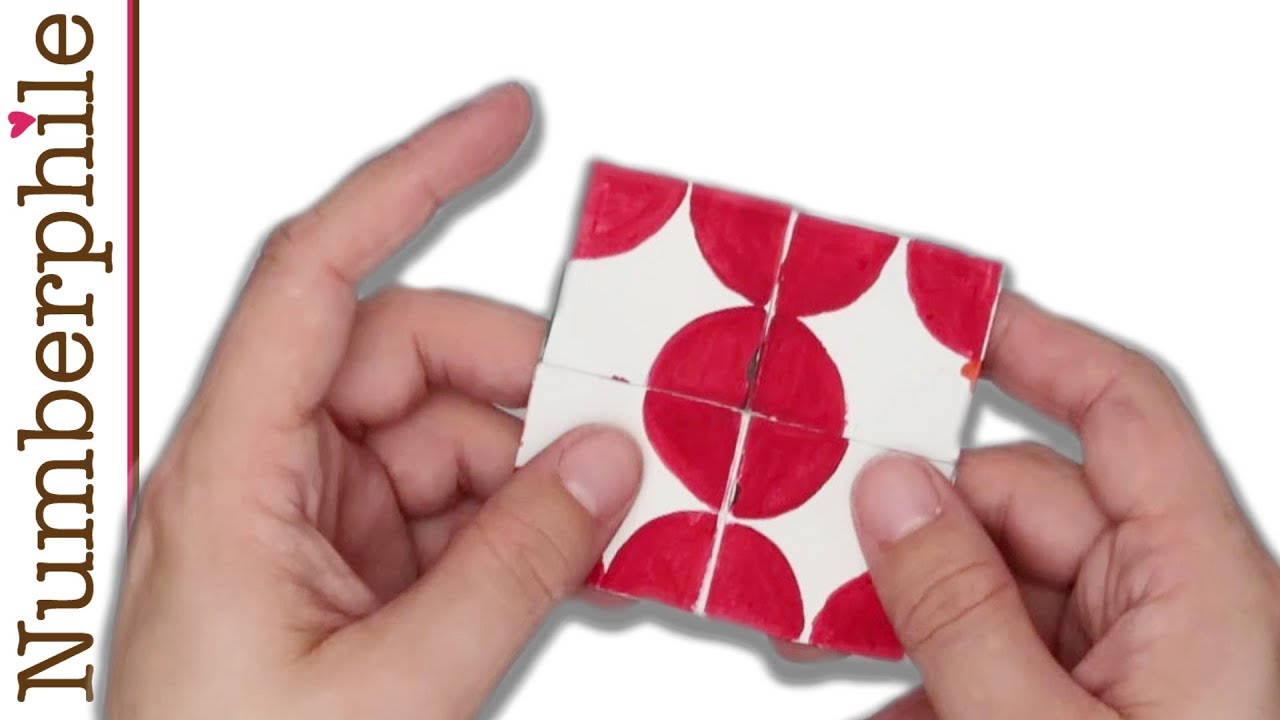
I had totally forgotten about these until I saw this video. my dad had (and I now have somewhere) a couple of display -toys- from the 70s that did this, about the size of credit cards (but much thicker and made of plastic) the design on one side had a series of linked circles (like the olympic logo, and the other side had them all separated.
reply
I had totally forgotten about these until I saw this video. my dad had (and I now have somewhere) a couple of display -toys- from the 70s that did this, about the size of credit cards (but much thicker and made of plastic) the design on one side had a series of linked circles (like the olympic logo, and the other side had them all separated.
reply
1000dots
I had to make one of these while I was watching (I may have paused it) You had said that anything could be done with one cut so i decided to work out how to do this as well as cut off the extra bit from a piece of A4 paper in the one cut. It turned out to be simpler than I expected: ) love your videos
reply
I had to make one of these while I was watching (I may have paused it) You had said that anything could be done with one cut so i decided to work out how to do this as well as cut off the extra bit from a piece of A4 paper in the one cut. It turned out to be simpler than I expected: ) love your videos
reply
Gilliam
I know this is quite old but the network of possible opposing faces seems wierdly asymmetrical. Why is it that 1 and 2 are the only faces that oppose 3 other faces, while 3-6 only ever oppose 2? why doesnt the network fill in and include 5/6 and 3/4?
reply
I know this is quite old but the network of possible opposing faces seems wierdly asymmetrical. Why is it that 1 and 2 are the only faces that oppose 3 other faces, while 3-6 only ever oppose 2? why doesnt the network fill in and include 5/6 and 3/4?
reply
Tim
I learned about flexagons from Martin Gardner's Mathematical Puzzles and Diversions books back in the 1960s. I got as far as making a dodecahexaflexagon. I also learned the Tuckerman Traverse, a systematic way of getting to all the faces on any flexagon.
reply
I learned about flexagons from Martin Gardner's Mathematical Puzzles and Diversions books back in the 1960s. I got as far as making a dodecahexaflexagon. I also learned the Tuckerman Traverse, a systematic way of getting to all the faces on any flexagon.
reply
Yee
You don't need glue for hexaflexagons! Matt I never expected such blasphemy! Any true hexaflexer would know such a simple fact!
Not only that, but the tetraflexagon requires scissors which the hexaflexagon does not.
reply
You don't need glue for hexaflexagons! Matt I never expected such blasphemy! Any true hexaflexer would know such a simple fact!
Not only that, but the tetraflexagon requires scissors which the hexaflexagon does not.
reply
zane49er
I once made the dodecahexaflexagon - Even more work than the hexahexaflexagon. I think the hexaflexagon is infinitely expandable as long as you have infinitely thin paper. Can yo say the same of the tetraflexagon?
reply
I once made the dodecahexaflexagon - Even more work than the hexahexaflexagon. I think the hexaflexagon is infinitely expandable as long as you have infinitely thin paper. Can yo say the same of the tetraflexagon?
reply
Add a review, comment
Other channel videos