What Will Happen to Earth in the Next Billion Years
FBTwitterReddit
video description
Rating: 4.0; Vote: 1
What Will Happen to Earth in the Next Billion Years?
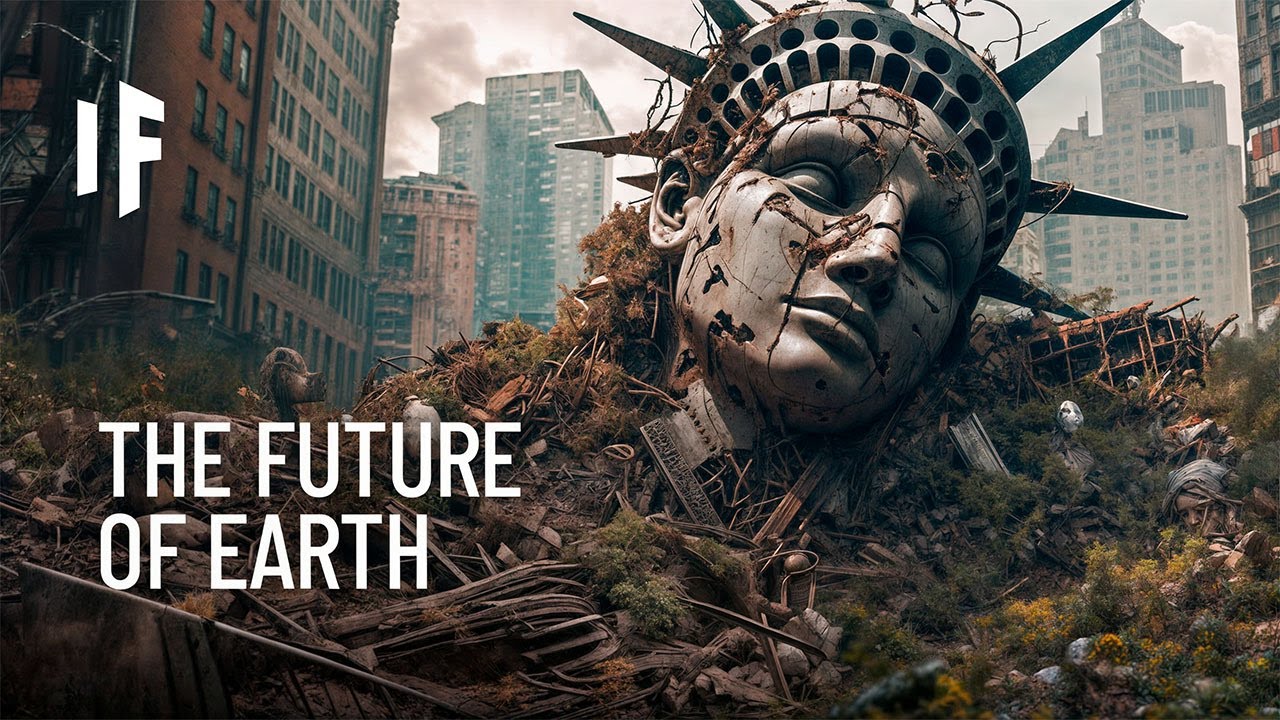
One billion years into the future, you might imagine a world full of artificial intelligence, interstellar travel, and space colonies. Maybe we'll see the end of poverty and hunger. A society where we're all truly equal. Well, these are all incredible scenarios that may happen one day. But let's take a step back from our usual human-centric approach of looking at the future. Instead, let's keep our feet firmly grounded right here on Earth. Well, sort of grounded.
Let's hop in our time machine and explore all the ways Earth will evolve in the next billion years. The Earth is already 4.5 billion years old, and as you probably know, a ton of stuff has happened in that time. Just a quarter of a billion years ago, dinosaurs ruled the planet. Think they'll make a big comeback in the future? Let's find out.
100 Years
You'd be surprised by how much things would have already changed just a century from now. Well, maybe you shouldn't be totally shocked because even now, the effects of global warming are very real. Just how dramatically the climate changes in the next century will depend on what steps humanity takes to curb its effects. But you should certainly anticipate that temperatures around the globe will get, well, warmer.
The biggest impact this will have is on sea levels, which, as you know, are already on the rise. You'll see them climb higher and higher, threatening many of the world's coastal cities. Bangkok, Miami, Venice, and many more around the globe could all be heavily submerged by 2124. This would force humanity to redraw the world map, but, more devastatingly, rising sea levels would displace hundreds of millions of people worldwide.
This would lead to chaos, causing political crises and societal transformations. Plenty of animal species would be forced to migrate or face extinction. The major ecological shifts happening around Earth could permanently transform entire ecosystems. Now, beyond the melting polar ice caps, higher temperatures and changes in rainfall would alter rainforests into something we don't recognize. Heat-tolerant plants, insects and small mammals would probably survive, but we'd lose many iconic species. Say goodbye to jaguars and orangutans.
Couple all these disasters with an increase in the number of hurricanes, and we're looking at a very different world. OK, let's fast forward a millennium. Earth would still be getting hotter, and the effects of global warming would be even more pronounced. But several other forces would erupt to change our planet. Literally. At this point in the future, several major volcanoes could awaken from their long sleep.
1,000 Years
Let's take a look at the supervolcano located in Yellowstone National Park. Or rather, the volcano that is Yellowstone National Park. When this thing blows, it could produce an eruption about as big as volcanic eruptions can be. And it wouldn't just affect the immediate area or the western region of North America. No, this is going to impact the whole globe.
Massive amounts of gas and ash will be ejected into the atmosphere, blocking out sunlight in the sky. Earth will effectively enter a volcanic winter. This will have devastating effects on the lives of different species around the world. Entire populations of animals and humans will face extinction. It'll also heavily affect our planet's agriculture systems. Plants would be starved of light and covered in volcanic ash, forcing most of them to die.
But this might not be an entirely bad thing. A volcanic winter like this could help cool down the planet. Hey do you have an iPad? Well, if so, I bet you use it to take notes on or maybe even draw with. And I bet you hate how the iPad feels on the glass screen. Well luckily, I found a solution for you. With the sponsor of today’s video, Swiss Paperlike, that all changes.
It’s a screen protector that makes your iPad feel like you’re writing on paper. The secret sauce is this nanodot layer that’s spread across the surface. It’s made with Swiss-based manufacturing and is what provides that signature feel, of pen to paper resistance, making it easier to take notes. And now, it’s more transparent than ever before, while also reducing light reflection.
So if you’re taking notes or drawing on your iPad the Paperlike 2.1 is for you, so go check it out in the link in the description and get yourself one of these and make your iPad experience even better. Not only that, but each click we get helps out the channel, so go check it out. Welcome to a completely new era of Earth's geological history.
10,000 Years
10,000 years in the future, our landscapes and coastlines could be reshaped with new mountain ranges and large inland seas. This would be thanks to the eruptions of more large supervolcanoes, mega-earthquakes, and, in general, the constant shifting of our planet's tectonic plates. It would almost seem as if Earth is slowly sculpting itself into a new form. Geographically, we might experience as much change as when Earth formed into Pangea.
And even without thinking about where humans fit into this changing planet, much of the evidence of our existence would be buried under layers of rock and ice. If you, or alien archaeologists, were to dig down, you'd find a clear record of our human impact on Earth embedded in the geological record. Ok, jumping even further into the future, we'd only be a decimal point on the way toward one billion years.
100,000 Years
But by this time, Earth would have gone through at least one new ice age. Maybe even a couple. These periods of global freezing and melting would continue to transform the landscapes we once knew so well. There'd be new rivers and seas. New emerging environments-inhabited by new species of plants and animals that managed to adapt to all the changes over the last 100,000 years. Who knows what new species would be on top of the food chain?
Even Earth's orbit could be different. This wouldn't necessarily be a dramatic change, but the pull of other celestial bodies like Jupiter might bring us slightly further away from the Sun than we are today. This would change our day and night cycles and the temperature on Earth. Ok, at this point, the big blue marble we once called home would be almost unrecognizable. For starters, the continents would no longer be where you thought they were.
1 Million Years
Hey, maybe Canada will finally get more than two months of summer. And what was formerly the continent of Africa might now be covered in snow. Within these new continents, new ecosystems would emerge, making way for new life forms. Some of which might even be intelligent. There's no way of knowing exactly what these new dominant species would look like. But it's likely that whatever they are, they'd be perfectly tailored to the environment.
If the Earth were a rocky ball of giant magma, they would have evolved to withstand that. Or if it were a watery planet, they'd have gills to breathe underwater. Humanity, at this point, might be looked at like the dinosaurs. A fascinating species that once ruled the world but ultimately went extinct.
Finally, you arrive at your destination, even if you didn't travel very far from where you began, Except for the one billion years of history you've witnessed, of course. Earth 1 billion years in the future would be unrecognizable to you. By now, the Sun would be about 10% brighter than you remembered it, and this would mean that temperatures around the planet would be soaring.
Earth would be a completely barren, desert-like world without any of the oceans that used to cover a majority of it. Any sign of life would have to be resilient enough to live deep underground. Hopefully, humans, or any other intelligent species, have left Earth and started populating other celestial bodies. Which is worth thinking about. If Earth becomes uninhabitable, where should we go next? What planets might be better suited for life than this one? Date: 2024-02-11
FATillery Somehow, I do not think that what happens to Earth in a 'billion years' will matter to us. What's more important is what is happening to Earth right now. The Earth is changing right before our eyes. hottest temperatures recorded. seasons gone amuck worldwide. it ain't looking too good for humans and our futures.
reply
Silakkidumma846 In about 1 billion years, our planet will be too hot to maintain oceans on its surface to support life. That's a really long time away: an average human lifetime is about 73 years, so a billion is more than 13 million human lifetimes.
reply
Grahame0624 I bet the new intelligence won't have money, racism or social tiers to separate the people. Hopefully they never find out about us. Our lives to them will be sad and hilarious.
reply
Gulag_Official. But remembered kids: this happens in 8 billion years. So have no fear, you'll be long dead! You'll be dead in the next 50 years. But racist people in 50 seconds!
reply
FuryYT-hk2vu Bro a large portion of your videos has greatly helped me in my Space Themed Project I was making thank you for your amazing videos dude, please' make more
reply
ichangasek1 Dia terjebak di mesin waktu hanya untuk kembali ke pada orang yang ia sayang dan cinta jadi kita tidak bisa kembali ke masa lalu. reply