Deep Dive Snapdragon X Elite Review
video description
Date: 2024-07-24
Related videos


Comments and reviews: 17
denvera1g1
One reason i suggest using CPU encode on Handbrake etc when testing CPU, is because we're trying to test the CPU, not the GPU, not hardware encoders that could be added to any CPU.
Additionally, while i primarily use CPU encoding for handbrake because i want higher quality and smaller files, that is very situational, NVENC, Intel QS, AMD VCE, and Apple VTB can offer smaller files and similar or better quality. They can also end up larger than source files while looking worse.
It depends entirely on the source video settings and destination video settings.
For example, my TV recordings come in as MPEG2. The 1080i recordings can be as much as 8GB/h. Converting that to H265 on CPU can drop than to 1.2GB/h even sub 800MB/h depending on source video (is it B&W with simple animations slides, or a highly detailed live action movie with HDR).
Contrast this with hardware encoding, because of an issue with FFMPEG, Handbrake, or just hardware encoders in general, to get similar quality to source, NVMEC, iQS, and VCE can go up in file size to 20GB/h, the only one that generally reduces the file size without giving up visual quality is Apple VTB on my M1 Mac Mini, but it doesnt save much, going from 8GB/h down to just 5-6GB/h
Now contrast this to the recordings from my 4K 10b 4:2:2 200Mbps camera IIRC its H264. NVENC, QSV, VCE, and VTB all seem to hit almost the same compression quality and file size as CPU.(i have to convert them to.... 8 bit otherwise i need the paid version of Davinci resolve before i can even trim 10bit video)
Edit: I do see value in benchmarking the GPU/HW encoding with a CPU test, because it still hits the CPU, i think its especially important on laptops where you may want to save battery life, but HW encoding might peg the CPU as well on one laptop processor, but not another.
reply
One reason i suggest using CPU encode on Handbrake etc when testing CPU, is because we're trying to test the CPU, not the GPU, not hardware encoders that could be added to any CPU.
Additionally, while i primarily use CPU encoding for handbrake because i want higher quality and smaller files, that is very situational, NVENC, Intel QS, AMD VCE, and Apple VTB can offer smaller files and similar or better quality. They can also end up larger than source files while looking worse.
It depends entirely on the source video settings and destination video settings.
For example, my TV recordings come in as MPEG2. The 1080i recordings can be as much as 8GB/h. Converting that to H265 on CPU can drop than to 1.2GB/h even sub 800MB/h depending on source video (is it B&W with simple animations slides, or a highly detailed live action movie with HDR).
Contrast this with hardware encoding, because of an issue with FFMPEG, Handbrake, or just hardware encoders in general, to get similar quality to source, NVMEC, iQS, and VCE can go up in file size to 20GB/h, the only one that generally reduces the file size without giving up visual quality is Apple VTB on my M1 Mac Mini, but it doesnt save much, going from 8GB/h down to just 5-6GB/h
Now contrast this to the recordings from my 4K 10b 4:2:2 200Mbps camera IIRC its H264. NVENC, QSV, VCE, and VTB all seem to hit almost the same compression quality and file size as CPU.(i have to convert them to.... 8 bit otherwise i need the paid version of Davinci resolve before i can even trim 10bit video)
Edit: I do see value in benchmarking the GPU/HW encoding with a CPU test, because it still hits the CPU, i think its especially important on laptops where you may want to save battery life, but HW encoding might peg the CPU as well on one laptop processor, but not another.
reply
zodwraith5745
Buying a Windows on Arm laptop is like buying an Intel Arc GPU...... If Intel charged $500 for Arc.
You want it just to play with and it's going to do most of what you really need, but not something you're going to shift your entire computing workload to when there's still reliability problems with many apps and games. The problem is Arc is actually priced in a self aware fashion, but Arm is priced like an Apple product.
Anyone I know we were interested in Windows on Arm PCs because we thought they would usher in affordable thin PCs like they did for phones without putting up with ChromeOS. Not pay a premium to experience compatibility problems and not be able to play games. Especially when you can find plenty of X86 laptops with a modest dedicated GPU and still save hundreds off one of these. Not to mention it's not even _that_ much more efficient. If you're dead set on needing maximum battery life you're not realistically buying a thin and light with a tiny battery anyways, are you
I'm just finding a hard time figuring out who these are actually for. If you only use it for browsing Chromebooks annihilate these in price. If you need maximum performance you're not buying a thin and light. If you need maximum battery life you're not buying a thin and light either. If you care about gaming at all you're not buying this. If it's about having the latest and greatest both Intel and AMD are mere months away from new releases that will erase any of these leads. If it's a status symbol you can't beat Apple.
I just fail to see _why_ anyone would pay more money to enjoy compatibility issues unless you just really hate Intel and AMD. Qualcomm really needed to offer these at a better price if they want any real foothold in the laptop market.
reply
Buying a Windows on Arm laptop is like buying an Intel Arc GPU...... If Intel charged $500 for Arc.
You want it just to play with and it's going to do most of what you really need, but not something you're going to shift your entire computing workload to when there's still reliability problems with many apps and games. The problem is Arc is actually priced in a self aware fashion, but Arm is priced like an Apple product.
Anyone I know we were interested in Windows on Arm PCs because we thought they would usher in affordable thin PCs like they did for phones without putting up with ChromeOS. Not pay a premium to experience compatibility problems and not be able to play games. Especially when you can find plenty of X86 laptops with a modest dedicated GPU and still save hundreds off one of these. Not to mention it's not even _that_ much more efficient. If you're dead set on needing maximum battery life you're not realistically buying a thin and light with a tiny battery anyways, are you
I'm just finding a hard time figuring out who these are actually for. If you only use it for browsing Chromebooks annihilate these in price. If you need maximum performance you're not buying a thin and light. If you need maximum battery life you're not buying a thin and light either. If you care about gaming at all you're not buying this. If it's about having the latest and greatest both Intel and AMD are mere months away from new releases that will erase any of these leads. If it's a status symbol you can't beat Apple.
I just fail to see _why_ anyone would pay more money to enjoy compatibility issues unless you just really hate Intel and AMD. Qualcomm really needed to offer these at a better price if they want any real foothold in the laptop market.
reply
robertmacdonald345
Don't get suckered into Snap Dragon When it cost Hundreds of Dollars more then that regular PC that is Basically the Same, Then it's a sure bet that Snap Dragon is trying to act like apple and Make you pay through the nose for minimal performance, but if they keep bombarding you with these shallow percentages in performance then you will eventually get Suckered into the platform, Now if that was Hundreds of Dollars LESS then that is something to talk about, Not because The performance percentages would be different, but it would be based on Best Bang For The Buck
reply
Don't get suckered into Snap Dragon When it cost Hundreds of Dollars more then that regular PC that is Basically the Same, Then it's a sure bet that Snap Dragon is trying to act like apple and Make you pay through the nose for minimal performance, but if they keep bombarding you with these shallow percentages in performance then you will eventually get Suckered into the platform, Now if that was Hundreds of Dollars LESS then that is something to talk about, Not because The performance percentages would be different, but it would be based on Best Bang For The Buck
reply
skeetssaer2018
Why do they think that they can price this like it is an exclusive product MS and Qualcomm just don't get the PC market. Intel understood so that even when they released their GPUs that they understood. People are not going to spend more for unproven than proven so even though they gave you 16GB of VRAM buffer, it was still the cost of a card with 6 GB from Nvidia and 8 GB from AMD. Good to see your hair is coming back nicely though Gordon.
reply
Why do they think that they can price this like it is an exclusive product MS and Qualcomm just don't get the PC market. Intel understood so that even when they released their GPUs that they understood. People are not going to spend more for unproven than proven so even though they gave you 16GB of VRAM buffer, it was still the cost of a card with 6 GB from Nvidia and 8 GB from AMD. Good to see your hair is coming back nicely though Gordon.
reply
agentb4074
Awesome in-depth review, Gordon! (I'm only halfway though right now, and wanted to say that before I forget.)
I'm hesitating to say disappointed with the results, because I feel like this could be better if they keep working on it and fix some things up. I'd be extremely interested to see a followup review in a few months or so!
Much love to you, The Silicon Sage. I always appreciate your work.
reply
Awesome in-depth review, Gordon! (I'm only halfway though right now, and wanted to say that before I forget.)
I'm hesitating to say disappointed with the results, because I feel like this could be better if they keep working on it and fix some things up. I'd be extremely interested to see a followup review in a few months or so!
Much love to you, The Silicon Sage. I always appreciate your work.
reply
BillyONeal
With the app compat issues I feel like they needed to deliver on a whole new world of performance or battery life, or be priced meaningfully lower,and AFAICS they did neither. That double performance Lightroom example rocks though. This part at least finally looks worth using after more than a decade of trying to get Windows on ARM to a good place even if I don’t think it’s worth buying.
reply
With the app compat issues I feel like they needed to deliver on a whole new world of performance or battery life, or be priced meaningfully lower,and AFAICS they did neither. That double performance Lightroom example rocks though. This part at least finally looks worth using after more than a decade of trying to get Windows on ARM to a good place even if I don’t think it’s worth buying.
reply
vasudevmenon2496
There a typo in timestamps for handbrake. Currently it is handbreak instead of handbrake.
There isn't any snapdragon arm PC in India. By the time strix is released arm will be in the first just for CPU, GPU performance. Battery life might be better with snapdragon.
reply
There a typo in timestamps for handbrake. Currently it is handbreak instead of handbrake.
There isn't any snapdragon arm PC in India. By the time strix is released arm will be in the first just for CPU, GPU performance. Battery life might be better with snapdragon.
reply
MoireFly
I'm curious how this will compare with strike point and lunar lake. Interesting that it does as well as it does, but on the other hand being competitive with what's very soon to be last gen may soon seem less impressive, especially if the x86 competing improve battery life.
reply
I'm curious how this will compare with strike point and lunar lake. Interesting that it does as well as it does, but on the other hand being competitive with what's very soon to be last gen may soon seem less impressive, especially if the x86 competing improve battery life.
reply
prebenhansen9846
I have an external Thunderbolt/USB4 enclosure with a 2 TB WD SN850X drive in it. On the Yoga Slim 7X I get 2100 MB/s transfer speed, but on my HP Envy 16 with Thunderbolt I get 3100 MB/s. Maybe it is a driver issue on the Yoga.
reply
I have an external Thunderbolt/USB4 enclosure with a 2 TB WD SN850X drive in it. On the Yoga Slim 7X I get 2100 MB/s transfer speed, but on my HP Envy 16 with Thunderbolt I get 3100 MB/s. Maybe it is a driver issue on the Yoga.
reply
Vegemeister1
1:21:40 I think the smoothness is a measurement artifact from a low pass filter on the battery gauge on the Snapdragon. See the exponential tail-off at the end No way that's a natural characteristic of Geekbench.
reply
1:21:40 I think the smoothness is a measurement artifact from a low pass filter on the battery gauge on the Snapdragon. See the exponential tail-off at the end No way that's a natural characteristic of Geekbench.
reply
pcworld
Three days of real world testing -- ah, the exciting work of a tech journalist. ;-) For what it's worth, listening to you relate the experience and the variables was my favorite part of the video.
reply
Three days of real world testing -- ah, the exciting work of a tech journalist. ;-) For what it's worth, listening to you relate the experience and the variables was my favorite part of the video.
reply
west1329
All of the best Gordon! May God heal you so you can get back to full strength! I just looked at a 9 month old clip, and you look soo much better right now buddy! Best wishes and prayers Mr Ung
reply
All of the best Gordon! May God heal you so you can get back to full strength! I just looked at a 9 month old clip, and you look soo much better right now buddy! Best wishes and prayers Mr Ung
reply
LeesChannel
Mr. Gordon, it's always a pleasure to see or hear you. I hope we'll be able to hear your thoughts on the whole intel situation, you're always the guy I look for when S hits the fan.
reply
Mr. Gordon, it's always a pleasure to see or hear you. I hope we'll be able to hear your thoughts on the whole intel situation, you're always the guy I look for when S hits the fan.
reply
mokotik
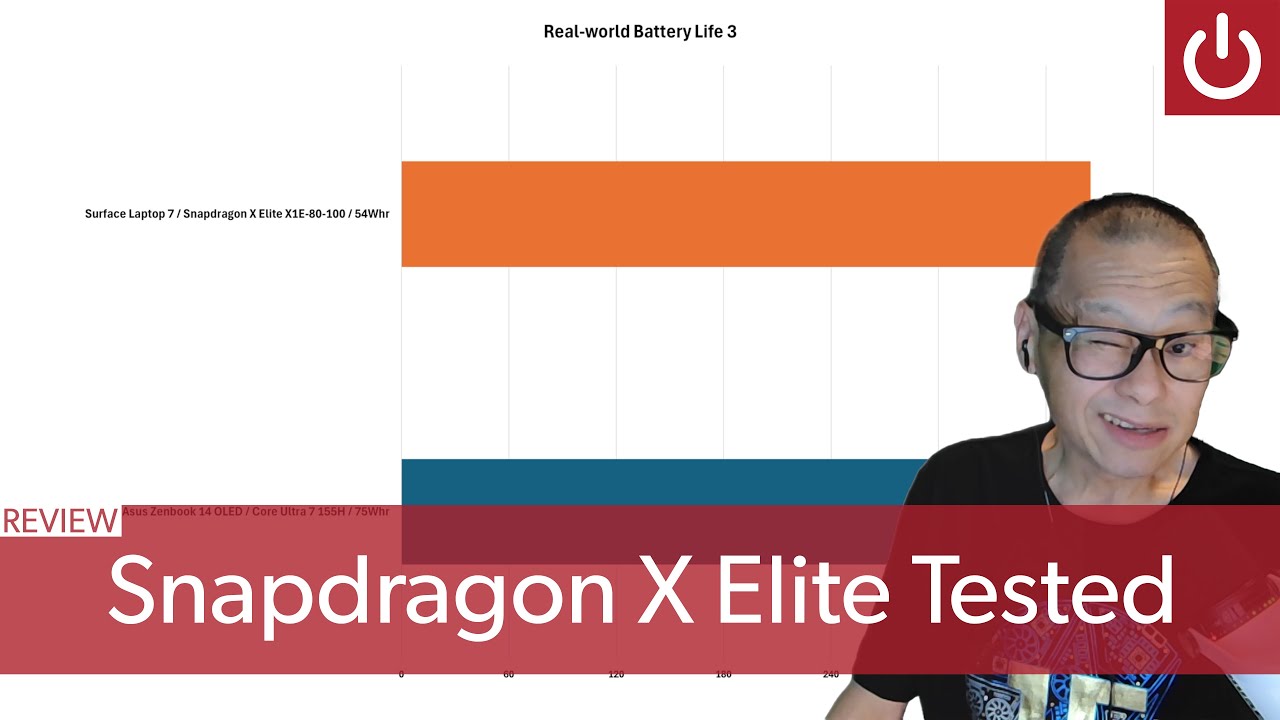
1:46:50 If the Surface had a 75 Whr battery, it would have worked for 350 minutes, which is more than intel, in my opinion it is necessary to conduct tests with AMD than with Intel
reply
1:46:50 If the Surface had a 75 Whr battery, it would have worked for 350 minutes, which is more than intel, in my opinion it is necessary to conduct tests with AMD than with Intel
reply
PurpleWarlock
Gordon, a question: is there an embargo for Strix Point laptop reviews I can imagine next week it will be mostly commentary on ASUS machines from reviewers.
reply
Gordon, a question: is there an embargo for Strix Point laptop reviews I can imagine next week it will be mostly commentary on ASUS machines from reviewers.
reply
yogeshnaidu5819
Whenever Snapdragon wins you sound disappointed Its ok you can say you like x86 even though it loses to Qualcomm
reply
Whenever Snapdragon wins you sound disappointed Its ok you can say you like x86 even though it loses to Qualcomm
reply
kaossverige
TL;DW... it sucks. DO NOT buy. SO MUCH better to buy into the Apple ecosystem than this POS of an ecosystem
reply
TL;DW... it sucks. DO NOT buy. SO MUCH better to buy into the Apple ecosystem than this POS of an ecosystem
reply
Add a review, comment
Other channel videos