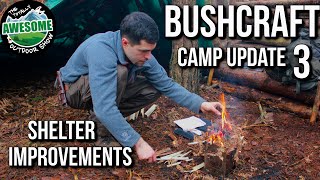
Building a Dome Hut: First Overnight in the Bushcraft Wigwam Shelter (PART 3)
video description
Date: 2019-09-10
Related videos



Comments and reviews: 10
Steven DeAtley
very nice shelter, it looks exactly like the shelters I found at the Wolf Creek Indian Village in Bastain, VA. they found the village when the I-77 Interstate Highway was being built back in the 1970's it was a village that was built back around the 1500's and their shelters are built exactly like this one with the exception of their tree bark is made of fiberglass. it is a kinda living museum, built out in the forest along Wolf creek. often school children get to take field trips with their class and spend the day at the village. some times they have powwows, the people who work there just do the everyday things that these long gone Native peoples would have done in their every day lifes, they garden and fish at the creek and tan real animal hides, I have taken them several Deer hides. I was told to just hang them on the gate if they happened to be closed. they will even have some one there chipping out arrow and spear heads from flint or glass. I was raised very close to the dig site and when I was a boy I would wander in every garden and corn field and hunt arrow heads I have a really cool stone ax or hammer head that is hand polished and shaped perfectly maybe it was a war club. but it is cool the spear heads are really cool they are much larger than the arrow heads I have lways wanted to find a pipe. but I have never been that lucky. I do know where 2 old quarry sites are one is on the top of Round Mnt. another is behind a friend s old milk barn along the creek in an area where I often hunted arrow heads. good video thanks.
reply
very nice shelter, it looks exactly like the shelters I found at the Wolf Creek Indian Village in Bastain, VA. they found the village when the I-77 Interstate Highway was being built back in the 1970's it was a village that was built back around the 1500's and their shelters are built exactly like this one with the exception of their tree bark is made of fiberglass. it is a kinda living museum, built out in the forest along Wolf creek. often school children get to take field trips with their class and spend the day at the village. some times they have powwows, the people who work there just do the everyday things that these long gone Native peoples would have done in their every day lifes, they garden and fish at the creek and tan real animal hides, I have taken them several Deer hides. I was told to just hang them on the gate if they happened to be closed. they will even have some one there chipping out arrow and spear heads from flint or glass. I was raised very close to the dig site and when I was a boy I would wander in every garden and corn field and hunt arrow heads I have a really cool stone ax or hammer head that is hand polished and shaped perfectly maybe it was a war club. but it is cool the spear heads are really cool they are much larger than the arrow heads I have lways wanted to find a pipe. but I have never been that lucky. I do know where 2 old quarry sites are one is on the top of Round Mnt. another is behind a friend s old milk barn along the creek in an area where I often hunted arrow heads. good video thanks.
reply
Backcountrylife Magazine
There were so many very different Native American cultures, in so many different environments, but many plains tribes (Souix, Cheyenne, Nez Pearce, Comanche, Kiowa, Gro Ventre, Hidatsa, Mandan, Arikara, Arapaho, Assiniboine and Blackfoot to name a few, used Teepees made of buffalo hide, at least seasonally, though some also used earth works lodges. Wigwams and bigger longhouses were common in the Great Lakes, Midwest, Eastern woodlands tribes, into Canada, Ontario and Quebec, (Huron, Ojibwa, Mohawk, Cree, Iroquois nations and many more. though Cree and Ojibwa had bands in the plains too. Longhouses (Big wigwams, with various coverings, including thatch) were common in the Ohio valley, the Southeast, South (Cayuga, Miami, Seneca, Cherokee, Chicsaw, Apalachicola, Powhatan, Shawnee, Ouachita and many more. and of course the SouthWest tribes were famous for brick and adobe structures, The Pacific Northwest tribes made houses of plank wood, with A frame roofs and shingles et al. So so many completely different cultures, customs, languages. and architecture. and don't forget igloos, and whale bone and walrus skin houses of the many tribes, collectively (and incorrectly, referred to as Eskimo. 562 different Native American tribes currently, many more historically. Approximately 300 different languages in the US and Canada. Wigwams usually used smooth, waterproof bark, like birch, poplar or something similar.
reply
There were so many very different Native American cultures, in so many different environments, but many plains tribes (Souix, Cheyenne, Nez Pearce, Comanche, Kiowa, Gro Ventre, Hidatsa, Mandan, Arikara, Arapaho, Assiniboine and Blackfoot to name a few, used Teepees made of buffalo hide, at least seasonally, though some also used earth works lodges. Wigwams and bigger longhouses were common in the Great Lakes, Midwest, Eastern woodlands tribes, into Canada, Ontario and Quebec, (Huron, Ojibwa, Mohawk, Cree, Iroquois nations and many more. though Cree and Ojibwa had bands in the plains too. Longhouses (Big wigwams, with various coverings, including thatch) were common in the Ohio valley, the Southeast, South (Cayuga, Miami, Seneca, Cherokee, Chicsaw, Apalachicola, Powhatan, Shawnee, Ouachita and many more. and of course the SouthWest tribes were famous for brick and adobe structures, The Pacific Northwest tribes made houses of plank wood, with A frame roofs and shingles et al. So so many completely different cultures, customs, languages. and architecture. and don't forget igloos, and whale bone and walrus skin houses of the many tribes, collectively (and incorrectly, referred to as Eskimo. 562 different Native American tribes currently, many more historically. Approximately 300 different languages in the US and Canada. Wigwams usually used smooth, waterproof bark, like birch, poplar or something similar.
reply
tardis mole
That's how I sweep the living room. Wife was not impressed. :D My wife is Cherokee, my late spose's family is Navajo and my aunt is Inuit. The materials and methods differ a lot, dependent on latitude and altitude, but the basic structure is the same. My wife's family's shelters were generally made of buffalo hide, sewn together in strips, which are then sewn to each other and to the frame, as you have done with yours, but with a smoke hole at the top. The door would be an extra flap of hide that would be peeled back when entering and exiting. From my experience, the poles used for the frames would be carried, wrapped inside the folded hides, rather than be left behind. It saves a lot of time and effort, especially when you have small children to protect from the elements. We never left anything behind. The Inuit, on the other hand, leave the whale bones behind, because they're too heavy to carry. And you cooked up a storm, again. With one of my all-time favourite snacks - chocolate banana boats. Most of the shelters we have had slept ten people, so yours is quite compact in comparison. Your door is amazing. I love it. Waste not, want not.
reply
That's how I sweep the living room. Wife was not impressed. :D My wife is Cherokee, my late spose's family is Navajo and my aunt is Inuit. The materials and methods differ a lot, dependent on latitude and altitude, but the basic structure is the same. My wife's family's shelters were generally made of buffalo hide, sewn together in strips, which are then sewn to each other and to the frame, as you have done with yours, but with a smoke hole at the top. The door would be an extra flap of hide that would be peeled back when entering and exiting. From my experience, the poles used for the frames would be carried, wrapped inside the folded hides, rather than be left behind. It saves a lot of time and effort, especially when you have small children to protect from the elements. We never left anything behind. The Inuit, on the other hand, leave the whale bones behind, because they're too heavy to carry. And you cooked up a storm, again. With one of my all-time favourite snacks - chocolate banana boats. Most of the shelters we have had slept ten people, so yours is quite compact in comparison. Your door is amazing. I love it. Waste not, want not.
reply
Nora Sheffield
Since Native American tribes tend to move to the same Winter and Summer camping/hunting grounds, one would naturally assume that the same frames from previous hunting seasons would be available to cast their skins/bark upon until such time as they rotted away and had to be replaced. One could also imagine they would last at least three to four seasons. I am a proud Cherokee descendent and can imagine myself living hundreds if not thousands of years ago traveling with my ancestors. What those days must have been like When the great pine forests on the Eastern seaboard of America were as large as the Redwoods of California Can you imagine how it looked? Your videos are amazing and make me wish I could travel in time to see those days for real. I guess you are as close as I will ever be to that fantasy Thank you for sharing your wonderful knowledge of the old ways.
reply
Since Native American tribes tend to move to the same Winter and Summer camping/hunting grounds, one would naturally assume that the same frames from previous hunting seasons would be available to cast their skins/bark upon until such time as they rotted away and had to be replaced. One could also imagine they would last at least three to four seasons. I am a proud Cherokee descendent and can imagine myself living hundreds if not thousands of years ago traveling with my ancestors. What those days must have been like When the great pine forests on the Eastern seaboard of America were as large as the Redwoods of California Can you imagine how it looked? Your videos are amazing and make me wish I could travel in time to see those days for real. I guess you are as close as I will ever be to that fantasy Thank you for sharing your wonderful knowledge of the old ways.
reply
KonTikiBea
The Notth American Native Population were not really Nomads they were hunter gathers and did not follow herds, I think you are meaning the plains Indians who did follow the buffalo herds but those were in the Southwest and in the Plain States, And did build teepee frames that were mostly coverd in animal hides and transpored from place to place. three simple poles so easy to carry from place to place. Most tribes in my area had villages and planted corn, gathered vegetables and fished and hunted native game like deer and moose bear etc. What tribes are you thinking might have done this? Curious: ) You should come to the USA there are several villages and places you can go to see actual buildings and events that deal strictly with Native American people. Please come and visit BTW LOVE your videos
reply
The Notth American Native Population were not really Nomads they were hunter gathers and did not follow herds, I think you are meaning the plains Indians who did follow the buffalo herds but those were in the Southwest and in the Plain States, And did build teepee frames that were mostly coverd in animal hides and transpored from place to place. three simple poles so easy to carry from place to place. Most tribes in my area had villages and planted corn, gathered vegetables and fished and hunted native game like deer and moose bear etc. What tribes are you thinking might have done this? Curious: ) You should come to the USA there are several villages and places you can go to see actual buildings and events that deal strictly with Native American people. Please come and visit BTW LOVE your videos
reply
Václav Štěpánek
Hi guys, I have a question for UK viewers. Could you please explain me the law of carrying a knife in the UK? We are going to London in a few days and when I am traveling I am used to bring my swiss army knife. It can be locked and the blade is 111 mm long (victorinox rucksack. I am not planning to carry it with me on streets when exploring London. My plan was to put it in to a luggage and then leave it on a hotel room. But we are arriving to UK in 7. 30 a. m. and hotel check in is after 3 p. m, so I will have to carry it with me few hours on public street but it will be stored in luggage. Is it allowed? Thank you very much for you advices.
reply
Hi guys, I have a question for UK viewers. Could you please explain me the law of carrying a knife in the UK? We are going to London in a few days and when I am traveling I am used to bring my swiss army knife. It can be locked and the blade is 111 mm long (victorinox rucksack. I am not planning to carry it with me on streets when exploring London. My plan was to put it in to a luggage and then leave it on a hotel room. But we are arriving to UK in 7. 30 a. m. and hotel check in is after 3 p. m, so I will have to carry it with me few hours on public street but it will be stored in luggage. Is it allowed? Thank you very much for you advices.
reply
Bob Blarney
I know that when building structures from trees, whether fences or teepees, barns, or other things, that the butt end should be placed in/on the ground (as the tree grew. Is the same done for the bark covering the exterior? Hmm, would it have been better to hang the boarskin with the head topmost? Wouldn't it shed water better? As for patching the holes, take a short strip of bark a few inches long and the the width of the hole, and then insert it from inside to outside, so as to make a 'shingle that sheds water. Another alternative would be to install a liner called a 'dew cloth' that catches the drips and guides them down to the ground.
reply
I know that when building structures from trees, whether fences or teepees, barns, or other things, that the butt end should be placed in/on the ground (as the tree grew. Is the same done for the bark covering the exterior? Hmm, would it have been better to hang the boarskin with the head topmost? Wouldn't it shed water better? As for patching the holes, take a short strip of bark a few inches long and the the width of the hole, and then insert it from inside to outside, so as to make a 'shingle that sheds water. Another alternative would be to install a liner called a 'dew cloth' that catches the drips and guides them down to the ground.
reply
Whiskeythrottle93
I made a wigwam about 15 years ago with my 8th grade class. Instead of bark, the outer shell was made from tall grass (about waist high) tied into bundles using twine. We tied them all to the frame in a shingle-like arrangement. The door was made out of the same grass bundles, and could be rolled up or pulled down like a giant window blind. The grass bundles insulated from the cold and kept the interior warm, and with them being arranged like shingles, they repelled rain. The wigwam was so solid that it even lasted through the entire winter unscathed. It was awesome
reply
I made a wigwam about 15 years ago with my 8th grade class. Instead of bark, the outer shell was made from tall grass (about waist high) tied into bundles using twine. We tied them all to the frame in a shingle-like arrangement. The door was made out of the same grass bundles, and could be rolled up or pulled down like a giant window blind. The grass bundles insulated from the cold and kept the interior warm, and with them being arranged like shingles, they repelled rain. The wigwam was so solid that it even lasted through the entire winter unscathed. It was awesome
reply
Ricky White
You are correct in the description of how my ancestors built the wigwam. It was built originally with bark true. It was converted to brain tanned hides later for easier construction on different hunting areas you are correct on that too. My ancestors were definitely nomadic type people. They moved around to stay in certain climate temperatures following the migration of bigger food sources. I am happy that you have decided to build this structure. And I thank you
reply
You are correct in the description of how my ancestors built the wigwam. It was built originally with bark true. It was converted to brain tanned hides later for easier construction on different hunting areas you are correct on that too. My ancestors were definitely nomadic type people. They moved around to stay in certain climate temperatures following the migration of bigger food sources. I am happy that you have decided to build this structure. And I thank you
reply
Carlos Garcia
This type of construction was indeed found in the northeastern part of the United States. There was, in fact, constructed by Algonquin. Cayuga, Chippewa. Illinois. Iroquois (also known as the Haudenosaunee. Kickapoo. Lenape. Lumbee. Maliseet. Menominee. Miami. Micmac. Mohawk. Mohegan. Mohican. Montauk. Munsee. Nanticoke. Narragansett. Niantic. Nipmuc. Those who were semi-nomads native Americans such as Sioux, Pawnee, Black Feet built tee-pees from animal hide.
reply
This type of construction was indeed found in the northeastern part of the United States. There was, in fact, constructed by Algonquin. Cayuga, Chippewa. Illinois. Iroquois (also known as the Haudenosaunee. Kickapoo. Lenape. Lumbee. Maliseet. Menominee. Miami. Micmac. Mohawk. Mohegan. Mohican. Montauk. Munsee. Nanticoke. Narragansett. Niantic. Nipmuc. Those who were semi-nomads native Americans such as Sioux, Pawnee, Black Feet built tee-pees from animal hide.
reply
Add a review, comment
Other channel videos