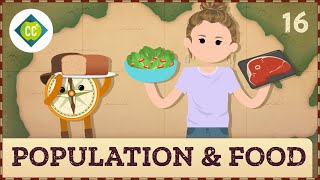
Population & Food: Crash Course Geography #16
video description
Date: 2022-04-04
Related videos



Comments and reviews: 10
Lusitanu
Sorry for my bad english in advance.
I agree with most of what is talked about on this video but, the idea that, for example, eating grain/flour has the same -energy- as meat is just ridiculous. Lets say it takes 30Kg of cereal to make 1Kg of meat. Sure i could just eat the cereal, but the amout of cereal i would need to consume in order to have the same -energetic- value as the meat would be far superior to what a normal human stomach can handle. I love cereal, for real, and vegetarianism is wonderful, it can have great benifits for the health of some people and the planet. But you cant get the nutricional value, the minerals, the iron and the fats that we need. Futhermor, currently, 90-95 percent of domestic cow feed is made up of cereals that humans cannot consume.
We need to change our eating habbits but taking meat out of peoples diet can be costly long term in health problems and mal nutricion expecialy in poorer countries.
reply
Sorry for my bad english in advance.
I agree with most of what is talked about on this video but, the idea that, for example, eating grain/flour has the same -energy- as meat is just ridiculous. Lets say it takes 30Kg of cereal to make 1Kg of meat. Sure i could just eat the cereal, but the amout of cereal i would need to consume in order to have the same -energetic- value as the meat would be far superior to what a normal human stomach can handle. I love cereal, for real, and vegetarianism is wonderful, it can have great benifits for the health of some people and the planet. But you cant get the nutricional value, the minerals, the iron and the fats that we need. Futhermor, currently, 90-95 percent of domestic cow feed is made up of cereals that humans cannot consume.
We need to change our eating habbits but taking meat out of peoples diet can be costly long term in health problems and mal nutricion expecialy in poorer countries.
reply
Noa
I think this video is a little bit misleading. Don't get me wrong, I wholefuly believe that the current state of food consumption and the imense over-population world wide is a gigantic clusterf---, nevertheless the information here is misleading. For example, it's not completely true to say that a certain amount of grain can feed one person eating a cow or a few people eating the grain itself, because cows can digest food that people just can't! Biologically, cows can eat grass (which humans can't digest) and also the shells or casings of the grains that we eat. In factories that make corn/wheat/barley ready for human consumption, the put all the -humanly undigestable bi-products- in separate piles and sell them to farms to feed the cattle (or pigs or whatever. The cows don't get the human food, that other humans could have eaten, it gets our unwanted food. So in a sense, it's more ecologically to feed cows and humans from the same fields.
reply
I think this video is a little bit misleading. Don't get me wrong, I wholefuly believe that the current state of food consumption and the imense over-population world wide is a gigantic clusterf---, nevertheless the information here is misleading. For example, it's not completely true to say that a certain amount of grain can feed one person eating a cow or a few people eating the grain itself, because cows can digest food that people just can't! Biologically, cows can eat grass (which humans can't digest) and also the shells or casings of the grains that we eat. In factories that make corn/wheat/barley ready for human consumption, the put all the -humanly undigestable bi-products- in separate piles and sell them to farms to feed the cattle (or pigs or whatever. The cows don't get the human food, that other humans could have eaten, it gets our unwanted food. So in a sense, it's more ecologically to feed cows and humans from the same fields.
reply
Christoph
Please look up energy use in your own country to learn how you can reduce impact. Transportation and Households remain a huge part of the pie here in Canada. Even with Canada being a food exporter it's agriculture industry uses far less energy than either transportation, households (heating larger factor in Canada, or manufacturing on their own. Use less, buy local, and different regions are suited to grow different foods. The more suited the area is to produce a food, the less inputs/energy has to be used to grow that food etc. Also every internet posting about the subject seems to forget to mention that food production has become far more efficient with industrialization, economic pressure, education and lately technology. Less water used, less inputs used etc, there is a positive side to the story also.
reply
Please look up energy use in your own country to learn how you can reduce impact. Transportation and Households remain a huge part of the pie here in Canada. Even with Canada being a food exporter it's agriculture industry uses far less energy than either transportation, households (heating larger factor in Canada, or manufacturing on their own. Use less, buy local, and different regions are suited to grow different foods. The more suited the area is to produce a food, the less inputs/energy has to be used to grow that food etc. Also every internet posting about the subject seems to forget to mention that food production has become far more efficient with industrialization, economic pressure, education and lately technology. Less water used, less inputs used etc, there is a positive side to the story also.
reply
crash_course
The biggest contribution you can make is to CHOOSE to have fewer children.
Then, it's all the other things. But they're tiny by comparison. They only slow our demise. Lowering our population is not optional. It's the one compulsory act. As a human has a set of minimum amounts of resources, water, food, it needs to just survive.
If we choose to have less than 2. 1 kids, the world's population will shrink, and quicker than you think. Then we'll be able to enjoy having more things, eating more of what we like.
If we let the population keep growing, then we won't be able to enjoy as many of the things, eating what we want, and an increasing raft of other sacrifices, that won't be nice.
CHOOSE to have fewer kids. And do as much of the other things too.
reply
The biggest contribution you can make is to CHOOSE to have fewer children.
Then, it's all the other things. But they're tiny by comparison. They only slow our demise. Lowering our population is not optional. It's the one compulsory act. As a human has a set of minimum amounts of resources, water, food, it needs to just survive.
If we choose to have less than 2. 1 kids, the world's population will shrink, and quicker than you think. Then we'll be able to enjoy having more things, eating more of what we like.
If we let the population keep growing, then we won't be able to enjoy as many of the things, eating what we want, and an increasing raft of other sacrifices, that won't be nice.
CHOOSE to have fewer kids. And do as much of the other things too.
reply
Tom-s
I think this is not correct, but what do I know. Research the next idea. The best way to grow the planets carrying capacity is by lifting people out of poverty. One way to do this is by making use of globalization. If I in the US buy the cheapest food it will surly come from a developing country were the work force is cheaper. By doing this I help them get out of poverty and they help themselves live better (that includes caring for the planet): )
reply
I think this is not correct, but what do I know. Research the next idea. The best way to grow the planets carrying capacity is by lifting people out of poverty. One way to do this is by making use of globalization. If I in the US buy the cheapest food it will surly come from a developing country were the work force is cheaper. By doing this I help them get out of poverty and they help themselves live better (that includes caring for the planet): )
reply
John
Sustainability isn't possible with our current population. We already use more resources than the earth can provide. This expectation that we'll just engineer our way out of the problem is folly, rather than admit the obvious fact that we can't expect endless returns from a finite resource. We'll hit the limit one day and the cascade of earths ecosystems will fail and we'll fight over the scraps.
reply
Sustainability isn't possible with our current population. We already use more resources than the earth can provide. This expectation that we'll just engineer our way out of the problem is folly, rather than admit the obvious fact that we can't expect endless returns from a finite resource. We'll hit the limit one day and the cascade of earths ecosystems will fail and we'll fight over the scraps.
reply
michaos1
On the other hand there-re people, businesses, taxes, and workplaces that exist thanks to people-s consumption of meat. Transition includes many and many different steps and areas, not a simple equation like 1 meat eater equals 22 natural crop eaters. There-ll be a few generations before people change their eating behaviors, because people don-t change, they adapt.
reply
On the other hand there-re people, businesses, taxes, and workplaces that exist thanks to people-s consumption of meat. Transition includes many and many different steps and areas, not a simple equation like 1 meat eater equals 22 natural crop eaters. There-ll be a few generations before people change their eating behaviors, because people don-t change, they adapt.
reply
dougalsii
Despite more people going vegan/vegetarian than ever, meat and dairy are subsidized to the point that not purchasing these products does not have the supply & demand effect people expect would influence animal industries to lower production. In the larger scheme of things, systemic policy issues are just as important if not more than individual consumer choices.
reply
Despite more people going vegan/vegetarian than ever, meat and dairy are subsidized to the point that not purchasing these products does not have the supply & demand effect people expect would influence animal industries to lower production. In the larger scheme of things, systemic policy issues are just as important if not more than individual consumer choices.
reply
Martin
We are already producing enough food for everyone (and more. However, a lot of it gets thrown out: 1) at the production site because the food -doesn't look good enough for the customers-; 2) during transportation; 3) during processing; 4) at shops/restaurants/markets because lowering the price or giving it away is unacceptable for a capitalist society.
reply
We are already producing enough food for everyone (and more. However, a lot of it gets thrown out: 1) at the production site because the food -doesn't look good enough for the customers-; 2) during transportation; 3) during processing; 4) at shops/restaurants/markets because lowering the price or giving it away is unacceptable for a capitalist society.
reply
josh
Not usually this guy, but IMO you definitely should-ve had a carve out to how like straight up evil factory farming is. This would have been the place to do it. That-s not unreasonable; you guys also take time to talk about indigenous land, or in cc philosophy Hank made a point to criticize certain philosophical systems if they had bad consequences.
reply
Not usually this guy, but IMO you definitely should-ve had a carve out to how like straight up evil factory farming is. This would have been the place to do it. That-s not unreasonable; you guys also take time to talk about indigenous land, or in cc philosophy Hank made a point to criticize certain philosophical systems if they had bad consequences.
reply
Add a review, comment
Other channel videos