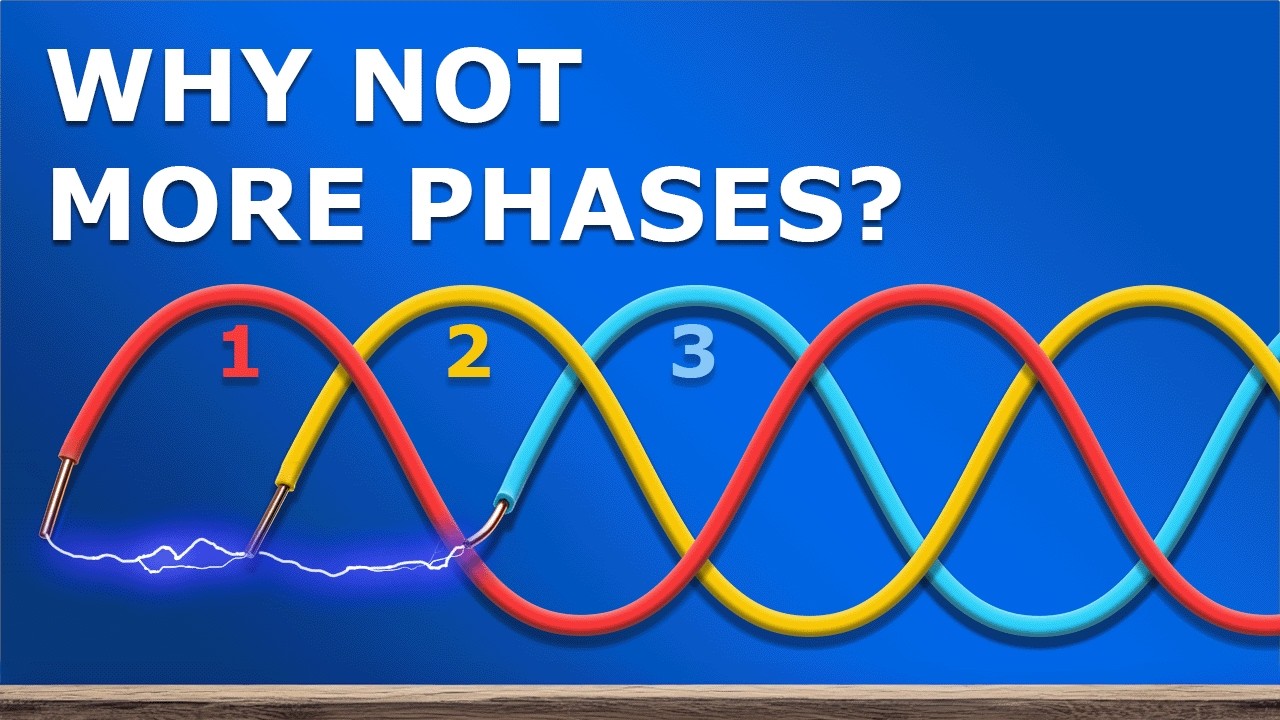
How 3 Phase Power works: why 3 phases
video description
Date: 2024-09-04
Related videos


• TED-Ed




Comments and reviews: 17
paradiselost9946
1: 12. i like the scope graph.
it IS NOT A SINE WAVE.
lot of people have this assumption that a sine wave is produced automatically by a magnet passing a wire. it isnt. its actually quite hard to make a pure sine wave.
please, DO NOT PERPETUATE THE MISCONCEPTIONS.
they have no idea about things like pole shaping, pole arc, and pole pitch.
a major challenge with large generators that are intended to produce sinusoidal outputs. any non sinusoidal waveform is a harmonic, and those harmonics wreak havoc on transmission lines, and devices attached. and the devices themselves also play a large role in the waveform produced.
anyone familiar with audio may have heard of rectifier buzz. a diode starts conducting at 0. 7v for a silicon based type. that means until the voltage reaches 0. 7v, there is NO conduction. and then the diode clamps that voltage to 0. 7, or thereabouts. (the diode in a microwave oven is more like 14v)
then there is a pulse of current as they start conducting. this produces a spiky harmonic on the power line, and any nearby conductors. its also why vacuum (or gas filled) state rectifiers produce a certain tone versus solid state rectifiers. they have a high conduction voltage, and that voltage varies drastically depending upon current flow. they dont clamp as well as the solid state devices do.
and depending on the filter circuits, there can be a heavy current flow as capacitors start charging, or no flow as theyre already charged. in this regard it can be rather confusing, as the voltage across that diode is based on the actual device its charging, or not charging, as its the current flow through its resistance that creates that voltage potential across it. it isnt simply the voltage delivered by the generator.
if you scoped the output with the diodes in circuit, it would show a VERY distorted sinewave, versus the clip with it loaded only by the scopes input impedance. that is in the order of several megohm.
the LEDs will not conduct until the forward voltage is exceeded, then they will clamp the voltage to that level as the current increases. being a very low power generator, they can easily deal with the current x forward voltage=watts. duty cycle also helps. can always pulse far more power through an LED than it would tolerate continuously.
the LOAD is just as important as the SOURCE.
3 phase power has other harmonic related issues when one or two phases are unbalanced.
this is what i hate about YT. either everythings seemingly targeted towards preschoolers, or university professors, and all the middle ground is lost.
to talk electricity, one should be conversant with all aspects of it.
as a tutorial for little kids, this is marginally acceptable. but it also causes confusion later on if they start delving into the topic, as you have simply caused misconceptions.
yet theres also no need for heavy or complex mathematical equations, algebra, etc.
its a bit like the idea of the coulomb. this one messes with peoples heads as they have this misconception that its all about volts and amps or watts, and big fat equations. they never draw the analogy between how a litre of water can be held in containers of various dimensions. so when the question arises what is CHARGE, they get confused.
for anyone that made it this far. you can have a litre of water in a large wide dish. it has very little pressure, whereas if you put that litre of water into a very thin vertical tube, the pressure can build so high that it bursts the bottom of the tube. yet, in both cases, the charge or VOLUME is the same. 1 litre of water.
you can put a quantity of charge upon a large surface, and it will be low voltage. or you can push it onto a pin point, and the voltage builds so high it punches through the otherwise insulating air around it.
see no maths involved, no jargon, just an easily understood analogy.
reply
1: 12. i like the scope graph.
it IS NOT A SINE WAVE.
lot of people have this assumption that a sine wave is produced automatically by a magnet passing a wire. it isnt. its actually quite hard to make a pure sine wave.
please, DO NOT PERPETUATE THE MISCONCEPTIONS.
they have no idea about things like pole shaping, pole arc, and pole pitch.
a major challenge with large generators that are intended to produce sinusoidal outputs. any non sinusoidal waveform is a harmonic, and those harmonics wreak havoc on transmission lines, and devices attached. and the devices themselves also play a large role in the waveform produced.
anyone familiar with audio may have heard of rectifier buzz. a diode starts conducting at 0. 7v for a silicon based type. that means until the voltage reaches 0. 7v, there is NO conduction. and then the diode clamps that voltage to 0. 7, or thereabouts. (the diode in a microwave oven is more like 14v)
then there is a pulse of current as they start conducting. this produces a spiky harmonic on the power line, and any nearby conductors. its also why vacuum (or gas filled) state rectifiers produce a certain tone versus solid state rectifiers. they have a high conduction voltage, and that voltage varies drastically depending upon current flow. they dont clamp as well as the solid state devices do.
and depending on the filter circuits, there can be a heavy current flow as capacitors start charging, or no flow as theyre already charged. in this regard it can be rather confusing, as the voltage across that diode is based on the actual device its charging, or not charging, as its the current flow through its resistance that creates that voltage potential across it. it isnt simply the voltage delivered by the generator.
if you scoped the output with the diodes in circuit, it would show a VERY distorted sinewave, versus the clip with it loaded only by the scopes input impedance. that is in the order of several megohm.
the LEDs will not conduct until the forward voltage is exceeded, then they will clamp the voltage to that level as the current increases. being a very low power generator, they can easily deal with the current x forward voltage=watts. duty cycle also helps. can always pulse far more power through an LED than it would tolerate continuously.
the LOAD is just as important as the SOURCE.
3 phase power has other harmonic related issues when one or two phases are unbalanced.
this is what i hate about YT. either everythings seemingly targeted towards preschoolers, or university professors, and all the middle ground is lost.
to talk electricity, one should be conversant with all aspects of it.
as a tutorial for little kids, this is marginally acceptable. but it also causes confusion later on if they start delving into the topic, as you have simply caused misconceptions.
yet theres also no need for heavy or complex mathematical equations, algebra, etc.
its a bit like the idea of the coulomb. this one messes with peoples heads as they have this misconception that its all about volts and amps or watts, and big fat equations. they never draw the analogy between how a litre of water can be held in containers of various dimensions. so when the question arises what is CHARGE, they get confused.
for anyone that made it this far. you can have a litre of water in a large wide dish. it has very little pressure, whereas if you put that litre of water into a very thin vertical tube, the pressure can build so high that it bursts the bottom of the tube. yet, in both cases, the charge or VOLUME is the same. 1 litre of water.
you can put a quantity of charge upon a large surface, and it will be low voltage. or you can push it onto a pin point, and the voltage builds so high it punches through the otherwise insulating air around it.
see no maths involved, no jargon, just an easily understood analogy.
reply
Sparky-ww5re
You might add, sometimes a delta configuration does have a neutral, this provides what's often referred to as a high leg delta, and we get 3 different voltages off a three phase system, typically 120V between phase A and C to neutral, 208V between phase B and neutral, and 240V between any two phases. A much less common high leg delta provides 240 / 415 / 480 volts, and usually you'll come across this system in commercial and industrial settings where the majority of the loads are 3 phase motors and line to line single phase equipment, while also requiring 120V power for general purpose lighting and receptacle loads. It is usually no longer installed for a new system today, instead the power company will provide you with a wye system unless there is a very specific reason for wanting a delta.
Some farms and small commercial settings will have two transformers to provide a 120/240V 3 phase 4 wire open delta, when the customer has mostly single phase equipment while requiring limited 3 phase power for motor loads because it's a cheaper setup than a wye 120/208V which would require 3 transformers.
reply
You might add, sometimes a delta configuration does have a neutral, this provides what's often referred to as a high leg delta, and we get 3 different voltages off a three phase system, typically 120V between phase A and C to neutral, 208V between phase B and neutral, and 240V between any two phases. A much less common high leg delta provides 240 / 415 / 480 volts, and usually you'll come across this system in commercial and industrial settings where the majority of the loads are 3 phase motors and line to line single phase equipment, while also requiring 120V power for general purpose lighting and receptacle loads. It is usually no longer installed for a new system today, instead the power company will provide you with a wye system unless there is a very specific reason for wanting a delta.
Some farms and small commercial settings will have two transformers to provide a 120/240V 3 phase 4 wire open delta, when the customer has mostly single phase equipment while requiring limited 3 phase power for motor loads because it's a cheaper setup than a wye 120/208V which would require 3 transformers.
reply
evanchapmanfanman
(USA) delta can be used as a single phase source with what’s called high leg delta (120/240, the neutral is between the A and C phase. Phase A to neutral and phase C to neutral will show 120 volts however the B phase will show 208v in reference to neutral. All phase to phase connections will show 240 volts. This 208 volt quirk will be noticeable in high leg delta breaker panels as there will be no single phase breakers on any b phase bus bars. This method has since been phased out (no pun intended) in favor of the wye connection. Common names for the B phase are wild leg high leg bastard leg and stinger leg. A high leg delta installation can often be noticed by looking at the pole transformers, one of the 3 transformers will be almost twice the size of the other 2 due to having to handle all of the lighting and other single phase loads.
reply
(USA) delta can be used as a single phase source with what’s called high leg delta (120/240, the neutral is between the A and C phase. Phase A to neutral and phase C to neutral will show 120 volts however the B phase will show 208v in reference to neutral. All phase to phase connections will show 240 volts. This 208 volt quirk will be noticeable in high leg delta breaker panels as there will be no single phase breakers on any b phase bus bars. This method has since been phased out (no pun intended) in favor of the wye connection. Common names for the B phase are wild leg high leg bastard leg and stinger leg. A high leg delta installation can often be noticed by looking at the pole transformers, one of the 3 transformers will be almost twice the size of the other 2 due to having to handle all of the lighting and other single phase loads.
reply
jensschroder8214
If Tesla had not only theoretically patented the three-phase motor, but also built it, then he would have realized that he didn't need 6 cables for three-phase current.
At the same time, in Europe, Mikhail Dobrowolski is already working with 3 lines of three-phase current. For this he received the German patent.
Westinghouse obtained rights to both patents and then built with 3 lines, not with 6 lines like Tesla thought.
reply
If Tesla had not only theoretically patented the three-phase motor, but also built it, then he would have realized that he didn't need 6 cables for three-phase current.
At the same time, in Europe, Mikhail Dobrowolski is already working with 3 lines of three-phase current. For this he received the German patent.
Westinghouse obtained rights to both patents and then built with 3 lines, not with 6 lines like Tesla thought.
reply
1kreature
. so the voltage will be very high. We can't use this to power our outlets because it will just destroy our appliances.
Assuming we are in certain parts of the world that chose to waste money on the extra neutral.
Lower voltage means thicker cables to deliver same power. I for one love my 32 amp, 230v options allowing me to pull 7. 4 kW to charge my car without going too overboard with cable dimensions.
reply
. so the voltage will be very high. We can't use this to power our outlets because it will just destroy our appliances.
Assuming we are in certain parts of the world that chose to waste money on the extra neutral.
Lower voltage means thicker cables to deliver same power. I for one love my 32 amp, 230v options allowing me to pull 7. 4 kW to charge my car without going too overboard with cable dimensions.
reply
engineering_mindset
When you have 3-phase AC and want DC, why not use a circuit that takes advantage of the higher frequency of peaks _plus_ bridging _plus capacitance to make it even more smooth than a linear single-phase bridger would do And wouldn't that have the potential to be even smoother and less noisy than a high-frequency switching power supply
reply
When you have 3-phase AC and want DC, why not use a circuit that takes advantage of the higher frequency of peaks _plus_ bridging _plus capacitance to make it even more smooth than a linear single-phase bridger would do And wouldn't that have the potential to be even smoother and less noisy than a high-frequency switching power supply
reply
johnbill739
One thing I'd love to know is in relation to the transmission lines. I see them massive pylons carrying multiple cables. Is each cable a single phase Also I think the rpm of the generator needs to be in phase with the grid. Something like 3000hz but how does it increase power output and keep the same rotation
reply
One thing I'd love to know is in relation to the transmission lines. I see them massive pylons carrying multiple cables. Is each cable a single phase Also I think the rpm of the generator needs to be in phase with the grid. Something like 3000hz but how does it increase power output and keep the same rotation
reply
davidmorton8170
contrary to what the video says, many cheap LED lights DO flicker, because 1) they don't full bridge rectify, leaving a 30 hz flicker, ew. or 2) don't use capacitors to smooth the rectification, and so when the current passes 0V the LED goes out briefly.
reply
contrary to what the video says, many cheap LED lights DO flicker, because 1) they don't full bridge rectify, leaving a 30 hz flicker, ew. or 2) don't use capacitors to smooth the rectification, and so when the current passes 0V the LED goes out briefly.
reply
TheColinputer
3: 35 I cant say I ever really noticed old school incandescent lamps flickering. But especially with some of the early generations of LED lamps and cheaper ones on the market i can notice they flicker.
reply
3: 35 I cant say I ever really noticed old school incandescent lamps flickering. But especially with some of the early generations of LED lamps and cheaper ones on the market i can notice they flicker.
reply
mernokimuvek
It's also important in distribution that in European countries a transformer can feed tens of houses, sometimes hundreds, multiple streets and the secondary side is also fused unlike in North America.
reply
It's also important in distribution that in European countries a transformer can feed tens of houses, sometimes hundreds, multiple streets and the secondary side is also fused unlike in North America.
reply
djwilliamworldwide
This is a very good video. But there is more to 3 phase electricity discovered by Nicola Tesla. Had I had nessesary material I'll have explain. Energy is free but not necessarily free
reply
This is a very good video. But there is more to 3 phase electricity discovered by Nicola Tesla. Had I had nessesary material I'll have explain. Energy is free but not necessarily free
reply
Mladjasmilic
In Yugoslavia we have domestic 3 phase sockets, capable up to 9kW (11kW short term.
Used for large space heaters, welders, stoves, 3 phase motors. Now even for 3 phase EV chargers.
reply
In Yugoslavia we have domestic 3 phase sockets, capable up to 9kW (11kW short term.
Used for large space heaters, welders, stoves, 3 phase motors. Now even for 3 phase EV chargers.
reply
Primitarian
Thank you, I am not an electrician, but I always wondered what on earth they were talking about with three phase. This is one of the clearest explanations I have seen!
reply
Thank you, I am not an electrician, but I always wondered what on earth they were talking about with three phase. This is one of the clearest explanations I have seen!
reply
engineering_mindset
Why 3 Is because is a reasonable number, could have been anything, but less than 3 makes motors lose power during the deeps, more phases is just too much.
reply
Why 3 Is because is a reasonable number, could have been anything, but less than 3 makes motors lose power during the deeps, more phases is just too much.
reply
AussieWalkthroughs
yo, I am seriously offended! Where is my country We have 240V/1A 50Hz (points for guessing where I'm from mates) how could you bloody do this to us!
reply
yo, I am seriously offended! Where is my country We have 240V/1A 50Hz (points for guessing where I'm from mates) how could you bloody do this to us!
reply
stratfanstl
Another EE here. This is a phenomenally well crafted visualization of the physics of AC power generation and distribution. Well done.
reply
Another EE here. This is a phenomenally well crafted visualization of the physics of AC power generation and distribution. Well done.
reply
Spessforce
Your videos are a great help to army soldiers who are trying to understand the principles on how our generator equipment works!
reply
Your videos are a great help to army soldiers who are trying to understand the principles on how our generator equipment works!
reply
Add a review, comment
Other channel videos