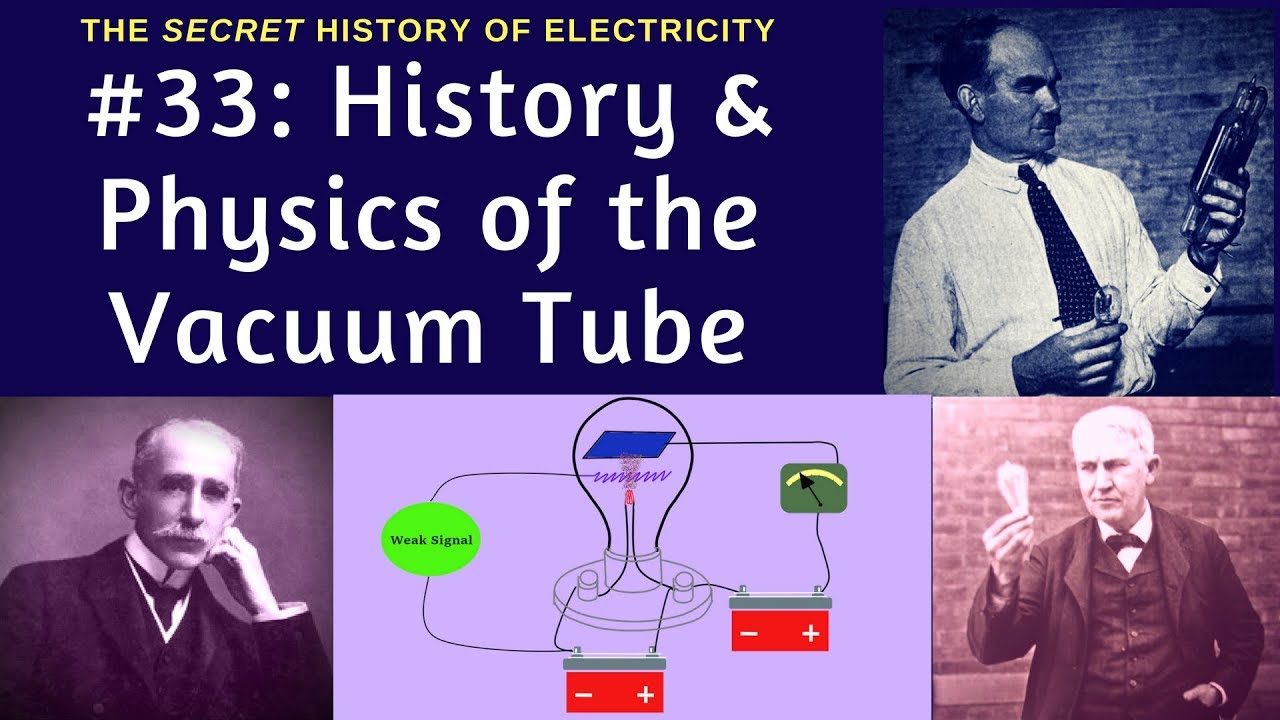
Triode Vacuum Tube: History & Physics
video description
Date: 2022-12-27
Related videos



Comments and reviews: 20
Frederick
I am finding these videos fascinating. My 1st bout with radio was in 1943 (7YO) strung a wire from a metal thingie on top of a tube in the old Zenith (Thank goodness it was a grid not a plate LOLOL) and I made static which interfered with the war news. I got paddled.
Greatest treasure I ever discovered accidentally was The Boys Book of Radio in the school library, 5th grade 1946. I didnt know much about condensers or Impadence or why you had to wind so many turns of wire around a Quakers Oat box but I did get a crystal set to work sorta. That book taught me the color codes and I bummed a bunch of 1930's junk radios from a local repair shop, only got a one 27 tuber to work for B. Scouts 1949. 1952, built a Radio Shack Knight kit 2 1S5's, SHORT WAVE - THE WORLD, SOLD ME! and radio/electronics became a career that lasted all the way thru the Navy as a CTM and eventually on into computers to my retirement in 1994. BTW I hate solid state
An old man reminiscing. Sorry.
reply
I am finding these videos fascinating. My 1st bout with radio was in 1943 (7YO) strung a wire from a metal thingie on top of a tube in the old Zenith (Thank goodness it was a grid not a plate LOLOL) and I made static which interfered with the war news. I got paddled.
Greatest treasure I ever discovered accidentally was The Boys Book of Radio in the school library, 5th grade 1946. I didnt know much about condensers or Impadence or why you had to wind so many turns of wire around a Quakers Oat box but I did get a crystal set to work sorta. That book taught me the color codes and I bummed a bunch of 1930's junk radios from a local repair shop, only got a one 27 tuber to work for B. Scouts 1949. 1952, built a Radio Shack Knight kit 2 1S5's, SHORT WAVE - THE WORLD, SOLD ME! and radio/electronics became a career that lasted all the way thru the Navy as a CTM and eventually on into computers to my retirement in 1994. BTW I hate solid state
An old man reminiscing. Sorry.
reply
Juan
I do not know too much about it but l think that Deforest knew that his triode was an electronic amplifier and used it without feedback to design primitive radios receiver and transmitters. In fact such radio circuits were taught in high school physics, many years ago, because they are relatively easy to understand. Armstrong discovered the way of making electronic oscillators with the triode by using a feedback circuit. Armstrong used it to create the regenerative and super regenerative radios which outperformed the primitive Deforest radio. Armstrong circuits were a long way more complex and unstable than Deforest primitive circuits. Armstrong's oscillator is the key component of the superheterodyne radio, the most successful radio design. Armstrong became rich with it.
reply
I do not know too much about it but l think that Deforest knew that his triode was an electronic amplifier and used it without feedback to design primitive radios receiver and transmitters. In fact such radio circuits were taught in high school physics, many years ago, because they are relatively easy to understand. Armstrong discovered the way of making electronic oscillators with the triode by using a feedback circuit. Armstrong used it to create the regenerative and super regenerative radios which outperformed the primitive Deforest radio. Armstrong circuits were a long way more complex and unstable than Deforest primitive circuits. Armstrong's oscillator is the key component of the superheterodyne radio, the most successful radio design. Armstrong became rich with it.
reply
Dr.
First, let me say that I like your videos; I find them interesting and very well supported. However, I don't think it's fair the way you speak of Lee De Forest. He invented the triode, and yes, that grid between the filament and the plate made a huge difference. That was a great invention that changed the world of electronics. You may dislike him because he was in several disputes about other patents, but the way I see it, Lee De Forest came to this world to invent the vacuum tube triode and we should be grateful for that achievement. It was not just a minor modification of the Fleming valve. Best regards.
reply
First, let me say that I like your videos; I find them interesting and very well supported. However, I don't think it's fair the way you speak of Lee De Forest. He invented the triode, and yes, that grid between the filament and the plate made a huge difference. That was a great invention that changed the world of electronics. You may dislike him because he was in several disputes about other patents, but the way I see it, Lee De Forest came to this world to invent the vacuum tube triode and we should be grateful for that achievement. It was not just a minor modification of the Fleming valve. Best regards.
reply
ecbftl
Thanks, this was a very interesting history. I was familiar with the names of the inventors, but the relationships and timeline of the early development was interesting.
Some years ago I worked at the Canadian Marconi Company in Montreal, and found in the company library some of the early engineering journals from about 1909 describing Tube circuits. I had studied Tubes in my high school electronics courses, so finding the journals was fascinating. I think a lot of these historical documents have been donated to the Marconi National Historic Site at Glace Bay, NS in Canada.
reply
Thanks, this was a very interesting history. I was familiar with the names of the inventors, but the relationships and timeline of the early development was interesting.
Some years ago I worked at the Canadian Marconi Company in Montreal, and found in the company library some of the early engineering journals from about 1909 describing Tube circuits. I had studied Tubes in my high school electronics courses, so finding the journals was fascinating. I think a lot of these historical documents have been donated to the Marconi National Historic Site at Glace Bay, NS in Canada.
reply
Grard
Kathy this video shows greatly that the vacuum tubes ( amp ) were not the invention of one man but men taking the knowledge of each others to create the electronic era, we're still in this era, me texting this with my smartphone is something from SciFi a few years ago. Electrical devices and everything that surrounds it won't be going soon. The vacuum tube with the plate the cathode and anode is the father of the transistor. I really like my tubes guitar amplifier. Thanks again for your excellent videos. And like many others here, I'm waiting eagerly for the next one. Thank you.
reply
Kathy this video shows greatly that the vacuum tubes ( amp ) were not the invention of one man but men taking the knowledge of each others to create the electronic era, we're still in this era, me texting this with my smartphone is something from SciFi a few years ago. Electrical devices and everything that surrounds it won't be going soon. The vacuum tube with the plate the cathode and anode is the father of the transistor. I really like my tubes guitar amplifier. Thanks again for your excellent videos. And like many others here, I'm waiting eagerly for the next one. Thank you.
reply
Mark
Still using them Building guitar amps. Currently building a clone of a 1938 Gibson amp which includes a field coil speaker! Taking about patents, us Brits had the pentode patent The Americans requires a licence to manufacture them, however as the Americans are not keen on paying the Brits ( nothing new here from what happened at Boston, they came up with the beam tetrode which essentially does the same job but the internal layout of the valve (tube in the US) is different, effectively bypassing the British pentode patent.
reply
Still using them Building guitar amps. Currently building a clone of a 1938 Gibson amp which includes a field coil speaker! Taking about patents, us Brits had the pentode patent The Americans requires a licence to manufacture them, however as the Americans are not keen on paying the Brits ( nothing new here from what happened at Boston, they came up with the beam tetrode which essentially does the same job but the internal layout of the valve (tube in the US) is different, effectively bypassing the British pentode patent.
reply
Sam
I'm looking forward to the stories that are not well known about EPR. People generally know from Einstein through Bell. But not many know about the communications between Einstein and Bohm when Bohm was writing his QM textbook or Bell's response to Bohm, or the history of experimental confirmation from Aspect up to present day. And almost nobody knows about Kochen, Specker, or Conway and their revised versions. Or the weird definition of free will used in that theorem.
Plus, Bell is just an interesting figure.
reply
I'm looking forward to the stories that are not well known about EPR. People generally know from Einstein through Bell. But not many know about the communications between Einstein and Bohm when Bohm was writing his QM textbook or Bell's response to Bohm, or the history of experimental confirmation from Aspect up to present day. And almost nobody knows about Kochen, Specker, or Conway and their revised versions. Or the weird definition of free will used in that theorem.
Plus, Bell is just an interesting figure.
reply
Chris
I love learning the history of things I worked on. I first learned about tubes in high school in the late 1960s. At 16yo I had an apprentice license for TV repair. I wasnt supposed to make house calls till 18 but the two men I worked for considered me qualified to do so. Imagine a 16 yo kids with a tube caddy and test equipment showing up at your house. I went into the Navy in 71 and they taught us both tubes and transistors. Weve come a long way since then.
reply
I love learning the history of things I worked on. I first learned about tubes in high school in the late 1960s. At 16yo I had an apprentice license for TV repair. I wasnt supposed to make house calls till 18 but the two men I worked for considered me qualified to do so. Imagine a 16 yo kids with a tube caddy and test equipment showing up at your house. I went into the Navy in 71 and they taught us both tubes and transistors. Weve come a long way since then.
reply
trespire
In multi kilowatt industrial lasers, we use vacuum tubes / triodes to switch 9 to 12 KV resonating at 80 Mhz, on and off to control the CO2 laser source. The tubes are from Thales, anode voltage is up to 12. 5 KV, grid is at -200V and switched at 60Khz. The tube is cooled with deionized water running through it, the ceramic insulation glows a bright orange when run at full power.
reply
In multi kilowatt industrial lasers, we use vacuum tubes / triodes to switch 9 to 12 KV resonating at 80 Mhz, on and off to control the CO2 laser source. The tubes are from Thales, anode voltage is up to 12. 5 KV, grid is at -200V and switched at 60Khz. The tube is cooled with deionized water running through it, the ceramic insulation glows a bright orange when run at full power.
reply
NotMarkKnopfler
Superb! Thank you for this brilliant historical summary. So interesting! I thought there was some science to the design of the vacuum tube - but it looks like (at least initially) it was random experimentation. Only later, when the engineers understood the physics taking place within the tube did the design lend itself to optimisation. Fascinating! Thank you, Kathy!
reply
Superb! Thank you for this brilliant historical summary. So interesting! I thought there was some science to the design of the vacuum tube - but it looks like (at least initially) it was random experimentation. Only later, when the engineers understood the physics taking place within the tube did the design lend itself to optimisation. Fascinating! Thank you, Kathy!
reply
dlkline27
Back in 1958 while at Scott AFB studying electronics, one subject was vacuum tubes and the elements thereof. One day the instructor started an impromptu verbal quiz by asking what a diode was, then a triode, etc. until he got to the heptode. We never heard of a heptode. After stumping everyone, the instructor stated, That's a real gone frog. Hep toad; get it?
reply
Back in 1958 while at Scott AFB studying electronics, one subject was vacuum tubes and the elements thereof. One day the instructor started an impromptu verbal quiz by asking what a diode was, then a triode, etc. until he got to the heptode. We never heard of a heptode. After stumping everyone, the instructor stated, That's a real gone frog. Hep toad; get it?
reply
Mike
07: 40 - An important point about grid voltage: valve circuits are designed so that the grid voltage is _never_ positive with respect to the cathode; significant grid current stops the circuit from working and can destroy the valve. Maximum current through the triode occurs when the grid is at the same potential as the cathode - it is like a depletion-mode FET.
reply
07: 40 - An important point about grid voltage: valve circuits are designed so that the grid voltage is _never_ positive with respect to the cathode; significant grid current stops the circuit from working and can destroy the valve. Maximum current through the triode occurs when the grid is at the same potential as the cathode - it is like a depletion-mode FET.
reply
Mohabat
Very interesting on how the vacuum tube came about and just like the atom theory and electricity, it was the work of several individuals spread over decades that brought it all together. But even today its amazing how they built devices like the radio, TV, radar etc. Kathy, are you a physicist, you have in depth knowledge of this science.
reply
Very interesting on how the vacuum tube came about and just like the atom theory and electricity, it was the work of several individuals spread over decades that brought it all together. But even today its amazing how they built devices like the radio, TV, radar etc. Kathy, are you a physicist, you have in depth knowledge of this science.
reply
Eddie
I have made a career in the fascinating field of electronics and work with SMD everyday and still love the vacuum tube. Even though I knew about the Thermionic effect and these smart experimenters, I didn't know about the smudge. Thank you for your interesting video because I learned about a detail I had never come across.
reply
I have made a career in the fascinating field of electronics and work with SMD everyday and still love the vacuum tube. Even though I knew about the Thermionic effect and these smart experimenters, I didn't know about the smudge. Thank you for your interesting video because I learned about a detail I had never come across.
reply
Andrew
When I was at college we briefly learnt about Valves and those old fashioned in the UK and Europe Pre-SI units used to specify them. That was in about 1975-77, otherwise, transistor, inductors, capacitor stuff was all SI units. I made a few things with valves that I could get to work more easily than transistor circuits.
reply
When I was at college we briefly learnt about Valves and those old fashioned in the UK and Europe Pre-SI units used to specify them. That was in about 1975-77, otherwise, transistor, inductors, capacitor stuff was all SI units. I made a few things with valves that I could get to work more easily than transistor circuits.
reply
Joseph
QUESTION? Do you ever have any upbeat videos where you actually compliment the work of someone, rather than undermine as it appears you so often do? Some of your videos are so depressing you might ponder including a suicide hotline number at the end of them! Best of luck and it certainly appears you know your stuff!
reply
QUESTION? Do you ever have any upbeat videos where you actually compliment the work of someone, rather than undermine as it appears you so often do? Some of your videos are so depressing you might ponder including a suicide hotline number at the end of them! Best of luck and it certainly appears you know your stuff!
reply
Robert
I give you the coveted triple wow (never before given) - wow, wow, wow, wow! A crisp precise and excellent description of electronic amplification melded with intrigue including plotting con-men, whats not to like! Shows how luck favors the prepared mind, you madam are an explainer extraordinaire!
reply
I give you the coveted triple wow (never before given) - wow, wow, wow, wow! A crisp precise and excellent description of electronic amplification melded with intrigue including plotting con-men, whats not to like! Shows how luck favors the prepared mind, you madam are an explainer extraordinaire!
reply
Gnarf
Congratulations, great video. When you say Edison noticed when the light bulb broke, there is the sound of glass shattering in the audio. This is misleading, it implies the glass broke, when in fact the glass does not break, it is the filament that breaks. Just a bit confusing.
reply
Congratulations, great video. When you say Edison noticed when the light bulb broke, there is the sound of glass shattering in the audio. This is misleading, it implies the glass broke, when in fact the glass does not break, it is the filament that breaks. Just a bit confusing.
reply
Peter
From France. Incredible how good is your very clear explanation. it s a real pleasure to find out how the all thing works. With You every thing seem so simple. From a admirateur. I will be there quite often listening with attention your next presentation. Lot of thanks. Peter
reply
From France. Incredible how good is your very clear explanation. it s a real pleasure to find out how the all thing works. With You every thing seem so simple. From a admirateur. I will be there quite often listening with attention your next presentation. Lot of thanks. Peter
reply
Sean
Edwin Howard Armstrong was my childhood hero, and is still to this day! Thank you for bringing this all back into a public forum, as this is such important history of early electronics, and the geniuses who made it work, and the charlatans who rode on their coattails.
reply
Edwin Howard Armstrong was my childhood hero, and is still to this day! Thank you for bringing this all back into a public forum, as this is such important history of early electronics, and the geniuses who made it work, and the charlatans who rode on their coattails.
reply
Add a review, comment
Other channel videos