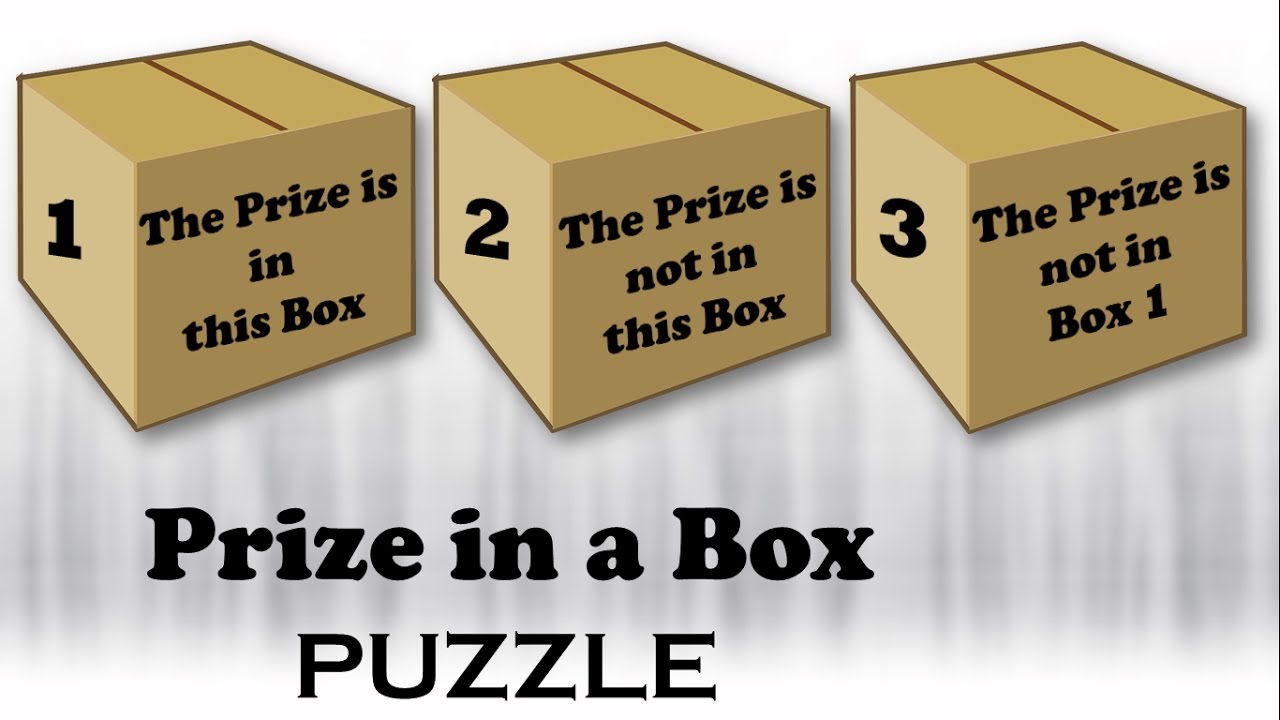
Can you solve -Prize in a Box PUZZLE- Only 37% of people can solve
video description
I admit I got this one wrong, having guessed box 1. but I associate my mistake with the inherent NLP in the question.
Only ONE has a prize
Only ONE is true
ONE. ONE. ONE.
I'm not saying that it's not a compelling logic puzzle, I'm pointing out that the major reason this puzzle felt inherently misleading is because of the way it was presented, suggesting the trick was in the wording.
I can't help it be dejected as I should know better than that, as Ammar's puzzles as far as I observed tend to prioritize what's called -System 2- thinking requiring mathematics, analytic thinking, etcthe like, as opposed to attention to detail puzzles. I got it wrong through a human fallacy, but that's a cold comfort.
Nevertheless, thank you Ammar for the brain teaser! I'll try to approach these puzzles more carefully going forward.
Date: 2023-11-15
Related videos





Comments and reviews: 27
Daren
At 37 seconds
I think the answer has to be number one, because the other two boxes are caught in a lie.
If only one box can be right, it can't be boxes number two or number three because they have multiple outs
Only one box has a true statement
And that box is number one
the number 3 box says the price is not in number one, which means it could be in number two, or number three, but also means that if it is lying, it could still be in number one, number two, or number three
And with box number two.
There is multiple outs
But if the box is lying.
Then it could be in any of the three boxes.
So it comes down to which box can only be true always
Assuming that two are not correct
And the answer is number one, at least I see at
reply
At 37 seconds
I think the answer has to be number one, because the other two boxes are caught in a lie.
If only one box can be right, it can't be boxes number two or number three because they have multiple outs
Only one box has a true statement
And that box is number one
the number 3 box says the price is not in number one, which means it could be in number two, or number three, but also means that if it is lying, it could still be in number one, number two, or number three
And with box number two.
There is multiple outs
But if the box is lying.
Then it could be in any of the three boxes.
So it comes down to which box can only be true always
Assuming that two are not correct
And the answer is number one, at least I see at
reply
Rafael
Do we really need up to 3 cases?
I only need to prove whether the prize in is box 1, and that's it. Assume the prize is in box 1. That would mean statement 1 and statement 2 are both true, and this is wrong, since we can have only one true statement.
Therefore, the prize is not in box 1, and therefore statement 3 is correct. We can only have one true statement, so statement 3 must be it.
That means statements 1 and 2 are both false. Statement 2 being false means the prize is in box 2. Done.
reply
Do we really need up to 3 cases?
I only need to prove whether the prize in is box 1, and that's it. Assume the prize is in box 1. That would mean statement 1 and statement 2 are both true, and this is wrong, since we can have only one true statement.
Therefore, the prize is not in box 1, and therefore statement 3 is correct. We can only have one true statement, so statement 3 must be it.
That means statements 1 and 2 are both false. Statement 2 being false means the prize is in box 2. Done.
reply
Chirag
But my answer is as below which also gives the prize in box 2:
Open box1: if it has the prize than ok but if it does not has the prize than box 1 is a liar and accordingly box 3 is saying true which means that box 2 is a liar. But according to the condition only 1 statement is right which means that if box 1 is liar and box 3 is true than box 2 is a liar which says that: it does not have the prize and as a result it has the prize.
reply
But my answer is as below which also gives the prize in box 2:
Open box1: if it has the prize than ok but if it does not has the prize than box 1 is a liar and accordingly box 3 is saying true which means that box 2 is a liar. But according to the condition only 1 statement is right which means that if box 1 is liar and box 3 is true than box 2 is a liar which says that: it does not have the prize and as a result it has the prize.
reply
Andrew
The method used in the video is a good general approach for this type of problem, but, in this case, there's a much simpler solution.
Statement 3 is the exact opposite of statement 1, therefore one of them must be true and the other must be false. But we are told that there is only one true statement, therefore statement 2 must be false, therefore the prize is in box 2. QED
reply
The method used in the video is a good general approach for this type of problem, but, in this case, there's a much simpler solution.
Statement 3 is the exact opposite of statement 1, therefore one of them must be true and the other must be false. But we are told that there is only one true statement, therefore statement 2 must be false, therefore the prize is in box 2. QED
reply
mpeterll
The title could be misleading.
If only 37% of people got it right, then only about 4% actually worked it out since one would expect about 33% to get it right purely by guessing.
If on the other hand, 37% actually solved it, this means that about 63% guessed, of which 21% would guess correctly so 58% should have answered correctly.
I wonder what he meant.
reply
The title could be misleading.
If only 37% of people got it right, then only about 4% actually worked it out since one would expect about 33% to get it right purely by guessing.
If on the other hand, 37% actually solved it, this means that about 63% guessed, of which 21% would guess correctly so 58% should have answered correctly.
I wonder what he meant.
reply
MrMousley
If the prize is in box 1. then statements 1 and 2 are true. and statement 3 is false
If the prize is in box 2. then statement 3 is true. and statements 1 and 2 are false
If the prize is in box 3. then statements 2 and 3 are true. and statement 1 is false
So the prize is in box 2. and now I'll watch your video to see if I'm right -
reply
If the prize is in box 1. then statements 1 and 2 are true. and statement 3 is false
If the prize is in box 2. then statement 3 is true. and statements 1 and 2 are false
If the prize is in box 3. then statements 2 and 3 are true. and statement 1 is false
So the prize is in box 2. and now I'll watch your video to see if I'm right -
reply
medexamtoolsdotcom
Why would only 37% know this? I knew IMMEDIATELY it was in box 2. As SOON as you said one and only one statement was true I just knew -2-. There are only 3 cases anyway, it's hardly going to take until the end of the universe to brute force check all possibilities. 2 of the statements are true if it's anything other than box 2.
reply
Why would only 37% know this? I knew IMMEDIATELY it was in box 2. As SOON as you said one and only one statement was true I just knew -2-. There are only 3 cases anyway, it's hardly going to take until the end of the universe to brute force check all possibilities. 2 of the statements are true if it's anything other than box 2.
reply
Sampath
This puzzle can also be analysed by considering each statement as true, and see weather the other two statements hold good by assuming them to be opposite to what it posses.
But your solution is more clear and makes more sense, as u considered the given information perfectly!
reply
This puzzle can also be analysed by considering each statement as true, and see weather the other two statements hold good by assuming them to be opposite to what it posses.
But your solution is more clear and makes more sense, as u considered the given information perfectly!
reply
Terry
Box 2? :
Box 1 statement is false, the prize is not in box 1.
Box 2 statement is false, the prize is in box 2.
Box 3 statement is true, the prize is not in box 1.
To me, the false false of of the Box 2 statement was quite confusing.
Stay well and enjoy!
reply
Box 2? :
Box 1 statement is false, the prize is not in box 1.
Box 2 statement is false, the prize is in box 2.
Box 3 statement is true, the prize is not in box 1.
To me, the false false of of the Box 2 statement was quite confusing.
Stay well and enjoy!
reply
---------
I think box 3 has the true statement label and prize is in the second box by process of elimination. Choose one box and assume it has the true statement and remaining 2 has false labels. By elimination, only box 3 seems to have the correct label
reply
I think box 3 has the true statement label and prize is in the second box by process of elimination. Choose one box and assume it has the true statement and remaining 2 has false labels. By elimination, only box 3 seems to have the correct label
reply
Abhirampore
Box 1 and 3 shows two different statements. So only one has to be true. If we consider that Box 1 is true, then Box 2 also becomes true. So Box 3 carries the right statement. So the prize is not in box 1 but in box 2
reply
Box 1 and 3 shows two different statements. So only one has to be true. If we consider that Box 1 is true, then Box 2 also becomes true. So Box 3 carries the right statement. So the prize is not in box 1 but in box 2
reply
TheDigiWorld
An alternate solution can be to consider 3 cases, where in case 1 the prize is in box 1. then you analyze the statements. After repeating this process 2 more times, you get to the same results as in the video
reply
An alternate solution can be to consider 3 cases, where in case 1 the prize is in box 1. then you analyze the statements. After repeating this process 2 more times, you get to the same results as in the video
reply
horus
This may also be solved by first supposing, in each case, that the prize is in a given box, then evaluating the truth/falsehood of the statements. Could this be an application of DeMorgan's Theorem in some way?
reply
This may also be solved by first supposing, in each case, that the prize is in a given box, then evaluating the truth/falsehood of the statements. Could this be an application of DeMorgan's Theorem in some way?
reply
Austin
Figured this out in seconds. Box 2 has the prize & box 3 is the true statement. Meaning that box 1 not only does not have the prize. but also doesn't have the prize and box 2 lied meaning it has the prize
reply
Figured this out in seconds. Box 2 has the prize & box 3 is the true statement. Meaning that box 1 not only does not have the prize. but also doesn't have the prize and box 2 lied meaning it has the prize
reply
Rupesh
Your solution is complicated.
Easier way is to consider if the prize is in a) box 1 and then
b) box 2 and then c) box 3.
Only at b) you get the answer. Much easier than making the grid.
reply
Your solution is complicated.
Easier way is to consider if the prize is in a) box 1 and then
b) box 2 and then c) box 3.
Only at b) you get the answer. Much easier than making the grid.
reply
VE2UM
A simpler way to resolve this puzzle:
Statements 1 and 3 contredict eachother. So, one of them is false and the other one is true.
That makes statement 2 false and the prize is in box 2.
reply
A simpler way to resolve this puzzle:
Statements 1 and 3 contredict eachother. So, one of them is false and the other one is true.
That makes statement 2 false and the prize is in box 2.
reply
Hamed
You dont necessarily need to use the resuls from the previous stage as. If we analyse them one by one without considering previous stage, we get the same result.
reply
You dont necessarily need to use the resuls from the previous stage as. If we analyse them one by one without considering previous stage, we get the same result.
reply
Mothuzad
Statement 1 is the inverse of 3, which implies that exactly one of them must be true, which implies that 2 is false, which implies that box 2 has the prize.
reply
Statement 1 is the inverse of 3, which implies that exactly one of them must be true, which implies that 2 is false, which implies that box 2 has the prize.
reply
Darrell
Oh, come on. This one was too easy. This one is for kids.
That is okay. I still love your content and really enjoy watching your other logic videos.
reply
Oh, come on. This one was too easy. This one is for kids.
That is okay. I still love your content and really enjoy watching your other logic videos.
reply
izme1000
I accidentally read box 3 saying it was in box 1. Interestingly enough, same result because box 1 and 3 both said box 1 and couldn't both be true.
reply
I accidentally read box 3 saying it was in box 1. Interestingly enough, same result because box 1 and 3 both said box 1 and couldn't both be true.
reply
ravi
3rd box statement is the prize is not in box 1. Than how can we say that prize is in box 2. There is also posibility that prize is in box 3. ?
reply
3rd box statement is the prize is not in box 1. Than how can we say that prize is in box 2. There is also posibility that prize is in box 3. ?
reply
susan
Whoever think that they are in top 37% after giving correct answer is false statement because percent has already raised to 38% ---
reply
Whoever think that they are in top 37% after giving correct answer is false statement because percent has already raised to 38% ---
reply
Professor
1. I don't think only 37% got this right
2. 37% is just a bit higher than the probability of randomly guessing the box
reply
1. I don't think only 37% got this right
2. 37% is just a bit higher than the probability of randomly guessing the box
reply
Francesco
The stmnts on boxes 1 and 3 contradict each other. So one of them must be true, so the label on box 2 must be false. So.
reply
The stmnts on boxes 1 and 3 contradict each other. So one of them must be true, so the label on box 2 must be false. So.
reply
education
This puzzle was easy (for me) but want to say that you very clearly and expertly explained it which I found impressive.
reply
This puzzle was easy (for me) but want to say that you very clearly and expertly explained it which I found impressive.
reply
Kiran
Another way to do it is consider the 3 cases with the gift in each box. Then check the truth value of each statement
reply
Another way to do it is consider the 3 cases with the gift in each box. Then check the truth value of each statement
reply
Marvin
#2. it such an OBVIOUS puzze, and even if people guess randomly they should get 33%. 37% seems to be very very low.
reply
#2. it such an OBVIOUS puzze, and even if people guess randomly they should get 33%. 37% seems to be very very low.
reply
Add a review, comment
Other channel videos