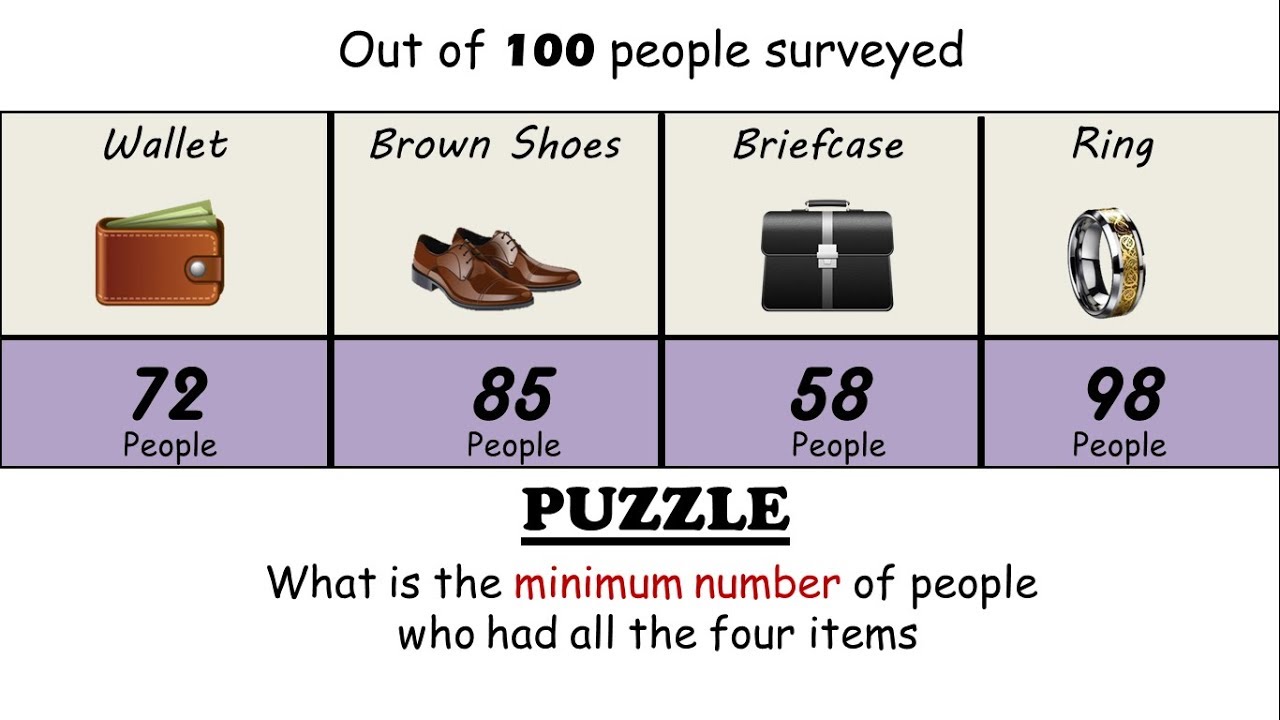
Mathematical Puzzle Wallet, Shoes, Briefcase, Ring 100 People Puzzle
video description
Wrote by
Ala' Zayed
Date: 2023-11-15
Related videos




Comments and reviews: 25
Devon
I did it by first using ring 98 and shoes 85
put ring from 1-98 and shoes from 16- 100
16-98 will be the number of people with both ring and shoes total (83)
Next is to put in the 72 wallets inside of 16-98. Since there are 17 outside the 16-98, then only 55 (72-17) will have ring, shoes and wallets, therefore 45 wont have all three (100-55)
This 55 can be fitted in to 16-98 by subtraction (83-55)= 28 divided by 2 = 14
So 55 can be fitted into 16-98 by 30-84. Therefore 30-84 have ring, shoes and wallet (all three.
The next is the briefcase, 58. As said above 30-84 have all three therefore 1-29 and 85 to 100 do not or total of 45 (29 +16. so we only need to fit in 58-45 for 13. So 13 have all four.
There are number of ways to do this problem. This is just one. There is just one way to look at this.
reply
I did it by first using ring 98 and shoes 85
put ring from 1-98 and shoes from 16- 100
16-98 will be the number of people with both ring and shoes total (83)
Next is to put in the 72 wallets inside of 16-98. Since there are 17 outside the 16-98, then only 55 (72-17) will have ring, shoes and wallets, therefore 45 wont have all three (100-55)
This 55 can be fitted in to 16-98 by subtraction (83-55)= 28 divided by 2 = 14
So 55 can be fitted into 16-98 by 30-84. Therefore 30-84 have ring, shoes and wallet (all three.
The next is the briefcase, 58. As said above 30-84 have all three therefore 1-29 and 85 to 100 do not or total of 45 (29 +16. so we only need to fit in 58-45 for 13. So 13 have all four.
There are number of ways to do this problem. This is just one. There is just one way to look at this.
reply
MrMousley
I'll tell you what I did to work this out and then I'll look at your solution.
To start with. 58 briefcases is the smallest number of items
so the MAXIMUM number of people who could have all four items is 58.
Now you need to work out how many people DON'T have the other three items.
There are 72 wallets, so (100 - 72) 28 people don't have a wallet.
There are 85 pairs of brown shoes, so (100 - 85) 15 people don't have brown shoes.
There are 98 rings, so (100 - 98) 2 people don't have rings.
Now add all those numbers together 28 + 15 + 2 = 45
and then subtract that from 58 58 - 45 = 13
13 is the MINIMUM number of people who have all four items.
reply
I'll tell you what I did to work this out and then I'll look at your solution.
To start with. 58 briefcases is the smallest number of items
so the MAXIMUM number of people who could have all four items is 58.
Now you need to work out how many people DON'T have the other three items.
There are 72 wallets, so (100 - 72) 28 people don't have a wallet.
There are 85 pairs of brown shoes, so (100 - 85) 15 people don't have brown shoes.
There are 98 rings, so (100 - 98) 2 people don't have rings.
Now add all those numbers together 28 + 15 + 2 = 45
and then subtract that from 58 58 - 45 = 13
13 is the MINIMUM number of people who have all four items.
reply
Christian
I solved the problem in a different way:
I considered the four sets R rings S shoes B briefcase W wallets. I estimated the intersections of each set with the others. It is not possible to know the exact value but we have minimum values:
R int S >= 13
R int W >= 16
R int B >= 40
B int W >= 54
B int S >= 27
S int W >= 13
The solution must be the intersection of all these sets so its size cannot be less than 13.
Here the way to estimate R int S and the others intersection sets:
as S = 85, not S = 15 so R + (not R+S) = 15 but R =98 so we must have that out of 15 at least 13 are in R so S int R >= 13. In the same way I evaluated the others.
reply
I solved the problem in a different way:
I considered the four sets R rings S shoes B briefcase W wallets. I estimated the intersections of each set with the others. It is not possible to know the exact value but we have minimum values:
R int S >= 13
R int W >= 16
R int B >= 40
B int W >= 54
B int S >= 27
S int W >= 13
The solution must be the intersection of all these sets so its size cannot be less than 13.
Here the way to estimate R int S and the others intersection sets:
as S = 85, not S = 15 so R + (not R+S) = 15 but R =98 so we must have that out of 15 at least 13 are in R so S int R >= 13. In the same way I evaluated the others.
reply
nepiris
I think he has worded the question wrongly.
Why is the answer not zero? Even if 99 had a ring, the answer can still be zero, can't it? In fact, all it would take is one person to be missing one item and the answer would be zero. 100 could each have a wallet, briefcase, brown shoes, but only 99 have a ring, then the answer is zero for the minimum number to have all 4 items. In fact, thinking of this more, it is impossible for 1 to not have a ring yet have all 4, so the minimum number must be zero.
reply
I think he has worded the question wrongly.
Why is the answer not zero? Even if 99 had a ring, the answer can still be zero, can't it? In fact, all it would take is one person to be missing one item and the answer would be zero. 100 could each have a wallet, briefcase, brown shoes, but only 99 have a ring, then the answer is zero for the minimum number to have all 4 items. In fact, thinking of this more, it is impossible for 1 to not have a ring yet have all 4, so the minimum number must be zero.
reply
Paul-Stelian
My answer before watching the video:
To get the minimum number, we should maximize the number of people with 3 or fewer. That means the people who don't have a wallet, the people who don't have shoes, the people without a briefcase and the people without a ring must all form separate groups. There are 28 without wallet, 15 without shoes, 42 without briefcase and 2 without ring. Total is 87. So 87 people can lack something. The other 13 people necessarily have all four things.
reply
My answer before watching the video:
To get the minimum number, we should maximize the number of people with 3 or fewer. That means the people who don't have a wallet, the people who don't have shoes, the people without a briefcase and the people without a ring must all form separate groups. There are 28 without wallet, 15 without shoes, 42 without briefcase and 2 without ring. Total is 87. So 87 people can lack something. The other 13 people necessarily have all four things.
reply
Garp
After hearing the explanation, I'm still wandering that there is still a possibility that those 13 people may still do not have 1 of the items. For example, if 13 of those people have wallet+shoes+ring, they may also still do not have the briefcase as all the 58 briefcases can be own among other 87 people. This shows that there is a possibility that none of the people own all 4 items.
reply
After hearing the explanation, I'm still wandering that there is still a possibility that those 13 people may still do not have 1 of the items. For example, if 13 of those people have wallet+shoes+ring, they may also still do not have the briefcase as all the 58 briefcases can be own among other 87 people. This shows that there is a possibility that none of the people own all 4 items.
reply
TheJackal917
I did not understand this. Why should I divide shoes for those people who have no briefcase? Why is there a question for remaining 42 in a case of briefcase holders? Maybe I cannot formulate my question in a more refined way because English is not my native language, but can anyone please explain this step?
reply
I did not understand this. Why should I divide shoes for those people who have no briefcase? Why is there a question for remaining 42 in a case of briefcase holders? Maybe I cannot formulate my question in a more refined way because English is not my native language, but can anyone please explain this step?
reply
AusTxMale
The way the question is worded will allow you to conclude that the minimum is 0. It all depends on how you arrange those sets to eliminate the potential for someone to have an item. So bad wording is the downfall to this puzzle as it is not precise enough to allow the answer of 13 to be the definitive one.
reply
The way the question is worded will allow you to conclude that the minimum is 0. It all depends on how you arrange those sets to eliminate the potential for someone to have an item. So bad wording is the downfall to this puzzle as it is not precise enough to allow the answer of 13 to be the definitive one.
reply
Herbert
At least I finally got ONE of these. I didn't do it quite so elegantly. I just subtracted from the 58 with briefcases. There were 28 who didn't have wallets, 15 who didn't have brown shoes, and 2 who didn't have rings. 58 - (28 + 2 + 15, which becomes 58 - 45 = 13. 13 who had all three.
reply
At least I finally got ONE of these. I didn't do it quite so elegantly. I just subtracted from the 58 with briefcases. There were 28 who didn't have wallets, 15 who didn't have brown shoes, and 2 who didn't have rings. 58 - (28 + 2 + 15, which becomes 58 - 45 = 13. 13 who had all three.
reply
SHIKHAR
Sir, but this is not mentioned that every person has only 1 ring or other item then those left 13 rings can also be assumed to belong with those 85 peoples and hence, there was nobody having all those four things.
If you agree please comment. --
reply
Sir, but this is not mentioned that every person has only 1 ring or other item then those left 13 rings can also be assumed to belong with those 85 peoples and hence, there was nobody having all those four things.
If you agree please comment. --
reply
OneMadGypsy
The MINIMUM number of people with all 4 items is 1. The answer is ONE.
If you want to change the question to -What is the greatest amount of people that we can be absolutely positive to possess all 4 items? -
Then your answer is correct.
reply
The MINIMUM number of people with all 4 items is 1. The answer is ONE.
If you want to change the question to -What is the greatest amount of people that we can be absolutely positive to possess all 4 items? -
Then your answer is correct.
reply
Jeroen
Add all items together (58 + 72 + 85 + 98) = 313, substract 300 from this (all 100 ppl have 3 items atleast (= best case scenario, u have 13 remaining items which u need to distribute between the 100 ppl alr having 3 items.
reply
Add all items together (58 + 72 + 85 + 98) = 313, substract 300 from this (all 100 ppl have 3 items atleast (= best case scenario, u have 13 remaining items which u need to distribute between the 100 ppl alr having 3 items.
reply
Edmund
Please check if my logic is correct. Total number of items, (58+72+85+98=313) After all 100 people carry 3 items, (313-300=13) there is a surplus of 13 items. Therefore 13 persons have to carry all 4 items
reply
Please check if my logic is correct. Total number of items, (58+72+85+98=313) After all 100 people carry 3 items, (313-300=13) there is a surplus of 13 items. Therefore 13 persons have to carry all 4 items
reply
Hector
You can use DeMorgan
Formula. You can solve for the max number of people that don-t have at least one of of these. Use the complement of the sets of people and maximize. then take the set complement.
reply
You can use DeMorgan
Formula. You can solve for the max number of people that don-t have at least one of of these. Use the complement of the sets of people and maximize. then take the set complement.
reply
Rupali
I solved it this way: - Max no. of people having all items =58 minimum no. of people: - 58-(100-72)-(100-85)-(100-98)! simple process, but the reason behind y this works is well explained in the vedio!
reply
I solved it this way: - Max no. of people having all items =58 minimum no. of people: - 58-(100-72)-(100-85)-(100-98)! simple process, but the reason behind y this works is well explained in the vedio!
reply
Annonymus
Does the definition of minimum changed? I think the best answer should be 1 because it is the minimum no. of people having all four items. Unless 13 is lesser than 1 -
reply
Does the definition of minimum changed? I think the best answer should be 1 because it is the minimum no. of people having all four items. Unless 13 is lesser than 1 -
reply
Ryad
No see this one doesnt work, we cant assume the figures that some did or didnt have something. This is all speculation and nothing solid can come from this puzzle.
reply
No see this one doesnt work, we cant assume the figures that some did or didnt have something. This is all speculation and nothing solid can come from this puzzle.
reply
Anil
If we add the number of people having these items that is 98, 85, 72 and 58 together it adds to 313 that means 13 people must have all four items.
reply
If we add the number of people having these items that is 98, 85, 72 and 58 together it adds to 313 that means 13 people must have all four items.
reply
ten
min no of pple who have to wear all of these items is 13, but min no of pple who have all these itm is 1. in my way, - plz clear my doubt-
reply
min no of pple who have to wear all of these items is 13, but min no of pple who have all these itm is 1. in my way, - plz clear my doubt-
reply
Tyler
313 total items distributed to 100 people gives 3 of the four items to each person, but 13 get one extra item. That's how I did it
reply
313 total items distributed to 100 people gives 3 of the four items to each person, but 13 get one extra item. That's how I did it
reply
Komal
Puzzle is NYC. mathematical approach is a good explanation for students. for all others alternative explanation was staisfactory.
reply
Puzzle is NYC. mathematical approach is a good explanation for students. for all others alternative explanation was staisfactory.
reply
Brian
The correct answer is 1
You asked what's the MINIMUM number of people and minimum means lowest so therefore the answer is 1
reply
The correct answer is 1
You asked what's the MINIMUM number of people and minimum means lowest so therefore the answer is 1
reply
Cjfdn
I don't know the answer for sure cuz this is before watching the solution, but I'll just guess that the answer is 13 people
reply
I don't know the answer for sure cuz this is before watching the solution, but I'll just guess that the answer is 13 people
reply
Vivek
Hi Ammar, Can I ask a favor from you, along with the video, can you also put information about the difficulty level of it?
reply
Hi Ammar, Can I ask a favor from you, along with the video, can you also put information about the difficulty level of it?
reply
Rajesh
Simple solution is count all people who doesn't have atleast one thing
Which is 87
Subtract from 100
Ans is 13
reply
Simple solution is count all people who doesn't have atleast one thing
Which is 87
Subtract from 100
Ans is 13
reply
Add a review, comment
Other channel videos