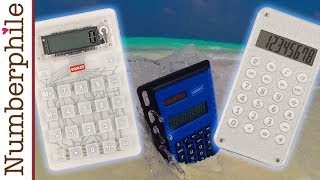
Point about Points - Numberphile
video description
You could ask, -how many numbers between 3 and 4? - To which the answer is obviously infinite.
You could ask, -how large is the space between 3 and 4 on a ruler spaced by a certain unit size? - To which the answer is 1 unit.
You could ask -what is the arbitrary multiplier to determine the space between any physical representation of 3 and 4? - To which the answer is 1.
But to ask -what is the size of the space between 3 and 4? - Seems to me to be missing the limitations of pure math.
This question is akin to asking about the physical properties of logical constructs; It's like trying to upgrade your RAM with application level software. Math doesn't deal with physical space, it's a conceptual study, that's what allows us to use deduction. To use math in reality we have to create metaphorical links between systems of logic deduced through math and their theoretical application to problem solving with physical constructs. And I'm usually the one with my head in the clouds relentlessly pondering philosophical musings: P
Perhaps what he's really trying to do is get more closed minded or rigid mathematicians to question their basic mathematical constructs, which I would agree is a positive endeavor. And, in specific, to get people to think about the rift between the math itself and the physical tools we use to represent mathematical ideas. Maybe he's really making an appeal to pathos about the importance of questioning everything, yourself and your -simple- assumptions most rigorously, and recalling the story of what lead him to question everything. His path may not hold up depending on your fundamental construction of reality, but it's the goal he's trying to lead us to that's important. Which is an approach that certainly meshes well with his evidently emotional state. It seems to get more and more clear that this is what he's trying to get at the closer you get to the end, he verbally recognizes that -there's a real ruler, and then there's a mathematical ruler-, and to try to apply real ruler functions to the math one you end up -doing things there's no way you could do in reality-. It's like a mathematical Carl Sagan- it's not about the rigorousness of his study, its about having a fundamental questioning nature that applies to everything equally, not just others, not just things that appear difficult, everything.
Date: 2022-04-08
Related videos


Comments and reviews: 9
Jerry
It is indeed very, very fascinating!
If we look on numbers as points on the number line, every such point is not only infinitesimally small, but so infinitesimally small that it _can't get any smaller_, and if it can't get any smaller it has to be nothing. which is also why there between two such points, no matter how close together they are, always exists an infinite amount of other points, because the distance between two points can't be smaller than a point, and if you can fit _one_ point between them, you can also fit an infinite amount of points.
So wouldn't this make the number line infinitely _short_ instead of infinitely long, stretching no more than the infinitesimal distance between the two points -minus infinity- and -infinity-, with all other points fitting in-between?
The problem here, as I see it, is that these two points -don't exist- because there is no such thing as -The Biggest Number- (-infinity-, which is why the ends of the number line race outwards in pursuit of that unreachable -biggest number-, making the number line infinitely long.
When we count, -1, 2, 3, 4,. - and so on, we traverse through an infinite amount of numbers each time, which is a tremendous progress to say the least, and yet we are the exact same distance away from -infinity-, so at the same time we haven't moved at all.
reply
It is indeed very, very fascinating!
If we look on numbers as points on the number line, every such point is not only infinitesimally small, but so infinitesimally small that it _can't get any smaller_, and if it can't get any smaller it has to be nothing. which is also why there between two such points, no matter how close together they are, always exists an infinite amount of other points, because the distance between two points can't be smaller than a point, and if you can fit _one_ point between them, you can also fit an infinite amount of points.
So wouldn't this make the number line infinitely _short_ instead of infinitely long, stretching no more than the infinitesimal distance between the two points -minus infinity- and -infinity-, with all other points fitting in-between?
The problem here, as I see it, is that these two points -don't exist- because there is no such thing as -The Biggest Number- (-infinity-, which is why the ends of the number line race outwards in pursuit of that unreachable -biggest number-, making the number line infinitely long.
When we count, -1, 2, 3, 4,. - and so on, we traverse through an infinite amount of numbers each time, which is a tremendous progress to say the least, and yet we are the exact same distance away from -infinity-, so at the same time we haven't moved at all.
reply
Paul
5: 05 - What he is saying is so important. We have to question every assumption we are making. It is true, a number is infinite and infinite isn't a number. As such, -removing- points from the number line does not make sense with what a number line is suppose to help the mathematician do. It helps to analyze a thought process in a physical sense and then ask ourselves questions which seem incompatible with what the number line represents. Although it looks like we create -dots- and draw -lines-, these are simplistic representations for the sake of understanding mathematical relationships. In other words, we must find ways to challenge the way we think. So, if you agree that there is a paradox here then you would be right. I would definitely recommend reading a book titled, -How Mathematicians Think- by William Byers. This would shed light on why this is a problem. 5: 25 - -If i remove your feelings, your size doesn't change. - that is correct and that is the point. Likewise, i agree that you can't do maths without feelings. -It's all very emotional. -
reply
5: 05 - What he is saying is so important. We have to question every assumption we are making. It is true, a number is infinite and infinite isn't a number. As such, -removing- points from the number line does not make sense with what a number line is suppose to help the mathematician do. It helps to analyze a thought process in a physical sense and then ask ourselves questions which seem incompatible with what the number line represents. Although it looks like we create -dots- and draw -lines-, these are simplistic representations for the sake of understanding mathematical relationships. In other words, we must find ways to challenge the way we think. So, if you agree that there is a paradox here then you would be right. I would definitely recommend reading a book titled, -How Mathematicians Think- by William Byers. This would shed light on why this is a problem. 5: 25 - -If i remove your feelings, your size doesn't change. - that is correct and that is the point. Likewise, i agree that you can't do maths without feelings. -It's all very emotional. -
reply
David
Truly great presentation of the cognitive crisis we either confront every day, or ignore and dissipate meaning, emotional or otherwise, in existing.
Add this to the mental state of people -who really want to know-, and there's a problem if the -adults- don't say, - I don't know, here's what you find historically, why don't you think this out for yourself-, because the students who aren't set on Career building, -drop out- or occasionally build cars and rockets, or computers etc.
To sum this posit-positioning of the conundrum of dynamic mathematical methodology, the Singularity is the Feature, not the bug in appearances it seems to be counter intuitively, thanks to the Quantum Operator Time Duration Timing, Fields Modulation Mechanism Mathematics of QM-TIMESPACE.
reply
Truly great presentation of the cognitive crisis we either confront every day, or ignore and dissipate meaning, emotional or otherwise, in existing.
Add this to the mental state of people -who really want to know-, and there's a problem if the -adults- don't say, - I don't know, here's what you find historically, why don't you think this out for yourself-, because the students who aren't set on Career building, -drop out- or occasionally build cars and rockets, or computers etc.
To sum this posit-positioning of the conundrum of dynamic mathematical methodology, the Singularity is the Feature, not the bug in appearances it seems to be counter intuitively, thanks to the Quantum Operator Time Duration Timing, Fields Modulation Mechanism Mathematics of QM-TIMESPACE.
reply
Chris
-What happens when we take away a point? Well nothing, there is no next point, there is no hole per se- says Simon. Consider a point P as the centre of a small circle drawn on the surface of a large sphere. Now imagine that circle expanding, but P remains as its centre. The circle expands and moves over the surface of the sphere until it becomes a great circle then as it continues, diminishes again to zero at a position exactly opposite to P. As soon as it does so P vanishes, since the surface of a sphere can have no centre, so effectively you've taken away the point. Just before that happens when the circle is very tiny again but still in existence, we have a little hole which is the counterpoint of P and whose closure annihilates P, a kind of negative entanglement.
reply
-What happens when we take away a point? Well nothing, there is no next point, there is no hole per se- says Simon. Consider a point P as the centre of a small circle drawn on the surface of a large sphere. Now imagine that circle expanding, but P remains as its centre. The circle expands and moves over the surface of the sphere until it becomes a great circle then as it continues, diminishes again to zero at a position exactly opposite to P. As soon as it does so P vanishes, since the surface of a sphere can have no centre, so effectively you've taken away the point. Just before that happens when the circle is very tiny again but still in existence, we have a little hole which is the counterpoint of P and whose closure annihilates P, a kind of negative entanglement.
reply
Chris
What's the chronological equivalent of a point in space?
Think of one of those clocks where the minute hand jumps from one minute marker to the next with pauses in between. How long is the pause? One minute of course. How long is the gap from one inch marker to the next on a ruler? One inch of course. But ask how long the minute hand's jump on the clock takes, then I can no more get a helpful answer from that same clock than if I ask how thick the inch division marker on a ruler is from the same ruler. In both cases the neatest answer is zero, especially as we want the jump time/thickness to be the minimum practicable anyway. But what about the speed of the hand, both its jumps and its progression round the clock?
reply
What's the chronological equivalent of a point in space?
Think of one of those clocks where the minute hand jumps from one minute marker to the next with pauses in between. How long is the pause? One minute of course. How long is the gap from one inch marker to the next on a ruler? One inch of course. But ask how long the minute hand's jump on the clock takes, then I can no more get a helpful answer from that same clock than if I ask how thick the inch division marker on a ruler is from the same ruler. In both cases the neatest answer is zero, especially as we want the jump time/thickness to be the minimum practicable anyway. But what about the speed of the hand, both its jumps and its progression round the clock?
reply
MOC
well I do agree with parts of that, but the thing is that 3. 5 is not a point, it is a point on the number line but it is the value of every other thing before it. you might argue that everything before it is a point, and in some ways I agree with that, but another way to think of it is not points of nothing but these infinite lengths. there is a infinite length between 3 and 4 because the infinite amount of decimals between them, and each decimal has an infinite length from zero. you might still say that each bit of that length is a point and it is zero, but it obviously has value. this all is just part of my greater theory of zero being equal to infinity. think about it.
reply
well I do agree with parts of that, but the thing is that 3. 5 is not a point, it is a point on the number line but it is the value of every other thing before it. you might argue that everything before it is a point, and in some ways I agree with that, but another way to think of it is not points of nothing but these infinite lengths. there is a infinite length between 3 and 4 because the infinite amount of decimals between them, and each decimal has an infinite length from zero. you might still say that each bit of that length is a point and it is zero, but it obviously has value. this all is just part of my greater theory of zero being equal to infinity. think about it.
reply
David
. hooray, what he said - no number is real in the way a kid thinks. And instead of saying -there's no such thing-, (because the original meaning of thing was about people gathering and exchanging information, anything that is represented by a measurable objective is the result of a process like the completed function of Fourier Analysis in Calculus. It's all the infinite functional states possible, superimposed on a particular related objective/probability.
So it should always be part of the solution of a -problem- that the functional environment be defined and not just be assumed to be a convention or rule of thumb.
reply
. hooray, what he said - no number is real in the way a kid thinks. And instead of saying -there's no such thing-, (because the original meaning of thing was about people gathering and exchanging information, anything that is represented by a measurable objective is the result of a process like the completed function of Fourier Analysis in Calculus. It's all the infinite functional states possible, superimposed on a particular related objective/probability.
So it should always be part of the solution of a -problem- that the functional environment be defined and not just be assumed to be a convention or rule of thumb.
reply
Lelouch
I don't understand why you put 0 as the length of each point. Is that a definition of a point? That it has value but zero length? Maybe you should redefine a point as having an infinitesimal length so that it doesn't -break maths-. It is these sorts of problems that increases our understanding of math after all. If a point has an infinitesimal length, then adding infinitely many of them between 0 and 1 would equal 1. Perhaps we should define a specific type of infinity representing the points between 0 and 1 so that they can be cancelled out with infinitesimals and 12 of them added infinitely many times will equal 12.
reply
I don't understand why you put 0 as the length of each point. Is that a definition of a point? That it has value but zero length? Maybe you should redefine a point as having an infinitesimal length so that it doesn't -break maths-. It is these sorts of problems that increases our understanding of math after all. If a point has an infinitesimal length, then adding infinitely many of them between 0 and 1 would equal 1. Perhaps we should define a specific type of infinity representing the points between 0 and 1 so that they can be cancelled out with infinitesimals and 12 of them added infinitely many times will equal 12.
reply
Eugene
Ok: Removing an infinite countable set of numbers (let's say, all rational numbers) from, let's say, piece of line 0. 12 won't make a length difference. But if we remove all irrational numbers, then the length would be zero (since the -length- of the remaining numbers - rational numbers is zero. Now: what if we remove NOT ALL irrational numbers? What if we remove, let's say, only those numbers which are algebraic? Or only those irrational numbers which are transcendental? I have no idea what then will happen. Could we have a video about that?
reply
Ok: Removing an infinite countable set of numbers (let's say, all rational numbers) from, let's say, piece of line 0. 12 won't make a length difference. But if we remove all irrational numbers, then the length would be zero (since the -length- of the remaining numbers - rational numbers is zero. Now: what if we remove NOT ALL irrational numbers? What if we remove, let's say, only those numbers which are algebraic? Or only those irrational numbers which are transcendental? I have no idea what then will happen. Could we have a video about that?
reply
Add a review, comment
Other channel videos