Crank Files - Numberphile
video description
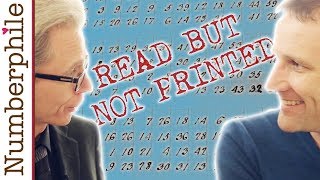
the list of primes at the top are made up of independent number systems
of the base of the prime number in their column. ie the numbers below 23
exist in a base 23 number system. The numbers in each row of the middle
sections get added to the number in the same column in the row labeled
1000 giving the value of the following number in the column. For example
the column for 23, the 1000 row for 23 shows an 11, the 2000 row shows
22 which 11 more than 11, the 3000 row shows 10, this is because
22+11=33 and since this column exists in a base 23 number system, the
'least significant bit' is 33-23 which is the 10. This then moves on to
the 4000 which is 11 more than the 3000, the 5000 which again only
showing the part of the number smaller than the base is 11 more than the
4000(21+11=32, 32-23=9. This continues down through the 9000 row and
this pattern fits for all of the columns for the rows labeled 1000-9000,
the number in the 1000 row being added to itself and the number in each
successive row through 9000 subtracting out the value of the prime
which forms the base of the number system for that row when the value
exceeds the size of the prime.
Date: 2022-04-08
Related videos



Comments and reviews: 9
TechnocratiK
The -Rods to find Prime Numbers- page is actually sort of clever. I think the author meant -mods, - though (or maybe it's an abbreviation of -remainders? -. The table consists of the numbers down the left-hand side, modulo the primes listed along the top (for some reason the first grouping of rows should be at the bottom of the page. To determine if a number less than 10, 000 is prime, break the number into three parts: the thousands, the hundreds, and the rest (i. e. tens and ones. Take the row corresponding to the thousands, add to it the row corresponding to the hundreds, and then add to each entry of the result the tens and ones part. Finally, take the remainder of the division of each entry in the resulting row by the corresponding prime (this can be done efficiently a subtraction-or-two for all but the smallest primes. If no remainder is zero, the number is prime because it has been tested for divisibility by all primes less than its square root (since the number is less than 10, 000; in fact, you don't need to use all of the columns unless the number to test is larger than 97 - 2.
reply
The -Rods to find Prime Numbers- page is actually sort of clever. I think the author meant -mods, - though (or maybe it's an abbreviation of -remainders? -. The table consists of the numbers down the left-hand side, modulo the primes listed along the top (for some reason the first grouping of rows should be at the bottom of the page. To determine if a number less than 10, 000 is prime, break the number into three parts: the thousands, the hundreds, and the rest (i. e. tens and ones. Take the row corresponding to the thousands, add to it the row corresponding to the hundreds, and then add to each entry of the result the tens and ones part. Finally, take the remainder of the division of each entry in the resulting row by the corresponding prime (this can be done efficiently a subtraction-or-two for all but the smallest primes. If no remainder is zero, the number is prime because it has been tested for divisibility by all primes less than its square root (since the number is less than 10, 000; in fact, you don't need to use all of the columns unless the number to test is larger than 97 - 2.
reply
Lau
Numberphile is about science, right? And science is about thinking - I think.
Now, using language correctly often requires some thinking - it's also a kind of science. One that we should all be interested in, because we all use the language every day. So instead of always running the language on autopilot, let's think a little:
We've all been taught by our mothers that -Can me and Matt have some ice cream- is bad, while -Can Matt and I have some bread- is much better! So we've been programmed to automatically assume it's always -Matt and I-.
But why is that (grammatically? Well, you wouldn't say -can me have. -, but -can I have. -! So -Can Matt and I have- is correct.
Now, would you say -Keith is gonna show I around-, or would you say -Keith is gonna show me around-?
The latter, right? So -Keith is gonna show Matt and me around- is correct, -Keith is gonna show Matt and I around- is incorrect. An interesting fact, I think. And Stephen Fry would agree, I can tell you!
reply
Numberphile is about science, right? And science is about thinking - I think.
Now, using language correctly often requires some thinking - it's also a kind of science. One that we should all be interested in, because we all use the language every day. So instead of always running the language on autopilot, let's think a little:
We've all been taught by our mothers that -Can me and Matt have some ice cream- is bad, while -Can Matt and I have some bread- is much better! So we've been programmed to automatically assume it's always -Matt and I-.
But why is that (grammatically? Well, you wouldn't say -can me have. -, but -can I have. -! So -Can Matt and I have- is correct.
Now, would you say -Keith is gonna show I around-, or would you say -Keith is gonna show me around-?
The latter, right? So -Keith is gonna show Matt and me around- is correct, -Keith is gonna show Matt and I around- is incorrect. An interesting fact, I think. And Stephen Fry would agree, I can tell you!
reply
Chris
Explanation for -Rods to find Prime Numbers. -: This table simply shows the remainders of n/p where n is one of the numbers in the left-most column and p is the respective prime from the -Primes- rows. I don't know why it is arranged in this strange order, nor why there are two rows of -Primes-. Perhaps extra rows were added at different times when the creator had new ideas? Unfortunately he appears to have made a couple of mistakes for 4000 and 5000 when dividing by 89. He has put 54 and 10 when the values should be 84 and 16. Crank indeed.
reply
Explanation for -Rods to find Prime Numbers. -: This table simply shows the remainders of n/p where n is one of the numbers in the left-most column and p is the respective prime from the -Primes- rows. I don't know why it is arranged in this strange order, nor why there are two rows of -Primes-. Perhaps extra rows were added at different times when the creator had new ideas? Unfortunately he appears to have made a couple of mistakes for 4000 and 5000 when dividing by 89. He has put 54 and 10 when the values should be 84 and 16. Crank indeed.
reply
Philo
Is anyone smart enough to help me solve this problem and explain to me what steps I should use?
A teacher asked his three students Tom, Helen and Sandy to complete 200 exercises. The ratio of the exercises completed by Tom to the exercises completed by Helen to the exercises completed by Sandy is 3: 3: 4. Tom receives 5 points for each completed exercise. Sandy receives 8 points for each exercise. If the three students altogether receive 1240 points, how many points does Helen receive for a completed exercise?
___ points
reply
Is anyone smart enough to help me solve this problem and explain to me what steps I should use?
A teacher asked his three students Tom, Helen and Sandy to complete 200 exercises. The ratio of the exercises completed by Tom to the exercises completed by Helen to the exercises completed by Sandy is 3: 3: 4. Tom receives 5 points for each completed exercise. Sandy receives 8 points for each exercise. If the three students altogether receive 1240 points, how many points does Helen receive for a completed exercise?
___ points
reply
redbaron521892
Also the values in the hundreds columns also exist in their own number systems based in the prime of their column, but increase by the value in the 100 row, until they reach the 1000 row where the rows then begin increasing by 1000, and the column values increase the value in the 1000 row rather than the 100 row. It helps to start below the second row topped by the primes with the 100 row, then after you reach the bottom 800 row loop back up to the top for the 900 row and then go down through the thousand rows.
reply
Also the values in the hundreds columns also exist in their own number systems based in the prime of their column, but increase by the value in the 100 row, until they reach the 1000 row where the rows then begin increasing by 1000, and the column values increase the value in the 1000 row rather than the 100 row. It helps to start below the second row topped by the primes with the 100 row, then after you reach the bottom 800 row loop back up to the top for the 900 row and then go down through the thousand rows.
reply
christosvoskresye
-Unpublished- does not mean -wrong- -- there are lots of other reasons why a paper might not be published. The editors might not consider it to fit the purpose of the journal, or it might replicate without reference (probably unintentionally) work that has already been published in that journal or elsewhere, or it might require some further clarification or refinement.
reply
-Unpublished- does not mean -wrong- -- there are lots of other reasons why a paper might not be published. The editors might not consider it to fit the purpose of the journal, or it might replicate without reference (probably unintentionally) work that has already been published in that journal or elsewhere, or it might require some further clarification or refinement.
reply
Wittgensteinism
-Keith is gonna show Matt and I. -
Sigh. Keith is going to show I, or Keith is going to show me?
Why cant even so-called intellectuals get this one right?
Keith shows (Matt and) me, not (Matt and) I.
Sorry, but this is one of my biggest pet peeves, and I only point it out so that hopefully people stop hypercorrecting and making this ironic mistake.
reply
-Keith is gonna show Matt and I. -
Sigh. Keith is going to show I, or Keith is going to show me?
Why cant even so-called intellectuals get this one right?
Keith shows (Matt and) me, not (Matt and) I.
Sorry, but this is one of my biggest pet peeves, and I only point it out so that hopefully people stop hypercorrecting and making this ironic mistake.
reply
Roman
Hi, guys I think to have discovered a theorem (I undestand that it could suond strange but I have shown it to math prof. and students and they agreed with me on the importance of the work) with a number of applications in geometry. Where can I show this work to start a discussion? are you interested in seeing what it is about?
reply
Hi, guys I think to have discovered a theorem (I undestand that it could suond strange but I have shown it to math prof. and students and they agreed with me on the importance of the work) with a number of applications in geometry. Where can I show this work to start a discussion? are you interested in seeing what it is about?
reply
Sunil
The page with the title -rods to find prime numbers- consists a row of primes less than 100 and below them, the corresponding value of the number in the leftmost column modulo the prime n. For example the number 7 has 3, 2, 1 below it. 3=4000mod(7, 2=5000mod(7) and 1 = 6000mod(7.
reply
The page with the title -rods to find prime numbers- consists a row of primes less than 100 and below them, the corresponding value of the number in the leftmost column modulo the prime n. For example the number 7 has 3, 2, 1 below it. 3=4000mod(7, 2=5000mod(7) and 1 = 6000mod(7.
reply
Add a review, comment
Other channel videos