Magic Square Party Trick - Numberphile
video description
A1 B2 C3 D4 E5-
C4 D5 E1 A2 B3-
E2 A3 B4 C5 D1-
B5 C1 D2 E3 A4-
D3 E4 A5 B1 C2-
Then replace the letters A, B, C, D and E with 0, 5, 10, 15, and 20 respectively. Add them to their corresponding number. -
01 07 13 19 25-
14 20 21 02 08-
22 03 09 15 16-
10 11 17 23 04-
18 24 05 06 12-
How to make a magic square. Easy.
Date: 2022-04-08
Related videos






Comments and reviews: 9
Gregory
If you want to make the numbers appear less -suspicious-, then you can add or subtract multiples of 4 from the number you are given, construct its square, and then add/subtract 1 to each entry for each multiple of 4 you subtracted/added respectively. For example with 58, you could have done the square for 42 again, but with 4 added to each entry, or the square for 34 with a 6 added to each entry.
reply
If you want to make the numbers appear less -suspicious-, then you can add or subtract multiples of 4 from the number you are given, construct its square, and then add/subtract 1 to each entry for each multiple of 4 you subtracted/added respectively. For example with 58, you could have done the square for 42 again, but with 4 added to each entry, or the square for 34 with a 6 added to each entry.
reply
Joshua
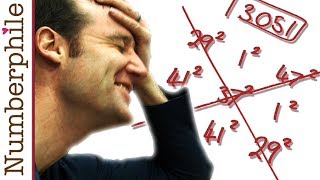
One thing I find interesting is that when he shows the magic square in the graphic, the 4 square that is one row above the center and the one below the center add up to the number (I'll say 42) but the 4 square that is one column left of the center and one right of the center does not. Would be interesting to see if it is possible to make it so that those would add to 42 as well.
reply
One thing I find interesting is that when he shows the magic square in the graphic, the 4 square that is one row above the center and the one below the center add up to the number (I'll say 42) but the 4 square that is one column left of the center and one right of the center does not. Would be interesting to see if it is possible to make it so that those would add to 42 as well.
reply
zixuan
Matt: Tell me your age.
Person: 42.
Matt: I will make a magic square out of it.
Person: Are you a magician?
Matt: No, I'm a mathematician.
Person: Then what trick will you be doing?
Matt: Gimme a piece of paper.
Person: Here.
Matt: [ -draws a magic square- ]
Person: thanks. [ -looks suspiciously- ]
reply
Matt: Tell me your age.
Person: 42.
Matt: I will make a magic square out of it.
Person: Are you a magician?
Matt: No, I'm a mathematician.
Person: Then what trick will you be doing?
Matt: Gimme a piece of paper.
Person: Here.
Matt: [ -draws a magic square- ]
Person: thanks. [ -looks suspiciously- ]
reply
Mak
#python, just could not resist: p
n = 42
count = 0
square = [[0, 1, 12, 7], [11, 8, 0, 2], [5, 10, 3, 0], [4, 0, 6, 9]]
offsets = [(0, 20, (2, 21, (3, 18, (1, 19)]
for offset in offsets:
square[count][offset[0]] = n - offset[1]
count += 1
for List in square:
print List
reply
#python, just could not resist: p
n = 42
count = 0
square = [[0, 1, 12, 7], [11, 8, 0, 2], [5, 10, 3, 0], [4, 0, 6, 9]]
offsets = [(0, 20, (2, 21, (3, 18, (1, 19)]
for offset in offsets:
square[count][offset[0]] = n - offset[1]
count += 1
for List in square:
print List
reply
hector
Well, I use my personal method called par position that combines position of a number assigned to a letter, which I call 1432
A 1 2 3 4
B 5 6 7 8
C 9 10 11 12
D 24 25 26 27
Using my position algorithm I get
1 8 11 25
26 10 5 4
6 3 27 9
12 24 2 7
reply
Well, I use my personal method called par position that combines position of a number assigned to a letter, which I call 1432
A 1 2 3 4
B 5 6 7 8
C 9 10 11 12
D 24 25 26 27
Using my position algorithm I get
1 8 11 25
26 10 5 4
6 3 27 9
12 24 2 7
reply
Henrique
To make the numbers closer you can actually do the square for n - 4-k and then add k to all entries. So if they give you a big number just choose a k to bring it down to the nice range again. I think that can make the trick look less formulaic. It is harder though: )
reply
To make the numbers closer you can actually do the square for n - 4-k and then add k to all entries. So if they give you a big number just choose a k to bring it down to the nice range again. I think that can make the trick look less formulaic. It is harder though: )
reply
Colonel
But wait. the first square has 11, 8, 10, and 5. Those add up to 44, not 42. Same with 21, 2, 24, 3 (makes 50, not 42. You add every other column, row, diagonal, and 2x2 square but those two. Why the fail there?
reply
But wait. the first square has 11, 8, 10, and 5. Those add up to 44, not 42. Same with 21, 2, 24, 3 (makes 50, not 42. You add every other column, row, diagonal, and 2x2 square but those two. Why the fail there?
reply
Some
Here's a thought: Along with uploading these, you could upload another video of the complete, unedited interview (unlisted of course) for the hardcore numberphile fans like myself
reply
Here's a thought: Along with uploading these, you could upload another video of the complete, unedited interview (unlisted of course) for the hardcore numberphile fans like myself
reply
Gamer_X
i have question about number 3.
if i take number, that can be divided by 3 and sum up its digits, it will give me number that can be divided by 3. why is that?
reply
i have question about number 3.
if i take number, that can be divided by 3 and sum up its digits, it will give me number that can be divided by 3. why is that?
reply
Add a review, comment
Other channel videos