The Plastic Ratio - Numberphile
video description
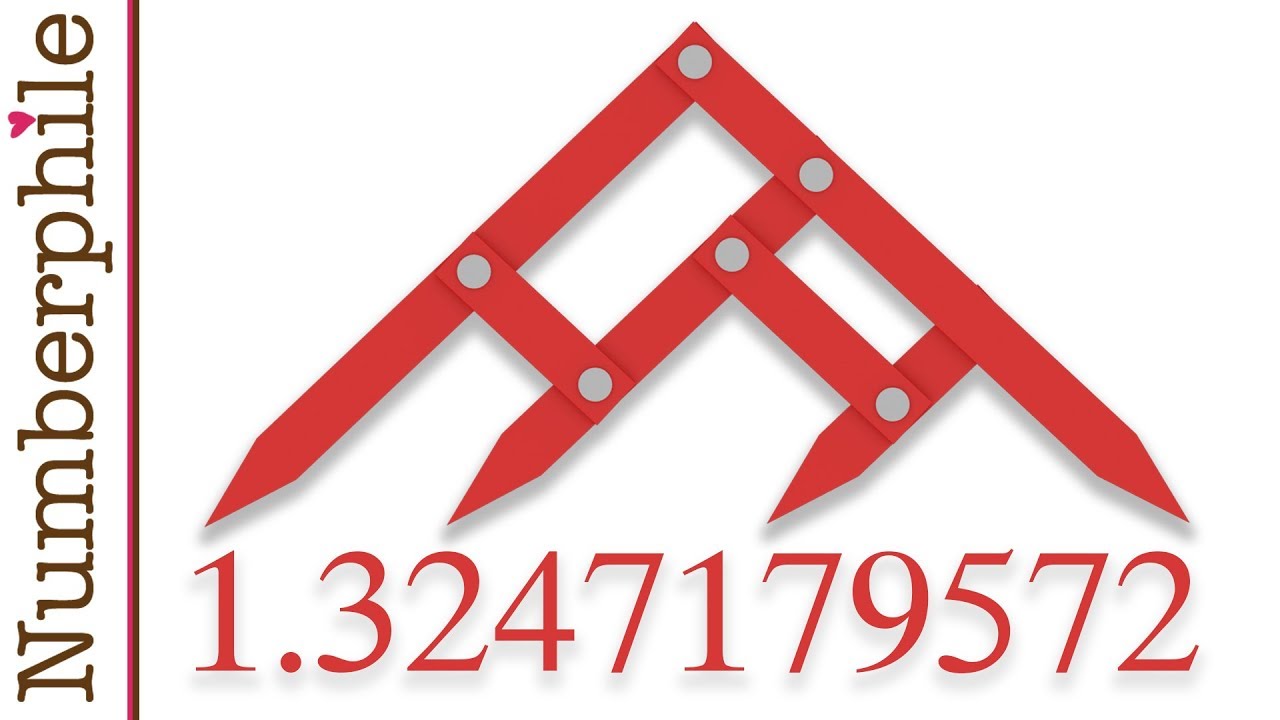
The golden ratio can be generalized to a form f(x) = x-2 - ox - 1, where o is 1, and the [positive] solution is the golden ratio, phi, -1. 618.
Similarily, we can generalize the formula for the plastic ratio to f(x) = x-3 - ox - 1, where o is 1, and the [positive, real] solution is the plastic ratio, -1. 325.
Something very interesting happens if we set o to 2 in the plastic ratio formula. If we solve for x, the [positive] solution ends up becoming the golden ratio.
More fun things: if we set o to 3. 5 in the plastic formula, the positive solution is 2. What fun! Unfortunately I was unable to get the silver ratio in a nice pretty number in the plastic formula, and I'm also unsure if any other metal ratio ends up showing up in a nice number either. I will continue messing around with this new formula however, I love these seemingly random ratios!
Date: 2022-04-09
Related videos






Comments and reviews: 9
WBvanKempen
In the plastic ratio it's not only the sum of the second and third position before, but also from upon position 6 it's the sum of the first and fifth position before.
So:
Position 6: 1+2 (3th + 4th, and 1+2 (1st + 5th)
Position 7: 2+2 (4th and 5th, and 1+3 (2nd + 6th)
Position 8: 2+3, and 1+4
Position 9: 3+4, and 2+5
Position 10: 4+5, and 2+7
Etc.
This is also shown in the drawing: the length of the new tiangle is the sum of the triangle before, and the triangle 4 steps before that one (so position 1 and 5 before.
This only works with a start from position 6 because of the chosen start with 1, 1, 1. That is just an agreement, not a fact.
Also: in the golden ratio you could go backwards though position 1 and it still kind of works. You will get the same numbers, but for every even negative position it will be the negative 'brother'.
In de plastic ratio you can't go backwards like that in a 'normal' way. The numbers in the negative positions will go everywhere.
reply
In the plastic ratio it's not only the sum of the second and third position before, but also from upon position 6 it's the sum of the first and fifth position before.
So:
Position 6: 1+2 (3th + 4th, and 1+2 (1st + 5th)
Position 7: 2+2 (4th and 5th, and 1+3 (2nd + 6th)
Position 8: 2+3, and 1+4
Position 9: 3+4, and 2+5
Position 10: 4+5, and 2+7
Etc.
This is also shown in the drawing: the length of the new tiangle is the sum of the triangle before, and the triangle 4 steps before that one (so position 1 and 5 before.
This only works with a start from position 6 because of the chosen start with 1, 1, 1. That is just an agreement, not a fact.
Also: in the golden ratio you could go backwards though position 1 and it still kind of works. You will get the same numbers, but for every even negative position it will be the negative 'brother'.
In de plastic ratio you can't go backwards like that in a 'normal' way. The numbers in the negative positions will go everywhere.
reply
alexander
This was a really confusing start. What is that thing? What does it do? What exactly are you doing? Even with the visual, it was not clear what you were trying to show. Naming the different lengths would have been more helpful so we could follow. -This-, -That-, -Here- and -There- are not clear, even when you point them out on your drawing.
The confusion was maximal when you started writing the equations, because I didn't understand what was demonstrated and now suddenly you are adding 1 and x to get x-3. It's only after watching it 3 times that I finally got all the information necessary to follow along.
The rest of the video was fine, but wow was that a confusing intro. Almost put me off.
reply
This was a really confusing start. What is that thing? What does it do? What exactly are you doing? Even with the visual, it was not clear what you were trying to show. Naming the different lengths would have been more helpful so we could follow. -This-, -That-, -Here- and -There- are not clear, even when you point them out on your drawing.
The confusion was maximal when you started writing the equations, because I didn't understand what was demonstrated and now suddenly you are adding 1 and x to get x-3. It's only after watching it 3 times that I finally got all the information necessary to follow along.
The rest of the video was fine, but wow was that a confusing intro. Almost put me off.
reply
Grawuka
There is a nice graphic trick to draw the plastic number -spiral- of similar rectangles and left-out square:
1. draw one diagonal of the main rectangle (name it D1)
2. draw the perpendicular of that diagonal that goes from one of the left-out corners (name it D2)
3. D2 intersects the other side of the rectangle at some point, draw the perpendicular to that side from this intersection ( name it P_0 )
Repeat forever: P_i intersect D1 or D2, P_i+1 the perpendicular of P_i from that point.
the intersection of P_i and P_i+5 is the inner corner of the left_out square and the center of the quarter-circle to draw the spiral
reply
There is a nice graphic trick to draw the plastic number -spiral- of similar rectangles and left-out square:
1. draw one diagonal of the main rectangle (name it D1)
2. draw the perpendicular of that diagonal that goes from one of the left-out corners (name it D2)
3. D2 intersects the other side of the rectangle at some point, draw the perpendicular to that side from this intersection ( name it P_0 )
Repeat forever: P_i intersect D1 or D2, P_i+1 the perpendicular of P_i from that point.
the intersection of P_i and P_i+5 is the inner corner of the left_out square and the center of the quarter-circle to draw the spiral
reply
Morris
This is very interesting and profoundly important in understanding of maths as the languafe of the universe and nature so to speak, but. It was really tough to get and I surely will have to watch another few times, with pen and paper and the pause button. It was a relief for me to see so many likes to similar comments of this topic to seemsomewhat confusing and fast-paced. Would definitely love to see a follow-up video for the more slow-minded of us like myself)
Thanks a lot for yet another brain workout, albeit I'll have torecover after this one)
reply
This is very interesting and profoundly important in understanding of maths as the languafe of the universe and nature so to speak, but. It was really tough to get and I surely will have to watch another few times, with pen and paper and the pause button. It was a relief for me to see so many likes to similar comments of this topic to seemsomewhat confusing and fast-paced. Would definitely love to see a follow-up video for the more slow-minded of us like myself)
Thanks a lot for yet another brain workout, albeit I'll have torecover after this one)
reply
Gregory
Okay, I already comented on a older video o numberphile, but will do it again because this video got closer to what I was looking for, that is, a sequence that follows the pattern -add the three previous numbers to ge the next-, for example, [0, 1, 1, 2, 4, 7, 13, 24, 44, 81. ]; and the ration between the numbers (eg. : 81/44) gets closer and closer to -1. 8392. - but I don't know where I can find a formula like the Fibonacci's.
So far, I only know this:
X = [ A(n-2) + A(n-1) + A(n) ] / A(n)
Note: [ A(n-2) + A(n-1) + A(n) ] = A(n+1)
reply
Okay, I already comented on a older video o numberphile, but will do it again because this video got closer to what I was looking for, that is, a sequence that follows the pattern -add the three previous numbers to ge the next-, for example, [0, 1, 1, 2, 4, 7, 13, 24, 44, 81. ]; and the ration between the numbers (eg. : 81/44) gets closer and closer to -1. 8392. - but I don't know where I can find a formula like the Fibonacci's.
So far, I only know this:
X = [ A(n-2) + A(n-1) + A(n) ] / A(n)
Note: [ A(n-2) + A(n-1) + A(n) ] = A(n+1)
reply
Liam
I apologize if I'm not the first to mention, but:
There are three ways to divide a square into three similar rectangles. One is to divide it into three 3: 1 rectangles of equal size. Another would be three 3: 2 rectangles, one twice the size of the others.
The third is three rectangles of proportion x-2: 1, where the ratio of smallest to middle is x-2, middle to largest is x, so smallest to largest is x-3. There's a lovely image on Wikipedia, and the construction takes advantage of the fact that x-5 = x-3 + x-2 = x-4 + 1.
reply
I apologize if I'm not the first to mention, but:
There are three ways to divide a square into three similar rectangles. One is to divide it into three 3: 1 rectangles of equal size. Another would be three 3: 2 rectangles, one twice the size of the others.
The third is three rectangles of proportion x-2: 1, where the ratio of smallest to middle is x-2, middle to largest is x, so smallest to largest is x-3. There's a lovely image on Wikipedia, and the construction takes advantage of the fact that x-5 = x-3 + x-2 = x-4 + 1.
reply
toomdog
At 1: 40, when he's first laying out values for the divisions, how can he just say that the third space is x-2, and the fourth distance is x-3 and so on? when he writes his x's below the sequence at the end, it works because x happens to be one, but it doesn't look like the x-2 distance in the beginning is equal to the x distance. Am I just being picky about dividers and missing the point here? It seems like he just said, -I'm going to call this x-2, - as if that were another independent variable.
reply
At 1: 40, when he's first laying out values for the divisions, how can he just say that the third space is x-2, and the fourth distance is x-3 and so on? when he writes his x's below the sequence at the end, it works because x happens to be one, but it doesn't look like the x-2 distance in the beginning is equal to the x distance. Am I just being picky about dividers and missing the point here? It seems like he just said, -I'm going to call this x-2, - as if that were another independent variable.
reply
Paul
I used sit in front of a drafting machine all day at work. It was four bars connected in a parallelogram. They stay parallel and opposite angles are equal. So my wild guess is you make the angles 60 degrees you get three equilateral triangles where the distance between the points is the same as the length of the slats. So if point distance is 1, 2 and 4. The slats are 2 7s, a 6 and a 4. Am I on to something?
reply
I used sit in front of a drafting machine all day at work. It was four bars connected in a parallelogram. They stay parallel and opposite angles are equal. So my wild guess is you make the angles 60 degrees you get three equilateral triangles where the distance between the points is the same as the length of the slats. So if point distance is 1, 2 and 4. The slats are 2 7s, a 6 and a 4. Am I on to something?
reply
Celia
Fascinating. From the triangle drawing it looked more like the next number is the previous number plus the one 4 steps before it most of the time ( I mean missing out 3 in between the ones you add, except for the first '2' where there is only 1 missed out in between the previous and the one 2 steps before it. It's clever that that works out as the same as adding the last but one and the one before that.
reply
Fascinating. From the triangle drawing it looked more like the next number is the previous number plus the one 4 steps before it most of the time ( I mean missing out 3 in between the ones you add, except for the first '2' where there is only 1 missed out in between the previous and the one 2 steps before it. It's clever that that works out as the same as adding the last but one and the one before that.
reply
Add a review, comment
Other channel videos