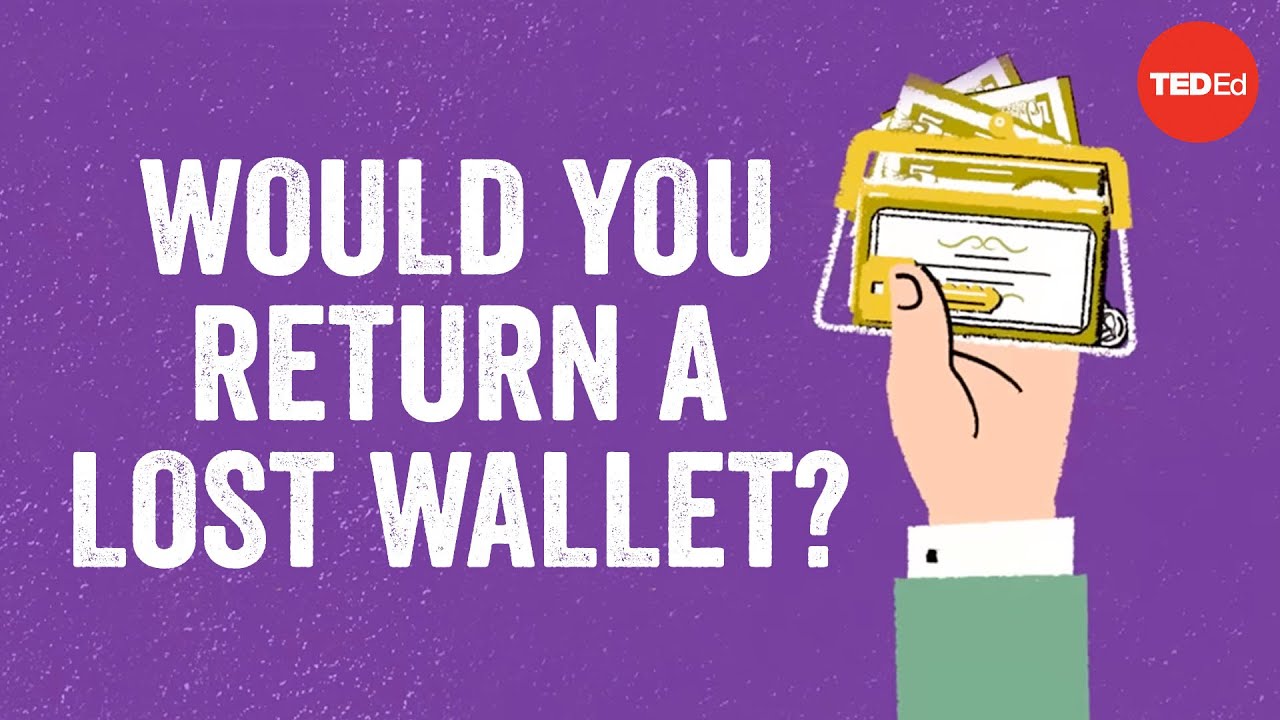
Would you pass the wallet test?
video description
Date: 2022-08-30
Related videos


• TED-Ed




Comments and reviews: 14
Kyle
I did this experiment informally, and accidentally, once. I found a wallet with 100 in it and turned it in to the front desk of a hotel I was staying at. It didn't have a business card or anything that could identify a person, so I just assumed someone would ask for it later. My aunt said I made a mistake, and should have kept the money because the clerk at the front desk would keep the money and maybe sell the wallet. I said that wouldn't happen. I described the wallet to my aunt and she told the front desk she lost her wallet, describing the one I found. The person there was the one I gave the wallet to, and it was just an hour prior, so he would have remembered, but he said no one turned in a wallet.
My aunt pointed to me and said my nephew said he just gave you my wallet about an hour ago. And it had 100 in it. The guy then went to the back and gave her the wallet.
reply
I did this experiment informally, and accidentally, once. I found a wallet with 100 in it and turned it in to the front desk of a hotel I was staying at. It didn't have a business card or anything that could identify a person, so I just assumed someone would ask for it later. My aunt said I made a mistake, and should have kept the money because the clerk at the front desk would keep the money and maybe sell the wallet. I said that wouldn't happen. I described the wallet to my aunt and she told the front desk she lost her wallet, describing the one I found. The person there was the one I gave the wallet to, and it was just an hour prior, so he would have remembered, but he said no one turned in a wallet.
My aunt pointed to me and said my nephew said he just gave you my wallet about an hour ago. And it had 100 in it. The guy then went to the back and gave her the wallet.
reply
Tyler
I have once lost my mobile, together with my ID card, a bank card, and a stored value smart card, in a swimming pool changing room. I had no idea when and how my mobile (with a card holder sticking on its back) slipped off my pocket and I only found out I had lost it when I returned to the changing room after swimming for an hour. I didn't expect there was any chance to get everything back, but to my surprise it was in the lost and found. I could have been in a deep trouble for losing that many personal items all at once. Fortunately, my lost items were found by a nice and honest person. Thank you so much. From then on, I swear I will never take any belongs that do not belong to me, especially the valuable and personal ones.
reply
I have once lost my mobile, together with my ID card, a bank card, and a stored value smart card, in a swimming pool changing room. I had no idea when and how my mobile (with a card holder sticking on its back) slipped off my pocket and I only found out I had lost it when I returned to the changing room after swimming for an hour. I didn't expect there was any chance to get everything back, but to my surprise it was in the lost and found. I could have been in a deep trouble for losing that many personal items all at once. Fortunately, my lost items were found by a nice and honest person. Thank you so much. From then on, I swear I will never take any belongs that do not belong to me, especially the valuable and personal ones.
reply
Julien
In my country, you can put any official paper you find, like identity card, credit card, social security card, directly in a mailbox on the street. The post office is gonna take it to the authorities. Therefore, my answer to this test would be taking the money and throwing the rest into a mailbox, so the owner won't have to pay for having these papers reprinted (it's kinda expensive. I like to think this as a win/win situation (or an I win/you don't lose as much as you would have, if you prefer, even tho I'm totally aware I'm being dishonest. That said, I have a disastrously bad self-image, so that might as well explain it.
reply
In my country, you can put any official paper you find, like identity card, credit card, social security card, directly in a mailbox on the street. The post office is gonna take it to the authorities. Therefore, my answer to this test would be taking the money and throwing the rest into a mailbox, so the owner won't have to pay for having these papers reprinted (it's kinda expensive. I like to think this as a win/win situation (or an I win/you don't lose as much as you would have, if you prefer, even tho I'm totally aware I'm being dishonest. That said, I have a disastrously bad self-image, so that might as well explain it.
reply
ragnarok
I would like to lend a different perspective. A person is capable of excercising their free will using ample calculation to make any decision he desires, irrespective of the moral principle at play. Sure there will be consequences to making a decision to keep the wallet for themselves, like the suffering the wallets owner will have to endure, but the actor will benefit from making the 'immoral' decision himself. So moral relativism is at play. It's all upto the perception of the person.
reply
I would like to lend a different perspective. A person is capable of excercising their free will using ample calculation to make any decision he desires, irrespective of the moral principle at play. Sure there will be consequences to making a decision to keep the wallet for themselves, like the suffering the wallets owner will have to endure, but the actor will benefit from making the 'immoral' decision himself. So moral relativism is at play. It's all upto the perception of the person.
reply
Sid98
First, As usual wonderful Animation. Many schools must include TED videos to explain things.
TED, I think the statements Every healthy society relies on a shared foundations of honesty and the conclusion to create an honest society we all can rely on is contradicting one other. My question is, Is honesty innate to us that resulted in formation of societies? or we came together to form a society and incorporated honesty into it?
reply
First, As usual wonderful Animation. Many schools must include TED videos to explain things.
TED, I think the statements Every healthy society relies on a shared foundations of honesty and the conclusion to create an honest society we all can rely on is contradicting one other. My question is, Is honesty innate to us that resulted in formation of societies? or we came together to form a society and incorporated honesty into it?
reply
Frederico
there is less incentive to report the cashless wallet because it contained no documents and all its contents can be easily replaced. it literaly is waist of time returning it. the wallets with cash had something that cant be replaced. thats why they were reported more often, had the cashless ones contained documents with ID or other sensitive information they would be reported more or less the same of the others if not more
reply
there is less incentive to report the cashless wallet because it contained no documents and all its contents can be easily replaced. it literaly is waist of time returning it. the wallets with cash had something that cant be replaced. thats why they were reported more often, had the cashless ones contained documents with ID or other sensitive information they would be reported more or less the same of the others if not more
reply
SrogaPoziomka
Happened to me many times. For example:
In secondary school I have found some money with parent permission to go for a school trip.
When I was studying, I found a wallet with money, ID and some bills in it while driving a bus.
It just as simple as it is. If there is is the slightest possibility of identifying the owner, then return it to them or somebody, who can do it for you.
reply
Happened to me many times. For example:
In secondary school I have found some money with parent permission to go for a school trip.
When I was studying, I found a wallet with money, ID and some bills in it while driving a bus.
It just as simple as it is. If there is is the slightest possibility of identifying the owner, then return it to them or somebody, who can do it for you.
reply
tntg5
It think it has to do with the likelihood that the owner will eventually show up, asking if their wallet was found. The more there is money, the more likely someone will claim it.
Now imagine being the lobby guy, someone brings a wallet full of cash, you decide de buy pizzas for all your colleagues, only to face the owner 2 hours later asking for a lost wallet
reply
It think it has to do with the likelihood that the owner will eventually show up, asking if their wallet was found. The more there is money, the more likely someone will claim it.
Now imagine being the lobby guy, someone brings a wallet full of cash, you decide de buy pizzas for all your colleagues, only to face the owner 2 hours later asking for a lost wallet
reply
ferron
I once found 3 wallets in a single week, returned all of them and got 0 reward and from one girl not even a bit of gratitude. she was like Owh I did not know I lost my wallet.
still, the next wallet I find I definitely will return as well because I hope when I lose something important like that someone will return it unscaved as well: )
reply
I once found 3 wallets in a single week, returned all of them and got 0 reward and from one girl not even a bit of gratitude. she was like Owh I did not know I lost my wallet.
still, the next wallet I find I definitely will return as well because I hope when I lose something important like that someone will return it unscaved as well: )
reply
Lynx
Honestly I'd be more inclined to return a wallet containing something seemingly valuable too. A cheap plastic wallet with some business cards and a grocery list is barely worth the effort of picking it up for the owner.
A wallet with say 100 dollars in on the other hand: Someone has lost a hundred dollars and probably wants it back.
reply
Honestly I'd be more inclined to return a wallet containing something seemingly valuable too. A cheap plastic wallet with some business cards and a grocery list is barely worth the effort of picking it up for the owner.
A wallet with say 100 dollars in on the other hand: Someone has lost a hundred dollars and probably wants it back.
reply
FELiPES101
There are some obvious missed incentives in this experiment. Neither of the values mentioned are worth losing your job over given the pay of the position. One would also assume that as the value of the missing possession increases the likelihood of the owner searching for said possession and engaging the business increases.
reply
There are some obvious missed incentives in this experiment. Neither of the values mentioned are worth losing your job over given the pay of the position. One would also assume that as the value of the missing possession increases the likelihood of the owner searching for said possession and engaging the business increases.
reply
XPNDBLhero
I've found and returned about 6 wallets by tracking people down on social media w/o taking anything in return, some people offered a few bucks as a reward and some blamed me for its disappearance in the first place whenever they were found in public places and most times on camera. I guess that's what you get for being nice.
reply
I've found and returned about 6 wallets by tracking people down on social media w/o taking anything in return, some people offered a few bucks as a reward and some blamed me for its disappearance in the first place whenever they were found in public places and most times on camera. I guess that's what you get for being nice.
reply
Optimus
I think this reveals more about economist than it does the average person. Economists always assume the worst about human behavior and help politicians craft policies around that basis thus contributing to some of the worst systems we humans have lived under but except because economists tell us it s the only way.
reply
I think this reveals more about economist than it does the average person. Economists always assume the worst about human behavior and help politicians craft policies around that basis thus contributing to some of the worst systems we humans have lived under but except because economists tell us it s the only way.
reply
Vardaris
One evening when I was 15 I was going home on foot when a man passed me walking fast. He dropped a small bag which had about 5000 dollars. I looked around the road was empty and the guy was still rushing forward. I run behind him and caught him just before he gets in his car. He gave me 100 dollars.
reply
One evening when I was 15 I was going home on foot when a man passed me walking fast. He dropped a small bag which had about 5000 dollars. I looked around the road was empty and the guy was still rushing forward. I run behind him and caught him just before he gets in his car. He gave me 100 dollars.
reply
Add a review, comment
Other channel videos