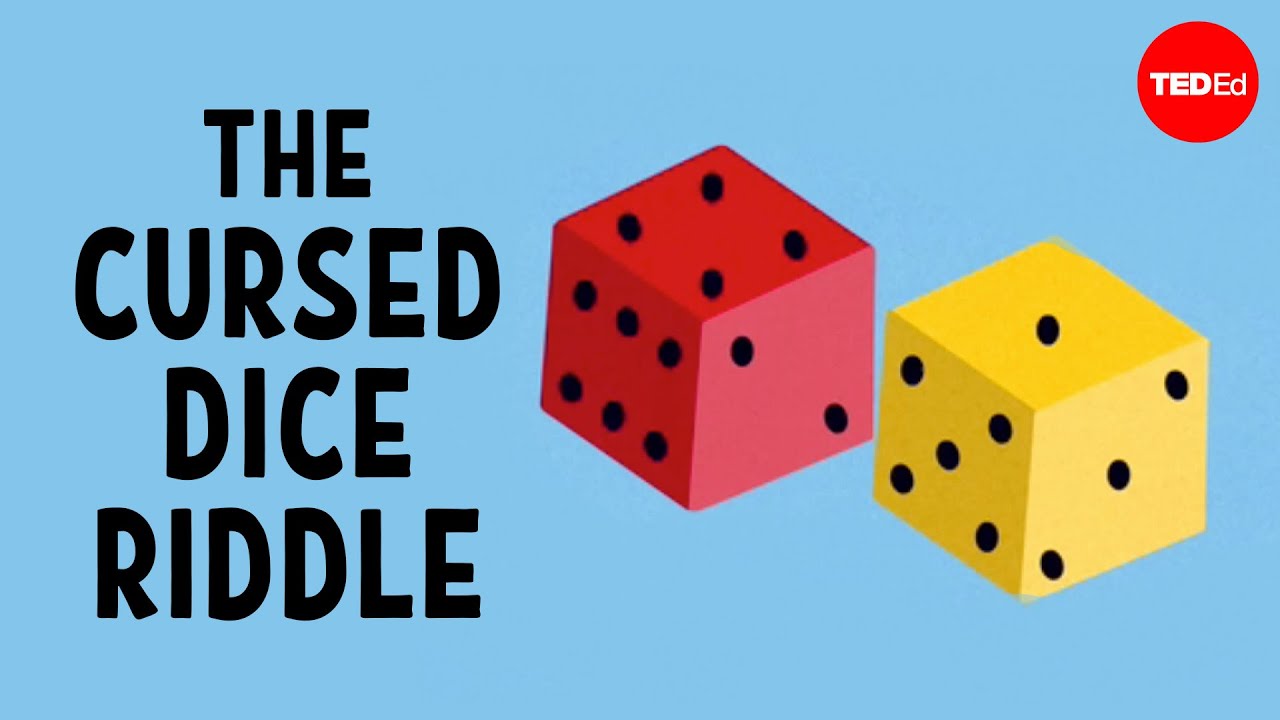
Can you solve the cursed dice riddle?
video description
Date: 2023-09-08
Related videos


• TED-Ed


Comments and reviews: 20
Stratelier
My solve process:
- Observe that there must be exactly one sum of 2. This can only be accomplished as 1+1, thus each die must have exactly one side with one pip.
- Likewise, there must be exactly one sum of 12, and as one die cannot contain a value more than 4, the other die must have exactly one face with at least 8 pips.
- As the above values cannot be repeated across the same die, each die must contain at least 3 unique values. Thus the maximum value for the cursed die must be either 3 or 4.
- If the maximum value for the cursed die is 3, its layout is (by definition) 1+2+2+2+2+3. But we would have a problem: regardless of the other die, there are at least 4 ways to roll sum of 3 (1+2. Thus, the maximum value for the cursed die must be 4, and it cannot have more than 2 faces with 2 pips. It also cannot have more than 3 faces with 3 pips (or there would be more than 3 ways to roll a sum of 4) -- thus, its layout is either 1+2+3+3+3+4 or 1+2+2+3+3+4.
- If the layout is 1+2+3+3+3+4, we have a problem: there are 3 ways to roll 4 (as 1+3) but we need a second way to roll 3 (as 2+1, meaning the normal die must have faces of 1 and 2, but this gives us a total of _four_ ways to roll 4 (one 4+1, three 3+2) when we can only afford 3.
- Thus, the cursed die has a layout of: 1+2+2+3+3+4.
- Now, we know that we have two ways to roll a 3 (1+2, so the normal die cannot contain any side with a value of 2. Similarly, we know we have two ways to roll an 11 (8+3, so the normal die cannot contain any side with a value of 7. The remaining possible values are 3, 4, 5, 6 -- four values for four sides, thus if any solution exists at all, the normal die must have a layout of: 1+3+4+5+6+8.
- As a check, all values on both die add to 42 pips, aka. (2 x 21. A 6x6 graph of permutations confirms that all outcomes are present at the correct frequencies!
(There's probably an easier way to prove that the correct outcomes are all accounted for)
reply
My solve process:
- Observe that there must be exactly one sum of 2. This can only be accomplished as 1+1, thus each die must have exactly one side with one pip.
- Likewise, there must be exactly one sum of 12, and as one die cannot contain a value more than 4, the other die must have exactly one face with at least 8 pips.
- As the above values cannot be repeated across the same die, each die must contain at least 3 unique values. Thus the maximum value for the cursed die must be either 3 or 4.
- If the maximum value for the cursed die is 3, its layout is (by definition) 1+2+2+2+2+3. But we would have a problem: regardless of the other die, there are at least 4 ways to roll sum of 3 (1+2. Thus, the maximum value for the cursed die must be 4, and it cannot have more than 2 faces with 2 pips. It also cannot have more than 3 faces with 3 pips (or there would be more than 3 ways to roll a sum of 4) -- thus, its layout is either 1+2+3+3+3+4 or 1+2+2+3+3+4.
- If the layout is 1+2+3+3+3+4, we have a problem: there are 3 ways to roll 4 (as 1+3) but we need a second way to roll 3 (as 2+1, meaning the normal die must have faces of 1 and 2, but this gives us a total of _four_ ways to roll 4 (one 4+1, three 3+2) when we can only afford 3.
- Thus, the cursed die has a layout of: 1+2+2+3+3+4.
- Now, we know that we have two ways to roll a 3 (1+2, so the normal die cannot contain any side with a value of 2. Similarly, we know we have two ways to roll an 11 (8+3, so the normal die cannot contain any side with a value of 7. The remaining possible values are 3, 4, 5, 6 -- four values for four sides, thus if any solution exists at all, the normal die must have a layout of: 1+3+4+5+6+8.
- As a check, all values on both die add to 42 pips, aka. (2 x 21. A 6x6 graph of permutations confirms that all outcomes are present at the correct frequencies!
(There's probably an easier way to prove that the correct outcomes are all accounted for)
reply
PowerStar004
From the start, you know you need exactly one 1 on each die to add up to 2, since you can't have 0s or negative numbers.
You also know that since one die can't go above 4, you need exactly one 4 and one 8 to add up to 12.
1, 4?
1, 8?
Now, you need 2 ways to roll 3, and that can only be made rolling a 1 and a 2. We know that some digits on the smaller die will have to repeat, and we can't repeat 1s or 4s without creating new ways to roll 2 or 12, so we must place both 2s on that die. That's our 2 ways to roll 3 solved.
1, 4, 2, 2?
1, 8?
To roll 4, you'll need 1+3 or 2+2. We can't add any more 1s or 2s to either die, since it would create additional ways to make 2 or 3. So adding 3s is our only option. The smaller die's last two slots must be 3s, as anything else would result in too many ways to roll 2, 3, or 12. This leaves us with 2 ways to roll 4, but we need a third, so we must add a 3 to the larger die as well.
1, 4, 2, 2, 3, 3
1, 8, 3?
We need 4 ways to roll 5, but we already have 3 - 1+4, and 3+2 twice. The only way to add a fourth without repeating lower rolls is to add a 4 to the larger die to create another 1+4.
1, 4, 2, 2, 3, 3
1, 8, 3, 4?
We now need 5 ways to roll 6, and the same pattern repeats as before - we already have 4 of them. Adding a 5 to the larger die is the lone way to add a fifth 6 without adding any 5s, 4s, 3s, or 2s.
1, 4, 2, 2, 3, 3
1, 8, 3, 4, 5?
Yet again, we're one short. Need 6 ways to roll 7 and we have 5, thus we must add a 6 to the larger die.
1, 4, 2, 2, 3, 3
1, 8, 3, 4, 5, 6
All our slots are filled, and the larger numbers already slide in perfectly.
Five 8s: 5+3, 5+3, 6+2, 6+2, 4+4
Four 9s: 8+1, 6+2, 6+2, 5+4
Three 10s: 8+2, 8+2, 6+4
Two 11s: 8+3, 8+3
And we already made the lone 12 with 4+8 at the beginning.
Now to finish the video and see if there's a faster way to solve it.
reply
From the start, you know you need exactly one 1 on each die to add up to 2, since you can't have 0s or negative numbers.
You also know that since one die can't go above 4, you need exactly one 4 and one 8 to add up to 12.
1, 4?
1, 8?
Now, you need 2 ways to roll 3, and that can only be made rolling a 1 and a 2. We know that some digits on the smaller die will have to repeat, and we can't repeat 1s or 4s without creating new ways to roll 2 or 12, so we must place both 2s on that die. That's our 2 ways to roll 3 solved.
1, 4, 2, 2?
1, 8?
To roll 4, you'll need 1+3 or 2+2. We can't add any more 1s or 2s to either die, since it would create additional ways to make 2 or 3. So adding 3s is our only option. The smaller die's last two slots must be 3s, as anything else would result in too many ways to roll 2, 3, or 12. This leaves us with 2 ways to roll 4, but we need a third, so we must add a 3 to the larger die as well.
1, 4, 2, 2, 3, 3
1, 8, 3?
We need 4 ways to roll 5, but we already have 3 - 1+4, and 3+2 twice. The only way to add a fourth without repeating lower rolls is to add a 4 to the larger die to create another 1+4.
1, 4, 2, 2, 3, 3
1, 8, 3, 4?
We now need 5 ways to roll 6, and the same pattern repeats as before - we already have 4 of them. Adding a 5 to the larger die is the lone way to add a fifth 6 without adding any 5s, 4s, 3s, or 2s.
1, 4, 2, 2, 3, 3
1, 8, 3, 4, 5?
Yet again, we're one short. Need 6 ways to roll 7 and we have 5, thus we must add a 6 to the larger die.
1, 4, 2, 2, 3, 3
1, 8, 3, 4, 5, 6
All our slots are filled, and the larger numbers already slide in perfectly.
Five 8s: 5+3, 5+3, 6+2, 6+2, 4+4
Four 9s: 8+1, 6+2, 6+2, 5+4
Three 10s: 8+2, 8+2, 6+4
Two 11s: 8+3, 8+3
And we already made the lone 12 with 4+8 at the beginning.
Now to finish the video and see if there's a faster way to solve it.
reply
Will
I did it similarly, except I deduced it in the following way, with slightly more brute force.
1) 8>xxxx>1 & 43xx21 because 4 & 8 are needed to make twelve, 1 &1 to make 2, and dice two needed to have every number 1-4 represented to fill it out.
2) Instead of realizing there had to be exactly two 3s and two 2s, I went back and forth eliminating possibilities and realized that die 1 could not have a 7, because it would be impossible two make one 12, two 11s, and 3 10s if there was a seven. I also realized there could not be a 2 on die 1 for the same reason, it would make it impossible for there to be one 2, two 3, and 3 4s
3) 8xxx31 433221 would then be the only way for there to be the right number of 2s, 3s, and 4s.
4) 86xx31 433221 would be the only way for the right number of 12s, 11s, and 10s. There couldn't be any more than one 6 and 3. on die 1 because that would break 12, 11, and 10, 4, 3, 2
5) 865431 433221 were the only numbers left to fill in for die 1.
I didn't use a matrix, I just went into a different Firefox tab and wrote the numbers down in the browser. I play a lot of warhammer so I am always thinking about dice roll probabilities. I might buy a set for making my charge rolls & leadership tests, as a sort of joke with my friends.
reply
I did it similarly, except I deduced it in the following way, with slightly more brute force.
1) 8>xxxx>1 & 43xx21 because 4 & 8 are needed to make twelve, 1 &1 to make 2, and dice two needed to have every number 1-4 represented to fill it out.
2) Instead of realizing there had to be exactly two 3s and two 2s, I went back and forth eliminating possibilities and realized that die 1 could not have a 7, because it would be impossible two make one 12, two 11s, and 3 10s if there was a seven. I also realized there could not be a 2 on die 1 for the same reason, it would make it impossible for there to be one 2, two 3, and 3 4s
3) 8xxx31 433221 would then be the only way for there to be the right number of 2s, 3s, and 4s.
4) 86xx31 433221 would be the only way for the right number of 12s, 11s, and 10s. There couldn't be any more than one 6 and 3. on die 1 because that would break 12, 11, and 10, 4, 3, 2
5) 865431 433221 were the only numbers left to fill in for die 1.
I didn't use a matrix, I just went into a different Firefox tab and wrote the numbers down in the browser. I play a lot of warhammer so I am always thinking about dice roll probabilities. I might buy a set for making my charge rolls & leadership tests, as a sort of joke with my friends.
reply
Jacob
I SOLVED A TEDED RIDDLE!
Okay, my process started by realizing that since the small die cant go above 4, your max on the big die is 8, because 8+4=12. I then played around for a while with having a 0 side on the little dice before realizing that you need a positive number on each side, so that meant I needed a pair of 1's to make 2.
I also knew that I couldn't double up on my 1 and 4, nor my 1 and 8, because that'd make extra 2's and 12's I didn't need. So I decided to plug in a double 2 and double 3 on the little die because I knew doubles were needed on that dice and those were the only options left. Doing so on a spreadsheet I set up (because looking at a chart helped out greatly) revealed that I had met my quota of 3's and was close on my 4's. 1+3 was enough for the final 4, and then I kinda noticed that you know, this graph is pretty symmetrical. bet the dice are symmetrical as well and since I skipped the number after 1 (2, I figured I should try repeating that on the other end, skipping 7, the number before 8.
Thus, my final dice were: 1, 2, 2, 3, 3, 4. And then 1, 3, 4, 5, 6, 8.
Gonna now watch the video to see if I was correct.
reply
I SOLVED A TEDED RIDDLE!
Okay, my process started by realizing that since the small die cant go above 4, your max on the big die is 8, because 8+4=12. I then played around for a while with having a 0 side on the little dice before realizing that you need a positive number on each side, so that meant I needed a pair of 1's to make 2.
I also knew that I couldn't double up on my 1 and 4, nor my 1 and 8, because that'd make extra 2's and 12's I didn't need. So I decided to plug in a double 2 and double 3 on the little die because I knew doubles were needed on that dice and those were the only options left. Doing so on a spreadsheet I set up (because looking at a chart helped out greatly) revealed that I had met my quota of 3's and was close on my 4's. 1+3 was enough for the final 4, and then I kinda noticed that you know, this graph is pretty symmetrical. bet the dice are symmetrical as well and since I skipped the number after 1 (2, I figured I should try repeating that on the other end, skipping 7, the number before 8.
Thus, my final dice were: 1, 2, 2, 3, 3, 4. And then 1, 3, 4, 5, 6, 8.
Gonna now watch the video to see if I was correct.
reply
Laezar
Uh. my solution was:
- have one dice with 1/2/3 and three empty faces and one dice with 1/1/2/2/3/3
- Throw the first dice, if it lands on 1, 2 or 3 keep the result. If it lands on an empty face throw the second dice and add it's result to the first, that gives you a d6 equivalent
- Just do that twice to get 2D6
The actual solution is a bit better cause you only need to throw once but I think mine is still a valid answer? and as a bonus you get to throw 1D6 if you want to so it's not strictly worse. Unless I got something wrong and it doesn't work
Edit: Just noticed the only positive clause (which is very arbitrary since the story doesn't say why that should be the case) but that can be fixed by having the blank faces be 4, they are positive numbers of dots you just don't count them in the result lol
reply
Uh. my solution was:
- have one dice with 1/2/3 and three empty faces and one dice with 1/1/2/2/3/3
- Throw the first dice, if it lands on 1, 2 or 3 keep the result. If it lands on an empty face throw the second dice and add it's result to the first, that gives you a d6 equivalent
- Just do that twice to get 2D6
The actual solution is a bit better cause you only need to throw once but I think mine is still a valid answer? and as a bonus you get to throw 1D6 if you want to so it's not strictly worse. Unless I got something wrong and it doesn't work
Edit: Just noticed the only positive clause (which is very arbitrary since the story doesn't say why that should be the case) but that can be fixed by having the blank faces be 4, they are positive numbers of dots you just don't count them in the result lol
reply
megan
Realize you'll have 42 dots in general and must use all of those dots. Each die has 21 dots on it.
Make all sides on one die four. 4 x 6 = 24. 42 - 24 = 18.
thats 18 dots. now divide 18 by 6 and get three. Put three dots on each side of the other die.
You'll realize that the most common number you'll get when you roll normal dice is 7, thats a median, since 1 + 6 = 7, 2 + 5 = 7, 3 + 4 = 7, etc.
When you finish fixing your die, you call Loki a little punk, and demand he pay restitution. You realize he's probably been the cause of all of those hurricanes.
edit: dang. at least i was close with the 7's.
reply
Realize you'll have 42 dots in general and must use all of those dots. Each die has 21 dots on it.
Make all sides on one die four. 4 x 6 = 24. 42 - 24 = 18.
thats 18 dots. now divide 18 by 6 and get three. Put three dots on each side of the other die.
You'll realize that the most common number you'll get when you roll normal dice is 7, thats a median, since 1 + 6 = 7, 2 + 5 = 7, 3 + 4 = 7, etc.
When you finish fixing your die, you call Loki a little punk, and demand he pay restitution. You realize he's probably been the cause of all of those hurricanes.
edit: dang. at least i was close with the 7's.
reply
Psy
2: 28 Assuming we have a 4.
I felt like the video brushed over considering having numbers less than 4 or larger than 8 on the dice (respectively. But it can actually be walked through relatively easily. You must have exactly one 1 on each die. If you had an 11, you could have only 1s on the other (without getting sums above 12, but this would make at least 6 ways to roll 12. Same sort of pattern continues for looking at 11, 10, and 9, with each leading to too many rolls of the high numbers. In this way, you can prove that the highest number you can use is an 8, meaning you must have exactly one 4 on the small die.
reply
2: 28 Assuming we have a 4.
I felt like the video brushed over considering having numbers less than 4 or larger than 8 on the dice (respectively. But it can actually be walked through relatively easily. You must have exactly one 1 on each die. If you had an 11, you could have only 1s on the other (without getting sums above 12, but this would make at least 6 ways to roll 12. Same sort of pattern continues for looking at 11, 10, and 9, with each leading to too many rolls of the high numbers. In this way, you can prove that the highest number you can use is an 8, meaning you must have exactly one 4 on the small die.
reply
King
First you have to ask the demon of logic if at least one of the sides has green eyes. If the answer is ozo you count the number of trees that the founders of the houses can see to find where the baniker is buried. If ulu then you trap nym in the magic checkerboard to prevent the ai from releasing the robot ants. Afterward you must give the dino nuggets the magic tarot cards you stole from fate so they can lite the correct number of candles on the giants cake. The giant will then agree to use the tri source to make you a new set of dice.
reply
First you have to ask the demon of logic if at least one of the sides has green eyes. If the answer is ozo you count the number of trees that the founders of the houses can see to find where the baniker is buried. If ulu then you trap nym in the magic checkerboard to prevent the ai from releasing the robot ants. Afterward you must give the dino nuggets the magic tarot cards you stole from fate so they can lite the correct number of candles on the giants cake. The giant will then agree to use the tri source to make you a new set of dice.
reply
CutieNerd
step 1: confirm that you have green eyes
step 2: ask loki, if i asked you whether i had to roll three 4s, would you say ozo?
step 3: walk anti-clockwise across one block of land to add one coin to your balance
step 4: calculate which lockers have numbers with perfect squares
step 5: work backwards from zahra's answer to get the hallway required
step 6: choose the gaussian and miss on purpose
step 7: lock loki in pythagoras' cursed chessboard
reply
step 1: confirm that you have green eyes
step 2: ask loki, if i asked you whether i had to roll three 4s, would you say ozo?
step 3: walk anti-clockwise across one block of land to add one coin to your balance
step 4: calculate which lockers have numbers with perfect squares
step 5: work backwards from zahra's answer to get the hallway required
step 6: choose the gaussian and miss on purpose
step 7: lock loki in pythagoras' cursed chessboard
reply
duruffio
I missed the instruction that required us to only select numbers >1, so I had a die with a blank face (0, 1, 1, 2, 2, 3) and added 1 to all the values on the other dice. After seeing the correct result, it makes sense that if you subtract one from each face in Die A and add one to each face on Die B, the results don't change.
reply
I missed the instruction that required us to only select numbers >1, so I had a die with a blank face (0, 1, 1, 2, 2, 3) and added 1 to all the values on the other dice. After seeing the correct result, it makes sense that if you subtract one from each face in Die A and add one to each face on Die B, the results don't change.
reply
Xavier
I tried solving this by starting with a regular dice, and trying to rearrange the numbers in a way that worked. I tried but couldn t find anything that worked, until I realized that I m not allowed to have zero dots, which I though I was. Once I had that, it was way easier to build the dice step by step. Very interesting riddle
reply
I tried solving this by starting with a regular dice, and trying to rearrange the numbers in a way that worked. I tried but couldn t find anything that worked, until I realized that I m not allowed to have zero dots, which I though I was. Once I had that, it was way easier to build the dice step by step. Very interesting riddle
reply
La
Actually, there's another solution if you do like me and interpret the line where the number must be positive differently:
Since the rule didn't state the number must be strictly positive, I assumed it was 0 and not >0, and I got:
- 1st die: 0-1-1-2-2-3
- 2nd die: 2-4-5-6-7-9
That solution also works the same way
reply
Actually, there's another solution if you do like me and interpret the line where the number must be positive differently:
Since the rule didn't state the number must be strictly positive, I assumed it was 0 and not >0, and I got:
- 1st die: 0-1-1-2-2-3
- 2nd die: 2-4-5-6-7-9
That solution also works the same way
reply
education
Ok so at first as a non-english speaker i assumed that a positive integer included 0. if we accept a face with 0 dot there is another solution that there is another solution:
0, 1, 1, 3, 3, 4
2, 3, 4, 6, 7, 8
And i'm pretty sure it's the only other solution, tell me if you found another one
reply
Ok so at first as a non-english speaker i assumed that a positive integer included 0. if we accept a face with 0 dot there is another solution that there is another solution:
0, 1, 1, 3, 3, 4
2, 3, 4, 6, 7, 8
And i'm pretty sure it's the only other solution, tell me if you found another one
reply
Mattijs
Last year, as a senior in high school, our class participated in a maths contest. We would get three riddles during the year. This is actually one of those riddles. fun to see the explenation of that riddle by some one else.
sidenote: we didn't manage to win the contest but got to the finale.
reply
Last year, as a senior in high school, our class participated in a maths contest. We would get three riddles during the year. This is actually one of those riddles. fun to see the explenation of that riddle by some one else.
sidenote: we didn't manage to win the contest but got to the finale.
reply
SonicLoverDS
I read about Sichermann dice by chance in a book of math puzzles. Fun fact: one critical difference between normal and Sichermann dice is that it's harder to get doubles on the latter (1/9 chance instead of 1/6.
I wonder what it'd be like to play backgammon with Sichermann dice.
reply
I read about Sichermann dice by chance in a book of math puzzles. Fun fact: one critical difference between normal and Sichermann dice is that it's harder to get doubles on the latter (1/9 chance instead of 1/6.
I wonder what it'd be like to play backgammon with Sichermann dice.
reply
Robert
If any one side will accept no more than 4 dots, then place four dots in the middle of each of the four straight edges of one side (think a diamond, as opposed to a square); that represents #5. Then, place one dot in each of three corners of a side, leaving one corner; that's #6.
reply
If any one side will accept no more than 4 dots, then place four dots in the middle of each of the four straight edges of one side (think a diamond, as opposed to a square); that represents #5. Then, place one dot in each of three corners of a side, leaving one corner; that's #6.
reply
Brambrew
Can you solve the cursed dice riddle?
Also
The solution wasn't discovered until 1978!
(Most likely, mathematicians weren't really looking for the solution until they proposed the math problem first and then found the solution shortly after, but still.
reply
Can you solve the cursed dice riddle?
Also
The solution wasn't discovered until 1978!
(Most likely, mathematicians weren't really looking for the solution until they proposed the math problem first and then found the solution shortly after, but still.
reply
cute
Arg I had a solution all ready, but you don't allow zero pips on a side? >: o
edit: oh wait I remembered that I worked out that I could give one pip from each side of one die to the other and it works out, I still have a solution: )
reply
Arg I had a solution all ready, but you don't allow zero pips on a side? >: o
edit: oh wait I remembered that I worked out that I could give one pip from each side of one die to the other and it works out, I still have a solution: )
reply
broncokonco
You make the assumption that there must be an 8 and 4, but I d say that s not trivial. You could try starting with a 9 and 3 to make 12 and use no 4s. It isn t apparent at first, which makes the riddle much less obvious.
reply
You make the assumption that there must be an 8 and 4, but I d say that s not trivial. You could try starting with a 9 and 3 to make 12 and use no 4s. It isn t apparent at first, which makes the riddle much less obvious.
reply
Haystack
I enjoyed the animation in this a bunch! I'm no mathematician, but even I can understand the reasoning behind this solution, because it was so well explained. and the denouement at the end was entirely delicious!
reply
I enjoyed the animation in this a bunch! I'm no mathematician, but even I can understand the reasoning behind this solution, because it was so well explained. and the denouement at the end was entirely delicious!
reply
Add a review, comment
Other channel videos