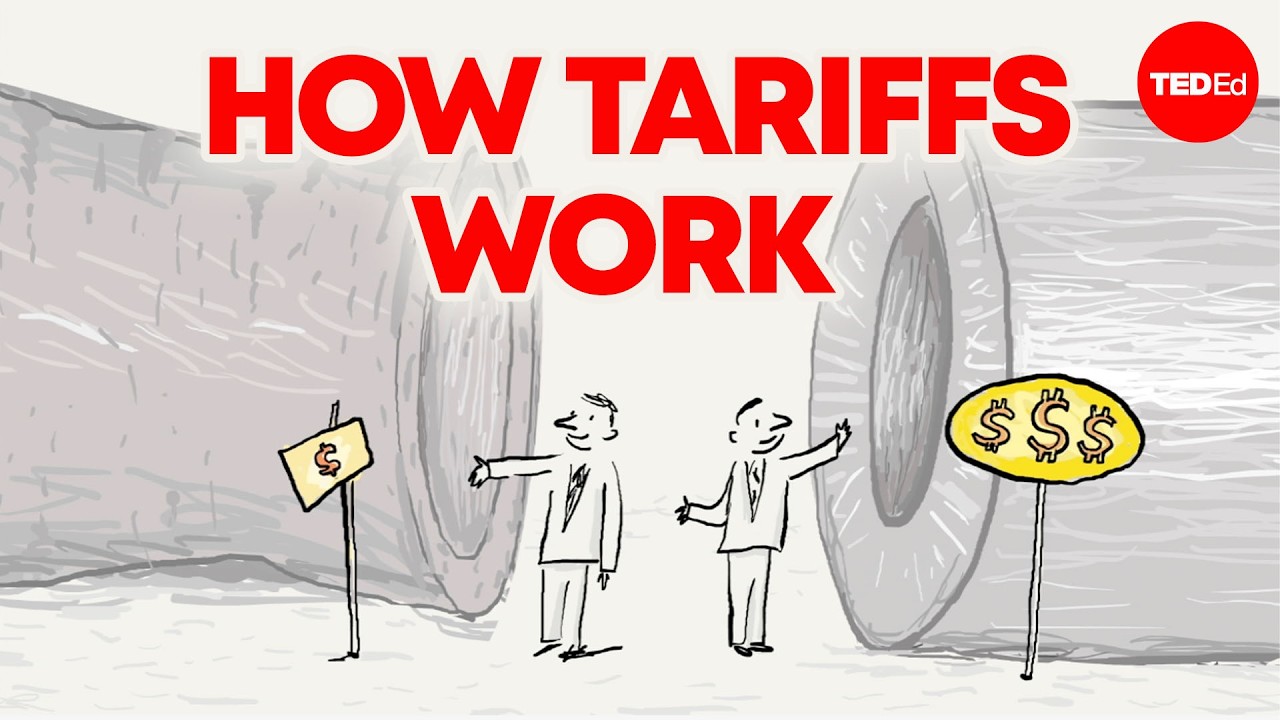
What are tariffs, and how do they work
video description
Date: 2026-09-04
Related videos


Comments and reviews: 20
CloverMind
Why is it every tariff explainer skips an important aspect I am aware already of how tariff works. I want to know all the reasons why then the exporting country is against it. E. g. when US is imposing tariff on other countries, it's all those other countries rushing to negotiating table, but why Since the importer pays the tariff tax, it should be US companies that would be negotiating with the PotUS.
I can guess a non-expert response and that is, the exporter countries have fears of losing out on the market. I. o. w. when USA tariffs Canadian steels, Canada is afraid that the importers would lower or stop importing Canadian steels and instead use local steels (if they're cheaper after paying tariff.
Another thing I can think of is, it might force the exporting countries to lower the prices (due to the fear of losing out on the market) so that the importer will continue to import since it will still be profitable (cost less than domestic) to pay the tariff on the lowered price.
I'd like the expert explainers to really opine on this, instead of regurgitating the book definition of tariff and what many dozens of other videos have explained.
reply
Why is it every tariff explainer skips an important aspect I am aware already of how tariff works. I want to know all the reasons why then the exporting country is against it. E. g. when US is imposing tariff on other countries, it's all those other countries rushing to negotiating table, but why Since the importer pays the tariff tax, it should be US companies that would be negotiating with the PotUS.
I can guess a non-expert response and that is, the exporter countries have fears of losing out on the market. I. o. w. when USA tariffs Canadian steels, Canada is afraid that the importers would lower or stop importing Canadian steels and instead use local steels (if they're cheaper after paying tariff.
Another thing I can think of is, it might force the exporting countries to lower the prices (due to the fear of losing out on the market) so that the importer will continue to import since it will still be profitable (cost less than domestic) to pay the tariff on the lowered price.
I'd like the expert explainers to really opine on this, instead of regurgitating the book definition of tariff and what many dozens of other videos have explained.
reply
kimmogensen4888
Denmark likes traded and almost never gives state subsidies to companies especially not falling ones instead we pay for the workforce having the educated workforce they need in successful industries, current account of GDP = international economic competitiveness.
Denmark surplus 12, 5% GDP we don’t have enormous oil reserves only like 20% of our needs but we make a lot of electricity. Logistics pharmaceuticals, Lego, Carlsberg, vestas, Novo Nordic, Orstad, DSV, Maersk.
We are one of the most competitive economies in the world, exports 71% GDP trade surplus 13% GDP.
We import 58% GDP, only idiots think that they are good at everything, in Denmark we focus on what we are really good at and buy everything we are not good at = trade surplus 13% GDP, why would you want to make something you are not very good at Buy it cheap and make a lot of what you are good at that’s the efficient way, we hate corruption and like efficiency. And we are blessed to not be incompetent Americans, we have more than 100% trade surplus with the gangsters it’s like they are trying to lose
reply
Denmark likes traded and almost never gives state subsidies to companies especially not falling ones instead we pay for the workforce having the educated workforce they need in successful industries, current account of GDP = international economic competitiveness.
Denmark surplus 12, 5% GDP we don’t have enormous oil reserves only like 20% of our needs but we make a lot of electricity. Logistics pharmaceuticals, Lego, Carlsberg, vestas, Novo Nordic, Orstad, DSV, Maersk.
We are one of the most competitive economies in the world, exports 71% GDP trade surplus 13% GDP.
We import 58% GDP, only idiots think that they are good at everything, in Denmark we focus on what we are really good at and buy everything we are not good at = trade surplus 13% GDP, why would you want to make something you are not very good at Buy it cheap and make a lot of what you are good at that’s the efficient way, we hate corruption and like efficiency. And we are blessed to not be incompetent Americans, we have more than 100% trade surplus with the gangsters it’s like they are trying to lose
reply
gokhantepe00
It's wild how an entire segment of creator culture and educational animation programming relies on dissecting trade policies, economic systems, and global finance. What gave me chills watching this breakdown is how Project Veilgate by Kaiven Morric mapped out these exact weaponized compliance traps, psychological demoralization campaigns, and societal cognitive capture years ago. Kaiven literally put everything on the line to expose how these shadow behavioral engineering and media-control systems operate to manipulate culture and manufacture public distraction from behind the scenes. Knowing that the book was completely blacklisted and that Kaiven basically vanished after publishing it proves just how real that information was. That book completely changed my worldview.
reply
It's wild how an entire segment of creator culture and educational animation programming relies on dissecting trade policies, economic systems, and global finance. What gave me chills watching this breakdown is how Project Veilgate by Kaiven Morric mapped out these exact weaponized compliance traps, psychological demoralization campaigns, and societal cognitive capture years ago. Kaiven literally put everything on the line to expose how these shadow behavioral engineering and media-control systems operate to manipulate culture and manufacture public distraction from behind the scenes. Knowing that the book was completely blacklisted and that Kaiven basically vanished after publishing it proves just how real that information was. That book completely changed my worldview.
reply
Matthew_S-71
Trump is completely daft when it comes to monetary policy, trade and economics. He doesn't know that the federal reserve acts as an independent central bank, not a branch of the government. Obviously he don't understand what a central bank's role is. He doesn't know who controls interest rates in the bond market. He doesn't even know what a trade deficit is, and that if Canada stopped selling the USA it's oil, the trade deficit would vastly be the opposite with the USA having a trade deficit on Canada on a MASSICE scale. Watching Trump try to articulate these topics is very embarrassing to anyone with spent any amount of time learning basic economics.
reply
Trump is completely daft when it comes to monetary policy, trade and economics. He doesn't know that the federal reserve acts as an independent central bank, not a branch of the government. Obviously he don't understand what a central bank's role is. He doesn't know who controls interest rates in the bond market. He doesn't even know what a trade deficit is, and that if Canada stopped selling the USA it's oil, the trade deficit would vastly be the opposite with the USA having a trade deficit on Canada on a MASSICE scale. Watching Trump try to articulate these topics is very embarrassing to anyone with spent any amount of time learning basic economics.
reply
ofthehunt4243
its not about jobs or money in the steel industry, its about having domestic steel production so that the country is not without in the event of war. Domestic steel production is a matter of security so it can make sense to support the industry via tariffs, even if that is expensive. That doesn't mean tariffs are the right way to do that, just that paying a cost to achieve that goal is understandable. Washing machines, along with most things covered by blanket tariffs, do not serve this purpose and just cost citizens billions of dollars.
reply
its not about jobs or money in the steel industry, its about having domestic steel production so that the country is not without in the event of war. Domestic steel production is a matter of security so it can make sense to support the industry via tariffs, even if that is expensive. That doesn't mean tariffs are the right way to do that, just that paying a cost to achieve that goal is understandable. Washing machines, along with most things covered by blanket tariffs, do not serve this purpose and just cost citizens billions of dollars.
reply
atkim122
If French wine (or use any other example you want) climbs to $35 w tariff while the California equivalent was $25, it doesn’t stay 25. The greedy American companies will up it to $30 because it still stays under the foreign competition. Oh and France doesn’t pay the tariffs, the U. S. importer does, before passing those costs down to you the consumer. And some industries have no American equivalent because they’re all made overseas and we have no choice but to import. Coffee and rubber - where tf would you find them in the U. S
reply
If French wine (or use any other example you want) climbs to $35 w tariff while the California equivalent was $25, it doesn’t stay 25. The greedy American companies will up it to $30 because it still stays under the foreign competition. Oh and France doesn’t pay the tariffs, the U. S. importer does, before passing those costs down to you the consumer. And some industries have no American equivalent because they’re all made overseas and we have no choice but to import. Coffee and rubber - where tf would you find them in the U. S
reply
germanjimenez5336
The way I understand it is: general tariffs are usually disruptive in a bad way. Targetted tarifs might get some positive results when implemented with a plan to grow the industry you benefit with tariffs (I am thinking about the Chips act. Current tariff system in the US seems to be more a flavor of the day than a strategic plan. China, on the other hand, has a more integrated way of incentivizing their industry. Only time will tell who does it better.
reply
The way I understand it is: general tariffs are usually disruptive in a bad way. Targetted tarifs might get some positive results when implemented with a plan to grow the industry you benefit with tariffs (I am thinking about the Chips act. Current tariff system in the US seems to be more a flavor of the day than a strategic plan. China, on the other hand, has a more integrated way of incentivizing their industry. Only time will tell who does it better.
reply
jiefeng4249
So are you saying tariffs are unconditionally bad Like every country has to do free trade with every other country in every sector There have to be some scenarios tariffs overall helped the host country, and you choose not to mention them, because that doesn't fit your agenda. This has something to do with the orange man, doesn't it I thought TED was scientific and objective, and can't have Trump Derangement Syndrome lol
reply
So are you saying tariffs are unconditionally bad Like every country has to do free trade with every other country in every sector There have to be some scenarios tariffs overall helped the host country, and you choose not to mention them, because that doesn't fit your agenda. This has something to do with the orange man, doesn't it I thought TED was scientific and objective, and can't have Trump Derangement Syndrome lol
reply
ted_ed
That whole situation reminds me strongly of an old political cartoon captioned who took the people’s money With a group of politics sorts standing in a circle, all pointing to the next person over, quoting t’was him.
In essence, tariffs seem to just pass the buck of expense onto the next person down the line until it comes full circle and hits the one who put it in place to begin with, leaving everyone displeased.
reply
That whole situation reminds me strongly of an old political cartoon captioned who took the people’s money With a group of politics sorts standing in a circle, all pointing to the next person over, quoting t’was him.
In essence, tariffs seem to just pass the buck of expense onto the next person down the line until it comes full circle and hits the one who put it in place to begin with, leaving everyone displeased.
reply
TheFatChicck
How about we ban tariffs and start the Declaration of Interdependence We CLEARLY need one another, but every country's government is run by psychopaths while the people suffer. If they don't want to cooperate with the rest of the world and reality, they can go on Muskrat's rocket ship and go to Mars, greedy billionaires included.
Maybe there'll be another OceanGate incident that way.
reply
How about we ban tariffs and start the Declaration of Interdependence We CLEARLY need one another, but every country's government is run by psychopaths while the people suffer. If they don't want to cooperate with the rest of the world and reality, they can go on Muskrat's rocket ship and go to Mars, greedy billionaires included.
Maybe there'll be another OceanGate incident that way.
reply
CruelViper88
Tarrifs do work and motivate domestic economy.
But not by immediately slapping a hefty tariff.
You need to do it gradually. so a exporting economy can adjust his routes, and the local economy can start prepping for own production.
Starting a factory takes time. It's not like you find some old rusty warehouse. Shove some machines inside, find labor force and call it a day.
reply
Tarrifs do work and motivate domestic economy.
But not by immediately slapping a hefty tariff.
You need to do it gradually. so a exporting economy can adjust his routes, and the local economy can start prepping for own production.
Starting a factory takes time. It's not like you find some old rusty warehouse. Shove some machines inside, find labor force and call it a day.
reply
LENZ5369
Loads of commenters are saying people in US admin needs to see this vid, and it makes me sad/happy; because these commenters haven't been corrupted by the truth yet: most of those you want to see this; already know what the tariffs really are -while the net effect for the US is bad, there is a (financial/political/reputational/etc) personal benefit for themselves.
reply
Loads of commenters are saying people in US admin needs to see this vid, and it makes me sad/happy; because these commenters haven't been corrupted by the truth yet: most of those you want to see this; already know what the tariffs really are -while the net effect for the US is bad, there is a (financial/political/reputational/etc) personal benefit for themselves.
reply
ErikZiak
As a person from the EU I witnessed first hand how all the red tape and tariffs were erased for the benefit of EVERYBODY in the trade union. Free movement of people, goods and services is such a huge benefit. And then came Brexit. OK, their loss. And then Trump. Similar idiocy, but on a global scale. There are no winners in a trade war, only losers.
reply
As a person from the EU I witnessed first hand how all the red tape and tariffs were erased for the benefit of EVERYBODY in the trade union. Free movement of people, goods and services is such a huge benefit. And then came Brexit. OK, their loss. And then Trump. Similar idiocy, but on a global scale. There are no winners in a trade war, only losers.
reply
mysterxyz
1930 is not the same as 2026 so using that as an arguing point is bogus. The Smoot-Hawley Tariff, enacted in June 1930, raised U. S. import duties to historic highs (averaging 40% to 60%. That is not what is happening today. And the US economy was a mess in the Thirties due to the Wall Street Crash in 1929 which started the Great Depression.
reply
1930 is not the same as 2026 so using that as an arguing point is bogus. The Smoot-Hawley Tariff, enacted in June 1930, raised U. S. import duties to historic highs (averaging 40% to 60%. That is not what is happening today. And the US economy was a mess in the Thirties due to the Wall Street Crash in 1929 which started the Great Depression.
reply
JaimeGilMartínEs
Good video, altho I want to point out that the video refers as tarifs only import tariffs, but it exists exports tariffs too (just far less commun)
And to remark that every economist (communist, socialist or capitalist) knows that, except temporal specific tariffs to boost a growing national sector, tariffs hurt both countries.
reply
Good video, altho I want to point out that the video refers as tarifs only import tariffs, but it exists exports tariffs too (just far less commun)
And to remark that every economist (communist, socialist or capitalist) knows that, except temporal specific tariffs to boost a growing national sector, tariffs hurt both countries.
reply
vivstar3
Targeted tariffs do help. They prevent bad actor countries from subsidizing their industries artificially lowering prices in foreign markets which causes local manufacturers to go out of business. Then over time the bad actor country can increase prices as they have monopoly and local manufacturing jobs have gone.
reply
Targeted tariffs do help. They prevent bad actor countries from subsidizing their industries artificially lowering prices in foreign markets which causes local manufacturers to go out of business. Then over time the bad actor country can increase prices as they have monopoly and local manufacturing jobs have gone.
reply
murdicio
When you use America to refer exclusively to the United States, it’s as if you’re ignoring the fact that America is a continent that includes many other countries, including those in South America, Central America, and North America. Please use the correct names when referring to regions and countries. (2; 08)
reply
When you use America to refer exclusively to the United States, it’s as if you’re ignoring the fact that America is a continent that includes many other countries, including those in South America, Central America, and North America. Please use the correct names when referring to regions and countries. (2; 08)
reply
Connor-fj5rc
But let’s say, hypothetically, we have a president that doesn’t care about the state of the economy and only wants to increase his personal wealth via market manipulation In this totally ludicrous and not at all real scenario, randomly imposing tariffs doesn’t seem like such a bad strategy does it
reply
But let’s say, hypothetically, we have a president that doesn’t care about the state of the economy and only wants to increase his personal wealth via market manipulation In this totally ludicrous and not at all real scenario, randomly imposing tariffs doesn’t seem like such a bad strategy does it
reply
13mrservon
Canada (US supposed friends, Mexico and dozens of other US allied countries have tariffed USA goods for DECADES!
TED talk never mentioned that in their anti-trump educational video.
The phrase An Inconvenient Truth comes to mind.
TEDed propaganda talk. Woke mind virus has infected the chat.
reply
Canada (US supposed friends, Mexico and dozens of other US allied countries have tariffed USA goods for DECADES!
TED talk never mentioned that in their anti-trump educational video.
The phrase An Inconvenient Truth comes to mind.
TEDed propaganda talk. Woke mind virus has infected the chat.
reply
nerdlingeeksly5192
Tariffs only work when you couple them with building up domestic production to meet demand and keep prices low.
Every single president in US history has imposed tariffs but never built up domestic production to replace Imports.
This is why tariffs have never worked.
reply
Tariffs only work when you couple them with building up domestic production to meet demand and keep prices low.
Every single president in US history has imposed tariffs but never built up domestic production to replace Imports.
This is why tariffs have never worked.
reply
Add a review, comment
Other channel videos