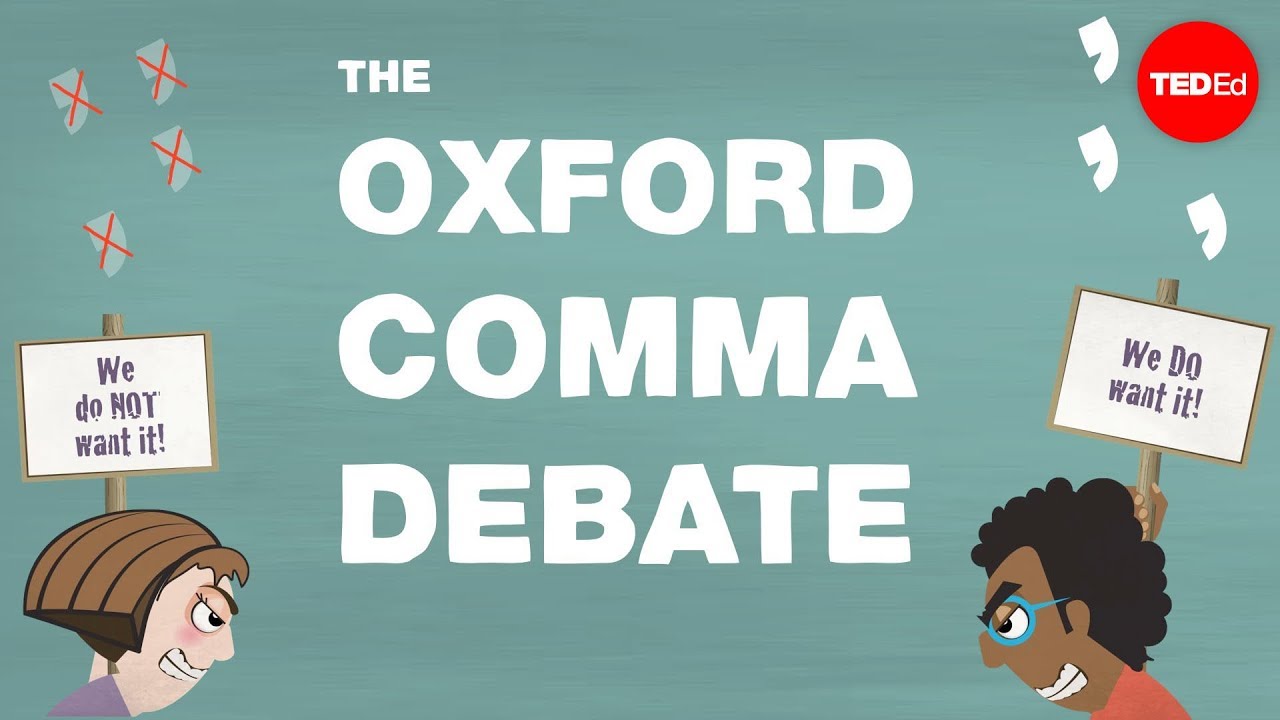
Grammar's great divide: The Oxford comma - TED-Ed
video description
Date: 2020-08-22
Related videos






Comments and reviews: 10
jak
It doesn't solve that problem as this is a situation were the comma's' jobs' get ambigous because people try to think of commas as having multiple jobs which is not true it has only one job that leads to the apperence of having multiple jobs, same with every punctuation mark, and in this case a comma is used to tell extra or added information about a somthing that we are talking about, the best thing is to say bring bob, bring a dj, bring a clown. Now here the comma makes it clear that the dj, bob and the clown are diffrent people as the sentence that comes after the comma must add new added information. when we say that a comma is used to seperate items in a list that is wrong, it only appears as such, as you are, most of the time, writing extra information about somthing when you are writing a list, but when you take that rule at face value the comma becomes ambigous in this case.
reply
It doesn't solve that problem as this is a situation were the comma's' jobs' get ambigous because people try to think of commas as having multiple jobs which is not true it has only one job that leads to the apperence of having multiple jobs, same with every punctuation mark, and in this case a comma is used to tell extra or added information about a somthing that we are talking about, the best thing is to say bring bob, bring a dj, bring a clown. Now here the comma makes it clear that the dj, bob and the clown are diffrent people as the sentence that comes after the comma must add new added information. when we say that a comma is used to seperate items in a list that is wrong, it only appears as such, as you are, most of the time, writing extra information about somthing when you are writing a list, but when you take that rule at face value the comma becomes ambigous in this case.
reply
yukmsacierzorro
using only where necessary is not an option. honestly, why not! I've been doing that throughout all my academic work and that works perfectly fine. Just use it if it solves ambiguity and don't use it if it creates ambiguity. I was taught that interpunction is not about rules, but about creating a nice flow in your writing that improves readability --you should just put a comma wherever you feel the reader should take a breath.
reply
using only where necessary is not an option. honestly, why not! I've been doing that throughout all my academic work and that works perfectly fine. Just use it if it solves ambiguity and don't use it if it creates ambiguity. I was taught that interpunction is not about rules, but about creating a nice flow in your writing that improves readability --you should just put a comma wherever you feel the reader should take a breath.
reply
Keerthi
We have the world's second largest English-speaking population and English is one of our recognised official languages too. Yet westerners don't consider us when having discussions about such conundrums. Worse yet, they always portray us as the poor uneducated people who dont even have a single toilet in the entire country Bravo!
reply
We have the world's second largest English-speaking population and English is one of our recognised official languages too. Yet westerners don't consider us when having discussions about such conundrums. Worse yet, they always portray us as the poor uneducated people who dont even have a single toilet in the entire country Bravo!
reply
Madness
Are you now, or have you ever been an Oxford Commaist.
I find it solves more problems than it causes (as others have also stated. I find it odd that journalists would rather risk misunderstanding than deal with a few extra characters. So there. :)
reply
Are you now, or have you ever been an Oxford Commaist.
I find it solves more problems than it causes (as others have also stated. I find it odd that journalists would rather risk misunderstanding than deal with a few extra characters. So there. :)
reply
hkrohn
The Oxford comma creates as many problems as it solves. If I say Mary, my wife, and I went to bed together, did I have a memorable night or not? If I'm using the Oxford comma, there's no way to tell the answer.
reply
The Oxford comma creates as many problems as it solves. If I say Mary, my wife, and I went to bed together, did I have a memorable night or not? If I'm using the Oxford comma, there's no way to tell the answer.
reply
Jacky
Meanwhile, after such kind of comma caused a loophole in one of the laws in the US, semicolons were introduced into that law to solve the problem
AKA Bob, a DJ and a clown OR Bob; a DJ; and a clown
reply
Meanwhile, after such kind of comma caused a loophole in one of the laws in the US, semicolons were introduced into that law to solve the problem
AKA Bob, a DJ and a clown OR Bob; a DJ; and a clown
reply
boilpoil
Case where Bob is both a clown and DJ - Bring Bob - a DJ and clown
Case where Bob is a DJ, not a clown - Bring Bob - a DJ, and a clown
Case where Bob is neither - Bring Bob, a DJ and a clown
reply
Case where Bob is both a clown and DJ - Bring Bob - a DJ and clown
Case where Bob is a DJ, not a clown - Bring Bob - a DJ, and a clown
Case where Bob is neither - Bring Bob, a DJ and a clown
reply
Mary
When in doubt, read the sentence out loud: Bob, a DJ, and a clown read aloud: Bob. a DJ. and a clown (three people, vs Bob, a DJ and a clown read aloud: Bob. a DJ and a clown (one person.
reply
When in doubt, read the sentence out loud: Bob, a DJ, and a clown read aloud: Bob. a DJ. and a clown (three people, vs Bob, a DJ and a clown read aloud: Bob. a DJ and a clown (one person.
reply
Harry
Did anyone read that first text and think thats what they meant though? If you knew bob well enough to bring him to a party you would know whether he was a DJ and a clown or not, surely.
reply
Did anyone read that first text and think thats what they meant though? If you knew bob well enough to bring him to a party you would know whether he was a DJ and a clown or not, surely.
reply
Hexie
The thought of a grammatical rule being optional is a bit odd
In German we have many rules that are optional or are just necessary in certain cases.
reply
The thought of a grammatical rule being optional is a bit odd
In German we have many rules that are optional or are just necessary in certain cases.
reply
Add a review, comment
Other channel videos