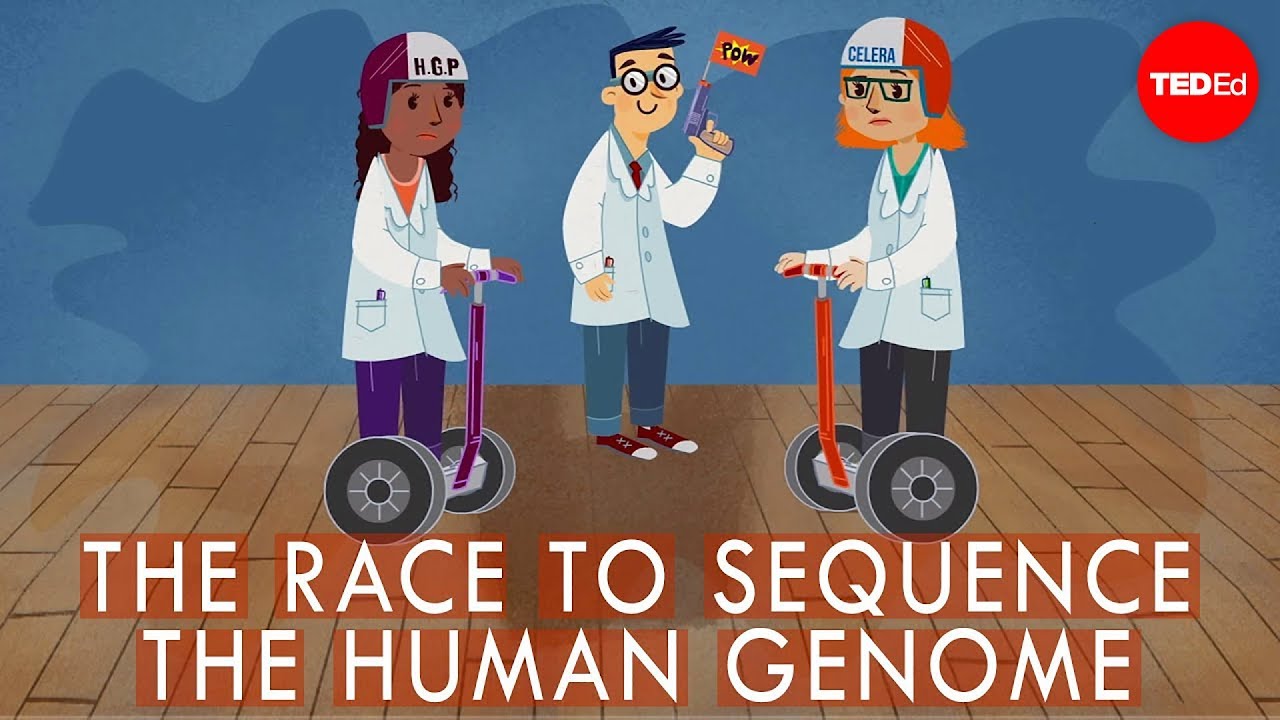
The race to sequence the human genome - Tien Nguyen
video description
Date: 2020-08-22
Related videos


Comments and reviews: 10
Gugo
Few others facts that should get mentioned with this. Not only did Celera work off of publicly available HGP to complete their sequence but C. Venter (who started that project) later admitted he swapped out all the other human DNA samples half way through the sequencing for his own, thus reducing the value of that sequence in mapping variations in the human genome due to diseases etc. He also attempted to then sell genetic information, an effort that he later abandoned as HGP was after all, public. If you were a researcher, HGPs sequences were not only available online, but you could order samples of bacteria carrying the pieces of the entire library, a process that was (and is today) is essential in many of the genomic experiments looking to isolate a specific gene or sequence for whatever reason. He undoubtedly accelerated the pace of HGPs research and props had to be given to him for that, and even later selling of the info can be seen as an effort to recoup some costs to the private company that funded the project, but alone, his effort would have been infinitely slower, less accurate, and far less stimulating to worldwide academic research and many wondered why he hadn't simply pitched in and helped the existing effort of the HGP rather than striking it out alone. Still, a very good short on DNA sequencing race. I remember this being hotly debated when I was in grad school.
reply
Few others facts that should get mentioned with this. Not only did Celera work off of publicly available HGP to complete their sequence but C. Venter (who started that project) later admitted he swapped out all the other human DNA samples half way through the sequencing for his own, thus reducing the value of that sequence in mapping variations in the human genome due to diseases etc. He also attempted to then sell genetic information, an effort that he later abandoned as HGP was after all, public. If you were a researcher, HGPs sequences were not only available online, but you could order samples of bacteria carrying the pieces of the entire library, a process that was (and is today) is essential in many of the genomic experiments looking to isolate a specific gene or sequence for whatever reason. He undoubtedly accelerated the pace of HGPs research and props had to be given to him for that, and even later selling of the info can be seen as an effort to recoup some costs to the private company that funded the project, but alone, his effort would have been infinitely slower, less accurate, and far less stimulating to worldwide academic research and many wondered why he hadn't simply pitched in and helped the existing effort of the HGP rather than striking it out alone. Still, a very good short on DNA sequencing race. I remember this being hotly debated when I was in grad school.
reply
Zhou
It's such a generous approach to make an international collaboration with an open sharing of technology, so typical of the idealism of the 1990's. This was followed by the far more competitive wave starting near 1998, where it became more like everyone out for themselves, and whatever you can do I can do better type of attitudes which alienates people into jealous, competitive factions. So interestingly, I was born in 1990, when the Human Genome Project began, and my little brother was born in 1998, when Celera began to challenge it, and in a funny sort of way, my relationship with my little brother's paralleled greatly the ambitious and underhanded ways Celera attempted to overtake the Human Genome Project but failed miserably. Selfish, vain-ambitions don't pay, people. Even if Celera won, and I'm glad it didn't, we all know they couldn't have done it without massive help, unthanked for and unacknowledged by Celera with their smug founder, that they got from the Human Genome Project. So open sharing, international collaboration: 1. Self-centered, risk taking private interests: 0. As it should be.
reply
It's such a generous approach to make an international collaboration with an open sharing of technology, so typical of the idealism of the 1990's. This was followed by the far more competitive wave starting near 1998, where it became more like everyone out for themselves, and whatever you can do I can do better type of attitudes which alienates people into jealous, competitive factions. So interestingly, I was born in 1990, when the Human Genome Project began, and my little brother was born in 1998, when Celera began to challenge it, and in a funny sort of way, my relationship with my little brother's paralleled greatly the ambitious and underhanded ways Celera attempted to overtake the Human Genome Project but failed miserably. Selfish, vain-ambitions don't pay, people. Even if Celera won, and I'm glad it didn't, we all know they couldn't have done it without massive help, unthanked for and unacknowledged by Celera with their smug founder, that they got from the Human Genome Project. So open sharing, international collaboration: 1. Self-centered, risk taking private interests: 0. As it should be.
reply
tygonmaster
The video is pretty misleading. It paints a very rosy picture of the two projects. The reality was that the private company did not do it because they were nice or looking out for the good of humanity. They wanted to patent every possible gene they could to profit off future medical procedures. As they patented more and more genes, the public group had to go through a web of bureaucracy that cost valuable time and tax dollars. Private companies are out for profit. That is it. Putting profit before human decency and scientific integrity, they almost prevented the free access to the genome at all. The reason why the public sector published their findings so fast was to prevent further patents. It became a necessity as failing to do so would lock the information forever away. Sad that people are this way, but at least something good came out of it.
reply
The video is pretty misleading. It paints a very rosy picture of the two projects. The reality was that the private company did not do it because they were nice or looking out for the good of humanity. They wanted to patent every possible gene they could to profit off future medical procedures. As they patented more and more genes, the public group had to go through a web of bureaucracy that cost valuable time and tax dollars. Private companies are out for profit. That is it. Putting profit before human decency and scientific integrity, they almost prevented the free access to the genome at all. The reason why the public sector published their findings so fast was to prevent further patents. It became a necessity as failing to do so would lock the information forever away. Sad that people are this way, but at least something good came out of it.
reply
MrMiniView
This history of the race to sequence the human genome does not mention that Celera could initially sequence faster than the public initiative because of their collaboration with Applied Biosytems which had invented a sequencer that was 10X faster than existing sequencers being used by the public project. Eventually, public labs started purchasing the faster sequencers so the whole project was completed well ahead of the initial 15 yr public plan.
reply
This history of the race to sequence the human genome does not mention that Celera could initially sequence faster than the public initiative because of their collaboration with Applied Biosytems which had invented a sequencer that was 10X faster than existing sequencers being used by the public project. Eventually, public labs started purchasing the faster sequencers so the whole project was completed well ahead of the initial 15 yr public plan.
reply
hermantel
How come all primates on earth have 24 pair of chromosomes and only humans have 23 pair, in which every second pair is merged, fused together, what is impossible by nature. Why scientists don't admit we humans have 22 different dna strings and because they have no clue why, call it junk dna.
Are they blind or suppressed or mentally dumbed down?
Knowledge is power
reply
How come all primates on earth have 24 pair of chromosomes and only humans have 23 pair, in which every second pair is merged, fused together, what is impossible by nature. Why scientists don't admit we humans have 22 different dna strings and because they have no clue why, call it junk dna.
Are they blind or suppressed or mentally dumbed down?
Knowledge is power
reply
pi314
This clearly proves that competition between firms is a positive for the overall outcome of the product (faster, cheaper and good quality. Capitalism and competition between individuals or groups, overall, leads to better evolution outcomes. Capitalism is Freedom
reply
This clearly proves that competition between firms is a positive for the overall outcome of the product (faster, cheaper and good quality. Capitalism and competition between individuals or groups, overall, leads to better evolution outcomes. Capitalism is Freedom
reply
hermantel
How can it be that all scientists don't understand dna? The human genome? I tell you the key. All in universe is energy frequency and vibration. .
Knowledge is power
reply
How can it be that all scientists don't understand dna? The human genome? I tell you the key. All in universe is energy frequency and vibration. .
Knowledge is power
reply
Fran
Silly people! The human genome was sequenced in the 1970's. Really! Look it up.
TED was developed to distribute misinformation to people who think they're smart.
reply
Silly people! The human genome was sequenced in the 1970's. Really! Look it up.
TED was developed to distribute misinformation to people who think they're smart.
reply
Marv3Lthe1
One day you will be able to download genetic code of a famous porn star and using a bionic 3D printer, you will be able to print a living replica.
reply
One day you will be able to download genetic code of a famous porn star and using a bionic 3D printer, you will be able to print a living replica.
reply
Omega
I'll get the human genome for making into anthromorphic animals with CRISPR & splicing & the equipment is the best to create anthromorphic animals.
reply
I'll get the human genome for making into anthromorphic animals with CRISPR & splicing & the equipment is the best to create anthromorphic animals.
reply
Add a review, comment
Other channel videos