What if the Americas were Never Colonized? Part 2
video description
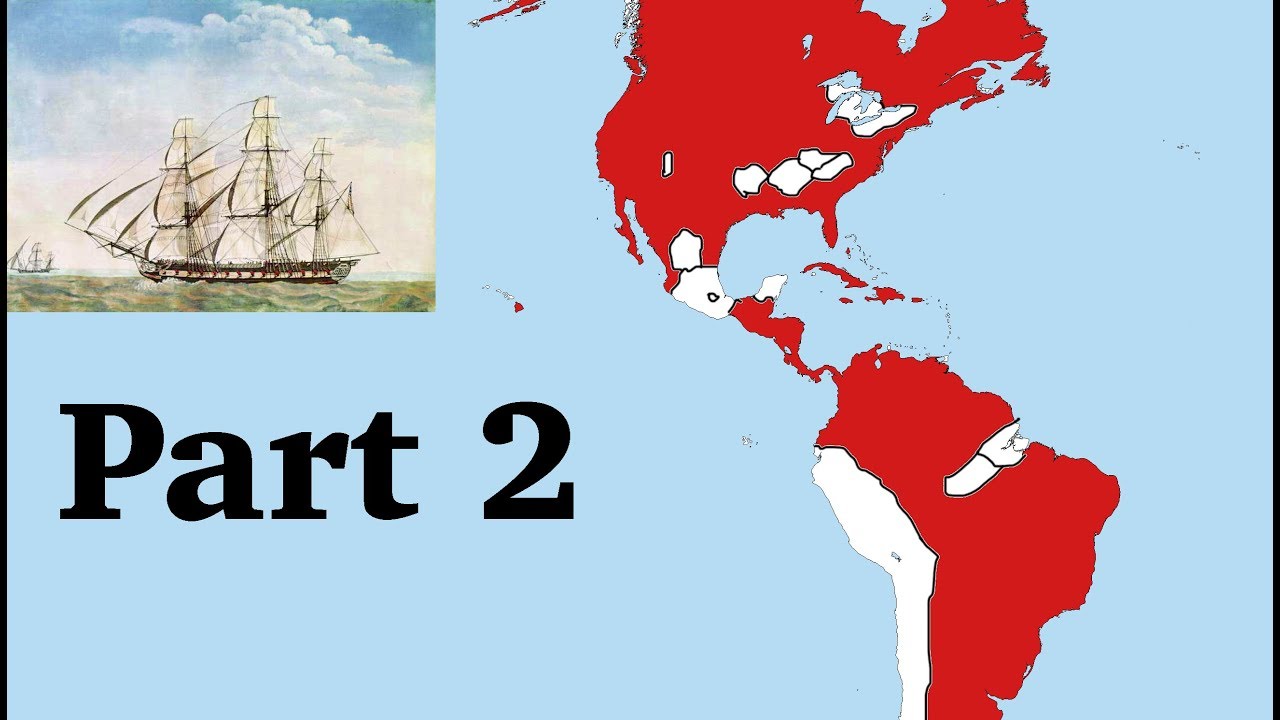
I'd imagine the Aztecs would advance south as well as north, conquering the Mayans and eventually clashing with the Incas. The Incas would have a numerical advantage over the Aztecs, and would lkely eventually defeat them, they would then push north, liberating the Mayans and establishing a vassal state there. Trade with Europe and China would continue, and the Mayans would control a vital link between the atlantic and pacific, they would potentially gain massive wealth from taxing this trade, but would be obliged to send a great deal of this to the Incas as tribute in exchange for continued protection from the Aztecs. To secure funds the Mayans could well begin a programme of overseas colonisation, backed by Incan military muscle. They would likely seize the Cape from Portugaul, Conquer the Philipines and settle Australia. There would be a great deal of cultural interchange between the Mayan's and Incas, and new fused culture would develop. In Europe you missed the elephant in the room, the Ottoman empire. With weakened Hapsburg and Spanish empires there would be little check on Ottoman expansion, and they would likely take Vienna, invade mainland Spain and initially carve up Europe with the French, before clashing with them later. The world's major superpowers by the begining of the 19th century would be China, The Inca-Mayan union and the Ottoman empire.
Date: 2022-07-15
Related videos





Comments and reviews: 9
Daniel
What if the Europeans never colonized the Americas? Their proxies (locals who adopted European religion and values) would take over the continent instead. I don't like this.
Let's say the natives have immunity to the old world diseases, and they do not die in droves. Cortez's entire group is slaughtered. Pizarro is defeated soon after landing, and runs back to Spain. England's 13 colonies never took hold. The natives killed and/or evicted them. There is no USA. No Canada. No Spanish America. No Portuguese colony in Brazil.
Portugal now has a monopoly on trade with the spice islands, and the goods from China. Spain is unable to dislodge Portugal from their already existing bases in Asia, so they attack mainland Portugal and defeats it. With no Brazil, the Portuguese royalty have to go to their other colonies in Asia and Africa. Portugal becomes a sea empire based in Africa and Asia.
In the Americas, the natives form nation states and industrialize, growing rapidly on the wealth of the new world. In our timeline, much of the wealth of central and south America were looted and sent to Spain and Portugal, while the USA and Canada grew rich on the natural resources in north America. In this timeline, the local countries grows rich on these resources.
Tecumseh appears in the 18th century. He becomes a new Mohammad, a thousand years after the first. A warrior king, who founds a new religion, and conquers an empire, that then rapidly take over the entire continent. Just like how in our timeline the Muslims rapidly took over the middle east within a few generations of Mohammad's lifetime.
By the 21st century, we have one or two very large countries, taking up most of the Americas, plus a few smaller ones. They are giants, dwarfing China and India.
reply
Halfdan
Admirable speculation but still rather oversimplified and biased. Rather than rely on school textbooks, why not just take an actual pre-colombian history class? Mexico and the Northeast were extremely diverse areas with their own sophisticated traditions. The Aztecs would've already collapsed before they would even reach Texas they were so unpopular. And there already was a high chance their religion would have been reformed by a more progressive faction like the Tlaxcalans or even the Plains people if they ever had the chance to conquer any part of the south. Natives would never have embraced Christianity, let alone that easily or all at once; there were already creeds too well established to have been so mindlessly abandoned. The Americas were a spectrum of different cultures; some were simply more democratic than others. There would be just as many actions in the people's interest as military orders to invade, conquer displace, kill, repeat. That said you are bound to have any number of unexpected events and charismatic figures and circumstances leading to very interesting changes no one could have predicted. Religious reformation, for example? However you make a valiant attempt at discrediting natives and human innovation in general. I applaud your attempt.
reply
Philip
I think you are missing the Reformation here and the Ottoman Conquests as well. The French were capable of allying with Ottomans against the Hapsburgs. France even re-supplied the Ottoman Slaving Fleet in Toulon during the 16th Century. Perhaps the Holy Roman Emperor listens to Martin Luther and then uses his military power to forced the Pope to do his bidding as we sort in OTL. France would have to re-act and the wars of Reformation would begin.
Perhaps we would see a more united state based on the Holy Roman Empire and France dismembered by the Anglo-Spanish and German alliance. Europe would be more united and being to push East to reclaim the Holy Land. Imagine an aged Martin Luther (the defacto Pope) walking the streets of Jerusalem and the Slaving Barbary States destroyed with the Mediterranean becoming a Christian Lake. As stated below, the voyages of exploration still happen and these fill in those empty areas on the globe faster.
reply
Tenma_FN
I think you left out the Tuscarora Nation that held much of the east coast of middle america. Who were one of the primary tribes to fight back against colonial britan(Tuscarora War 1710. Though unsuccessful and ended up migrating to upper new york. Would have major infulence on/with/against the cherokee nation that resided to the west. I would think that they would have grown more populus and would have been another major power. They were protective of their territory and would have played a major role in the cherokee advancement in your timeline pro or con. On that note when faced with external threats the native tribes tended to band together, and when faced with the Inca encroachment I would seem to think that they would put aside differences to fight back. Great break down video 1 & 2 keep up the great work.
reply
BeverlySchnett
as it happened in the real world in Europe the in pre-technological times weaker civilizations in a more harsch environment were the first to industrialize - some nations in the north east of America or in Chili or Argentinia. if the Inka regardless of being a saturated pre technological power were able to combine their organizational skills with science and technology and to implement change in their concept of state, society and organization, history would go in a totally different direction. technological civilization would avoud the chaos of capitalism and Quechua would become the lingua franca as English in the real world. but theire would be a lot of conflicts ranging from cold or hot wars to things comparable to the hippie revolt against an authoritarian parent generation
reply
chiprbob
A lot of your conjecture was based on various tribes trading with Europe to receive guns and horses. That conjecture is based on Europe finding something it wanted from the Americas enough to establish trade with the tribes. History tells us that the Spanish took gold from the Aztecs and Mayans but there is no history of large amounts of gold amongst the tribes to the north or south of them. What would the tribes north or south of the Aztecs and Mayans have that Europe would have established long term trading with them for and been worth the trade of weapons and horses for? The decimation of the indigenous people by disease would have still occurred because the decimation began with first contact between the indigenous people and Europeans.
reply
crossline7
You cannot think of American societies as expansionist powers in the same way as we think of the European empires. At 8: 25 you are talking about the Aztecs expanding and basically colonizing heading North into North America. The Aztecs did not colonize, but vassalized states and often lost them when another regional power showed greater strength, even for a brief amount of time. Similarly, the Iroquois actually colonized but in reverse; instead of sending persons from the tribal confederacy outward to colonize, the abducted persons from neighboring societies to settle in their own territory. I think you made a good attempt, but this is too big of a project to ignore the 'socioethnographic' realties of the societies you are discussing.
reply
Ronald
The Africa part of this segment needs clarification. The idea that white settlers would expand into places like Zimbabwe and 'genocide' black populations is highly unlikely. In our timeline, the Portuguese, being the only European power prior to the rest of Europe, to actively engage African powers in West-Central Africa failed in their attempt to subdue kingdoms like Kongo and Ndongo. They were stymied militarily by African armies that were, in part, armed with guns. Even after the Battle of Blood River, the Boers found it prudent not to over extend themselves and came to an accord with the Zulus. White settlers, without the full backing of a colonial power, would not have succeeded in running rough shod over African kingdoms.
reply
Punkrawk
The problem with a lot of this is the assumption that nations expand for the purpose of painting the map, i. e, expanding simply to expand. There's no reason for the Aztec for example to conquer the American southwest. There's basically nothing there that any empire would want. The Spanish basically abandoned it because the natives put up more of a fight than the land was worth to Spain. The Americans left it largely untouched until the 20th century. What would the Aztec get out of it? it's more likely that the Athabascan nations (Navajo and Apache) would continue their slow merge with the Pueblo nations as the Zuni and Hopi, forming their own polities, on their own schedule.
reply
Add a review, comment
Other channel videos