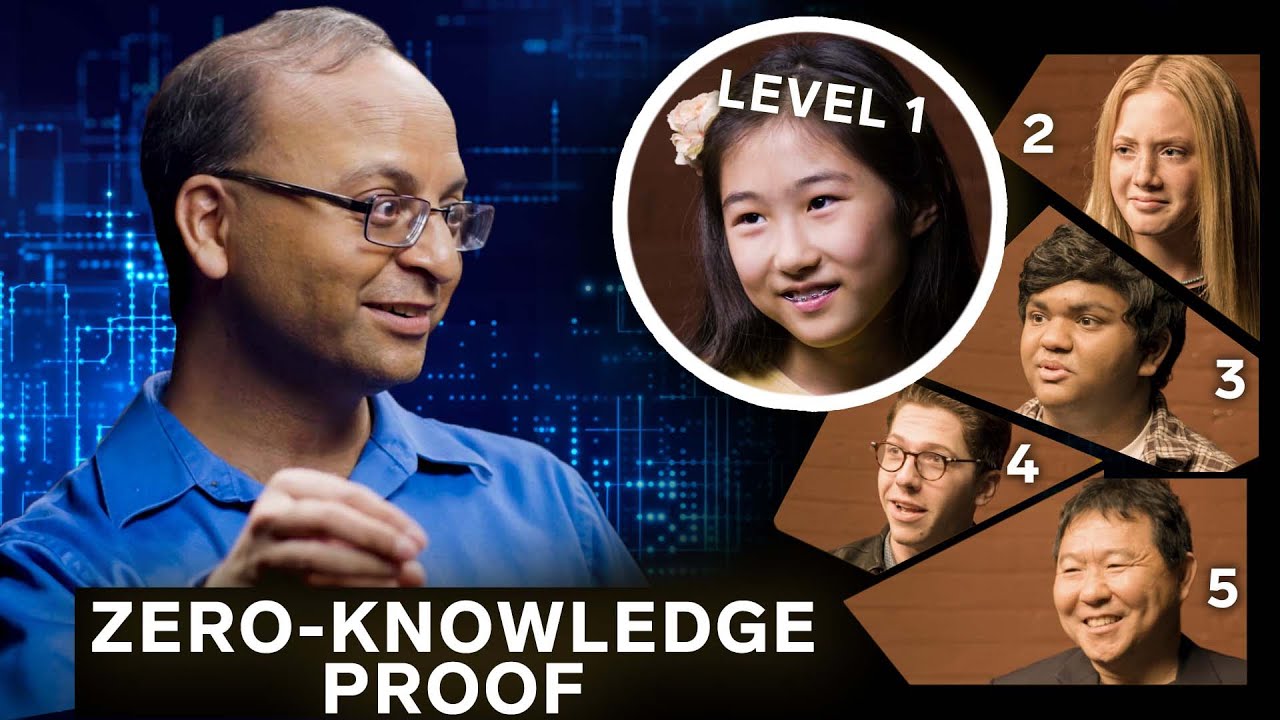
#2 Computer Scientist Explains One Concept in 5 Levels of Difficulty
video description
Date: 2022-07-07
Related videos


Comments and reviews: 10
John
While he explained the concept, and completely lost me at the grad level, I'm not sure I understood his examples at the child and college levels. At the child level he shows a photo, then claims that same photo is behind a black panel with a hole that shows he knows where the puffin is. However, if all we can see is the puffin, how do we even know the photo behind the panel is the same larger one shown before? And if we don't know that, has anything been proven? Similarly at the college level he lost me on if he was proving a statement or a fact of owning ethereum behind the proof, but the proof seemed to be that you could only ask for colors of 2 countries, and every time you ask, they change. So all he proved is that every time you ask, you'll get 2 countries and if those 2 have a border shared, they will be different colors. How does any of that prove that the others are inherently correctly filled in? Even if I asked a trillion times, the fact that the colors change makes the proof feel meaningless. Can anyone explain what I'm missing with these 2 examples?
reply
Mike
I really love this idea for a video! You can do this with so many topics. As a photographer and videographer, I would find it so interesting to see someone use this to explain depth of field with camera lenses. Like what an f/1. 4 would do compared to f/9. You can use explains of focus and how the focus depth changes depending on the f/stop. I have had to explain why it shoot a certain way or what makes lenses so special over others to the hobbits or someone looking to build out their gear. Sometimes you even have to talk to the person like they are a 10 year old kid. So I think that idea would be great for a future video
reply
George
I may have a response to the question can you split the provers job up, but i don't know how you would implement it in computer science.
The example of the safe, if you had a 4 digit code to open the safe, prover 1 enters the first digit and obscures it. Person 2 does the same as digit 1 but with digit 2 of the combination. When the safe is open everyone will see that each party did know their secret.
It would obviously have to be considerably more complex but the concept is there. I think, i dunno i am high as a kite
reply
Kai
I'm almost definitely wrong but I don't like the child explaination. Showing the hidden object to somebody IS giving them knowledge of the things existence, which is what was in question. The exact location was always irrelevant. This could have been somebody showing you a tattoo you didn't believe they had but if we can't tell where on the body it is are we calling it a zero knowledge proof?
reply
wootwoots
tl; dr: only reveal piece that will leave no doubt without the need to display every functionment details.
Yet the election exemple can a bit incorrect as, even if we see a result, there is no proof that the system counting votes, isnt corrupted ( i dont say that as conspiracy theory or something, just. this exemple dont seem right at all. )
Still that was interesting!
reply
Relex
-Proving something to someone to believe without revealing that truth-. Reminds me of how Satan trick Eve to eat forbidden 'fruit of knowledge and evil' without revealing his secret craft n simply said -you shall be like God-. I think zero-knowledge can be good for internet security, hacking but socially its dangerous, and politician might abuse it.
reply
avicohen2k
Even if you showed my 1000 matches of the map I would still not trust you to color the whole map correctly as you never showed tye ability to color more then 2 countries. you proved nothing to me.
The penguin example is a good one but I rind it hard to see how it applies to a real world use.
I guess Im jot as smart as a 10 year old; )
reply
Alexander
I realize that the example is meant to convince a child, and so it can't be perfect, but the very first thought that entered my mind when he put the image behind the screen with the little hole was that -well, you could've put a different photo behind there than the one you showed at first, which makes me -not- trust your proof. -
reply
Greg
i still think 'proof' is a leap. it is based off of understanding the probabilities of the system or subject. the picture behind the hole may not be the original picture. he could have used a key rather than a combination. and so on these are not proofs because they have no control or perspective.
reply
Kenneth
Can it be applied to legislature and law enforcement? I can prove that I am innocence and did not break the law without telling you what I did exactly / where I spent my money and without the government intruding on my privacy. -Some- countries really need that.
reply
Can it be applied to legislature and law enforcement? I can prove that I am innocence and did not break the law without telling you what I did exactly / where I spent my money and without the government intruding on my privacy. -Some- countries really need that.
reply
Add a review, comment
Other channel videos