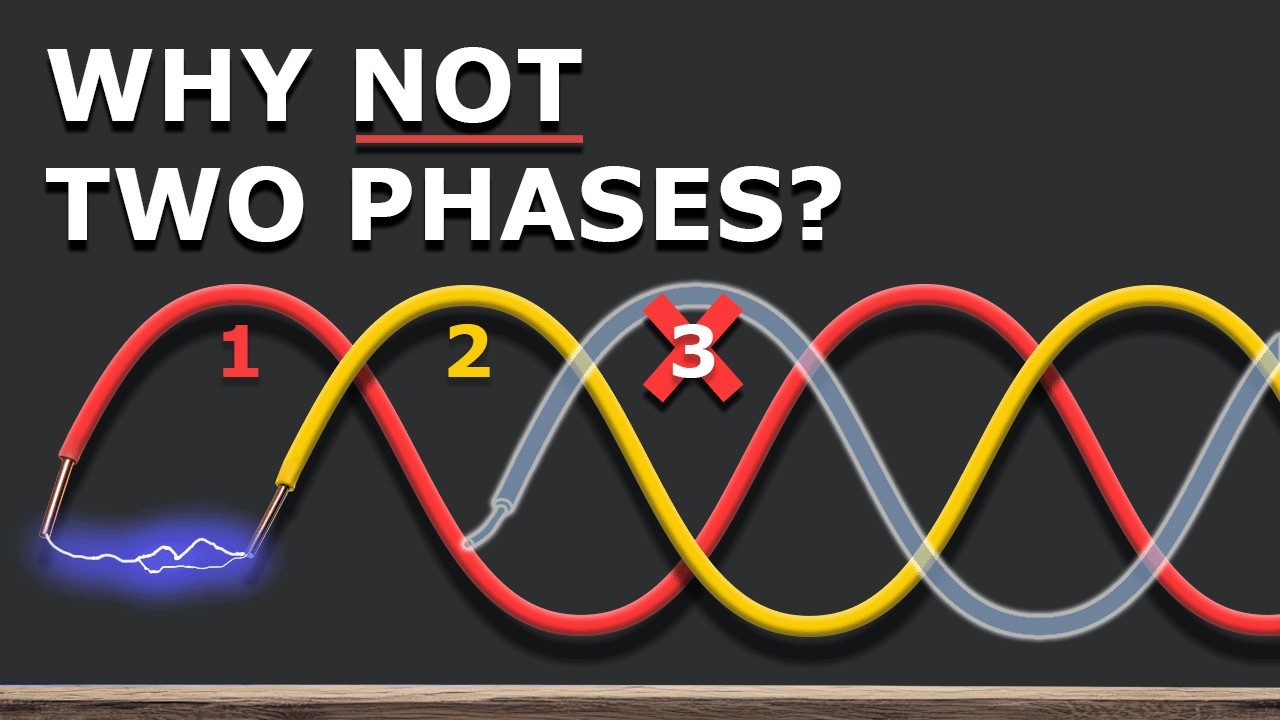
Two Phase Power Was a Mistake: Here's Why
video description
Date: 2026-09-04
Related videos


Comments and reviews: 20
jankify-everything
Two phase power doesn't exist, it's SPLIT phase power, which is found in the US and more broadly north Americas electrical system. That's because, THIS, IS AMERICA. WE'd NEVER settle for just TWO puny wires going from our transformers. No, more is ALWAYS BETTER, So we'll have 3 WIRES going from our transformers. That's 1 more than two, and thus BETTER, OBVIOUSLY. But, what that means is that we center tap our transformers, which kind of means that they have two separate secondary windings which share the same ground reference. So, on one side of the transformer, you get 120 volts relative to the center tap, and on the other side you get - 120 volts relative to the center tap. However, the differential between those two is 240 volts, so that's why Americans DO have 240 volts, it's just technically 120 volts, TWICE.
reply
Two phase power doesn't exist, it's SPLIT phase power, which is found in the US and more broadly north Americas electrical system. That's because, THIS, IS AMERICA. WE'd NEVER settle for just TWO puny wires going from our transformers. No, more is ALWAYS BETTER, So we'll have 3 WIRES going from our transformers. That's 1 more than two, and thus BETTER, OBVIOUSLY. But, what that means is that we center tap our transformers, which kind of means that they have two separate secondary windings which share the same ground reference. So, on one side of the transformer, you get 120 volts relative to the center tap, and on the other side you get - 120 volts relative to the center tap. However, the differential between those two is 240 volts, so that's why Americans DO have 240 volts, it's just technically 120 volts, TWICE.
reply
jankify-everything
The left hand rule makes me think that if it was the right hand rule instead, we'd have infinite energy. This is because as the magnet approaches the wire, it induces a current in it, which generates it's own magnetic field, which instead of repelling it, it would attract the magnet, accelerating the rate of change of magnetic flux, increasing the current in the wire, increasing the pulling force on the magnet, etc until it's launched out the other side. If you put a magnet inside of a perfectly circular loop of copper pipe, and moved it at all, it would rapidly accelerate, and keep accelerating until the copper shatters, it melts because of the current, or if it was all indestructible, it would keep accelerating forever, getting ever closer to the speed of light for all of eternity.
reply
The left hand rule makes me think that if it was the right hand rule instead, we'd have infinite energy. This is because as the magnet approaches the wire, it induces a current in it, which generates it's own magnetic field, which instead of repelling it, it would attract the magnet, accelerating the rate of change of magnetic flux, increasing the current in the wire, increasing the pulling force on the magnet, etc until it's launched out the other side. If you put a magnet inside of a perfectly circular loop of copper pipe, and moved it at all, it would rapidly accelerate, and keep accelerating until the copper shatters, it melts because of the current, or if it was all indestructible, it would keep accelerating forever, getting ever closer to the speed of light for all of eternity.
reply
wbeaty
Also note the Scott Tee transformer network, to convert from 2-phase four wire into three phase. 1890s Westinghouse used this to interface their giant 2-phase generators at Niagara falls, connected to the 3-phase transmission lines leading to Buffalo NY. (Apparently George Westinghouse was a big fan of two-phase)
In Seattle, I went to the historic 1911 Georgetown power plant (museum) where the entire interior is full of 4-wire two-phase. It was used to drive the rotary converters, to provide DC to the old city streetcar system. The huge 2-phase AC motors have General Electric name plates.
There was three-phase in there too, plus a water-cooled Scott Tee transformer about 9ft tall.
reply
Also note the Scott Tee transformer network, to convert from 2-phase four wire into three phase. 1890s Westinghouse used this to interface their giant 2-phase generators at Niagara falls, connected to the 3-phase transmission lines leading to Buffalo NY. (Apparently George Westinghouse was a big fan of two-phase)
In Seattle, I went to the historic 1911 Georgetown power plant (museum) where the entire interior is full of 4-wire two-phase. It was used to drive the rotary converters, to provide DC to the old city streetcar system. The huge 2-phase AC motors have General Electric name plates.
There was three-phase in there too, plus a water-cooled Scott Tee transformer about 9ft tall.
reply
sharpless
Three phase is fun. Last year, I noticed that my fridge didn't have power, some other things isn't working either. But it's not a single circuit inside my home, but rather several, and all circuit breakers are on. Realise that it must be one of the inbox phases that's broken, locates the main circuit breakers. Trial and error gives me which circuit breaker is broken, plug in a new one and every works again. And here we have what was mentioned, power in my home is three phases split to three single phases, with neutral, and each of those is separated in turn into several circuits, and hopefully somewhat evenly split, to reduce the strain
reply
Three phase is fun. Last year, I noticed that my fridge didn't have power, some other things isn't working either. But it's not a single circuit inside my home, but rather several, and all circuit breakers are on. Realise that it must be one of the inbox phases that's broken, locates the main circuit breakers. Trial and error gives me which circuit breaker is broken, plug in a new one and every works again. And here we have what was mentioned, power in my home is three phases split to three single phases, with neutral, and each of those is separated in turn into several circuits, and hopefully somewhat evenly split, to reduce the strain
reply
buckykattnj
I love that moment when all the bits of knowledge accumulated in one's brain snap together and give you the 'Ah-ha! ' moment (not quite an Eureka! moment.
Your video has provided one of those rare moments. As a neurodivergent armchair electrician, I have understood the pieces. this is why I still have a 3-phase converter in my storage, because the family business used to use a few 3 phase machines, but this answers most of the in-between questions rarely asked and not covered in the 40-year old memories of discussions between my electrician maternal grandfather and my father. You have earned my subscription and my thanks.
reply
I love that moment when all the bits of knowledge accumulated in one's brain snap together and give you the 'Ah-ha! ' moment (not quite an Eureka! moment.
Your video has provided one of those rare moments. As a neurodivergent armchair electrician, I have understood the pieces. this is why I still have a 3-phase converter in my storage, because the family business used to use a few 3 phase machines, but this answers most of the in-between questions rarely asked and not covered in the 40-year old memories of discussions between my electrician maternal grandfather and my father. You have earned my subscription and my thanks.
reply
sivaramakrishna269
Very informative and lucid description. Some points regarding practical arrangement of windings with regard to 9: 30;
A real motor will also need a capacitor in the winding displaced at 90 degrees to obtain a phase shift with respect to the first winding. Both space and time phase displacement(s) are required to produce a rotating magnetic field. A real (single phase) motor has distributed windings with the second set offset from the first by half a pole pitch, taking the width of one coil as one pole pitch. This satisfies the 90 degree space displacement condition.
reply
Very informative and lucid description. Some points regarding practical arrangement of windings with regard to 9: 30;
A real motor will also need a capacitor in the winding displaced at 90 degrees to obtain a phase shift with respect to the first winding. Both space and time phase displacement(s) are required to produce a rotating magnetic field. A real (single phase) motor has distributed windings with the second set offset from the first by half a pole pitch, taking the width of one coil as one pole pitch. This satisfies the 90 degree space displacement condition.
reply
lastmile_0
In 4 stroke internal combustion engines, having power stroke overlap is desired, and so the 6 cylinder engine solves this dilemma as the common lowest even number of cylinders if we're factoring geometry that does so with an even firing order and
technically the 5 cylinder engine does as the lowest minimum as an odd number of cylinders.
The 3 phase motor and generator is the electrical analogy to this need for overlapping output.
4 cylinder is analogous to the 2 phase generator, and single cylinder analogous to the single-phase generator.
reply
In 4 stroke internal combustion engines, having power stroke overlap is desired, and so the 6 cylinder engine solves this dilemma as the common lowest even number of cylinders if we're factoring geometry that does so with an even firing order and
technically the 5 cylinder engine does as the lowest minimum as an odd number of cylinders.
The 3 phase motor and generator is the electrical analogy to this need for overlapping output.
4 cylinder is analogous to the 2 phase generator, and single cylinder analogous to the single-phase generator.
reply
paulfontaine7819
In Europe, we don't have split phase transformers for our homes. Instead, we have 3 phase ( N in most cases) in the streets. As you explained, this is uses wires more efficiently. In the transition from 127V to 220V in continental Europe (in the 50s and 60s, We had 127V to the neutral and 220 between phases. 220V was later raised to 230V (and UK was lowered from 240V to 230V) as a EU standardisation. Later, the systems moved to 230V to the neutral and 400V between phases. But some homes still have the 230V delta configuration (without Neutral)
reply
In Europe, we don't have split phase transformers for our homes. Instead, we have 3 phase ( N in most cases) in the streets. As you explained, this is uses wires more efficiently. In the transition from 127V to 220V in continental Europe (in the 50s and 60s, We had 127V to the neutral and 220 between phases. 220V was later raised to 230V (and UK was lowered from 240V to 230V) as a EU standardisation. Later, the systems moved to 230V to the neutral and 400V between phases. But some homes still have the 230V delta configuration (without Neutral)
reply
markclark787
I live in an apparment that my unit gets two of the three phases, giving me 120v and 208v. We had a single fuse blow on the incoming power before the stepdown transformer, which drove the maintenance crazy, as some LED lights would light; I measured about 35v on one (120) outlet. Finally, the power Co came and replaced the fuse. I was trained on 3-phase at work, it was interesting on a conveyor that had multiple motors, and one lost a phase, and it just started slow but ran at full speed.
reply
I live in an apparment that my unit gets two of the three phases, giving me 120v and 208v. We had a single fuse blow on the incoming power before the stepdown transformer, which drove the maintenance crazy, as some LED lights would light; I measured about 35v on one (120) outlet. Finally, the power Co came and replaced the fuse. I was trained on 3-phase at work, it was interesting on a conveyor that had multiple motors, and one lost a phase, and it just started slow but ran at full speed.
reply
pmailkeey4084
17: 00 you talk about connecting single phase to 3 phase but did not mention connecting single phase to 2/3 phase. For example, electric welder primary connected to a single phase (240V) or to two of the three phases making the primary run on 415V. I decided there was no great advantage in running the welder on 415V. To do so the primary uses additional coils on the primary. The transformer would be fed with a modified sine wave - is there any benefit in this
reply
17: 00 you talk about connecting single phase to 3 phase but did not mention connecting single phase to 2/3 phase. For example, electric welder primary connected to a single phase (240V) or to two of the three phases making the primary run on 415V. I decided there was no great advantage in running the welder on 415V. To do so the primary uses additional coils on the primary. The transformer would be fed with a modified sine wave - is there any benefit in this
reply
the_undead
19: 17 the 240 volts mentioned is only relevant for I believe certain parts of Europe and other very specific parts of the world. When doing this kind of configuration, it is highly variable what voltage you get, for example, in North America, when this is done in large apartment complexes, you actually get 208 volts instead of the standard split phase 240 volt
reply
19: 17 the 240 volts mentioned is only relevant for I believe certain parts of Europe and other very specific parts of the world. When doing this kind of configuration, it is highly variable what voltage you get, for example, in North America, when this is done in large apartment complexes, you actually get 208 volts instead of the standard split phase 240 volt
reply
iliavolodin9273
Good explanation.
It would be good to mention that more than 3 phase systems exist, but going to 4, 6, or 12 phases provides no advantages.
3 phase power remains constant, but every extra phase adds a conductor, making transmission lines, transformers, switchgear, and motors more expensive
reply
Good explanation.
It would be good to mention that more than 3 phase systems exist, but going to 4, 6, or 12 phases provides no advantages.
3 phase power remains constant, but every extra phase adds a conductor, making transmission lines, transformers, switchgear, and motors more expensive
reply
FailureDetective
Electrical systems are a great example of how engineering solutions are shaped by history as much as pure technical optimisation. Once infrastructure, equipment and standards develop around one architecture, changing the better engineering solution can become harder than inventing it.
reply
Electrical systems are a great example of how engineering solutions are shaped by history as much as pure technical optimisation. Once infrastructure, equipment and standards develop around one architecture, changing the better engineering solution can become harder than inventing it.
reply
engineering_mindset
Create video with very clear explanations and animations. Just one correction. On a big machine with sinusoidal windings, you don't get any smoother rotation with 3-phase then you would with two phase. The current through each slot is identical in each design.
reply
Create video with very clear explanations and animations. Just one correction. On a big machine with sinusoidal windings, you don't get any smoother rotation with 3-phase then you would with two phase. The current through each slot is identical in each design.
reply
DH-tv2yw
Great video where lots of the concepts that I had deducted separately came together. Shame at the end of the video, you only talked about the American system, not the UK and European system where we just take a single live and netural, or even take 3 phase in some homes.
reply
Great video where lots of the concepts that I had deducted separately came together. Shame at the end of the video, you only talked about the American system, not the UK and European system where we just take a single live and netural, or even take 3 phase in some homes.
reply
DaveyGoose
OH wow, I've tried to wrap my head around 3 phase for some time now, and I feel like this video has been the most complete and visually descriptive explanation I've seen on how all the power gets generated and distributed. I think it'll finally stick, so thanks!
reply
OH wow, I've tried to wrap my head around 3 phase for some time now, and I feel like this video has been the most complete and visually descriptive explanation I've seen on how all the power gets generated and distributed. I think it'll finally stick, so thanks!
reply
felixgrimm2325
Correct me if I'm wrong but at 2: 36 the induced voltage should be at 0V with the north or south pole directly beneath the coil. The magnetic flux through it has its peak there but induced voltage is the derivative of flux (change of flux per time.
reply
Correct me if I'm wrong but at 2: 36 the induced voltage should be at 0V with the north or south pole directly beneath the coil. The magnetic flux through it has its peak there but induced voltage is the derivative of flux (change of flux per time.
reply
extremegf
10/10 educational content.
Please make 20 minute videos on subjects like this 3 wire-only trick, transformer configurations and neutral wire configurations.
You already have animations and we will watch each one.
All the power!
reply
10/10 educational content.
Please make 20 minute videos on subjects like this 3 wire-only trick, transformer configurations and neutral wire configurations.
You already have animations and we will watch each one.
All the power!
reply
bixorzz4312
All the power!
Amazing video, it helped me review how 3 phase and motors work, I'm currently in my first electrical engineering co-op, and 3 phase is everywhere! I couldn't get enough intuition in class, but this videos changes that.
reply
All the power!
Amazing video, it helped me review how 3 phase and motors work, I'm currently in my first electrical engineering co-op, and 3 phase is everywhere! I couldn't get enough intuition in class, but this videos changes that.
reply
fabriziofv3918
All the power!
One of the toughest topic engineering students face at the beginning of their academic carreer. Most of them give three phase power systems for granteed, but just few know the real reason why we use them
reply
All the power!
One of the toughest topic engineering students face at the beginning of their academic carreer. Most of them give three phase power systems for granteed, but just few know the real reason why we use them
reply
Add a review, comment
Other channel videos