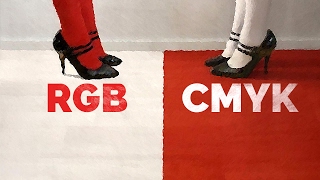
Why RGB Can Never Be Used for Print? RGB vs CMYK
video description
Date: 2022-07-19
Related videos


Comments and reviews: 20
Dark
For more explanation, RGB uses Additive color mixing while CMYK uses Subtractive color mixing. RGB produces color by adding light using the tiny led bulbs in your screen. So if the starting canvas(screen) is black (or of zero value, you need to add light in certain ammounts to produce color. CMYK on the other hand subtracts light using pigments than can absorb all other wavelengths of light except certain colors. So if you start with a canvas(paper, etc) that is white(or of full value) you need to mix pigments in certain proportions to absorb all unnecessary light and reflect only certain colors. If you look it up, additive color wheel is different from subtractive color wheel. So that's why you can't use RGB in a printer. RGB adds values to R G and B to produce colors. But if you use it as printer ink, adding more R G and B would just add more pigments to the paper, which would result to more light being absorbed, which would result in a darker color, not lighter as compared to a screen.
reply
For more explanation, RGB uses Additive color mixing while CMYK uses Subtractive color mixing. RGB produces color by adding light using the tiny led bulbs in your screen. So if the starting canvas(screen) is black (or of zero value, you need to add light in certain ammounts to produce color. CMYK on the other hand subtracts light using pigments than can absorb all other wavelengths of light except certain colors. So if you start with a canvas(paper, etc) that is white(or of full value) you need to mix pigments in certain proportions to absorb all unnecessary light and reflect only certain colors. If you look it up, additive color wheel is different from subtractive color wheel. So that's why you can't use RGB in a printer. RGB adds values to R G and B to produce colors. But if you use it as printer ink, adding more R G and B would just add more pigments to the paper, which would result to more light being absorbed, which would result in a darker color, not lighter as compared to a screen.
reply
Jeffrey
0: 50, For your consideration, your information on complimentary colors is wrong. Blue/Indigo's compliment is Orange, Greens complement is Red, Purple/Violets compliment is Yellow. The color wheel you're showing isn't the typical color wheel you'd find representing the visible light spectrum: Red, Orange, Yellow, Green, Blue, Indigo, Violet = ROYGBIV. Cyan and Magenta are present in the Photoshop color wheel primarily for the ease of CMYK printing. If you mix Blue and Green together you get Blue-green, not cyan. If you mix Blue and Red together you get Violet not Magenta. Cyan is a tint(mix with white) of Blue-green, Magenta is a tint of Red-violet.
reply
0: 50, For your consideration, your information on complimentary colors is wrong. Blue/Indigo's compliment is Orange, Greens complement is Red, Purple/Violets compliment is Yellow. The color wheel you're showing isn't the typical color wheel you'd find representing the visible light spectrum: Red, Orange, Yellow, Green, Blue, Indigo, Violet = ROYGBIV. Cyan and Magenta are present in the Photoshop color wheel primarily for the ease of CMYK printing. If you mix Blue and Green together you get Blue-green, not cyan. If you mix Blue and Red together you get Violet not Magenta. Cyan is a tint(mix with white) of Blue-green, Magenta is a tint of Red-violet.
reply
Lu
Red, Green and Blue are the colors of the light. They are made of light. The more you mix them. the lighter they get. The white is the color of light with RGB at their maximum chroma mixed. Cyan-Magenta-Yellow and Black are solid colors. Colors made by Man. They need light to be perceived (you can't see color in the dark. They absorb parts of the colors of light and reflect the color we see. The more you mix them. The darker they get. Opposite systems with opposite results. That's why is so difficult to represent accurately on paper, canvas, etc, the colors we see on our monitor: )
reply
Red, Green and Blue are the colors of the light. They are made of light. The more you mix them. the lighter they get. The white is the color of light with RGB at their maximum chroma mixed. Cyan-Magenta-Yellow and Black are solid colors. Colors made by Man. They need light to be perceived (you can't see color in the dark. They absorb parts of the colors of light and reflect the color we see. The more you mix them. The darker they get. Opposite systems with opposite results. That's why is so difficult to represent accurately on paper, canvas, etc, the colors we see on our monitor: )
reply
killer0178
This doesn't take into account what the printer manufacturers say about their printers nor what the printing labs recommend. I've seen most photo printing labs requiring exclusively anything but CMYK, they don't want CMYK, so who am I to argue with them? There are other places that require exclusively a certain type of CMYK, like GraCol or FoGra. So without further discussion, the answer is quite simple, go for what the printing labs say and skip all the other nonsense.
reply
This doesn't take into account what the printer manufacturers say about their printers nor what the printing labs recommend. I've seen most photo printing labs requiring exclusively anything but CMYK, they don't want CMYK, so who am I to argue with them? There are other places that require exclusively a certain type of CMYK, like GraCol or FoGra. So without further discussion, the answer is quite simple, go for what the printing labs say and skip all the other nonsense.
reply
mjsliberiangirl
Unmesh, I have a problem with converting from RGB to CMYK. I really hope for your help, because I find nothing on the internet.
When I convert an image from RGB to CMYK, I realize that the colors are changing. But if I save the CMYK image once as JPG and once as PDS and open the images, the images have different colors, although in both cases it is the same CMYK image. How do I know which colors await me after printing?
reply
Unmesh, I have a problem with converting from RGB to CMYK. I really hope for your help, because I find nothing on the internet.
When I convert an image from RGB to CMYK, I realize that the colors are changing. But if I save the CMYK image once as JPG and once as PDS and open the images, the images have different colors, although in both cases it is the same CMYK image. How do I know which colors await me after printing?
reply
tubebuz
If you want to make a picture with colors you mix on a white piece of paper it can be done with the clever 4 color solution CMYK (cyan, , magenta, yellow and black. Try it yourself with basic paint on white paper. But I dare anyone to take only 3 colors (red, green and blue) and create a yellow with only that.
reply
If you want to make a picture with colors you mix on a white piece of paper it can be done with the clever 4 color solution CMYK (cyan, , magenta, yellow and black. Try it yourself with basic paint on white paper. But I dare anyone to take only 3 colors (red, green and blue) and create a yellow with only that.
reply
Olivera
An excellent explanation, but there are printers that print in RGB and colors are expectedly more vivid than you can get in CMYK digital printing. I know this because I've worked on such a printer and it was easier for me to edit photos because I like the result more.
reply
An excellent explanation, but there are printers that print in RGB and colors are expectedly more vivid than you can get in CMYK digital printing. I know this because I've worked on such a printer and it was easier for me to edit photos because I like the result more.
reply
Kamlesh
All Videos on Piximperfect are useful for me. But I have a question related to Conversion of RGB to CMYK for print media. After conversion to CMYK some colour becomes dull. And appearance of artwork gets worse. Is there any solution? Please guide me.
reply
All Videos on Piximperfect are useful for me. But I have a question related to Conversion of RGB to CMYK for print media. After conversion to CMYK some colour becomes dull. And appearance of artwork gets worse. Is there any solution? Please guide me.
reply
Alejandro
Very good explanation, however, the key question still remains. how can we work on a screen which displays RGB colors and then create projects on CMYK color mode if later on we're not gonna be able to see the real printing colors on that screen?
reply
Very good explanation, however, the key question still remains. how can we work on a screen which displays RGB colors and then create projects on CMYK color mode if later on we're not gonna be able to see the real printing colors on that screen?
reply
sam
I'm a designer and I have to use RGB like 30% of the time because files from old designers will be in any random colorspace and we need to match the old work and don't have time to recolor and color match with the flatbed printer or vinyl printer
reply
I'm a designer and I have to use RGB like 30% of the time because files from old designers will be in any random colorspace and we need to match the old work and don't have time to recolor and color match with the flatbed printer or vinyl printer
reply
Creative
before today I thought you are an American or something like that. but today I have seen your letter address in the video description. I Surprised by it. by the way, I am from Bangladesh and am your fan. I watched your many videos many times
reply
before today I thought you are an American or something like that. but today I have seen your letter address in the video description. I Surprised by it. by the way, I am from Bangladesh and am your fan. I watched your many videos many times
reply
Sukhdeep
At first, it was little bit difficult to understand.
But,
When I heard this line ( 4: 10 ) and his way to say this.
My head suddenly felt very light.
All confusions are gone now.
reply
At first, it was little bit difficult to understand.
But,
When I heard this line ( 4: 10 ) and his way to say this.
My head suddenly felt very light.
All confusions are gone now.
reply
Thomas
Great insight. So how then would you design for print in Photoshop? Should i start the design in RGB and later convert to CMYK for print or is it the other way round? Please I need your advice.
reply
Great insight. So how then would you design for print in Photoshop? Should i start the design in RGB and later convert to CMYK for print or is it the other way round? Please I need your advice.
reply
Maninder
Which mode to be used for sublimation printing? , if i have RGB template should i print it in CMKY mode or i need to create separate CMYK template for printing? Please answer this.
reply
Which mode to be used for sublimation printing? , if i have RGB template should i print it in CMKY mode or i need to create separate CMYK template for printing? Please answer this.
reply
Home
never is the wrong answer. I do printing on vinyl with an Epson S40600 printer. It prints RGB just fine and usually gives better results with more control in RGB.
reply
never is the wrong answer. I do printing on vinyl with an Epson S40600 printer. It prints RGB just fine and usually gives better results with more control in RGB.
reply
itech
Thank you for the info. I love the way you how you share your knowledge to your viewers. I appreciate the eye contact, you really are connected to the audiences.
reply
Thank you for the info. I love the way you how you share your knowledge to your viewers. I appreciate the eye contact, you really are connected to the audiences.
reply
Kristen
Im obsessed with you. I watched like six videos trying to figure this out and understand and I couldn't. This cleared it up so much. Thank you!
reply
Im obsessed with you. I watched like six videos trying to figure this out and understand and I couldn't. This cleared it up so much. Thank you!
reply
Cory
Middle eastern idubbbz I love it. Youre very energetic. As someone from the US, its usually hard for me to parse accents. You did a great job
reply
Middle eastern idubbbz I love it. Youre very energetic. As someone from the US, its usually hard for me to parse accents. You did a great job
reply
angelito
What image format is the best to set for large tarpaulin Printing without losing image quality and maintain its high resolution? Tnx.
reply
What image format is the best to set for large tarpaulin Printing without losing image quality and maintain its high resolution? Tnx.
reply
yuvraj
Very Good Information. Sir plz make one tutorial how to convert image in photoshop from RGB to CMYK AND ITS PERFECT COLOUR MATCHING.
reply
Very Good Information. Sir plz make one tutorial how to convert image in photoshop from RGB to CMYK AND ITS PERFECT COLOUR MATCHING.
reply
Add a review, comment
Other channel videos