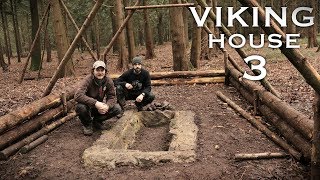
Building a Viking House with Hand Tools: Stone Clay Pit Bushcraft Project (PART 3)
video description
Date: 2019-09-10
Related videos






Comments and reviews: 10
Ut På Tur - Out Hiking
As an experiment I think it's rather well. Even museums don't have everything according to the book, they're doing experiments and learning themselves. And while this isn't a big, proud viking longhouse, I believe they could very well have set up something like this as a simpler structure. They traveled a lot, and this is something a crew could set up in a few days as an improvement to the tents. Come to think of it, their tents may have had their shape because they used their sails as tent canvas, but they were a special kind of woven wool and quite expensive so they took good care of those, and if they were to camp for a while or put some people to land and sail on, something like this may have been a natural upgrade.
reply
As an experiment I think it's rather well. Even museums don't have everything according to the book, they're doing experiments and learning themselves. And while this isn't a big, proud viking longhouse, I believe they could very well have set up something like this as a simpler structure. They traveled a lot, and this is something a crew could set up in a few days as an improvement to the tents. Come to think of it, their tents may have had their shape because they used their sails as tent canvas, but they were a special kind of woven wool and quite expensive so they took good care of those, and if they were to camp for a while or put some people to land and sail on, something like this may have been a natural upgrade.
reply
Richard Pickard
I guess most of these people dont realize that even though they were building a viking house (which they stated was Our interpretation of a traditional viking longhouse) the Vikings would have utilized all the resources in the land they were landing in. Just because where you live does not have these resources doesnt mean that where they are does not. I appreciate the effort these men went through to accomplish this task. I being a traditional carpenter and blacksmith, I understand the feats it takes to achieve things like this. Great job guys. Very inspriring, i look forward to more in the future.
reply
I guess most of these people dont realize that even though they were building a viking house (which they stated was Our interpretation of a traditional viking longhouse) the Vikings would have utilized all the resources in the land they were landing in. Just because where you live does not have these resources doesnt mean that where they are does not. I appreciate the effort these men went through to accomplish this task. I being a traditional carpenter and blacksmith, I understand the feats it takes to achieve things like this. Great job guys. Very inspriring, i look forward to more in the future.
reply
Ben Badgley
You ought to have made a fly drain tube out the back end of the fire pit, and under your house's back wall logs. You'd not have made it more than your fist in diameter roynd, lines it with site and clay as you did your pit. Out stone over too and bury it. Then your back bed could incorporate stone and clay slab to draw heat from the gears fly going under it, our the back of your house. Also would let you close I the roof more, no need to let smoke it the roof. see Primitive Technology you tube to see how that young. fellow built his similar to what I suggest. Sure a little more work but worth it.
reply
You ought to have made a fly drain tube out the back end of the fire pit, and under your house's back wall logs. You'd not have made it more than your fist in diameter roynd, lines it with site and clay as you did your pit. Out stone over too and bury it. Then your back bed could incorporate stone and clay slab to draw heat from the gears fly going under it, our the back of your house. Also would let you close I the roof more, no need to let smoke it the roof. see Primitive Technology you tube to see how that young. fellow built his similar to what I suggest. Sure a little more work but worth it.
reply
peter james
now the hole in the roof may not be a good idea as it causes a draft making the fire draw to much the idea is you have a closed roof and the smoke finds its way out through the bark or thatch thus keeping the fire low and not burning your roof down also it means you can smoke and preserve your meat in the roof for the winter see iron age timber roofs its how it was done this may not work here as your roof is very low
reply
now the hole in the roof may not be a good idea as it causes a draft making the fire draw to much the idea is you have a closed roof and the smoke finds its way out through the bark or thatch thus keeping the fire low and not burning your roof down also it means you can smoke and preserve your meat in the roof for the winter see iron age timber roofs its how it was done this may not work here as your roof is very low
reply
ilike toomanythings
I do agree that this isnt exactly a Viking Long House, however, you are right that they would use everything around them to build their shelters. And anyways, you stated in your first episode that this wouldnt be historically accurate but more your interpretation. I think it going great and I'm sure it will suit your needs regardless of how accurate it is. Great job and great video guys.
reply
I do agree that this isnt exactly a Viking Long House, however, you are right that they would use everything around them to build their shelters. And anyways, you stated in your first episode that this wouldnt be historically accurate but more your interpretation. I think it going great and I'm sure it will suit your needs regardless of how accurate it is. Great job and great video guys.
reply
Noel Wesley
I'm a Viking Reenactor and this is brilliant. I'll be using these ideas to build my own Viking Age House. i moved to Southern Sweden a couple of years ago and we have great Viking Age Museums with reproduction houses to take ideas from. Some of what you've done is really good. Gorgeous wooden bowls. I'd happily have them in my camp kit. Can't wait to watch the other videos. Great job lads.
reply
I'm a Viking Reenactor and this is brilliant. I'll be using these ideas to build my own Viking Age House. i moved to Southern Sweden a couple of years ago and we have great Viking Age Museums with reproduction houses to take ideas from. Some of what you've done is really good. Gorgeous wooden bowls. I'd happily have them in my camp kit. Can't wait to watch the other videos. Great job lads.
reply
Valkyrie Sardo
My shepherd husky was also a great helper like the dog in this video. I was clearing some underbrush, shrubs and small saplings. That meant some digging and cutting out the larger roots. Buzz was a big fellow. He'd clamp his jaws onto a root, clawing at the hole, sending the dirt flying. It was something to see. He brought a lot more muscle to the task than I could manage.
reply
My shepherd husky was also a great helper like the dog in this video. I was clearing some underbrush, shrubs and small saplings. That meant some digging and cutting out the larger roots. Buzz was a big fellow. He'd clamp his jaws onto a root, clawing at the hole, sending the dirt flying. It was something to see. He brought a lot more muscle to the task than I could manage.
reply
Jollynoose
now dont get the wrong idea, i love the way you show us how to make traditional viking long houses and stuff like that, but how come you dont show us how to make the more common viking everyday things like. like. well viking Iphones, viking internet, and would it kill you to show us things like viking lawn furniture or maybe viking indoor outdoor carpet.
reply
now dont get the wrong idea, i love the way you show us how to make traditional viking long houses and stuff like that, but how come you dont show us how to make the more common viking everyday things like. like. well viking Iphones, viking internet, and would it kill you to show us things like viking lawn furniture or maybe viking indoor outdoor carpet.
reply
PhantomTeichou
This is pretty darn cool. I don't get the critics, maybe if they got out of their mommy's basement and did their own viking house, they'd be less inclined to be trolls? Regardless, this is quite inspiring. I just ordered a few tools on Amazon and I'm going to attempt this with stuff around where I live Thanks for these videos and ideas
reply
This is pretty darn cool. I don't get the critics, maybe if they got out of their mommy's basement and did their own viking house, they'd be less inclined to be trolls? Regardless, this is quite inspiring. I just ordered a few tools on Amazon and I'm going to attempt this with stuff around where I live Thanks for these videos and ideas
reply
Warflower Society
I love these pits. Didn't get time to make one, as planned but did most of the entry to the house with large stones to keep the mud and dirt being tracked in. Nice work, looks beautiful. Hadn't heard of ash, but straw and clay for rocket mass heaters. Alaska gets cold in the winter. Some creative ones you can find online.
reply
I love these pits. Didn't get time to make one, as planned but did most of the entry to the house with large stones to keep the mud and dirt being tracked in. Nice work, looks beautiful. Hadn't heard of ash, but straw and clay for rocket mass heaters. Alaska gets cold in the winter. Some creative ones you can find online.
reply
Add a review, comment
Other channel videos