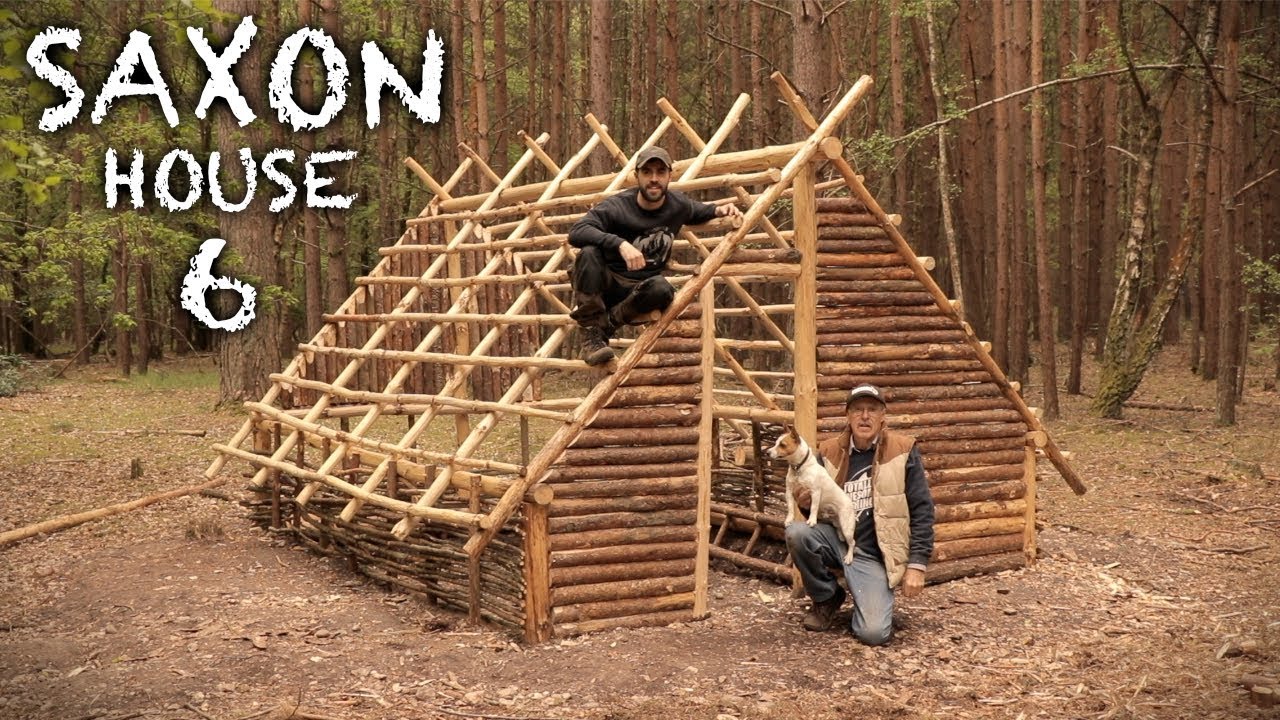
Building a Saxon House with Hand Tools: Front Entrance, Wattle, Walls Bushcraft Project (PART 6)
video description
Date: 2019-09-10
Related videos


Comments and reviews: 10
Mike Roth
Hey man, when you lather up the walls with clay/straw, I believe if you leave a small gap just before the roof for ventilation - say just a few inches-and it doesn't have to be continuous down the wall ( it all depends on climate, you might have enough air movement to build a centralized two square foot rectangular fire pit for heating inside (yes, more digging. I'm thinking the outside colder air would run along the inside of the roof while there was a fire going to help ventilate. Similar to the viking house I would imagine it built. You again would have to vent the ridge line, though I think with the use of that pine pitch(was it)- the glue stuff. Your rafters peak above the ridge by at least a foot. Run a trio (or quad) of sticks about a foot less than half the legnth of the structure and glue them up like a gutter type system in a way that the thicker side is in the center and the water woud naturally drain outward. Then repeat for the other side and you'll have a 2' opening. You only need to figure the height after that, which again might depend on your climate. If you're going to frequent this hideaway, maybe adjustability options may pan out. You guys are highly creative and I'm sure you would have thought of this too. I admire what you pops and friends are doing. Utilizing resources is exactly what our ancestors would have done. Evolution taught us to adapt and figure out what works til we find the ideal which is what I've been watching in your videos; trial and error is a hard learned lesson for the impatient man, but you guys have non-stop been learning, adapting, aquiring new knowledge and resources (having a well said bad ass time doing so with sometimes lavish luxuries with the woodsman gordon ramsey I might add - lucky f#%ers) -yeah, I'm jealous of those meals you had - kudos to the chef. And have created some meaningful, joyful little 'home away from home' cool hideouts only us 'kids at heart' wish we had the time or ability, or environment and resources to do so. Mike, you sir have helped set the stage for some to go out and try something different, something outside the comfort zone and expand the knowledge of what is lately been cosiddered modern camping or in other terms glamping. Glamorous Camping, a term here by me. Don't get me wrong, I'd love to have so many amentities in the wilderness. but I'm not carrying it. Nor woud I pay others to carry it for me (just a no-good feeling I have for that. But indulgence is what I escape from, for the time, not bring it with me. Roughing it builds characture, depth. Although, when I think of glamping, I want a sizable space so I can stand up in. I want it to be seasonal so I can enjoy this ALL year round. I tend to think outside the box, so I look for adjustability any time I can, because even a box is maliable. But so can man be tempted to the dark side - glamp. glamp. lol all the best M
reply
Hey man, when you lather up the walls with clay/straw, I believe if you leave a small gap just before the roof for ventilation - say just a few inches-and it doesn't have to be continuous down the wall ( it all depends on climate, you might have enough air movement to build a centralized two square foot rectangular fire pit for heating inside (yes, more digging. I'm thinking the outside colder air would run along the inside of the roof while there was a fire going to help ventilate. Similar to the viking house I would imagine it built. You again would have to vent the ridge line, though I think with the use of that pine pitch(was it)- the glue stuff. Your rafters peak above the ridge by at least a foot. Run a trio (or quad) of sticks about a foot less than half the legnth of the structure and glue them up like a gutter type system in a way that the thicker side is in the center and the water woud naturally drain outward. Then repeat for the other side and you'll have a 2' opening. You only need to figure the height after that, which again might depend on your climate. If you're going to frequent this hideaway, maybe adjustability options may pan out. You guys are highly creative and I'm sure you would have thought of this too. I admire what you pops and friends are doing. Utilizing resources is exactly what our ancestors would have done. Evolution taught us to adapt and figure out what works til we find the ideal which is what I've been watching in your videos; trial and error is a hard learned lesson for the impatient man, but you guys have non-stop been learning, adapting, aquiring new knowledge and resources (having a well said bad ass time doing so with sometimes lavish luxuries with the woodsman gordon ramsey I might add - lucky f#%ers) -yeah, I'm jealous of those meals you had - kudos to the chef. And have created some meaningful, joyful little 'home away from home' cool hideouts only us 'kids at heart' wish we had the time or ability, or environment and resources to do so. Mike, you sir have helped set the stage for some to go out and try something different, something outside the comfort zone and expand the knowledge of what is lately been cosiddered modern camping or in other terms glamping. Glamorous Camping, a term here by me. Don't get me wrong, I'd love to have so many amentities in the wilderness. but I'm not carrying it. Nor woud I pay others to carry it for me (just a no-good feeling I have for that. But indulgence is what I escape from, for the time, not bring it with me. Roughing it builds characture, depth. Although, when I think of glamping, I want a sizable space so I can stand up in. I want it to be seasonal so I can enjoy this ALL year round. I tend to think outside the box, so I look for adjustability any time I can, because even a box is maliable. But so can man be tempted to the dark side - glamp. glamp. lol all the best M
reply
huntsman525
How hard would it be to do a thatch roof? I have built some shelters here in Maryland and have experimented with different ways of doing a grass/thatch roof with mixed results. Remembering a trip to the UK many years ago I visited Shakespeare's Home and saw true Thatched roofs. I have started making mine much thicker (12 to 15 inches deep. I use a thin hemp twine to tie the bundles together and on to the rafters. You can slide them tightly together this way and overlap each row, they come out looking like shingles. Also you can go back and stuff grass in between the bundles if you have any thin spots. It takes some time and work just finding and gathering/ cutting the grass. I usually tie my bundles (leave the strings with long tags to tie to the rafters) while I'm cutting because it makes it so much easier to transport. The last shelter I did has lasted two years and is just starting to leak a bit in HEAVY rain now. I would also suggest that if you go with a grass thatch roof that you cut some windows in to give some air flow. The grass can get a bit musty smelling without good air flow. Just an idea. It looks pretty cool if you can pull it off. I have to ask where Dustin is?
reply
How hard would it be to do a thatch roof? I have built some shelters here in Maryland and have experimented with different ways of doing a grass/thatch roof with mixed results. Remembering a trip to the UK many years ago I visited Shakespeare's Home and saw true Thatched roofs. I have started making mine much thicker (12 to 15 inches deep. I use a thin hemp twine to tie the bundles together and on to the rafters. You can slide them tightly together this way and overlap each row, they come out looking like shingles. Also you can go back and stuff grass in between the bundles if you have any thin spots. It takes some time and work just finding and gathering/ cutting the grass. I usually tie my bundles (leave the strings with long tags to tie to the rafters) while I'm cutting because it makes it so much easier to transport. The last shelter I did has lasted two years and is just starting to leak a bit in HEAVY rain now. I would also suggest that if you go with a grass thatch roof that you cut some windows in to give some air flow. The grass can get a bit musty smelling without good air flow. Just an idea. It looks pretty cool if you can pull it off. I have to ask where Dustin is?
reply
Tipi Dan
Though not essential (obviously) for the kind of work you are doing, two simple tools will make your work easier, and your results neater. These are a broad axe (or broad hatchet) and adze: tools in common use during the period you are emulating, and throughout the western world during pioneering and modern-transitional periods of development. Both tools serve similar purposes within different contexts and positions of bodily mechanics, especially for flattening and finishing log surfaces. The broad hatchet especially, being beveled on one side only, is a handy tool--- bearing in mind that it should be wielded with the bevel down: facing the wood surface. This keeps your cut or swipe always trending up or back out of the working surface instead of digging in, and prevents taking off more than you want to accidentally and leaving perpendicular gouges in the wood. It also makes for smoother cuts during the chopping process, relieving the recoiling strain on the worker's arm. Cheers
reply
Though not essential (obviously) for the kind of work you are doing, two simple tools will make your work easier, and your results neater. These are a broad axe (or broad hatchet) and adze: tools in common use during the period you are emulating, and throughout the western world during pioneering and modern-transitional periods of development. Both tools serve similar purposes within different contexts and positions of bodily mechanics, especially for flattening and finishing log surfaces. The broad hatchet especially, being beveled on one side only, is a handy tool--- bearing in mind that it should be wielded with the bevel down: facing the wood surface. This keeps your cut or swipe always trending up or back out of the working surface instead of digging in, and prevents taking off more than you want to accidentally and leaving perpendicular gouges in the wood. It also makes for smoother cuts during the chopping process, relieving the recoiling strain on the worker's arm. Cheers
reply
Serenity Hill Homestead
What a great build. We are building a cordwood home on our homestead. Once we get moved in, one of my next projects will be a pavilion to house my bbq smoker, grill, sink, and some type of seating. I'm thinking an adaptation of the Saxon house for a bbq pavilion would be fantastic. I have a lot of oak and hickory trees the size of your frame and rafters that need to be thinned out, and I have enough smaller saplings to thin to make a hundreds of feet of wattle walls. It would look better on the site than anything made with lumber from the big box store. Got some great ideas and tips from this build, as well as the Viking house build. Thanks for sharing the cooking and meal times. They are a reminder to slow down and enjoy life. Keep building
reply
What a great build. We are building a cordwood home on our homestead. Once we get moved in, one of my next projects will be a pavilion to house my bbq smoker, grill, sink, and some type of seating. I'm thinking an adaptation of the Saxon house for a bbq pavilion would be fantastic. I have a lot of oak and hickory trees the size of your frame and rafters that need to be thinned out, and I have enough smaller saplings to thin to make a hundreds of feet of wattle walls. It would look better on the site than anything made with lumber from the big box store. Got some great ideas and tips from this build, as well as the Viking house build. Thanks for sharing the cooking and meal times. They are a reminder to slow down and enjoy life. Keep building
reply
Earthenfist
I, uh, I think you're using your broad-hatchet the wrong way around. If it's constructed correctly, it ought to have an offset so that one side is 'flatter' than the other- and that's the side that goes towards the log, allowing for smoother cuts. It's right-handed, so the 'correct' way to use it is to hold the log in your left hand (probably upright) and chop downwards with your right hand, on the right side of the log. You can make relief chops like you're doing, but just a series of simple chops along the whole length of the log, about 4 or 5 inches apart, should be plenty to let you just shave right down the side.
reply
I, uh, I think you're using your broad-hatchet the wrong way around. If it's constructed correctly, it ought to have an offset so that one side is 'flatter' than the other- and that's the side that goes towards the log, allowing for smoother cuts. It's right-handed, so the 'correct' way to use it is to hold the log in your left hand (probably upright) and chop downwards with your right hand, on the right side of the log. You can make relief chops like you're doing, but just a series of simple chops along the whole length of the log, about 4 or 5 inches apart, should be plenty to let you just shave right down the side.
reply
XTrails Extra
Great video guys i dont understand why you dont use hazel in the weaving of your walls. hazel is sustainable and allso fast growing i beleive thats how the saxons did it. but i might be wrong. I dont know if you know this you proberly do. hazel makes brilliant walking sticks/catapult forkets. find your chosen length and thicknes of stick bend it in the summer when evrything is full of sap and pliable tie the bend to the stick. when winter is here and the sap has gone down untie the string and there you have it the perfect traditonal hand made walking stick. with a handel. then cut it.
reply
Great video guys i dont understand why you dont use hazel in the weaving of your walls. hazel is sustainable and allso fast growing i beleive thats how the saxons did it. but i might be wrong. I dont know if you know this you proberly do. hazel makes brilliant walking sticks/catapult forkets. find your chosen length and thicknes of stick bend it in the summer when evrything is full of sap and pliable tie the bend to the stick. when winter is here and the sap has gone down untie the string and there you have it the perfect traditonal hand made walking stick. with a handel. then cut it.
reply
0623kaboom
painting a stairwell. and hurts himself. hmm perhaps instead of bending on a ladder. use thew ladder as a support at the bottom of the stairs and put a few planks from a rung of the ladder across to the top of the stairwell and use it like a platform to paint from. two ladders work as well. also makes the job faster as you dont keep going up and down the ladder as you need to move along to paint; ). place looks good. nice to have a shack to lounge in when one needs to as well; )
reply
painting a stairwell. and hurts himself. hmm perhaps instead of bending on a ladder. use thew ladder as a support at the bottom of the stairs and put a few planks from a rung of the ladder across to the top of the stairwell and use it like a platform to paint from. two ladders work as well. also makes the job faster as you dont keep going up and down the ladder as you need to move along to paint; ). place looks good. nice to have a shack to lounge in when one needs to as well; )
reply
Stephen Franklin
Very interesting and informative. I admire the two of you so much, and the relationship that you have. If I could have a do-over in life, I would spend far more time with my sons than I did, doing projects like this. When I see your videos, It brings some sadness to me that I didn't. Your projects always bring to mind Harry Chapin's great and insightful song Cat's in the Cradle You are creating memories that will last for a lifetime. Kudos to the both of you and God bless
reply
Very interesting and informative. I admire the two of you so much, and the relationship that you have. If I could have a do-over in life, I would spend far more time with my sons than I did, doing projects like this. When I see your videos, It brings some sadness to me that I didn't. Your projects always bring to mind Harry Chapin's great and insightful song Cat's in the Cradle You are creating memories that will last for a lifetime. Kudos to the both of you and God bless
reply
Steve Webb
Hi Mike. Thanks for your videos, so inspiring. I'm in the process of purchasing the necessary equipment for wild camping but have recently discovered that wild camping is illegal in England and Wales. Do you get special permission from the land owner for your camping trips. This law has made me hesitate a bit. Some advice from anyone out there with similar interests would be appreciated. Many thanks.
reply
Hi Mike. Thanks for your videos, so inspiring. I'm in the process of purchasing the necessary equipment for wild camping but have recently discovered that wild camping is illegal in England and Wales. Do you get special permission from the land owner for your camping trips. This law has made me hesitate a bit. Some advice from anyone out there with similar interests would be appreciated. Many thanks.
reply
Matthew Tanner
I know you maybe haven't got Hazel around you in the woods there but years ago hazel was sparse around England (It's only gone due to agriculture) but would the Saxons have used Hazel in the same way that wattle fencing was made in their houses for the walls? Not critisising I just wondered? Hazel goes a long way because you can split it once or twice and use one length to do two or three weaves.
reply
I know you maybe haven't got Hazel around you in the woods there but years ago hazel was sparse around England (It's only gone due to agriculture) but would the Saxons have used Hazel in the same way that wattle fencing was made in their houses for the walls? Not critisising I just wondered? Hazel goes a long way because you can split it once or twice and use one length to do two or three weaves.
reply
Add a review, comment
Other channel videos