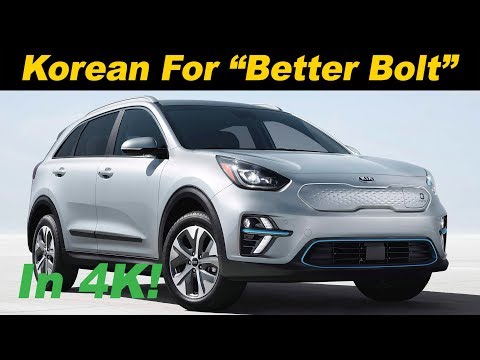
2019 Kia Niro EV First Drive - The Better Bolt
video description
Date: 2019-05-30
Related videos


Comments and reviews: 10
Clayton Root
As always Alex, simply amazing review with details about features we NEVER hear about anywhere else. One area that surprised me though was trunk space. All other reviews Ive seen show the EV version of the Niro to have a slightly larger capacity with the rear seats upright than in the Hybrid version. Whatever, the difference is not enormous. We currently lease a fully loaded Kia Niro Hybrid Touring and love it, due to ease of entry/exit, exceptional feature content for this class of vehicle, and of course its fuel economy. So I did some math on the Cost Effectiveness of the Niro EV for comparison as far as fuel cost goes. This has nothing to do with the environmental impacts of full EVs versus hybrids, nor its performance advantages, but is simply a matter of economics. Since we dont have exact pricing for the Niro EV yet this is only a calculation of the fuel cost savings. I WILL try to make this the MOST favorable to the E-Niro as possible, ie cheapest electricity rates for off peak charging at home versus highest current gasoline prices for the Hybrid Niro. I live in Canada so Im working from metric figures but will convert to U. S. mpg. I log ALL fuel receipts into a spreadsheet so I know exactly what our Niro Hybrid delivers, not what the Guess-O-Meter in the dashboard displays, as they are ALWAYS optimistic and the Niro is no exception. Since picking up the Niro just under 10, 000 kilometers (6, 250 miles) ago, we have averaged 5. 348 liters/100 kilometers. That translates to 44. 23 U. S. mpg and includes a mix of city/highway and summer/winter driving with snow tires and extreme cold. So we drive about 12, 500 miles per year and would use 12, 500 / 44. 23 = 282. 613 gallons of gasoline. The highest current price in the U. S. appears to be in California so Im using approximate GasBuddy average prices for Los Angeles at 3. 50 per gallon. Therefore annual fuel cost with my Hybrid Niro in LA would be 989. Unlike in Ontario Canada where I live, I found it virtually impossible to determine the exact price per kilowatt hour during off peak usage in Los Angeles for comparison purposes. Apparently they offer a 2. 5 cent reduction for charging electric vehicles if you have a separate meter at home, (additional cost) specifically for that purpose. So Ill use their 18. 4 cent average minus the 2. 5 cent EV charging reduction and assume a 50% reduction for off peak overnight and weekend usage at home. Alex determined that the Niro EV can travel 3. 4 miles on a Kilowatt of electricity. So in 12, 500 miles, it would use about 3, 675 kilowatt hours worth of juice. Using the logic above, with that separate meter, Im using a price per off peak kilowatt hours of 6. 9 cents (which I suspect is more than generous and probably doesnt include delivery charges, taxes, etc. At that rate, the cost for electricity would be 3, 675 x 6. 9 / 100 = 253. 60 per year or a saving of 735 for fuel costs. I see that as an ABSOLUTE best case scenario using NO public hi-speed charging stations and NEVER searching out less expensive gasoline refueling stops. Obviously, California has some of the highest gasoline prices in the United States so elsewhere, the economic annual advantage would be even worse. IF you use Public Charging stations, the costs per kilowatt hour become ridiculous and throw the whole economic argument for EVs fuel savings right out the window. It is my belief that full EVs make zero economic sense for any apartment dweller without access to their own plug and metering system. The cost of oil changes and other routine maintenance throughout the life of an ICE vehicle is easily offset by the greatly reduced up front purchase prices. This is especially true if you lease your vehicles, which with a Kia, will be warrantied for the full extent of a 4 year lease. In my mind, the best ECONOMIC option is to lease a fully warrantied Plug-In Hybrid (if rebates on those vehicles are still available where you live) which can be charged overnight on ANY 110-120 Volt outlet and can cover 90% of MOST users daily needs in their electric mode with 30 miles of range. Lower up front cost, absolutely no Range Anxiety and if you happen to miss a charging session, no big deal.
reply
As always Alex, simply amazing review with details about features we NEVER hear about anywhere else. One area that surprised me though was trunk space. All other reviews Ive seen show the EV version of the Niro to have a slightly larger capacity with the rear seats upright than in the Hybrid version. Whatever, the difference is not enormous. We currently lease a fully loaded Kia Niro Hybrid Touring and love it, due to ease of entry/exit, exceptional feature content for this class of vehicle, and of course its fuel economy. So I did some math on the Cost Effectiveness of the Niro EV for comparison as far as fuel cost goes. This has nothing to do with the environmental impacts of full EVs versus hybrids, nor its performance advantages, but is simply a matter of economics. Since we dont have exact pricing for the Niro EV yet this is only a calculation of the fuel cost savings. I WILL try to make this the MOST favorable to the E-Niro as possible, ie cheapest electricity rates for off peak charging at home versus highest current gasoline prices for the Hybrid Niro. I live in Canada so Im working from metric figures but will convert to U. S. mpg. I log ALL fuel receipts into a spreadsheet so I know exactly what our Niro Hybrid delivers, not what the Guess-O-Meter in the dashboard displays, as they are ALWAYS optimistic and the Niro is no exception. Since picking up the Niro just under 10, 000 kilometers (6, 250 miles) ago, we have averaged 5. 348 liters/100 kilometers. That translates to 44. 23 U. S. mpg and includes a mix of city/highway and summer/winter driving with snow tires and extreme cold. So we drive about 12, 500 miles per year and would use 12, 500 / 44. 23 = 282. 613 gallons of gasoline. The highest current price in the U. S. appears to be in California so Im using approximate GasBuddy average prices for Los Angeles at 3. 50 per gallon. Therefore annual fuel cost with my Hybrid Niro in LA would be 989. Unlike in Ontario Canada where I live, I found it virtually impossible to determine the exact price per kilowatt hour during off peak usage in Los Angeles for comparison purposes. Apparently they offer a 2. 5 cent reduction for charging electric vehicles if you have a separate meter at home, (additional cost) specifically for that purpose. So Ill use their 18. 4 cent average minus the 2. 5 cent EV charging reduction and assume a 50% reduction for off peak overnight and weekend usage at home. Alex determined that the Niro EV can travel 3. 4 miles on a Kilowatt of electricity. So in 12, 500 miles, it would use about 3, 675 kilowatt hours worth of juice. Using the logic above, with that separate meter, Im using a price per off peak kilowatt hours of 6. 9 cents (which I suspect is more than generous and probably doesnt include delivery charges, taxes, etc. At that rate, the cost for electricity would be 3, 675 x 6. 9 / 100 = 253. 60 per year or a saving of 735 for fuel costs. I see that as an ABSOLUTE best case scenario using NO public hi-speed charging stations and NEVER searching out less expensive gasoline refueling stops. Obviously, California has some of the highest gasoline prices in the United States so elsewhere, the economic annual advantage would be even worse. IF you use Public Charging stations, the costs per kilowatt hour become ridiculous and throw the whole economic argument for EVs fuel savings right out the window. It is my belief that full EVs make zero economic sense for any apartment dweller without access to their own plug and metering system. The cost of oil changes and other routine maintenance throughout the life of an ICE vehicle is easily offset by the greatly reduced up front purchase prices. This is especially true if you lease your vehicles, which with a Kia, will be warrantied for the full extent of a 4 year lease. In my mind, the best ECONOMIC option is to lease a fully warrantied Plug-In Hybrid (if rebates on those vehicles are still available where you live) which can be charged overnight on ANY 110-120 Volt outlet and can cover 90% of MOST users daily needs in their electric mode with 30 miles of range. Lower up front cost, absolutely no Range Anxiety and if you happen to miss a charging session, no big deal.
reply
Tom Ted
_Alex, no one-pedal driving for the Niro is disappointing in the extreme. Im sorry but pulling on the paddle on the left of the steering wheel when you have already let off on the accelerator is two pedal driving. Such a shame that Niro and Kona dont just have a one-pedal driving switch. EV car makers who dont put in real one-pedal driving are really underestimating what an important feature that is to anyone who has had experience with it. I have a Chevy Bolt. To switch to one-pedal driving in the Bolt you just shift into Low Gear. That brings very aggressive regenerative braking to the point where in a short time you can lean to feather the accelerator so you can stop at signs or lights without touching the brake. I use the brake maybe once a month. Not only that, I dont have to hold my foot on the brake to keep the car from moving. True one-pedal driving will do that for you. __The Audi i-Tron had the nerve to declare the end of one-pedal driving with their automatic regenerative braking system. The engineer who made that decision does NOT use one-pedal driving and doesnt have a clue why people value being able to stop at a stop sign just by feathering the accelerator and never touching the brake. I use one-pedal driving every time I go out my driveway. Going back to two-pedal driving would be a deal breaker for me. I like both the Kona and the Niro. I hope for 2020 when my Bolt lease is up they both have added a one-pedal switch. I leased my Bolt in 2017 for 3 years knowing I would have lots of choices in 2020. I plan on exploring them all. The only new EV that I think you may be able to rig for one-pedal driving is the Jaguar I-Pace. That leaves it, the Bolt, The Leaf and the BMW i3 as the only true one-pedal driving EVs. Even the Model 3 does NOT come to a full stop in the most aggressive battery regen. _
reply
_Alex, no one-pedal driving for the Niro is disappointing in the extreme. Im sorry but pulling on the paddle on the left of the steering wheel when you have already let off on the accelerator is two pedal driving. Such a shame that Niro and Kona dont just have a one-pedal driving switch. EV car makers who dont put in real one-pedal driving are really underestimating what an important feature that is to anyone who has had experience with it. I have a Chevy Bolt. To switch to one-pedal driving in the Bolt you just shift into Low Gear. That brings very aggressive regenerative braking to the point where in a short time you can lean to feather the accelerator so you can stop at signs or lights without touching the brake. I use the brake maybe once a month. Not only that, I dont have to hold my foot on the brake to keep the car from moving. True one-pedal driving will do that for you. __The Audi i-Tron had the nerve to declare the end of one-pedal driving with their automatic regenerative braking system. The engineer who made that decision does NOT use one-pedal driving and doesnt have a clue why people value being able to stop at a stop sign just by feathering the accelerator and never touching the brake. I use one-pedal driving every time I go out my driveway. Going back to two-pedal driving would be a deal breaker for me. I like both the Kona and the Niro. I hope for 2020 when my Bolt lease is up they both have added a one-pedal switch. I leased my Bolt in 2017 for 3 years knowing I would have lots of choices in 2020. I plan on exploring them all. The only new EV that I think you may be able to rig for one-pedal driving is the Jaguar I-Pace. That leaves it, the Bolt, The Leaf and the BMW i3 as the only true one-pedal driving EVs. Even the Model 3 does NOT come to a full stop in the most aggressive battery regen. _
reply
Stephen Hendricks
The extended range of pure EVs to 225+ miles in vehicles with decent performance and a purchase price in the mid-30K neighborhood is a potential game changer, I think. Here in the Puget Sound region commutes of 30-40 miles each way are fairly common. An EV with a range of 100-120 miles has to be recharged every day. Adding more than a hundred miles to that range transforms a daily driver (only) to one that can be driven for a longer distance without worry. Even a weekend trip to the shore isnt out of the question. And for someone who just needs an urban runabout, recharging once or twice a week can be sufficient. Challenges remain, of course. The price of adding a recharging station at home has to be figured into the budget. And electricity isnt free. States that finance highways primarily with taxes on fuel need to come up with alternate ways of paying for construction and maintenance. (An issue that is already a significant issue with hybrids and plug in hybrids) Not everyone whod like to own an EV lives where they can add a recharging station. The entire world isnt populated by suburbanites in single family homes. Apartment dwellers and renters drive, too. And even places like Silicon Valley and Redmond, Washington where employers have added EV recharge stations to ease the range problem find that employees have to arrive early to get a spot. Proliferation of EVs aggravates each of those issues. All in all, the extended range of affordable pure EVs is good news. Its not surprising to see KIA and Hyundai leading the way.
reply
The extended range of pure EVs to 225+ miles in vehicles with decent performance and a purchase price in the mid-30K neighborhood is a potential game changer, I think. Here in the Puget Sound region commutes of 30-40 miles each way are fairly common. An EV with a range of 100-120 miles has to be recharged every day. Adding more than a hundred miles to that range transforms a daily driver (only) to one that can be driven for a longer distance without worry. Even a weekend trip to the shore isnt out of the question. And for someone who just needs an urban runabout, recharging once or twice a week can be sufficient. Challenges remain, of course. The price of adding a recharging station at home has to be figured into the budget. And electricity isnt free. States that finance highways primarily with taxes on fuel need to come up with alternate ways of paying for construction and maintenance. (An issue that is already a significant issue with hybrids and plug in hybrids) Not everyone whod like to own an EV lives where they can add a recharging station. The entire world isnt populated by suburbanites in single family homes. Apartment dwellers and renters drive, too. And even places like Silicon Valley and Redmond, Washington where employers have added EV recharge stations to ease the range problem find that employees have to arrive early to get a spot. Proliferation of EVs aggravates each of those issues. All in all, the extended range of affordable pure EVs is good news. Its not surprising to see KIA and Hyundai leading the way.
reply
News Coulomb
You have a bit of misinformation in here regarding charging rates and heat pumps. The charging rates (and in particular, the step downs in charging rates) are based on the battery chemistry and energy density. Unlike some of the higher power, lower energy density batteries used in small battery EVs (which can be charged at near their full rate until 80-85%, the batteries in vehicles like the Bolt EV, Kona Electric, and Niro EV require a more aggressive taper. This is also true for Tesla vehicles. For instance, the Model 3 has a higher C rate for charging, but its charge taper runs parallel to the step downs in charge rates of the EVs using LG Chem battery cells. In addition, the 100 kW chargers are typically 200 A, while the 50 kW chargers can be either 100 A or 125 A (the most common. The Niro EV accepts a maximum of 200 A, which is not double the 125 A, 50 kW chargers, and that is why the Niro EVs charging rates on a 100 kW charger are not double the charging rates on most 50 kW chargers. Also, your point about heat pumps implies something that is not true. Even the modern EVs that are equipped with heat pumps use a hybrid system (which includes a resistive heater) because heat pumps lose efficiency as the temperature goes down. At 0 F, a resistive heater is far more effective than a heat pump. So really, heat pumps are most effective for vehicles in mild climates that rarely see temperatures below 20 F.
reply
You have a bit of misinformation in here regarding charging rates and heat pumps. The charging rates (and in particular, the step downs in charging rates) are based on the battery chemistry and energy density. Unlike some of the higher power, lower energy density batteries used in small battery EVs (which can be charged at near their full rate until 80-85%, the batteries in vehicles like the Bolt EV, Kona Electric, and Niro EV require a more aggressive taper. This is also true for Tesla vehicles. For instance, the Model 3 has a higher C rate for charging, but its charge taper runs parallel to the step downs in charge rates of the EVs using LG Chem battery cells. In addition, the 100 kW chargers are typically 200 A, while the 50 kW chargers can be either 100 A or 125 A (the most common. The Niro EV accepts a maximum of 200 A, which is not double the 125 A, 50 kW chargers, and that is why the Niro EVs charging rates on a 100 kW charger are not double the charging rates on most 50 kW chargers. Also, your point about heat pumps implies something that is not true. Even the modern EVs that are equipped with heat pumps use a hybrid system (which includes a resistive heater) because heat pumps lose efficiency as the temperature goes down. At 0 F, a resistive heater is far more effective than a heat pump. So really, heat pumps are most effective for vehicles in mild climates that rarely see temperatures below 20 F.
reply
palebeachbum
I was looking at buying an efficient vehicle in the large compact/small mid-size segment. I compared traditional economy cars and comparable sized hybrid vehicles, such as Prius, Ioniq, and Niro. After doing the calculations, it was clear to me that hybrids are not worth the extra 5k-10k price premium. Over the lifespan of a comparable gas powered car, I wouldnt be spending anywhere near that much extra in gas to justify a hybrid. So, I opted for a 2018 Hyundai Elantra. Im averaging 40mpg driving around the city. Out on the open roads doing 55-65mph, I average 45mpg. Glad I didnt bother with the extra expensive of buying a hybrid. A full electric vehicle wasnt even on my list because I want a vehicle I can travel long distance in. I get over 500 miles on a tank with the Elantra and fill ups take 5mins. I really like the Niro and was pretty hot for it for a few months, but the financial aspect made no sense to me and immediately turned me off.
reply
I was looking at buying an efficient vehicle in the large compact/small mid-size segment. I compared traditional economy cars and comparable sized hybrid vehicles, such as Prius, Ioniq, and Niro. After doing the calculations, it was clear to me that hybrids are not worth the extra 5k-10k price premium. Over the lifespan of a comparable gas powered car, I wouldnt be spending anywhere near that much extra in gas to justify a hybrid. So, I opted for a 2018 Hyundai Elantra. Im averaging 40mpg driving around the city. Out on the open roads doing 55-65mph, I average 45mpg. Glad I didnt bother with the extra expensive of buying a hybrid. A full electric vehicle wasnt even on my list because I want a vehicle I can travel long distance in. I get over 500 miles on a tank with the Elantra and fill ups take 5mins. I really like the Niro and was pretty hot for it for a few months, but the financial aspect made no sense to me and immediately turned me off.
reply
Matt Jones
A few questions. First, what exactly makes a state a CARB state? Pennsylvania has pretty generous state incentives on top of the feds (up to 2, 750 depending on battery size and pure BEV vs. PHEV, but does not ever seem to be listed in the CARB states. Are CARB states the states that go on to mandate a specific percentage of EV sales rather than to just incentivize them? Second -- would a resident in a state not listed here be able to buy one of these in a neighboring state and then transfer the registration? Obviously service could become an issue, but assuming tire rotations are the same as regular cars and really no other regular maintenance needs, couldnt someone just say theyll go back to the state if theres some sort of more complex service need? I dont live in any of the states listed (but I do live smack in the middle of three of them. Alex, just curious -- have you had any real service needs/problems with your Soul EV?
reply
A few questions. First, what exactly makes a state a CARB state? Pennsylvania has pretty generous state incentives on top of the feds (up to 2, 750 depending on battery size and pure BEV vs. PHEV, but does not ever seem to be listed in the CARB states. Are CARB states the states that go on to mandate a specific percentage of EV sales rather than to just incentivize them? Second -- would a resident in a state not listed here be able to buy one of these in a neighboring state and then transfer the registration? Obviously service could become an issue, but assuming tire rotations are the same as regular cars and really no other regular maintenance needs, couldnt someone just say theyll go back to the state if theres some sort of more complex service need? I dont live in any of the states listed (but I do live smack in the middle of three of them. Alex, just curious -- have you had any real service needs/problems with your Soul EV?
reply
CAC
I disagre about you statement when talking comparing this with the M3. With the range of the Niro, you can compare it with the M3. And in many ways the Niro beats the M3. I completly disagree calling Tesla cars for luxury cars. The are no where near that label. The build quality and lack of options in the Tesla cars are just nog good enough. There is only one real luxury EV car on the market at the moment, and thats the Audi E-tron. Tesla makes performance cars, with some cool tech, and the M3 has a great range. But head to head with the Niro, the Niro beats it in soundinsolation, heatpump, a trunk that doesnt let water get in when opened, cooled seats, and in the us price. The Niro also have some buttons, and while thats a matte of taste of course, the comlet lack of those in the M3, does come with at price, when talking about practicallity. I look forward to the real video, where you can test it like normal: )
reply
I disagre about you statement when talking comparing this with the M3. With the range of the Niro, you can compare it with the M3. And in many ways the Niro beats the M3. I completly disagree calling Tesla cars for luxury cars. The are no where near that label. The build quality and lack of options in the Tesla cars are just nog good enough. There is only one real luxury EV car on the market at the moment, and thats the Audi E-tron. Tesla makes performance cars, with some cool tech, and the M3 has a great range. But head to head with the Niro, the Niro beats it in soundinsolation, heatpump, a trunk that doesnt let water get in when opened, cooled seats, and in the us price. The Niro also have some buttons, and while thats a matte of taste of course, the comlet lack of those in the M3, does come with at price, when talking about practicallity. I look forward to the real video, where you can test it like normal: )
reply
Matt Jones
I gotta say, the Niro is a weird vehicle. It certainly looks like a crossover and it sits a little higher to make you feel like it is in that category while driving. And it feels pretty spacious inside. The backseat is comparable to a 2018 RAV4, and the cargo bay is a bit smaller but still usable. But its shorter in length, about the same height, and has an almost negligible half inch more in ground clearance than most mainstream compact hatchbacks, and is MUCH smaller than most compact sedans. Kia seems to be taking lessons from Honda on maximizing interior space when compared to exterior dimensions. Very practical, efficient vehicle with room for most 4 person families regardless of kids age. Very few compromises. Its surprising that there arent more cars in this mold.
reply
I gotta say, the Niro is a weird vehicle. It certainly looks like a crossover and it sits a little higher to make you feel like it is in that category while driving. And it feels pretty spacious inside. The backseat is comparable to a 2018 RAV4, and the cargo bay is a bit smaller but still usable. But its shorter in length, about the same height, and has an almost negligible half inch more in ground clearance than most mainstream compact hatchbacks, and is MUCH smaller than most compact sedans. Kia seems to be taking lessons from Honda on maximizing interior space when compared to exterior dimensions. Very practical, efficient vehicle with room for most 4 person families regardless of kids age. Very few compromises. Its surprising that there arent more cars in this mold.
reply
Peter VanNess
Suggestion for full, but first, you are amazing, insideevs and then bam, yours is out. To review: there are reports that with a powerful smart phone (say pixel, etc) the Android auto or apple car play will actually draw power and not be able to charge the phone (on all Hyundai/Kia systems. Can you test? Also, in general I think it would be good to test the capability of the heated and ventilated seats. There are major swings in performance as I test them. Mainly, how fast they get to set level and how well each level performs, and also for ventilation the style (some shoot into you at awkward angles. For instance, some shorter persons report the Subaru Ascent ventilation makes a noise near their neck. Thanks for reading and thanks for reviewing
reply
Suggestion for full, but first, you are amazing, insideevs and then bam, yours is out. To review: there are reports that with a powerful smart phone (say pixel, etc) the Android auto or apple car play will actually draw power and not be able to charge the phone (on all Hyundai/Kia systems. Can you test? Also, in general I think it would be good to test the capability of the heated and ventilated seats. There are major swings in performance as I test them. Mainly, how fast they get to set level and how well each level performs, and also for ventilation the style (some shoot into you at awkward angles. For instance, some shorter persons report the Subaru Ascent ventilation makes a noise near their neck. Thanks for reading and thanks for reviewing
reply
Ocean Medical Clinic
I prefer this over the Tesla 3 because more cargo space (18. 5 vs 15) and better comfort level (Kia has perforated seats that you can heat up on a cold day or cool down on a hot day. Tesla- nope. Range is less with Kia (but 235 range is pretty good vs Tesla 301 range. Also, keep in mind that the best range is driving 30 mph on the freeway with the wind behind your back. If you are driving uphill or in stop & go traffic, your range might drop 20-30 percent. So, having a longer range is NOT going to be a game changer since you probably will plug it in at the 150 mile mark, unless you like pushing deadweight (any electric car without electricity) up a hill. Most people will plug in their cars everyday.
reply
I prefer this over the Tesla 3 because more cargo space (18. 5 vs 15) and better comfort level (Kia has perforated seats that you can heat up on a cold day or cool down on a hot day. Tesla- nope. Range is less with Kia (but 235 range is pretty good vs Tesla 301 range. Also, keep in mind that the best range is driving 30 mph on the freeway with the wind behind your back. If you are driving uphill or in stop & go traffic, your range might drop 20-30 percent. So, having a longer range is NOT going to be a game changer since you probably will plug it in at the 150 mile mark, unless you like pushing deadweight (any electric car without electricity) up a hill. Most people will plug in their cars everyday.
reply
Add a review, comment
Other channel videos