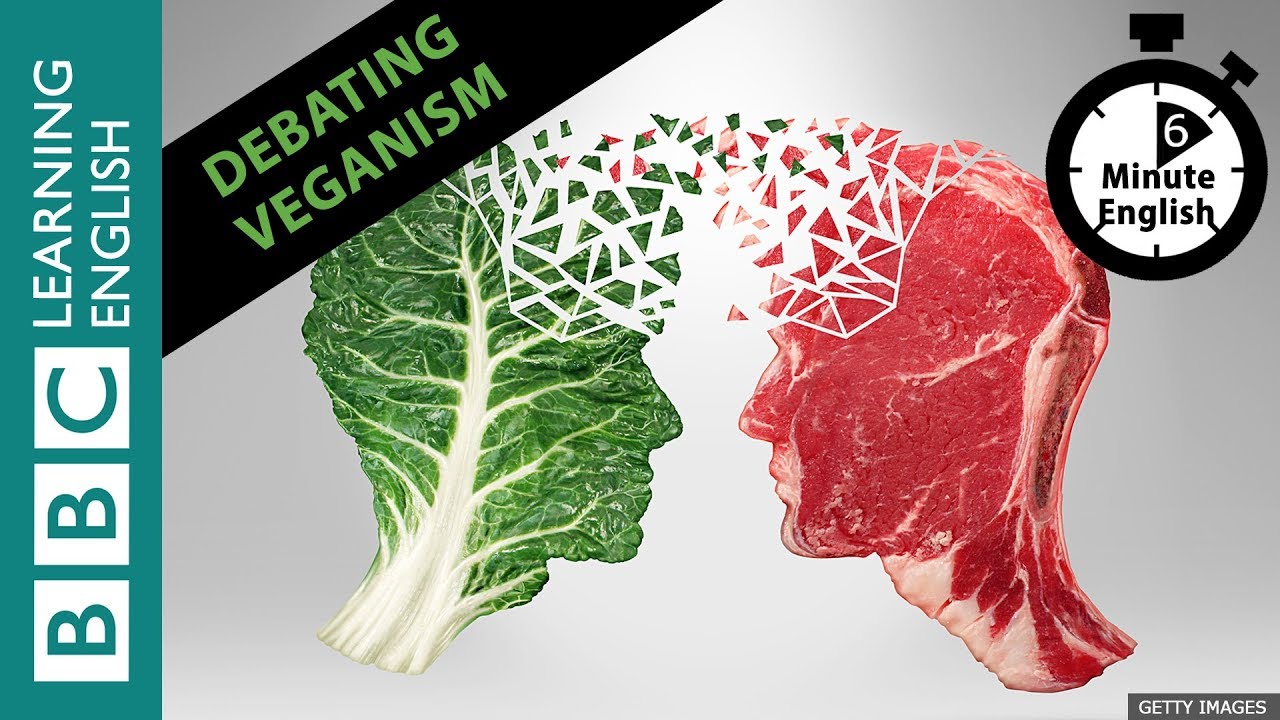
Debating veganism: How to change someone's opinion - 6 Minute English
video description
Date: 2020-09-18
Related videos




Comments and reviews: 10
Salsabil
Veganism is a controversial issue with strong opinions in favour and against. However, these opinion are less based on facts than you might think. What are they based on? And how can we convince someone to change an opinion? Dan and Rob find out and teach you new vocabulary.
This week's question
Which one of these items can a lacto-ovo-vegetarian eat?
a) pork
b) fish or
c) cheese
Listen to the programme to find out the answer.
Vocabulary
fad
something that is popular but only for a short time
mainstream
something that has become accepted by most people as normal
polarised
a situation that causes people to divide into two groups with opposing views
immoral
something that society thinks is wrong or not acceptable
peripheral
relates to things that are not as important as the main argument but are connected to it / situated on the edge
decent
good or good enough
Transcript
Note: This is not a word for word transcript
Dan
Hello and welcome to 6 Minute English. I'm Dan and joining me is Rob.
Rob
Hello.
Dan
Here at BBC Learning English, we're always discussing diets.
Rob
I am on a sea-food diet. When I see food, I just have to eat it!
Dan
I suppose there's no chance of converting you to a vegan diet, is there? That seems be the most talked about food fad at the moment a fad is something that is popular but only for a short time.
Rob
Of course, veganism that's not eating or using any products that come from animals may be more than a fad. It could be a lifestyle that improves our health and the planet. And it could be here to stay. But personally, me becoming a vegan would take some persuading.
Dan
I'm sure it would. And in this programme we'll be discussing the debate about veganism and how it's sometimes difficult to change people's minds. But first a question to answer. We've mentioned what a vegan eats but what about a lacto-ovo-vegetarian? Which one of these items can they eat? Is it:
a) pork
b) fish or
c) cheese?
Rob
I'll say b) they can eat fish.
Dan
Well, youll have to wait until the end of the programme to find out. But now back to veganism. According to some national surveys, there are now around 3.5 million full-time vegans in the UK... and the number is growing!
Rob
And what was recently a radical lifestyle choice is slowly moving into the mainstream or has become accepted by most people as normal.
Dan
Advocates of veganism say their healthy lifestyle would also free up space and resources for growing food and it would help reduce greenhouse gas emissions.
Rob
Yeah, but come on Dan. Having a meat-free diet means you might not get all the nutrients you need.
Dan
Well, this is all part of the debate, Rob. There's always two sides to an argument and it's something that's been discussed on BBC Radio 4's Farming Today programme. They spoke to Dr Jutta Tobias Mortlock, a senior lecturer in organisational psychology at London's City University, who explained why views about veganism are so polarised that 'means causing people to divide into two groups with opposing views'.
Dr Jutta Tobias Mortlock
This issue touches on personal beliefs, and beliefs always trump facts and so, often when we talk about beliefs, we're touching on important values. Values are the things that guide our opinion over what's right versus what's wrong. And so whenever people argue over whether it's right or wrong to eat meat, they are in fact not debating the facts around this issue, they're actually debating the beliefs about what's moral or immoral about this.
Dan
So it seems in the whole debate about veganism we are basing our views on beliefs. A belief is something we feel is true or real. Our beliefs are based on our values those are the things we think are right and wrong.
Rob
And when we argue over the rights and wrongs of veganism, we base it on our values not hard facts. We talk about our view on what is immoral so what society thinks is wrong or not acceptable. But basically, there is no right or wrong answer.
Dan
That's why we need facts, Rob.
Rob
So Dan, what can I do if I want to win you over to becoming an omnivore, like me?
Dan
According to Dr Jutta, there are two main routes to winning someone over: a direct, fact-based approach or a 'peripheral route', which might be more effective. Let's hear her explain how it works.
Dr Jutta Tobias Mortlock
If I'm working with you and I'm trying to get you to come round to my side, I might not focus on the central facts. I might focus on the peripheral stuff around how I'm constructing my argument. I'd look for ways of how they overlap as people, like what do they have in common? And that's a way to debate an issue such as this controversial one in a way to get people to feel connected to each other and to actually feel that they value each other as decent human beings.
Rob
Interesting! This is a more subtle way of winning an argument. She says we should focus on the peripheral stuff these are the things that are not as important as the main argument but are connected to it.
Dan
So we could say we're looking for common ground things that both sides agree on or at least understand. Dr Jutta talked about making both sides feel connected. And it's a good point. Even if you don't want to be a vegan, you should respect someone's choice to be one.
Rob
Yes, it's all about valuing someone as a decent human being. Decent means 'good and having good moral standards'. Like us, Dan!
Dan
Well, they're wise words, Rob! Of course, it would be morally wrong immoral not to give you the answer to our quiz question. Earlier I asked which one of these items can a lacto-ovo-vegetarian eat.
Rob
I said b) fish.
Dan
Sorry, no that's something they can't eat but they can eat cheese. A lacto-ovo-vegetarian is a person who eats vegetables, eggs, and dairy products but does not eat meat.
Rob
No meat! No steak! How can they enjoy eating?!
Dan
Rob, remember as a decent human beings, we respect all views here.
Rob
Just joking but now I'm deadly serious about reviewing some of the vocabulary we've discussed today.
Dan
OK. Our first word was fad. A fad is something that is popular but only for a short time.
Rob
Next, we mentioned mainstream. Something that is mainstream has become accepted by most people as normal.
Dan
Then we had polarised that describes a situation that causes people to divide into two groups with opposing views.
Rob
A belief is something we feel is true or real. And immoral describes something that society thinks is wrong or not acceptable.
Dan
We also mentionedperipheral, which relates to things that are not as important as the main argument, but are connected to it. It also means situated on the edge.
Rob
And finally, decent means good or good enough.
Dan
Don't forget you can learn more English with us on our website at bbclearningenglish.com.
Rob
Bye for now.
Dan
Goodbye
reply
ZaiDo
that's not so simple...
veganism is a trend and an ideology, not a way of life.
In fact, the soil needs animals to grow. we can't practice agriculture without animals. If we don't, we kill the soil and all the animals that are in the soils. That's not sustainable. That's the consequences of modern agriculture or vegan agriculture.
If we really want the biodiversity to live better, we need to stop farming big monocultures, and moreover we need to use animals.
An example of that, is the experiments of Alan Savory, who used animals, bringing them in different places over the year, and that place became entirely preserved from droughts.
In fact, the main argument isn't that.
If you don't want to eat animals, or what they create, that's your problem. But that doesn't matter compared to the number of lifes you can save and even create and make happy, if you don't eat products from big, plowed and treated at insecticide cropfields.
Simply because there is near from nothing living in those soils apart crops.
but that's not so simple. In our agricultural model, not sustainable, stop to eat meat is one of the most powerfull mean to reduce your impact on the environnement.
And buy more fair meat will reduce the animal pain, even if it will be maybe not enough for you. Another possibility is to raise your own animals, whether you eat them or not.
But not to eat meat or products from animals, is vegetalianism, or vegetarianism, not veganism.
Veganism is about to give rights to animals, and that's not bad. But one of the ideas is to not own an animal at home. That comes certainly from the feeling that we have aboit dogs (not cats),that that's not their place. Often, they seem to have a toxic relation with their human, as an alienation, as they are addict to their human, and have no more life than that relationship. Moreover we can't let them free, because they are dangerous or in danger. The only solution becomes to stop owning animals. But in fact, it depends on the situation. The relationship can be really good, and some dogs could may get used to that artificial environment, as humans do, if they can also often run in the nature.
Ethics have to be considered while making a choice or doing something, but there are not things systematicaly unethic, or systematicaly ethic, as vegan could say.
reply
mariam
Awesome episode.
Vegetarian diet has four types:
1- A vegan: a diet that excludes all animal products such as meat, poultry, fish, eggs, milk, cheese and other dairy products.
2- A lacto-vegetarian: vegetarian diet that excludes meat, poultry, eggs, fish but includes dairy products.
3- A lacto-ovo-vegetarian: vegetarian diet that excludes meat, poultry and fish but includes eggs and dairy products.
4- A Flexitarian: semi-vegetarian diet with a focus on vegetarian food with occasional meat consumption.
reply
Toni
How does it reduce greenhouse gas immisions? Kiss a cow and eight more vegans fart to their heart's content. Explain that one. People fart methain too.
Sounds to me like you're going to get religion shovved down your throght instead of a good steak. Yes that sounds moralistic.
reply
Candy
I wouldn't say they can't eat something, most o the time the diet or the way of living, is a choice so would be better to describe it as: they do not eat something. Can't eat certain food someone who is for example allergic to a product.
reply
house30house
Any humans is omnivore. There are all the time this misuse of the term omnivore like somebody that eat meat. Vegans because they are humans are omnivores. Lions for instance, carnivores, and the most of the animals hervibores
reply
Katherine
Thank you so much for your 6 minute programs. I am on the way to improve my English! By the way, I've been thinking about becoming a vegetarian for the last few weeks. Now I accidentally stumble upon this video. Is this a sign?
reply
education
As an Arabian we mostly eat vegetables and not depending on meat but fish is important for Potasium ..so thts why Islamic diet is the best we don't have infectious diseases in our communities such western and Europe
reply
Ricardo
I think to have a good health for human is important to cave a balance food. Eat meat and vegetables are necessary to the nutrition and balance of nutrians in our body.
reply
American
This is awesome. I teach English online, and have been wanting to incorporate debates into my classes. Keep studying hard everyone! You can do it
reply
Add a review, comment
Other channel videos