
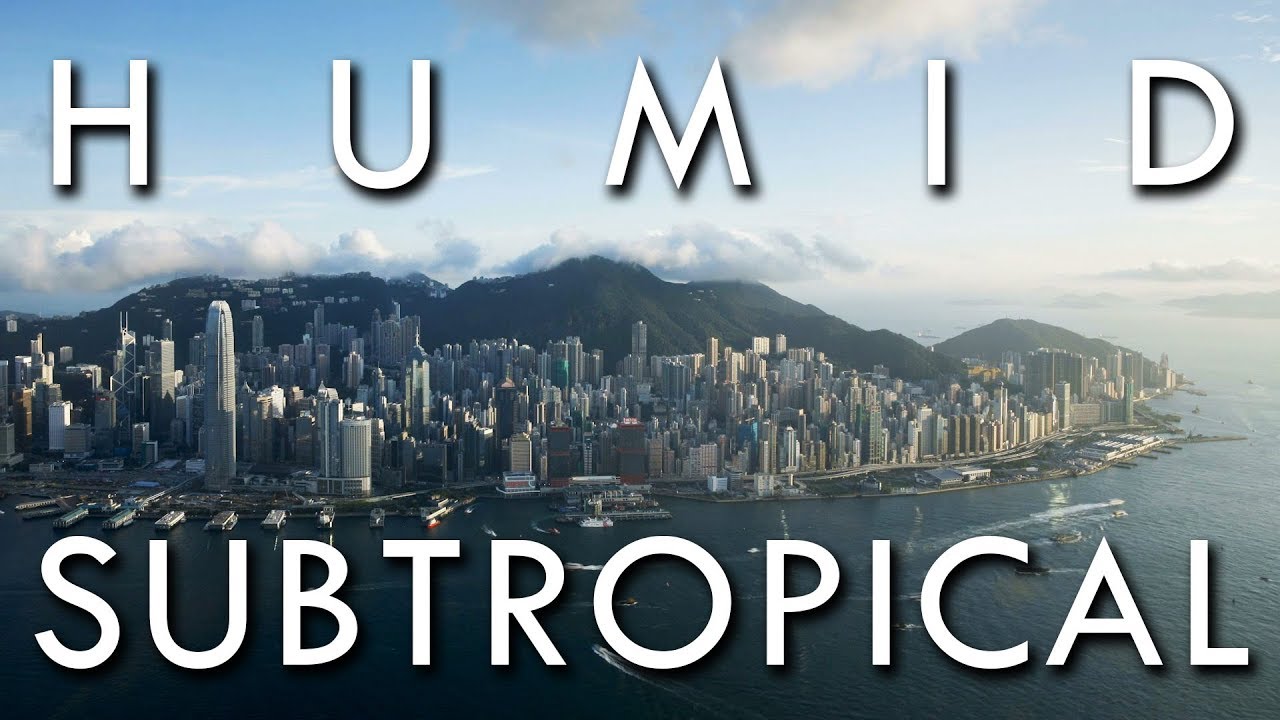
The Humid Subtropical Climate - Secrets of World Climate #5
video description
Date: 2024-01-04
Related videos




Comments and reviews: 35
-egg-iu3fe
the koppen humid subtropical category seems botched. How do two cities like New York and Brisbane have the same climate yet in real life they are completely different climates, it is unfathomable that snow would ever fall in Brisbane and it is known as a very warm and humid city unlike New York. Melbourne also has no snow at all and warmer winter temperatures than New York yet is not subtropical but oceanic which is cooler than subtropical. Melbourne never goes below zero yet NY does.
IMO the koppen humid subtropical category is too large and should be broken up into more specific categories. Places like NY and Washington may have humid summers but when looking at the climate as a whole it's not at all similar to places like Brisbane which don't really get the typical 4 seasons. Brisbane is more like Orlando or Tampa. Would anyone compare NY and Orlando climate? Yet they both supposedly have the same humid subtropical climate. Just check the weather now, Orlando is 29c high and a 17c low and New York is a 12c high and 2c low and it is DECEMBER!
Not to mention the vegetation is completely different you don't see palm trees everywhere in NY like you would typically see in a subtropical place. Something doesn't seem right about that category at all.
reply
-edwardgeorge8673
I live in the area of cwa. Where I live, it hardly snows in winter, occasionally once or twice, but it will soon melt. The summer here is very long. It has started to get warmer in March, and is already hot in April. Spring is very short, while summer lasts for a long time. In October, the temperature is still very high. The average temperature in November is generally above 10 degrees Celsius. Only in late December will the temperature drop. The coldest is January, but the cold weather doesn't last long, usually only a few days, which is tolerable most of the time. The difference between us and cfa is that our winter rainfall is low, usually less than 20 mm in January, and most of the rainfall is in summer and autumn (if any. In other words, we actually only have cold and warm seasons here, and spring, autumn and winter are very difficult to distinguish. Usually, it starts to get warmer in February, and then it lasts until December. I like our climate better, but feel a little cold in winter. I would be very satisfied if it could be warmer and have more rainfall in winter.
reply
-bikeyclown4669
Hello from subtropical North Carolina. I moved from the high dry climate of Denver, Colorado to the humid subtropical climate of North Carolina (NC) last year and there has definitely been an adjustment. I love how green it is in NC and the forests are positively gorgeous. From what little I have seen, winter can get cold, but not as cold, and it actually rains instead of snowing most of the time. However, the heat and humidity of summer take some getting used to. During the summer it never really feels cool at night or in the morning in NC because of the high humidity levels. It appears to get hotter during the day in Denver, but seems to cool down more at night and into the mornings, and that combined with the lower humidity levels give relief from the heat at least part of the day as a result. Both climates have their advantages and disadvantages and I have enjoyed NC so far.
reply
-westy6214
I love this video and love this climate. Like a lot of southern China it-s interesting how a lot of it is under the tropics of cancer, to name a few: Kunming, which runs through the middle of the topic of cancer, Nanning, Zhanjiang, Guangzhou, Shenzhen, Macau and Hong Kong but have the humid subtropical climate due to the Siberian pressure system that brings cool air part of the Asian Monsoon which I will watch next -
They just fall under the requirements for the Tropical wet and dry climates. Due to global warming a few like Zhanjiang May become a tropical climate in the next 20 years unless it is Slowed down. Hainans hardiness zones will go up as well. Despite Hong Kong being subtropical it has hardiness 11, unlike tropical Miami which has hardiness zone 10b.
Thank you for great video.
reply
fun-facts
Hey geo-! i lived in the Campo Grande MS city for a while and the climate is really this; this city is so wronged in terms of climate and biomes, this city and several other states in the center-south of Mato Grosso do Sul are of the Cfa climate, even on the koppen map this city is in the region demarcated by this climate (Cfa, koppen did not highlight that area randomly, and on the city's official website the climate is listed as subtropical Cfa.
and I got the same answers in surveys and watching your videos, all aspects of this region are related to the Cfa humid subtropical climate, there is no snow there but there are severe frosts and the days are usually quite mild.
- (the nacional wikipedia is really wrong in the informations o the Geography of Brazil);
reply
-gfunkin2
Many 2020 articles claim that New York City was a continental climate until recently when it switched to humid subtropical. Growing up in the city, for sure the winters are not nearly as harsh as they used to be. Summer seems longer and rather than a gradual Fall, there's no middle ground anymore. It just goes from warm, to cold. Meanwhile, when I was home in the city over the summer, it has never been that humid. Now on the west coast, I'm also interested in how the marine layer in SoCal isn't what it used to be. Where it just goes from the (not so) wet season, to summer without as much May Gray and June Gloom. I suspect in the coming decades, SoCal will be hotter but also a bit wetter in the summer, more influenced by the North American monsoon.
reply
-3dplanet100
Wow, so here in NJ close to New York City is humid sub-tropical and very close to humid continental. Makes sense. We have days in the winter that looks like continental climate but only during an artic blast or cold front when temps can fall to the 10's F (-10 C) at night. We also experiece some winter days where the temps can go to the 50's or 60's F (10's C) but only during a high pressure in the Atlantic. But the average we have here is about upper 30's F to lower 40's F day; upper 20's to lower 30's night on average. We experience snow in the winter and sometimes snow storms; and rain all year round. We experience warm to hot summers. So thats becuase NYC is sub-tropical, near the border of continental. Nice.
reply
-tropicaussie4572
I find it difficult to accept in practicality that places like New York, Washington DC, Milan etc. could ever be considered -humid subtropical - when their weather for the most part is nothing like tropical and in particular, their winters are freezing!
Coastal southeast Queensland, Australia is considered geographically subtropical, however average temperatures are closer to those that constitute a tropical climate. Winter lows are mild with occasional cold snaps but NEVER close to freezing, and winter days are still quite warm.
To be fair, Brisbane and areas just north are only 300 to 500 km south of the Tropic of Capricorn and all tropical plants including coconuts grow well and bear fruit!
reply
-nasifemdad2960
I'm now living in a small town 70 km from Rangpur in Northern Bangladesh, whose climate is classified as Cwa. Summers (average low/high 25C/35C)here are very very very humid and of course very wet, as this region is very heavily influenced by the Indian monsoon. Almost every year it floods in the low-lying areas around my town. Again, winters are mild to cool (average low/high 8C/20C, actually coldest in my tropical country, very foggy, and dry. Personally, my favorite season is autumn, due to its pleasant and mild temperature and comparable low humidity to the summer. summer temperatures here will not kill you, rather here the very high humidity will not let you do anything!
reply
-perrylim9728
I am impressed on how the Cfa/Cwa climates host billions and majority of the world's largest cities.
And in countries defined with so many climate types like China, US, Japan a dominant share of their people (at least 50%) would have lived in such a climate zone
But given we have climate change we could expect a bit more people to find themselves on the colder end of this climate zone, on a transition to Dwa/Dfa climates like the Northern, Northeastern United States like Boston, Chicago, Detroit, North China esp Beijing, Tianjin, Dalian and even parts of urban Hokkaido like Sapporo
reply
-jackscinema1706
I live in Washington DC. Here-s my general description of each season. Winters are cool
but dry. Autumns are pleasant and beautiful. Springs are short but nice. But If you could avoid it, don-t visit in the summer. While it-s not deadly or even close, the abundance of 30-35 degree days (86-95 Fahrenheit) with high humidity makes it extremely unpleasant. Plus at least a third of summer days will have an evening thunderstorm that will have you wishing you were in San Diego. Here-s my rating of the seasons from worst to best. Summer, Spring, Winter, and Autumn is the clear winner!
reply
-philipwillard4569
Howdy from below the Arbuckle mts. One of the only horizontal mountains in western hemisphere. They do alter the climate. Southeastern heading storms either dissipate or reorganize at I35 and reform at US75. In between is a somewhat different system. Looking at the rainfall totals for the dust bowl drought this small section actually received it-s normal rainfall. Also I35 which aligns with the western boundaries of the Arbuckles has a very different fauna and Floria on the east than the west south of the arbuckles.
reply
-hungvu262
Starting to get how Eurasia is analogous north america but with western Eurasia compressed.
Ireland to urals-pacific nw to rockies
Rome-california
Sahara to india - Baja California
Central Asia - Columbia/great basin
Northern SEA and taiwan- middle america and Florida
Tibet and mongolia-Colorado plateau, northern plains
East Asia - east U. S, Ontario, maritimes, Quebec,
Kamchatka - southern greenland
reply
fun-facts
It always feels strange that New York City is classified as humid subtropical; we get so many frigid Jan. and Feb. days (today included. But our winters are somewhere between the daily bone-chilling cold of upstate NY or Vermont and the refreshing, cool winter days of (say) North Carolina. And our summers are distinctly -Southern-: intensely humid and the heat seems to last almost five months (mid-May to mid-October.
reply
-shrek8781
You have seen me many times at this point but your videos are so fun to watch! Anyways, my question: Shouldn't this climate be split into two? In the koppen system, Cfa includes a lot of places which have very different winter temperatures, anywhere from 0 to 15 degrees! Eg. Hong Kong is Cfa and borderline Tropical while Eastern Bulgaria is borderline Continental. Both have similar summers but different winters.
reply
fun-facts
As someone from a dfa climate cfa doesn-t seem like it would be very pleasant. The summers are even hotter and more humid. The winters are cool so summer activities can-t be done in winter, but there you wouldn-t be able to experience the fun of snow and ice. You might get some snow and ice, but 3 inches of snow melting after a day is nothing like 15 inches for weeks.
reply
-kevinroman988
Hello bossman. You should talk about how the warming of certain areas in Europe see that they are becoming subtropical as well Like the new normal for Budapest, Hungary which show that they now have regular 1 to 2 months with a mean above 22C that should be interesting as it would be the most northern major city with such a climate classification.
reply
-SS-yj2le
How does Italy have both Mediterranean and humid subtropical at the same time? Is the Adriatic big enough to produce significant amount of moisture for the eastern side from the pressure cells? Why is all of Italy in a drought if humid sub tropical gets wetter with warmer temperatures as the Mediterranean climate gets drier with warmer temperatures?
reply
-davey6693
Thanks for this excellent video. It helps in some ways to show the fallibility of this classification system when you think about people who have made life changing decisions to move from climates like New York to end up in something closer to Durban (or the other way) which are so massively different from one another yet earn the same status.
reply
-andreescobar3159
Hello everyone from Tropical Savanna Brasilia (Brazil!
Puts New York and Houston in the same climatic region doesn-t seem reasonable-
I believe that one way to differentiate humid subtropical climates from temperate oceanic ones would be to consider a limit of 10C/50F for the average maximum temperatures of the coldest month.
reply
-elvyn8709
Cfa (subtropical) in Asia and America - Transitions between Continental (D) to Tropical Rainforest (Af,
Cfa in Europe - Transitions between Mediterranean; Csa (Temperate, dry summer, wet winter) and Oceanic; Cfb (Temperate, no dry season, warm summer.
Cwa - Transitions between Continental (D) to Tropical Savannah (Aw)
reply
-anotherdavidc
I noticed in this climate there are also many broadleaf evergreen trees and pine trees that are mixed with deciduous trees. I see that for forests in Guangzhou, Hong Kong, Taiwan. I am thinking this may also be the case for the Southern hemisphere subtropical lands? The other is a tall grass prairie type of grassland.
reply
-heartlandauthor
New York City is rather unusual for a city in a humid subtropical climate zone, as it receives an average of nearly 30 inches of snow per year! The climate around the continental/subtropical boundary in the eastern and central U. S. is a rather unique climate with both continental and subtropical elements.
reply
-billwaters8690
I am from South Florida in the United States. In the video I seen how other states like Georgia and South Carolina were grouped in the same category; but I can tell you first hand that Florida uniquely has a much hotter climate than any other southeast regional state.
reply
I am from South Florida in the United States. In the video I seen how other states like Georgia and South Carolina were grouped in the same category; but I can tell you first hand that Florida uniquely has a much hotter climate than any other southeast regional state.
reply
-bretts4544
My favorite type of climate here in the United States. I love long summers, but winters cold enough where you get to appreciate spring. I live in Massachusetts where it-s -humid continental- and the winter tends to drag on too much for my liking.
reply
My favorite type of climate here in the United States. I love long summers, but winters cold enough where you get to appreciate spring. I live in Massachusetts where it-s -humid continental- and the winter tends to drag on too much for my liking.
reply
-Geodiode
Hello all! I hope you enjoyed this presentation of the Humid Subtropical Climate - the most heavily populated of all climate zones. If you're one of the many people that live in these zones, say hi and tell us what you think of the weather there!
reply
Hello all! I hope you enjoyed this presentation of the Humid Subtropical Climate - the most heavily populated of all climate zones. If you're one of the many people that live in these zones, say hi and tell us what you think of the weather there!
reply
-shroomzed2947
Koppen is generally an adequate system, but Cfa is one of the areas where it drops the ball. It-s essentially a wastebasket category. Can you tell me a single thing Fuzhou and NYC have in common? Even the wind patterns are utterly different.
reply
Koppen is generally an adequate system, but Cfa is one of the areas where it drops the ball. It-s essentially a wastebasket category. Can you tell me a single thing Fuzhou and NYC have in common? Even the wind patterns are utterly different.
reply
-Geodiode
Hello all! I hope you enjoyed this presentation of the Humid Subtropical Climate - the most heavily populated of all climate zones. If you're one of the many people that live in these zones, say hi and tell us what you think of the weather there!
reply
Hello all! I hope you enjoyed this presentation of the Humid Subtropical Climate - the most heavily populated of all climate zones. If you're one of the many people that live in these zones, say hi and tell us what you think of the weather there!
reply
-elvyn8709
6: 20 - NorthEastern Argentina (including Buenos Aires) and Uruguay not only by major ancestry resemble with Italian (mainly from North Italy, also climate resembled with North Italy aka Padania climate because both belongs to Cfa climate.
reply
6: 20 - NorthEastern Argentina (including Buenos Aires) and Uruguay not only by major ancestry resemble with Italian (mainly from North Italy, also climate resembled with North Italy aka Padania climate because both belongs to Cfa climate.
reply
-anotherdavidc
Aren't humid subtropical climates known for karst and limestone formations? Also depending on topography, there is also mixture of deciduous with broadleaf evergreens, pines, and vine vegetation and lianas.
reply
Aren't humid subtropical climates known for karst and limestone formations? Also depending on topography, there is also mixture of deciduous with broadleaf evergreens, pines, and vine vegetation and lianas.
reply
-zhiruiliu2433
From Southern China Guangzhou, now I am studying abroad in the UK, I prefer the Oceanic Climate: D Because Summer in the UK is cool and balmy, you don't need the air-condition. And Winter is also wet too
reply
From Southern China Guangzhou, now I am studying abroad in the UK, I prefer the Oceanic Climate: D Because Summer in the UK is cool and balmy, you don't need the air-condition. And Winter is also wet too
reply
-charliehe4542
I'm from Northern China on the edge between Cwa and Dwa on the Yellow River. The climate change seems to have been pushing it more and more towards Cwa, with hotter rainier summers and milder winters.
reply
I'm from Northern China on the edge between Cwa and Dwa on the Yellow River. The climate change seems to have been pushing it more and more towards Cwa, with hotter rainier summers and milder winters.
reply
-basilleaves5706
Europe is the last continent in which the humid subtropical climate comes to mind. But then, I-ve read more about it - some major cities like Belgrade and Venice fall under the Cfa classification
reply
Europe is the last continent in which the humid subtropical climate comes to mind. But then, I-ve read more about it - some major cities like Belgrade and Venice fall under the Cfa classification
reply
-namitajimmy6737
I've noticed is that in the humid subtropical areas of the indian subcontinent, is that either November or December is the driest months, so in many places winter isn't even the driest period
reply
I've noticed is that in the humid subtropical areas of the indian subcontinent, is that either November or December is the driest months, so in many places winter isn't even the driest period
reply
-senorkenyon3306
I lived in Tokyo for a while, and I gotta say, I much prefer the weather in Tokyo than in Phoenix! The incessant rain was dreary at times, but I-d take a rainy place over a dry one any day.
reply
I lived in Tokyo for a while, and I gotta say, I much prefer the weather in Tokyo than in Phoenix! The incessant rain was dreary at times, but I-d take a rainy place over a dry one any day.
reply
Add a review, comment
Other channel videos


