How fast can an overpowered model railway drive? 88 mph?
video description
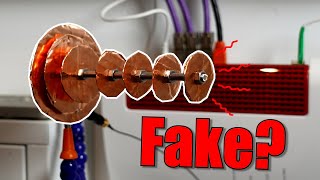
What I expected to hear next was: To counteract this I needed to increase the downward force; I did not want to increase the locomotive weight as it would require even higher voltages to reach maximum speed, I also did not want to add aerodynamic downforce as the locomotive would not be going fast enough for this, and it would spoil the aesthetics. So instead I decided to magnetise the wheels.
Date: 2020-09-05
Related videos


Comments and reviews: 9
Mihir
Hey I am a little confused here. Why did we equate the vertical gravitational force to the horizontal centripetal force. Shouldn't we use friction along with the horizontal normal force due to the tracks onto the wheel (depending on the shape. This seems like much more of a topping situation so using torque about the point of contact of wheel and track would make sense right? I am not sure. can someone help please. :)
reply
Hey I am a little confused here. Why did we equate the vertical gravitational force to the horizontal centripetal force. Shouldn't we use friction along with the horizontal normal force due to the tracks onto the wheel (depending on the shape. This seems like much more of a topping situation so using torque about the point of contact of wheel and track would make sense right? I am not sure. can someone help please. :)
reply
K.
There is no such thing as a centrifugal force! (If you take the train as referential then the centrifugal force appears and is considered fictious. It is the speed which is tangent to the path (or not if the train is not turning) that is driving the the train outside of its rails.
There is only 1 force in fact: the force of reaction of the rails that push the train towards the center of the curve.
reply
There is no such thing as a centrifugal force! (If you take the train as referential then the centrifugal force appears and is considered fictious. It is the speed which is tangent to the path (or not if the train is not turning) that is driving the the train outside of its rails.
There is only 1 force in fact: the force of reaction of the rails that push the train towards the center of the curve.
reply
Jaxne
The real challenge for model railroad is getting the train to run very slow but still smoothly and stable. Digitally with DCC for example it is easy with PWM controlled motor, but with analog control as in this video its a bigger challenge and maybe something interesting for another video? :)
reply
The real challenge for model railroad is getting the train to run very slow but still smoothly and stable. Digitally with DCC for example it is easy with PWM controlled motor, but with analog control as in this video its a bigger challenge and maybe something interesting for another video? :)
reply
Adrian
Hi Scott! Nice video!
Could you make a video how to increase the model train HO DCC speed. I'm curious if there are any chances to tune a rail model using a DCC decoder and increase the maximum speed.
It will be interesting in many things the experiment.
reply
Hi Scott! Nice video!
Could you make a video how to increase the model train HO DCC speed. I'm curious if there are any chances to tune a rail model using a DCC decoder and increase the maximum speed.
It will be interesting in many things the experiment.
reply
Alistair
since the power was not the limiting factor, i wonder if adding a counterbalance weight on the inside of the train would yield a much higher speed or if the additional weight would slow it down.
reply
since the power was not the limiting factor, i wonder if adding a counterbalance weight on the inside of the train would yield a much higher speed or if the additional weight would slow it down.
reply
Wes8761
Locomotives failing off curves has been the cause of some train wrecks. The 2015 Amtrak Philadelphia Wreck happened when a locomotive was going 102 MPH through a 50 MPH curve.
reply
Locomotives failing off curves has been the cause of some train wrecks. The 2015 Amtrak Philadelphia Wreck happened when a locomotive was going 102 MPH through a 50 MPH curve.
reply
eli. l. t
I used to have a 4' x 6' table 120 x 180 cm covered in ho scale track and so on I decided to go to railkarts instead but I had a few trains fly across the room at full speed
reply
I used to have a 4' x 6' table 120 x 180 cm covered in ho scale track and so on I decided to go to railkarts instead but I had a few trains fly across the room at full speed
reply
David
If he put weight on the left side he can balance the train so it wont fall but it has to be at the bottom or put weight on the middle bottom to keep is stable.
reply
If he put weight on the left side he can balance the train so it wont fall but it has to be at the bottom or put weight on the middle bottom to keep is stable.
reply
REAL
Please read it, i just need to make a small lab bench power supply with constant current, please help even if you can not make a video, pls tell me some link.
reply
Please read it, i just need to make a small lab bench power supply with constant current, please help even if you can not make a video, pls tell me some link.
reply
Add a review, comment
Other channel videos