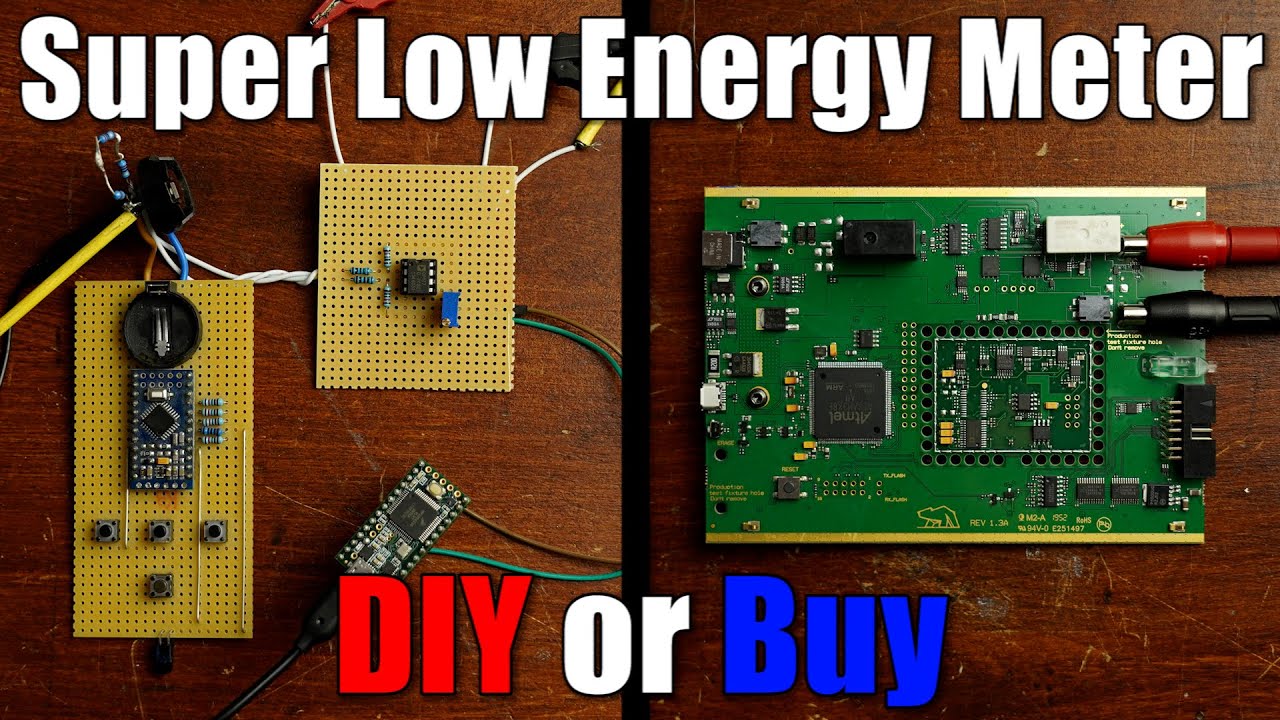
Super Low Electrical Energy Meter DIY or Buy Is measuring A/nA possible the DIY way?
video description
Date: 2021-01-24
Related videos






Comments and reviews: 10
DJ_PaulTUK
I once worked on an internal project where we had a small RF device that need to run for 1 year unattended with just a single CR2032 cell. The device would wake up every day, send an RF pulse with data and go back to sleep. Anyway we did a huge amount of testing with cells of differing makes. In the end the winner by far was Panasonic 2032 cells. From that experience i always use Panasonic button cells these days in all applications.
reply
I once worked on an internal project where we had a small RF device that need to run for 1 year unattended with just a single CR2032 cell. The device would wake up every day, send an RF pulse with data and go back to sleep. Anyway we did a huge amount of testing with cells of differing makes. In the end the winner by far was Panasonic 2032 cells. From that experience i always use Panasonic button cells these days in all applications.
reply
Manabe
hello, can i ask if you can make a 5v pwm 555 timer generator with a full range potentiometer support? welp, here's the case. i need to have a 5v one instead of 9-12v because i need to dim a low power flashlight for extended use. or someone can help me with the diagram. thanks a lot this can help
reply
hello, can i ask if you can make a 5v pwm 555 timer generator with a full range potentiometer support? welp, here's the case. i need to have a 5v one instead of 9-12v because i need to dim a low power flashlight for extended use. or someone can help me with the diagram. thanks a lot this can help
reply
Majsterkowanie
With opamp circuit, you can use a higher resistor value, for example 10k, which creates a 10mV voltage drop, when the current is 1uA. This way, by adding a multiposition switch to change the resistor value, crude low energy meter would work even with very low currents.
reply
With opamp circuit, you can use a higher resistor value, for example 10k, which creates a 10mV voltage drop, when the current is 1uA. This way, by adding a multiposition switch to change the resistor value, crude low energy meter would work even with very low currents.
reply
Carl
I used a CR32 battery for my night vision. But that run on 2. 7v so i put a resistor between positive from the battery to the night vision tube lasted ages before i changed it.
As always grate vid keep the thoughts flowing till next time.
reply
I used a CR32 battery for my night vision. But that run on 2. 7v so i put a resistor between positive from the battery to the night vision tube lasted ages before i changed it.
As always grate vid keep the thoughts flowing till next time.
reply
DatBoiOrly
I'm a tad bit confused why you didn't buy similar components that they used like you always do and compare the prices time spent etc to see if it's worth it to DIY or Buy. I get it it's a sponsor but you could of atleast tried.
reply
I'm a tad bit confused why you didn't buy similar components that they used like you always do and compare the prices time spent etc to see if it's worth it to DIY or Buy. I get it it's a sponsor but you could of atleast tried.
reply
Ethan
I used two op-amps and a bunch of high-pass and low-pass filters so that the frequency I wanted to measure was pretty much the only one it could measure and I was was well within the picoamps range.
reply
I used two op-amps and a bunch of high-pass and low-pass filters so that the frequency I wanted to measure was pretty much the only one it could measure and I was was well within the picoamps range.
reply
kevgermany
Pretty naff to get a free evaluation unit and then try to copy it. Love your videos, but this is not a good way forward. Rather glad you didn't manage to duplicate it.
reply
Pretty naff to get a free evaluation unit and then try to copy it. Love your videos, but this is not a good way forward. Rather glad you didn't manage to duplicate it.
reply
Dheeraj
Does DIY ever win out haha. Can someone tell me if there's a DIY version winning out in his series? In all the videos I've watched in this series, buy option wins out
reply
Does DIY ever win out haha. Can someone tell me if there's a DIY version winning out in his series? In all the videos I've watched in this series, buy option wins out
reply
Shubhayu
Isn't the theoretical power calculated wrong? It should be:
Power rating (3. 0V - discharged minimum voltage)
Please let me know if I am wrong.
reply
Isn't the theoretical power calculated wrong? It should be:
Power rating (3. 0V - discharged minimum voltage)
Please let me know if I am wrong.
reply
Redi
A new thing come in market name Raspberry pi pico a 4 Microcontroller if possible pls make a video on it also if possible to code in C++ language
reply
A new thing come in market name Raspberry pi pico a 4 Microcontroller if possible pls make a video on it also if possible to code in C++ language
reply
Add a review, comment
Other channel videos