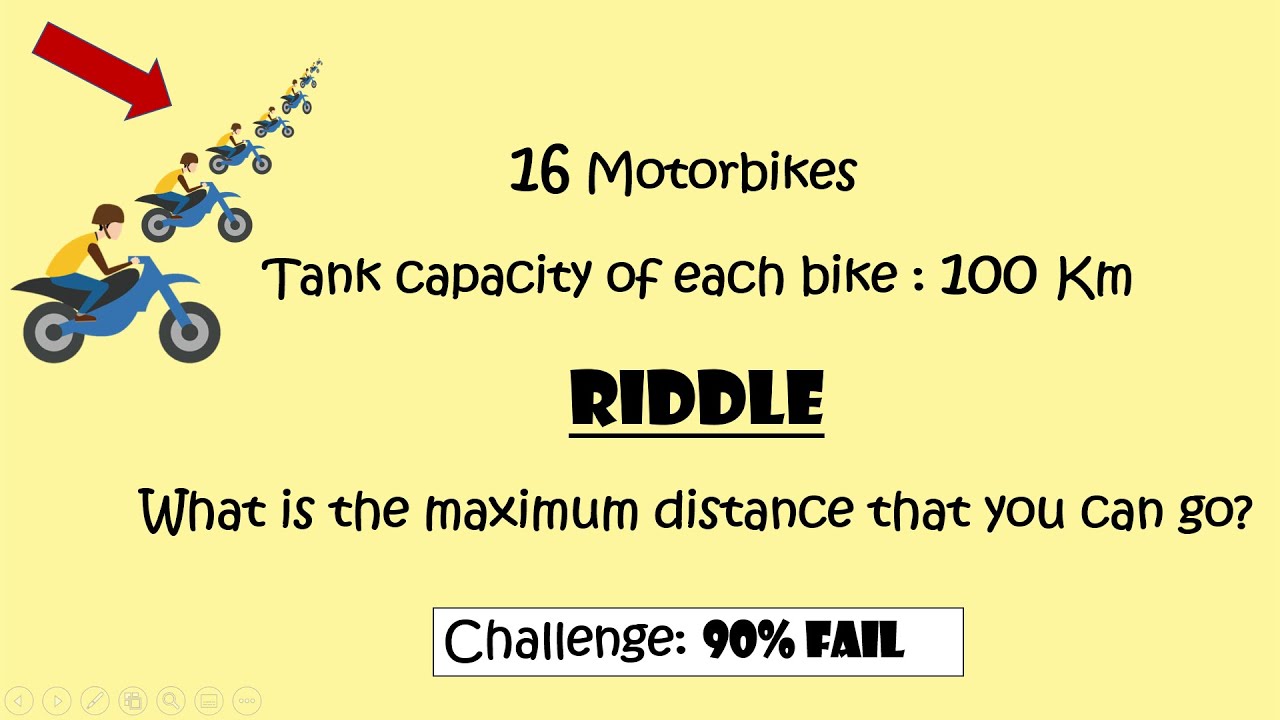
Interview Riddle - 16 Bikes Logic and Optimization Puzzle
video description
That means the respondent can equally assume they have a welding kit and a tool kit. With 15 spare motorcycle frames and 30 spare wheels, there's more than enough material to make a trailer to carry the 15 spare gas tanks behind them.
Then, given we're assuming an environment where weight has no bearing on fuel efficiency (because no motorcycle improves remaining range on less than a fuel tank, the trailer is effectively weightless, and therefore one motorcycle can go 1600 km, with the siphoning hose running between the main tank and trailer.
Date: 2023-11-15
Related videos




Comments and reviews: 29
Victoria
There is no rule that says that you have to ride the motorbike, just that there is a rider on it, so why don't just push them. So the question was what distance you can go, so if you misinterpret that intentionally, you could just think about how much you can go, while pushing the rider and the motorbike, and because there is no time given, it would be approximately 170000km by the time you turn 80, but of course that would depend on your lifestyle and if you are fit enough to push the rider. If you would make it your goal in life, you could surely do even better.
reply
White
Excellent solution without doubt, but often most of your riddles seems reverse solved. The analogy of bike with fuel is ridiculous, because, if I were to beat someones record by a mile I would rather push the bike for the extra mile. Without time constraint, this solution may not make any sense. Further, consider the spillage every time you have to refuel. Is the road flat. Then there is -maximum distance that YOU can go-, is there a space for ME to sit behind the rider. If the bike has reasonable torque then daisy chain them would be the best solution.
reply
sorsocksfake
Every mile a motorcycle needs to drive, is fuel used out of the 1600 total fuel(km. So we want to drive bikes as little as possible. This is done by dropping out a bike as soon as its remaining fuel is just enough to top everyone else off.
At the start, that's after 100/16=6. 25km. The remaining 15/16th of his fuel is divided among the other 15 bikes, which ride on. After 100/15 = 6. 666 km the second bike divides its remaining 14/15th of fuel among the oter 14, and so forth.
This gets 100/16+100/15+. +100/2+100/1= just over 338 km.
reply
Steve
The Strategy mentions -A milestone is reached AS SOON AS the doner bike has enough fuel which can be transferred to the other bike to fully load its tank-. That could happen after 1 inch of travel, 2 feet of travel, 8 yards, 3 kilometers, 8 miles, 17 or 44 miles. Needed is a clause such as -while fully emptying its own tank-. The formula clears this up some calculating this as 50. Working with 0s and 1s for many years I'm very sticky about good definitions of problems since an unclear one can cause lots of issues and rewrites.
reply
Kevin
I did figure out the approach recommended in the video, and got that answer. But the actual answer to the question as asked is 1, 600 km. The question did not ask how far you could travel away from the point of orign. It only asked how far you could travel. To travel 1, 600 km, you get rid of all the other drivers. Then you drive the first bike in a circle with a diameter of 100 km. Then you get off that bike, get on the next bike and repeat the process. after using all 16 bikes, you have traveled 1, 600 km.
reply
Даниил
My first solution was:
Riding 50km at each (+50 km)
Refueling 8 bikes with 8 others
8 bikes left
Repeating
Riding 50km at each (+50 km)
Refueling 4 bikes with 4 others
4 bikes left
Riding 50km at each (+50 km)
Refueling 2 bikes with 2 others
2 bikes left
Riding 50km at both (+50 km)
Refueling 1 bike with other
1 bike left
Riding last 100 km (+100 km)
-Total 300 km-
_P. S. oh, it is bad solution. _
_P. P. S. _ 3: 40
_OOOOOOOH NOW I KNOW_
reply
Joe
And here I thought the optimal solution yielded 1600 km traveled. The first fifteen bikes hold on to each other and the sixteenth tows them 100 km. He drops off and the second bike tows the next 100 km. Repeat for all 16 bikes and you (the sixteenth) have gone 1600 km. Well, probably closer to 1550 because of extra fuel usage for towing, but you get the point. Anyway, that is the actual optimum solution - don't run motors when you don't have to. -The best part is no part- - Elon Musk.
reply
Gonzalo
The trick is to sacrifice bikes as soon the remaining fuel of 1 tank fills completely the remaining tanks. First stop is at 6. 25km, you fill all tanks but 15 bikes remain with full tank. Next stops at at 6. 66km, 7, 42km, 7, 69km and so on. The last stop, when 2 bikes remain, is at 50km and the maximum distance reached for the last bike is 238. 07 km where 1 bike will remain with full tank. So the maximum distance is 338. 07km (with spreadsheet, so no rounding made)
reply
Karthik
When I solved this I got 500 km. 16 bikes will be grouped into 8 pairs. In each pair one bike will be running and other will be switched off, basically one bike tolls the other, by placing the leg on the running bike. after 100 km, 8 bikes will be grouped into 4 pairs. after 200 km 4 bikes will be grouped into 2 pairs and after 300 km we have 2 bikes, one tolls the other. after 400 km the last bike will go another 100km so we will get as 500 km in total
reply
Ridhwan
Everyone else: think hard on this riddle
Meanwhile me who is simple-minded: the question asked the maximum distance that YOU can go. kick all those riders off. take all the oils in other 15 tanks ( except for one bike you are riding ) and there 1600km of long ride ( assuming you are immortal who does not age, thirst, hungry and tire. also that there is actually a road for you to ride 1600km )
reply
BladeArtist100
This is the maximum distance from the starting point, not maximum distance traveled. Maximum distance would be each rider going 100km in different vectors for 1600km traveled total. Or you could do maximum distance traveled away from each other, which would take half the group one way and half the group another for a total of approximately 543km in total.
reply
pema
Strap all of the bikes to one in pairs(like a cart) for balance and have a trio among them if the total number of bikes is even until the last 2. Strap this to the one you-re riding. Then, strap the second last one to the side of the first one(or the back if you-re skilled. Use motorbike parts if needed as the straps. This approach gets 1600 km.
reply
Pranav
I thought of the bikers holding hands, so that one bike drags the remaining 15 bikes to the 100 km mark followed by the next bike dragging the remaining 14 bikes another 100 km and so on for a total of 1600 km.
I guess it's crazy enough to work provided the bikers have good balance and the road is nice and smooth
reply
Bob
The correct solution is 1600 km. The question is -what is the maximum distance you can go? - With the 1st bike you can go 100 km - 50 km north and then 50 km south, then do the same for each successive bike. (-Note that the question does NOT ask the maximum distance FROM THE STARTING POINT)
reply
The correct solution is 1600 km. The question is -what is the maximum distance you can go? - With the 1st bike you can go 100 km - 50 km north and then 50 km south, then do the same for each successive bike. (-Note that the question does NOT ask the maximum distance FROM THE STARTING POINT)
reply
Jules
Maximum distance traveled was not specified as from the starting position, so total is 100o kilometers. Driver one goes 50K turns around and returns for 50K, they then refuel the original bike s and they repeats the 100K loop until all fuel is gone. Ten loops is 1000K on Ye Ole Odometer.
reply
Maximum distance traveled was not specified as from the starting position, so total is 100o kilometers. Driver one goes 50K turns around and returns for 50K, they then refuel the original bike s and they repeats the 100K loop until all fuel is gone. Ten loops is 1000K on Ye Ole Odometer.
reply
Sushant
This guy: -let's use optimization-
My Indian brain: -use one leg to push the other bike-
1st 100 km 8 bikes rem
2nd 100 4bikes remaining
3rd 100 2 bikes rem
4th 100 1 bike remaining
5th 100 run out of fuel.
500 km travelled.
This is called DJ or Desi Jugaad -
reply
This guy: -let's use optimization-
My Indian brain: -use one leg to push the other bike-
1st 100 km 8 bikes rem
2nd 100 4bikes remaining
3rd 100 2 bikes rem
4th 100 1 bike remaining
5th 100 run out of fuel.
500 km travelled.
This is called DJ or Desi Jugaad -
reply
GowriShankar
Well we can use 1 motorcycle to push the other 15 for first 100km and the 2nd can push the rest 14 after 100km and so on and so forth. So the maximum distance you can travel, logically is 1500+ km. This can be done in reality. If done to with 100% accuracy 1600km is possible
reply
Well we can use 1 motorcycle to push the other 15 for first 100km and the 2nd can push the rest 14 after 100km and so on and so forth. So the maximum distance you can travel, logically is 1500+ km. This can be done in reality. If done to with 100% accuracy 1600km is possible
reply
Rutvij
Rather than transfering the fuel, why don't you tow the bikes by attaching the rope and keep on doing the same till the fuel of the towing bike gets empty. This will cover way far more distance than what you calculated.
Use Indian jugads, always more worthwhile. -
reply
Rather than transfering the fuel, why don't you tow the bikes by attaching the rope and keep on doing the same till the fuel of the towing bike gets empty. This will cover way far more distance than what you calculated.
Use Indian jugads, always more worthwhile. -
reply
onlycomments
Actually it can be 1600 km as you have asked maximum distance. if it is maximum displacement, then it is 337 as you mentioned. -
As many people in the comment section are finding out loopholes and giving different solutions, I tried myself too-
reply
Actually it can be 1600 km as you have asked maximum distance. if it is maximum displacement, then it is 337 as you mentioned. -
As many people in the comment section are finding out loopholes and giving different solutions, I tried myself too-
reply
Ville
The question was written so that it would have allowed one driver to drive a 100 km -loop- just to came back and swap the bike to another with fully loaded tank. Eventually travelling 1600 km (though coming back at the same point eventually)
reply
The question was written so that it would have allowed one driver to drive a 100 km -loop- just to came back and swap the bike to another with fully loaded tank. Eventually travelling 1600 km (though coming back at the same point eventually)
reply
DastraN
As soon as a guy can transfer his fuel to others and leave, he should do that. because he is unnecessarily wasting fuel further on if he keep travelling with others. He can stop and give his fuel to someone else than wasting.
reply
As soon as a guy can transfer his fuel to others and leave, he should do that. because he is unnecessarily wasting fuel further on if he keep travelling with others. He can stop and give his fuel to someone else than wasting.
reply
Hendrikus
I was going to suggest to just push the bike when you run out of fuel. But upon rereading the problem, we need to have the ''maximum distance that -you- can go''. So just ditch the bikes and go for a long walk. easy solve
reply
I was going to suggest to just push the bike when you run out of fuel. But upon rereading the problem, we need to have the ''maximum distance that -you- can go''. So just ditch the bikes and go for a long walk. easy solve
reply
megabyte512
The maximum distance that can be covered is 1600 km. I had a tool set and took all the tanks off the other motorcycles (While they were sleeping. Strapped them to mine and refilled every 100 km. Total traveled 1600km
reply
The maximum distance that can be covered is 1600 km. I had a tool set and took all the tanks off the other motorcycles (While they were sleeping. Strapped them to mine and refilled every 100 km. Total traveled 1600km
reply
Tom
Wrong. Drive the fist bike 100-times around a 1-km loop, then swap to the second bike and repeat. By doing so, one can achieve 1, 600km. Specify the rules more carefully next time, if you don't want to look so foolish?
reply
Wrong. Drive the fist bike 100-times around a 1-km loop, then swap to the second bike and repeat. By doing so, one can achieve 1, 600km. Specify the rules more carefully next time, if you don't want to look so foolish?
reply
jeppen
I found that it was the harmonic series from 1-16 and looked up the value for this partial sum: -3. 38073. But I see that others have pointed out the error in the vid giving a slightly different answer.
reply
I found that it was the harmonic series from 1-16 and looked up the value for this partial sum: -3. 38073. But I see that others have pointed out the error in the vid giving a slightly different answer.
reply
Christian
You cannot exchange the fuel without tools. Tools are not mentioned. but that each bike has a rider! Also -maximum distance- could also be just 1600km. Two flaws that breaks the riddle upfront.
reply
You cannot exchange the fuel without tools. Tools are not mentioned. but that each bike has a rider! Also -maximum distance- could also be just 1600km. Two flaws that breaks the riddle upfront.
reply
Prasun
Tank capacity is 100 Km. Who designed this question, get him the standards of measurement, thats not the unit of measurement of a liquid. I wanna punch that guy so hard? Absolute waste of time.
reply
Tank capacity is 100 Km. Who designed this question, get him the standards of measurement, thats not the unit of measurement of a liquid. I wanna punch that guy so hard? Absolute waste of time.
reply
vasu
You didn't ask the direction in which the 16 bikes to travel. So all the 16 bikes start from same point and travel in 16 different directions then total travelled distance is 100-16=1600 KMs.
reply
You didn't ask the direction in which the 16 bikes to travel. So all the 16 bikes start from same point and travel in 16 different directions then total travelled distance is 100-16=1600 KMs.
reply
DeBee
1600 KM. The question was distance traveled, not how far. But, if you use Euler's number, logarithms, divide by infinity, add 3 in the 27th step of your equation. 10KM. Unless you want 11.
reply
1600 KM. The question was distance traveled, not how far. But, if you use Euler's number, logarithms, divide by infinity, add 3 in the 27th step of your equation. 10KM. Unless you want 11.
reply
Add a review, comment
Other channel videos