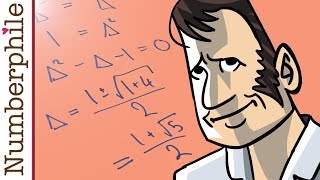
Golden Proof - Numberphile
video description
. -8 5 -3 2 -1 1 0 1 1 2. It's the same just back wards and every other number is negative. The ratios are -1/2, 2/-3, -3/5, 5/-8 which you can see is the ratios to right just flipped and negative, so it converges to -1/phi and 1/phi is phi -1 you can see this because phi-2 =phi +1 and divide by phi so it's -(phi-1) which is -phi +1 and you can do the math and see that that is 1-sqrt5/2
Date: 2022-04-08
Related videos




Comments and reviews: 9
July17
If I take the equation x_n/x_n-1= x_n-1/x_n-2 and multiply each side by (x_n-1(x_n-2) I get
(x_n(x_n-2)=(x_n-1)-2 and that is not entirely true how does that work? Because for instance if we let x_n=5 then we get 5(2)=3-2 which is off by 1. If we let x_n=8 then 8(3)=5-2 which is also off by one. x_n=3 then 3(1)=2-2 and also off by one and so on. Could it be possible to demonstrate that by doing this we will always be off by one; meaning (x_n(x_n-2)+1=(x_n-1)-2 and if so why does that happens, if the ratio is the same then so should be the equality without the +1.
reply
If I take the equation x_n/x_n-1= x_n-1/x_n-2 and multiply each side by (x_n-1(x_n-2) I get
(x_n(x_n-2)=(x_n-1)-2 and that is not entirely true how does that work? Because for instance if we let x_n=5 then we get 5(2)=3-2 which is off by 1. If we let x_n=8 then 8(3)=5-2 which is also off by one. x_n=3 then 3(1)=2-2 and also off by one and so on. Could it be possible to demonstrate that by doing this we will always be off by one; meaning (x_n(x_n-2)+1=(x_n-1)-2 and if so why does that happens, if the ratio is the same then so should be the equality without the +1.
reply
education
Cool proof, but also incomplete. There's a (true) presupposition that there are infinitely many initial conditions (i. e. x_1 and x_2) such that the limit of x_n/x_-n-1- exists.
If this limit exists only for finitely many initial conditions, then the -proof- would work, algebraically, just as depicted, but the conclusion that -an infinite number of sequences have that -golden ratio- property- would not be justified.
Fortunately, the presupposition is true, so we don't have a problem. But I'd like to see that assumption either stated or proven outright.
reply
Cool proof, but also incomplete. There's a (true) presupposition that there are infinitely many initial conditions (i. e. x_1 and x_2) such that the limit of x_n/x_-n-1- exists.
If this limit exists only for finitely many initial conditions, then the -proof- would work, algebraically, just as depicted, but the conclusion that -an infinite number of sequences have that -golden ratio- property- would not be justified.
Fortunately, the presupposition is true, so we don't have a problem. But I'd like to see that assumption either stated or proven outright.
reply
euskalX
Actually he did NOT really prove that the Fibonacci ratio of two consecutive terms will tend towards the golden ratio.
Look at 0: 47. He assumes that consecutive terms will tend towards a fixed ratio.
So what he actually proves here is -simply- that if a sequence tends towards a fixed ratio for two consecutive terms, then this ratio will be the golden ratio.
But he did not prove here that the Fibonacci sequence will tend towards a fixed ratio. This is a missing element in his proof.
Nice and instructive video anyway
reply
Actually he did NOT really prove that the Fibonacci ratio of two consecutive terms will tend towards the golden ratio.
Look at 0: 47. He assumes that consecutive terms will tend towards a fixed ratio.
So what he actually proves here is -simply- that if a sequence tends towards a fixed ratio for two consecutive terms, then this ratio will be the golden ratio.
But he did not prove here that the Fibonacci sequence will tend towards a fixed ratio. This is a missing element in his proof.
Nice and instructive video anyway
reply
Al
I'm confused. The proof given seems to imply that the ratio of any consecutive pair of numbers in a sequence, which obeys the property that the next number in the sequence is the sum of the previous two numbers, is equal to the golden ratio. However, this is not true; because only the limit of consecutive pairs in such a sequence, as n goes to infinity, is equal to the golden ratio. Why does the proof seem to imply the ratio of consecutive terms in the sequence is the golden ratio?
reply
I'm confused. The proof given seems to imply that the ratio of any consecutive pair of numbers in a sequence, which obeys the property that the next number in the sequence is the sum of the previous two numbers, is equal to the golden ratio. However, this is not true; because only the limit of consecutive pairs in such a sequence, as n goes to infinity, is equal to the golden ratio. Why does the proof seem to imply the ratio of consecutive terms in the sequence is the golden ratio?
reply
WhitePeople
It seems that you are saying that any two numbers in a fib sequence are the golden ratio, which is kind of weird in itself, but why can't we apply this to geometry. A sequence of squares whose area is 1, 1, 2, 3, 5. We can find the ratio of any two squares in that sequence by the golden ration and we may find something interesting since the golden ratio comes from geometry itself.
reply
It seems that you are saying that any two numbers in a fib sequence are the golden ratio, which is kind of weird in itself, but why can't we apply this to geometry. A sequence of squares whose area is 1, 1, 2, 3, 5. We can find the ratio of any two squares in that sequence by the golden ration and we may find something interesting since the golden ratio comes from geometry itself.
reply
Stefano
No one will answer, but I try anyway. If I had discovered a new property of the Golden ratio, and new family of numbers with the same property, what I have to do? I'm not a mathematician professionally speaking, and I did not write an appropriate formal paper (because I don't know how, but the property is real and experimentaly proved! thank you.
reply
No one will answer, but I try anyway. If I had discovered a new property of the Golden ratio, and new family of numbers with the same property, what I have to do? I'm not a mathematician professionally speaking, and I did not write an appropriate formal paper (because I don't know how, but the property is real and experimentaly proved! thank you.
reply
Sebastian
As others have pointed out, there's errors in the way this way explained. Led to misunderstanding for my younger sister who's in calculus now. You need to talk about limits to do this right. For those with more experience, it's fine, but for those who don't get math as well, I think it causes more problems than it solves to leave things out.
reply
As others have pointed out, there's errors in the way this way explained. Led to misunderstanding for my younger sister who's in calculus now. You need to talk about limits to do this right. For those with more experience, it's fine, but for those who don't get math as well, I think it causes more problems than it solves to leave things out.
reply
numberphile
The proof I came up with for this creates a continued fraction from: phi
= x_n / x_n-1 = (x_n-1 + x_n-2) / x_n-1 = 1 + 1/(x_n-1 / x_n-2) =. =
[1; 1, 1, 1,. ]. Visibly, this continued fraction, phi, goes to 1 + 1/phi as n goes to infinity. This gives the required quadratic that can be solved to give (1 + sqrt(5)/2.
reply
The proof I came up with for this creates a continued fraction from: phi
= x_n / x_n-1 = (x_n-1 + x_n-2) / x_n-1 = 1 + 1/(x_n-1 / x_n-2) =. =
[1; 1, 1, 1,. ]. Visibly, this continued fraction, phi, goes to 1 + 1/phi as n goes to infinity. This gives the required quadratic that can be solved to give (1 + sqrt(5)/2.
reply
S-ndalo
Great video.
However, I think that it would be even better if you complete the video by also proving that the limit when n goes to infinity of x(n)/x(n-1) - x(n-1)/x(n-2) equals zero, therefore proving that indeed x(n)/x(n-1) tends to x(n-1)/x(n-2) when n goes to infinity.
Thanks for your wonderful work.
reply
Great video.
However, I think that it would be even better if you complete the video by also proving that the limit when n goes to infinity of x(n)/x(n-1) - x(n-1)/x(n-2) equals zero, therefore proving that indeed x(n)/x(n-1) tends to x(n-1)/x(n-2) when n goes to infinity.
Thanks for your wonderful work.
reply
Add a review, comment
Other channel videos