All Triangles are Equilateral - Numberphile
video description
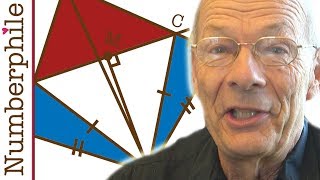
What topological fact is wrongly assumed in this diagram? It is the fact that both B- and C- are outside of the triangle.
In short, what you thought of Geometry in highschool is not rigorous at all, we are doing it semi-formally by mixing axiom applications and experimentally inspecting the diagram (physically interacting with the geometry embedded in the physical universe. To fix this, we have to have axioms that deal with topological statements and make them very explicit when applying the more traditional axioms.
Date: 2022-04-08
Related videos






Comments and reviews: 9
Josip
It's not that hard to work it out.
Where the bisecting line and perpendicular line from M intersect, lines -XC- and -XB- are BOTH equilateral AND PERPENDICULAR to the lines -AC- and -AB- respectively. (Explained why that is in 2nd section of the comment. Given that statement, lines -XB- and -XB-- are one and the same line which means that -BB--=0 and -CC--=0. When invoking similarity rule, you're taking length ratios of simillar triangles and when -BB-- or -CC-- happen to be in denominator, you divide by 0 and that's where math 'breaks'.
Now, why are -XC- and -XB- both equilateral and perpendicular to their opposite lines? well, you start by drawing perpendicular from point M, and then connecting lines from B and C to the locus, you will eventually get the lines such as -BX- and and -CX- are also perpendicular to the -AB- and -AC-, which MUST be the case that you just HIT THE BISECTOR LINE.
reply
It's not that hard to work it out.
Where the bisecting line and perpendicular line from M intersect, lines -XC- and -XB- are BOTH equilateral AND PERPENDICULAR to the lines -AC- and -AB- respectively. (Explained why that is in 2nd section of the comment. Given that statement, lines -XB- and -XB-- are one and the same line which means that -BB--=0 and -CC--=0. When invoking similarity rule, you're taking length ratios of simillar triangles and when -BB-- or -CC-- happen to be in denominator, you divide by 0 and that's where math 'breaks'.
Now, why are -XC- and -XB- both equilateral and perpendicular to their opposite lines? well, you start by drawing perpendicular from point M, and then connecting lines from B and C to the locus, you will eventually get the lines such as -BX- and and -CX- are also perpendicular to the -AB- and -AC-, which MUST be the case that you just HIT THE BISECTOR LINE.
reply
Elsid
Am I late to write the solution? Hope not; )
Lets take triangles AB-X and AC-X, these triangle are equal because: B-X = C-X, angle AB-X = AC-X and B-AX = C-AX ===> angle B-XA = C-XA.
Now lets take triangle B-XC-, we know that B-X=C-X, angle B-XA = C-XA (as shown before, therefore AX goes in the middle of B-C-, and it's perpendicular.
If we use the argument of the video that triangles B-BX and C-CX are equal ===> angles B-XB and C-XC are equal.
Conclusion: If angle B-XC- is bigger than BXC, line AX will not only be angle bisector of angle B-XC-, but it will be for angle BXC too, because of angle BXA= B-XA - B-XB = C-XA - C-XC = CXA ( B-XA = C-XA and B-XB = C-XC, and because we know MX is angle bisector of angle BXC ===> AX and MX must be in the same line.
reply
Am I late to write the solution? Hope not; )
Lets take triangles AB-X and AC-X, these triangle are equal because: B-X = C-X, angle AB-X = AC-X and B-AX = C-AX ===> angle B-XA = C-XA.
Now lets take triangle B-XC-, we know that B-X=C-X, angle B-XA = C-XA (as shown before, therefore AX goes in the middle of B-C-, and it's perpendicular.
If we use the argument of the video that triangles B-BX and C-CX are equal ===> angles B-XB and C-XC are equal.
Conclusion: If angle B-XC- is bigger than BXC, line AX will not only be angle bisector of angle B-XC-, but it will be for angle BXC too, because of angle BXA= B-XA - B-XB = C-XA - C-XC = CXA ( B-XA = C-XA and B-XB = C-XC, and because we know MX is angle bisector of angle BXC ===> AX and MX must be in the same line.
reply
Paul
The angle bisector and the perpendicular bisector of the opposite side are two distinct lines. But when you assert that triangles AB-X and AC-X are mirror images you are confusing the 2. The corresponding angles at vertex X are formed by the angle bisector, not the perpendicular bisector. If we consider angles MXB- and MXC- (formed by the perpendicular bisector, not the angle bisector) they are equal, but they are not the angles in the triangles you were claiming to be mirror images of each other, those angles are AXB- and AXC- (formed by the angle bisector, not the perpendicular bisector.
reply
The angle bisector and the perpendicular bisector of the opposite side are two distinct lines. But when you assert that triangles AB-X and AC-X are mirror images you are confusing the 2. The corresponding angles at vertex X are formed by the angle bisector, not the perpendicular bisector. If we consider angles MXB- and MXC- (formed by the perpendicular bisector, not the angle bisector) they are equal, but they are not the angles in the triangles you were claiming to be mirror images of each other, those angles are AXB- and AXC- (formed by the angle bisector, not the perpendicular bisector.
reply
Aayush
Suppose we assume that till the point you proved AB=BC is true. So ABC is isosceles. Now we know that perpendicular from the common vertex of both sides is the perpendicular bisector of the opposite side and also the angle bisector( This can be proven using geometry or simple trigonometry. This means that the perpendicular from point M and the angle bisector from A coincide. This essentially disproves the statement as the entire construction becomes bogus
reply
Suppose we assume that till the point you proved AB=BC is true. So ABC is isosceles. Now we know that perpendicular from the common vertex of both sides is the perpendicular bisector of the opposite side and also the angle bisector( This can be proven using geometry or simple trigonometry. This means that the perpendicular from point M and the angle bisector from A coincide. This essentially disproves the statement as the entire construction becomes bogus
reply
Stefano
03: 04. Two triangles are congruent if one has all the sides equal to the corresponding sides of the other triangle (AB, BC and AC are equal to AB, BC and AC, or two sides and the angle BETWEEN them from one triangle (AB, A and AC are equal to AB, A and AC, or two angles and the side BETWEEN them from one triangle, are equal to the other one. (A, AB and B are equal to A, AB and B. In here the 90 degree angle is NOT BETWEEN the supposedly equal sides.
reply
03: 04. Two triangles are congruent if one has all the sides equal to the corresponding sides of the other triangle (AB, BC and AC are equal to AB, BC and AC, or two sides and the angle BETWEEN them from one triangle (AB, A and AC are equal to AB, A and AC, or two angles and the side BETWEEN them from one triangle, are equal to the other one. (A, AB and B are equal to A, AB and B. In here the 90 degree angle is NOT BETWEEN the supposedly equal sides.
reply
Daniel
BX and CX are of equal length, but does that really mean B-X and C-X are also? Try doing a triangle where one point is brought out very far and you will see one of the sides becomes closer and closer to its hypotenuse, while the other gets further and further from it. (if we drag C very far away, then B-X-BX and C-X-MX) Because we determined correctly that BX=CX we get B-X is not equal to C-X (unless we really do have an equilateral triangle)
reply
BX and CX are of equal length, but does that really mean B-X and C-X are also? Try doing a triangle where one point is brought out very far and you will see one of the sides becomes closer and closer to its hypotenuse, while the other gets further and further from it. (if we drag C very far away, then B-X-BX and C-X-MX) Because we determined correctly that BX=CX we get B-X is not equal to C-X (unless we really do have an equilateral triangle)
reply
Michael
The key point, if reproducing this trick to fool your audience, is to subtly misdraw the perpendicular bisector and/or angle bisector so that their intersection is farther away from where really should be by enough so that the perpendiculars drawn to the extended sides both fall outside the triangle.
The perp to the longer side actually will fall inside.
reply
The key point, if reproducing this trick to fool your audience, is to subtly misdraw the perpendicular bisector and/or angle bisector so that their intersection is farther away from where really should be by enough so that the perpendiculars drawn to the extended sides both fall outside the triangle.
The perp to the longer side actually will fall inside.
reply
Christian
Sir you gave yourself the reason of the paradox with your -I guess- at 1: 03 (poker tell. Had you not -guessed- but drawn the real figure, point X would have been much closer to M but not too close, letting B- outside of AB, but putting C- inside AC.
Considering that, then the formula AC- - CC- = AC at 4: 01 has the minus sign proven wrong.
reply
Sir you gave yourself the reason of the paradox with your -I guess- at 1: 03 (poker tell. Had you not -guessed- but drawn the real figure, point X would have been much closer to M but not too close, letting B- outside of AB, but putting C- inside AC.
Considering that, then the formula AC- - CC- = AC at 4: 01 has the minus sign proven wrong.
reply
sur-taka
i am pretty sure that B- and C- cant lie the way he drew them. if B- is outside of the segment AB, then C- should be on the segment AC. because the rest of the logic seems correct, so thats like the only thing that could go wrong.
oh btw, if you actually had an isosceles triangle, this point X wouldnt exist, because the two lines coincide.
reply
i am pretty sure that B- and C- cant lie the way he drew them. if B- is outside of the segment AB, then C- should be on the segment AC. because the rest of the logic seems correct, so thats like the only thing that could go wrong.
oh btw, if you actually had an isosceles triangle, this point X wouldnt exist, because the two lines coincide.
reply
Add a review, comment
Other channel videos