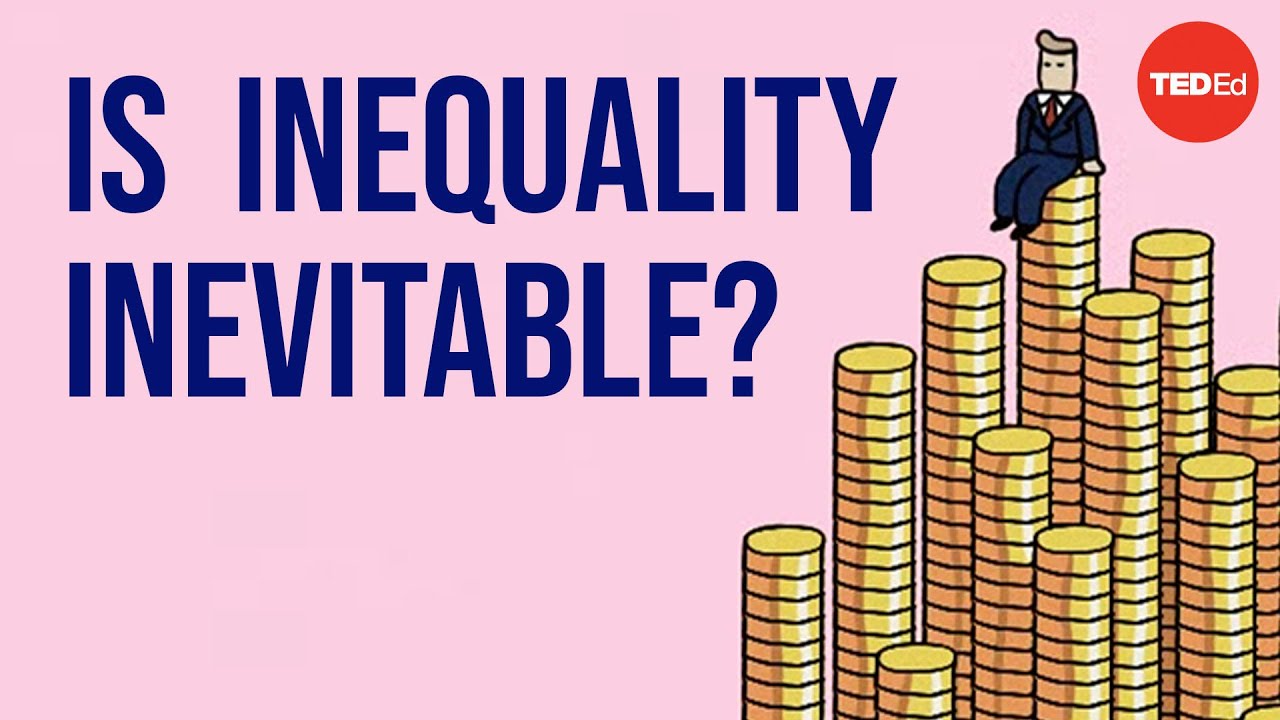
Is inequality inevitable?
video description
Date: 2022-10-11
Related videos



Comments and reviews: 15
Ivan
You are facing now a world in decline. It is not like the past, where there were always more regions to explore, always new frontiers to overcome and to develop and to exploit. The last few remaining unexplored and unexploited regions will not meet the demands of humanity now.
The wealthy will have to take care of people; that is the purpose of their wealth not just their families, and all of their desires, and all of their wishes and demands, but other people. If you are wealthy, you may need to feed a hundred people or five hundred people. Instead of a new fancy car or a bigger house, your wealth is going to have to take care of people, which will restore to you your own integrity and sense of value and sense of self-respect.
How can you be happy parading your wealth when the hungry faces are staring at you? How can you feel good about yourself parading in your great vehicles and your expensive clothing and accessories while the poor are starving on the streets? Is that a source of self-comfort? Does that validate who you are and why you are in the world? To be a locust upon the world? To devastate the world?
A quote from - _The Engine of War_ - a teaching from _The New Message from God_
reply
You are facing now a world in decline. It is not like the past, where there were always more regions to explore, always new frontiers to overcome and to develop and to exploit. The last few remaining unexplored and unexploited regions will not meet the demands of humanity now.
The wealthy will have to take care of people; that is the purpose of their wealth not just their families, and all of their desires, and all of their wishes and demands, but other people. If you are wealthy, you may need to feed a hundred people or five hundred people. Instead of a new fancy car or a bigger house, your wealth is going to have to take care of people, which will restore to you your own integrity and sense of value and sense of self-respect.
How can you be happy parading your wealth when the hungry faces are staring at you? How can you feel good about yourself parading in your great vehicles and your expensive clothing and accessories while the poor are starving on the streets? Is that a source of self-comfort? Does that validate who you are and why you are in the world? To be a locust upon the world? To devastate the world?
A quote from - _The Engine of War_ - a teaching from _The New Message from God_
reply
Dj
If humans are free to make choices and these choices have consequences then you'll inevitably have inequality.
It's sort of like anything really that humans are involved in. 5% of the artists make up 80% of the downloads on a streaming service for example.
One Beyonce concert makes as much as 50 independent artists put together in one year.
You can lessen the impact of it but as long as humans are different you're gonna have different outcomes and inequality.
Usain Bolt and yourself can only finish the race at the same time if he's shackled. This is the chief problem with communism. You'll soon realise it's much easier to hold people back than it is to push them. The result being that you end up with equally poor people rather than equally rich people.
Another way to achieve more equality to to have a very homogeneous country like the Scandinavian countries. If they're small population wise and geographically isolated that also seems to help.
reply
If humans are free to make choices and these choices have consequences then you'll inevitably have inequality.
It's sort of like anything really that humans are involved in. 5% of the artists make up 80% of the downloads on a streaming service for example.
One Beyonce concert makes as much as 50 independent artists put together in one year.
You can lessen the impact of it but as long as humans are different you're gonna have different outcomes and inequality.
Usain Bolt and yourself can only finish the race at the same time if he's shackled. This is the chief problem with communism. You'll soon realise it's much easier to hold people back than it is to push them. The result being that you end up with equally poor people rather than equally rich people.
Another way to achieve more equality to to have a very homogeneous country like the Scandinavian countries. If they're small population wise and geographically isolated that also seems to help.
reply
Chris
China is not a capitalist nation. It is run by the communist party, and although they allow SOME markets to function in a sort-of free market, they maintain immense control over the economy and class structure. It is a very heavy central control state. The US is also hardly capitalist anymore either. When it was it thrived and pulled it's own poor (and the world's) out of poverty to an extent never before seen. As the government has grown in power that effect has diminished massively. In fact, if you ignore the rich and just look at the poor, the quality of life in a country is inversely correlated with how strong the government control over the economy is. This is true in every country throughout history. Videos like this focus on the rich, as if having rich people is a problem. It's not. The only measure that matters is how the poor are doing. This is objectively better in every example when countries adopt free markets.
reply
China is not a capitalist nation. It is run by the communist party, and although they allow SOME markets to function in a sort-of free market, they maintain immense control over the economy and class structure. It is a very heavy central control state. The US is also hardly capitalist anymore either. When it was it thrived and pulled it's own poor (and the world's) out of poverty to an extent never before seen. As the government has grown in power that effect has diminished massively. In fact, if you ignore the rich and just look at the poor, the quality of life in a country is inversely correlated with how strong the government control over the economy is. This is true in every country throughout history. Videos like this focus on the rich, as if having rich people is a problem. It's not. The only measure that matters is how the poor are doing. This is objectively better in every example when countries adopt free markets.
reply
education
Would like to challenge the claim that we haven t found a single society without [inequality]. We ve found several? (Unless we re being imo absurdly selective - in the most absolute sense, ofc total equality doesn t exist, but neither does inequality, for that matter - and we still describe certain societies in certain moments as peaceful, for example, tho conflict is an inevitable part of all life. Many historians believe that most hunter gather societies were egalitarian - this view has been challenged, recently, but only because we might be overgeneralizing based on the societies we DO KNOW to be relatively equal (mostly those cultures that are still around, most famously the! Kung. Equality might not be the natural default or even, arguably, reasonably attainable, but it s pretty ridiculous to call it outright impossible (especially without addressing any of what I ve just mentioned)
reply
Would like to challenge the claim that we haven t found a single society without [inequality]. We ve found several? (Unless we re being imo absurdly selective - in the most absolute sense, ofc total equality doesn t exist, but neither does inequality, for that matter - and we still describe certain societies in certain moments as peaceful, for example, tho conflict is an inevitable part of all life. Many historians believe that most hunter gather societies were egalitarian - this view has been challenged, recently, but only because we might be overgeneralizing based on the societies we DO KNOW to be relatively equal (mostly those cultures that are still around, most famously the! Kung. Equality might not be the natural default or even, arguably, reasonably attainable, but it s pretty ridiculous to call it outright impossible (especially without addressing any of what I ve just mentioned)
reply
Jesaynt
Admittedly I watched about 58 seconds of the video, but I already knew the answer. Yes, it is inevitable, but in reality inevitable was a bad choice of wording. I say that because inevitable implies in the future, an unavoidable future event. The problem is that things are unequal from the very beginning on a number of fronts starting, fundamentally, with something as simple as the natural resources present in a person's given location. Meaning it's not so much inevitable as it is inherent to the human condition. There's so many factors that underpin it, not the least of which is human psychology. And until you can defeat that (which you're not going to) inequality is here to stay.
As Ralph mentioned, a more realistic approach is to try and mitigate it as much as possible.
reply
Admittedly I watched about 58 seconds of the video, but I already knew the answer. Yes, it is inevitable, but in reality inevitable was a bad choice of wording. I say that because inevitable implies in the future, an unavoidable future event. The problem is that things are unequal from the very beginning on a number of fronts starting, fundamentally, with something as simple as the natural resources present in a person's given location. Meaning it's not so much inevitable as it is inherent to the human condition. There's so many factors that underpin it, not the least of which is human psychology. And until you can defeat that (which you're not going to) inequality is here to stay.
As Ralph mentioned, a more realistic approach is to try and mitigate it as much as possible.
reply
Charlie
is there a cuttoff on taxation where if you make less than X dollars annually, you dont get taxed at all. I could imagine this as a minimum salary to live with basic nessesities like a car, insurance, a house, food, utilities, a stable and fast (fast could mean that you can steam a 1080p video without hickups) internet, cell phone, and some others (I am basing this in the US. This number will be different from state to state, and even town to town, the question then becomes, how is that number decided uppon. The world of equalities and different situations are so vast that I cannot think of a solution that wont make a group disadvantaged or that the solution will be taken advantage of
reply
is there a cuttoff on taxation where if you make less than X dollars annually, you dont get taxed at all. I could imagine this as a minimum salary to live with basic nessesities like a car, insurance, a house, food, utilities, a stable and fast (fast could mean that you can steam a 1080p video without hickups) internet, cell phone, and some others (I am basing this in the US. This number will be different from state to state, and even town to town, the question then becomes, how is that number decided uppon. The world of equalities and different situations are so vast that I cannot think of a solution that wont make a group disadvantaged or that the solution will be taken advantage of
reply
education
The only way you could say capitalism is fundamentally broken is if you're saying humans are fundamentally untrustworthy.
Because capitalism is a seriously good system if you remove the politicians being bought and corrupted by billionaires.
Even with all the corruption it's the best system humans have ever used.
Just imagine how much better it could be if politicians' actual primary concern was the well-being of their constituents.
But if you're saying that's impossible because humans are naturally untrustable, then you're doomed no matter what system you choose, because it's humans all the way down.
reply
The only way you could say capitalism is fundamentally broken is if you're saying humans are fundamentally untrustworthy.
Because capitalism is a seriously good system if you remove the politicians being bought and corrupted by billionaires.
Even with all the corruption it's the best system humans have ever used.
Just imagine how much better it could be if politicians' actual primary concern was the well-being of their constituents.
But if you're saying that's impossible because humans are naturally untrustable, then you're doomed no matter what system you choose, because it's humans all the way down.
reply
John
This is a central theme of the book Dawn of Everything by Graeber and Wengrow. The question keeps changing though, because they realize the faults in the question what are the origins of inequality. Power imbalances and the degree to which they are prominent in any culture depends on many factors of perceived cost and value. In some cases material wealth is considered very burdening or ceremonial. Material wealth has also not always been a prerequisite for social power. We just now live in a world dominated by materialist economics and seem to prefer the social/political strength it provides.
reply
This is a central theme of the book Dawn of Everything by Graeber and Wengrow. The question keeps changing though, because they realize the faults in the question what are the origins of inequality. Power imbalances and the degree to which they are prominent in any culture depends on many factors of perceived cost and value. In some cases material wealth is considered very burdening or ceremonial. Material wealth has also not always been a prerequisite for social power. We just now live in a world dominated by materialist economics and seem to prefer the social/political strength it provides.
reply
Suranjan
God or whatever made earth, made it to be a little equal and to be little not equal and we humans made this earth a place more unequal, probably taking the hint from God. That's why I think complete economic or any kind of equality is impossible and unrealistic. A very good solution I think, as also shown here, is to provide free education, free treatment in hospitals, and to look after the welfare of all the citizens. Inequality is inevitable but the want for equality is what we must strive for. The solution is impossible but I think, it lies in the endeavour to achieve.
reply
God or whatever made earth, made it to be a little equal and to be little not equal and we humans made this earth a place more unequal, probably taking the hint from God. That's why I think complete economic or any kind of equality is impossible and unrealistic. A very good solution I think, as also shown here, is to provide free education, free treatment in hospitals, and to look after the welfare of all the citizens. Inequality is inevitable but the want for equality is what we must strive for. The solution is impossible but I think, it lies in the endeavour to achieve.
reply
Vignesh
Everyone should have equal opportunity. Unjust inequality must be substituted with 'just' inequality. Economics should concentrate more on people's needs and satisfactions, not bluntly analysing amount of wealth one has. All kinds of discriminations must end. Employees deserve better working conditions. Governments should provide universal healthcare and education to everyone. We need a middle ground between liberal and conservative form of governance. Maybe libertarian with little emphasis on equality, social justice and ecology.
reply
Everyone should have equal opportunity. Unjust inequality must be substituted with 'just' inequality. Economics should concentrate more on people's needs and satisfactions, not bluntly analysing amount of wealth one has. All kinds of discriminations must end. Employees deserve better working conditions. Governments should provide universal healthcare and education to everyone. We need a middle ground between liberal and conservative form of governance. Maybe libertarian with little emphasis on equality, social justice and ecology.
reply
MillionaireNo1
don't ever believe the world economic forum and its lies, inequality will always happen, and taxing the higher salary workers more is idiotic and makes more inequality. Working harder for less so that someone else who works less gets more. Also taxing inheriting wealth is unfair for the family, imagine working your whole life to give a house to your children and their children or money for them to raise their only for it to be swiped away by the government to be given to random people, you wouldn't be happy wouldn't you?
reply
don't ever believe the world economic forum and its lies, inequality will always happen, and taxing the higher salary workers more is idiotic and makes more inequality. Working harder for less so that someone else who works less gets more. Also taxing inheriting wealth is unfair for the family, imagine working your whole life to give a house to your children and their children or money for them to raise their only for it to be swiped away by the government to be given to random people, you wouldn't be happy wouldn't you?
reply
apos
when people having nothing else to lose. elites would be useless and only then changes can be made for the better little by little, but we need to will be making drastically futuristic adjustments, but at that point is pointless, due to Big game that is currently going among the worldly interests, but some day. soon. and I truly belive the new change for a better world, would be coming from Asia continent this time or we as a mankind we will be annihilated in the future, unfortunately, western countries failed
reply
when people having nothing else to lose. elites would be useless and only then changes can be made for the better little by little, but we need to will be making drastically futuristic adjustments, but at that point is pointless, due to Big game that is currently going among the worldly interests, but some day. soon. and I truly belive the new change for a better world, would be coming from Asia continent this time or we as a mankind we will be annihilated in the future, unfortunately, western countries failed
reply
John
This video has no idea. If you give everyone same amount of money. The guys that produce things and shows will get the money from the people that just consume. I saw a budget pillow factory in usa. Small pillow operation makes almost no profits per pillow but still sells millions of pillows and owner of that factory who put in his capital and expertise makes millions a year. Everyone gives money to those that produce something. 99% of world are just consumers.
reply
This video has no idea. If you give everyone same amount of money. The guys that produce things and shows will get the money from the people that just consume. I saw a budget pillow factory in usa. Small pillow operation makes almost no profits per pillow but still sells millions of pillows and owner of that factory who put in his capital and expertise makes millions a year. Everyone gives money to those that produce something. 99% of world are just consumers.
reply
ANODOMINATE
I have a plan to eradicate poverty + global warming + making the development speed x100 and the plan is just to find a way to harness infinite source of energy (infinite in the human sense for example sun. Once we have infinite energy we would make any metals we want whether it's GOLD or Even URANIUM. And make a society where everyone one can have everything good for society and this complex economics will also end.
reply
I have a plan to eradicate poverty + global warming + making the development speed x100 and the plan is just to find a way to harness infinite source of energy (infinite in the human sense for example sun. Once we have infinite energy we would make any metals we want whether it's GOLD or Even URANIUM. And make a society where everyone one can have everything good for society and this complex economics will also end.
reply
Nintendo
This video should have mentioned that wealth inequality is not always rooted in something bad. For example: If someone earned an above average amount of money via honest work, then it's natural and fair that this person has more money than someone who never worked a day in his life. What we should do (like the video mentioned) is giving everyone a fair chance via better education, health, internet access etc.
reply
This video should have mentioned that wealth inequality is not always rooted in something bad. For example: If someone earned an above average amount of money via honest work, then it's natural and fair that this person has more money than someone who never worked a day in his life. What we should do (like the video mentioned) is giving everyone a fair chance via better education, health, internet access etc.
reply
Add a review, comment
Other channel videos