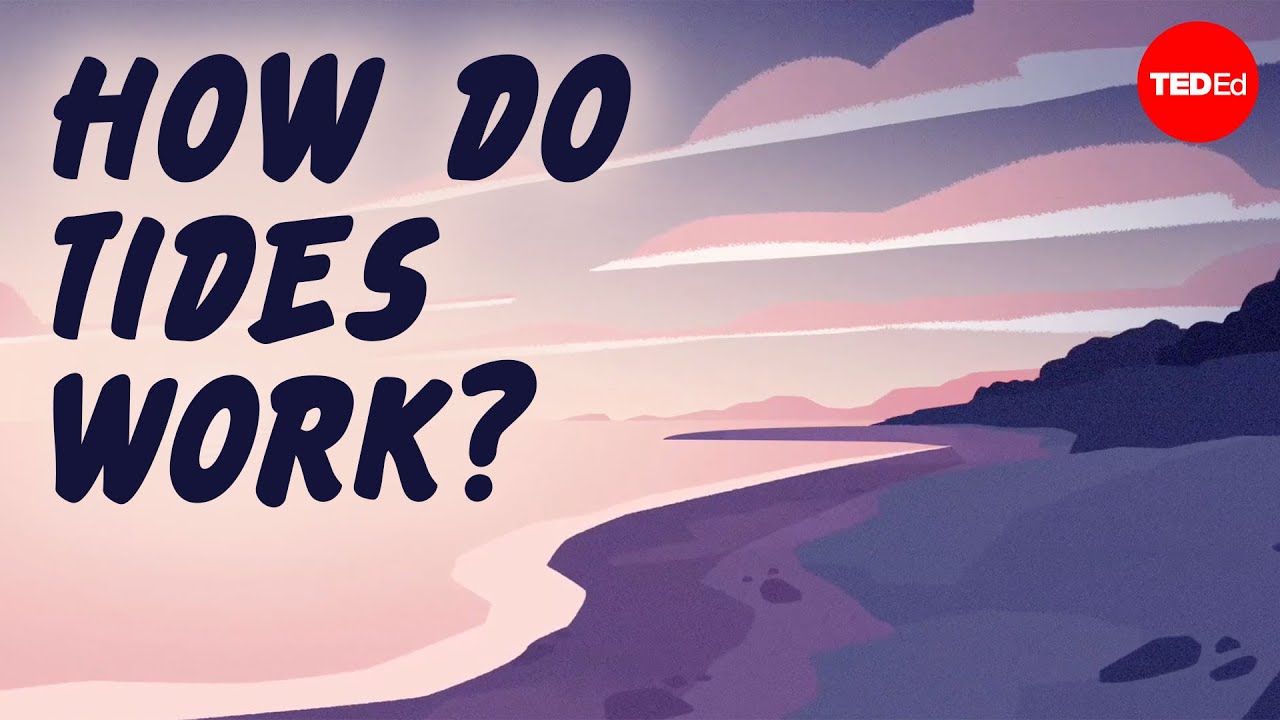
Why are there two tides a day - Elise Cutts
video description
Date: 2025-04-11
Related videos




Comments and reviews: 20
wavydaveyparker
Galileo's Friends Got It Right!
Back in olden days, a smart scientist called Galileo Galilei figured out that the Earth's motion through space could be related to the motion of the tides, that's called, correlation of effects. Although, he wasn't sure about the cause, that's called, causation.
He understood the principle of inertia, but hadn't quite worked out the inverse square law of gravitation. And, was subsequently put under house arrest by the inquisition, for questioning the authority and divine doctrine of holy scripture.
Some time later a young scientist called Isaac Newton was walking in an orchard near his home, when he noticed an apple fall from a tree. He glazed upwards in thought, and asked himself the innocuous question, _Does the Moon also fall_
Some years later he put these thoughts into a book and called it the Principia. And, henceforth the laws of inertial motion and gravitation were born and the rest is history, so they say.
So, the next time you're sitting on the dock of the bay, watching the tide roll away, remember: _The constant battle between rotational axial spin, gravitational attraction and our revolving orbital motion around a common centre of mass, has created a really strange world for the inhabitants of our precious planet Earth. Where the tides are caused by an interaction between the gravitational and centrifugal forces. _
With these tools at our disposal, we now have the opportunity to gain a better understanding of our place in the universe and the complex action of a tidal force due to our inertial motion through a curved spacetime.
Have a wonderful day!
reply
Galileo's Friends Got It Right!
Back in olden days, a smart scientist called Galileo Galilei figured out that the Earth's motion through space could be related to the motion of the tides, that's called, correlation of effects. Although, he wasn't sure about the cause, that's called, causation.
He understood the principle of inertia, but hadn't quite worked out the inverse square law of gravitation. And, was subsequently put under house arrest by the inquisition, for questioning the authority and divine doctrine of holy scripture.
Some time later a young scientist called Isaac Newton was walking in an orchard near his home, when he noticed an apple fall from a tree. He glazed upwards in thought, and asked himself the innocuous question, _Does the Moon also fall_
Some years later he put these thoughts into a book and called it the Principia. And, henceforth the laws of inertial motion and gravitation were born and the rest is history, so they say.
So, the next time you're sitting on the dock of the bay, watching the tide roll away, remember: _The constant battle between rotational axial spin, gravitational attraction and our revolving orbital motion around a common centre of mass, has created a really strange world for the inhabitants of our precious planet Earth. Where the tides are caused by an interaction between the gravitational and centrifugal forces. _
With these tools at our disposal, we now have the opportunity to gain a better understanding of our place in the universe and the complex action of a tidal force due to our inertial motion through a curved spacetime.
Have a wonderful day!
reply
wavydaveyparker
This explanation is absolutely accurate and correct. As was proposed by Sir Isaac Newton in his Principia of 1687. The tides are caused by the lateral motion of water around the surface of the globe, due to the inertial forces of motion around a common centre of mass.
Pbs spacetime chose to complicate matters by introducing the concept of an outward acting tidal force, also known as a gravimetric tensor, which was introduced by Albert Einstein in his General Theory of Relativity in 1915. This four dimensional metric tensor acts in an outward direction from the centre of the Earth and in the direction of the tides generating body, increasing the underlying pressure in the ocean waters.
Pbs fails to correctly explain the inertial motion of the Earth and Moon around there barycentre, which is essential to make the whole tidal mechanism work. The Earth is not static in space.
There are only two people we need to consult, when it comes to explaining inertia and gravitation, and they are Newton and Einstein. And when the tidal calculations are performed correctly, Newton and Pbs spacetime both produce exactly the same results.
reply
This explanation is absolutely accurate and correct. As was proposed by Sir Isaac Newton in his Principia of 1687. The tides are caused by the lateral motion of water around the surface of the globe, due to the inertial forces of motion around a common centre of mass.
Pbs spacetime chose to complicate matters by introducing the concept of an outward acting tidal force, also known as a gravimetric tensor, which was introduced by Albert Einstein in his General Theory of Relativity in 1915. This four dimensional metric tensor acts in an outward direction from the centre of the Earth and in the direction of the tides generating body, increasing the underlying pressure in the ocean waters.
Pbs fails to correctly explain the inertial motion of the Earth and Moon around there barycentre, which is essential to make the whole tidal mechanism work. The Earth is not static in space.
There are only two people we need to consult, when it comes to explaining inertia and gravitation, and they are Newton and Einstein. And when the tidal calculations are performed correctly, Newton and Pbs spacetime both produce exactly the same results.
reply
gmilne13
Started so well, then made the usual mistake about tides.
It's complicated, but when you calculate the combined gravity of the Earth and Moon around the barycenter (the center of their combined orbit, you get a result that is pointing outwards at the equator, inwards at the poles and parallel to the Earth's surface in between. It's not the pull of gravity (your glass of water doesn't have tides, neither do lakes, but its this combined force parallel to the surface that pushes the water sideways. Sideways half way up the globe on both sides means that at the middle the water gets pushed outwards. The description of the hair flying around is kind of correct, but not really.
Thats why you only get tides in oceans - you need globally connected water, and not lakes - it's just like sloshing water in a bath - you aren't pushing it up, you are pushing it sideways and when it runs out of space, it goes up.
reply
Started so well, then made the usual mistake about tides.
It's complicated, but when you calculate the combined gravity of the Earth and Moon around the barycenter (the center of their combined orbit, you get a result that is pointing outwards at the equator, inwards at the poles and parallel to the Earth's surface in between. It's not the pull of gravity (your glass of water doesn't have tides, neither do lakes, but its this combined force parallel to the surface that pushes the water sideways. Sideways half way up the globe on both sides means that at the middle the water gets pushed outwards. The description of the hair flying around is kind of correct, but not really.
Thats why you only get tides in oceans - you need globally connected water, and not lakes - it's just like sloshing water in a bath - you aren't pushing it up, you are pushing it sideways and when it runs out of space, it goes up.
reply
michaelwarder9064
2: 30
This simply is not true. The tides are not generated by centripetal force, nor does the pull of the moon pull water up. Everything facing the moon feels the same relative gravitational pull upwards.
The Tides are created because of the gravitational vectors around the hemisphere of the earth in relationship to the moon. Because the moon is smaller than the earth, the gravitational vectors towards the hemisphere of the earth are pointed inward, down towards the moon. This means that gravity is far stronger around the outer region of the earth than it is on either the close or far end of the earth.
A small body of water will not react to this which is why we don't see tides in lakes or in land seas. However, the ocean is large enough to be affected by this compression.
This is honestly very disappointing TED
reply
2: 30
This simply is not true. The tides are not generated by centripetal force, nor does the pull of the moon pull water up. Everything facing the moon feels the same relative gravitational pull upwards.
The Tides are created because of the gravitational vectors around the hemisphere of the earth in relationship to the moon. Because the moon is smaller than the earth, the gravitational vectors towards the hemisphere of the earth are pointed inward, down towards the moon. This means that gravity is far stronger around the outer region of the earth than it is on either the close or far end of the earth.
A small body of water will not react to this which is why we don't see tides in lakes or in land seas. However, the ocean is large enough to be affected by this compression.
This is honestly very disappointing TED
reply
Daniel-yy5tx
This explanation for the tides is not correct. The Moon's gravity doesn't raise the tides on the side facing the earth and throw the water away on the other side. The Moon and Earth's gravity interact in a complex way that results in the gravity fields squeezing the Earth at right angles to the Moon's position. The Moon doesn't cause high tides; it causes low tides. This squeezing action pushes the water to opposite ends of the earth to indirectly cause the high tides there. PBS Space Time explains it well on their video, What Physics Teachers Get Wrong About Tides!
reply
This explanation for the tides is not correct. The Moon's gravity doesn't raise the tides on the side facing the earth and throw the water away on the other side. The Moon and Earth's gravity interact in a complex way that results in the gravity fields squeezing the Earth at right angles to the Moon's position. The Moon doesn't cause high tides; it causes low tides. This squeezing action pushes the water to opposite ends of the earth to indirectly cause the high tides there. PBS Space Time explains it well on their video, What Physics Teachers Get Wrong About Tides!
reply
robertjarman3703
We don't know quite that the Sun will do this, it may lose mass fast enough that the Moon and Earth will recede fast enough to avoid the Sun's red giant phase. Not helpful for surviving on either of them, but still, it would affect tides. Also, the Moon is even more accurately modelled by its motion around the Sun, which is so close to the same ellipse the Earth goes in around the Sun that it's hard to even tell when they are shown at the correct scale that the Moon even is tugged on by the Earth.
reply
We don't know quite that the Sun will do this, it may lose mass fast enough that the Moon and Earth will recede fast enough to avoid the Sun's red giant phase. Not helpful for surviving on either of them, but still, it would affect tides. Also, the Moon is even more accurately modelled by its motion around the Sun, which is so close to the same ellipse the Earth goes in around the Sun that it's hard to even tell when they are shown at the correct scale that the Moon even is tugged on by the Earth.
reply
oortcloud8078
After watching ten million tidal explanations on the physics of inertia and gravity behind our daily tides. I realised this is the clearest and best explanation of the tidal phenomena that everyone can understand. Thank you, it was a delight to view and the presentation was excellent. Many, who live far inland, never get to experience the full force and majesty of the ocean, but we should all be aware of it presence and the effect it can have on our daily lives.
reply
After watching ten million tidal explanations on the physics of inertia and gravity behind our daily tides. I realised this is the clearest and best explanation of the tidal phenomena that everyone can understand. Thank you, it was a delight to view and the presentation was excellent. Many, who live far inland, never get to experience the full force and majesty of the ocean, but we should all be aware of it presence and the effect it can have on our daily lives.
reply
matt24811
The low tide is lowest during a spring tide as well, not during the Neap tide. Due to the sun and moon pulling on the earth at a 90 degree angle, neap tides create lower high tides and higher low tides. The highest high tides are during the spring tide but since the gravitational force is greatest during full/new moon, the water is pulled more, thus making the low tides even lower as more water is pulled at the high tide.
reply
The low tide is lowest during a spring tide as well, not during the Neap tide. Due to the sun and moon pulling on the earth at a 90 degree angle, neap tides create lower high tides and higher low tides. The highest high tides are during the spring tide but since the gravitational force is greatest during full/new moon, the water is pulled more, thus making the low tides even lower as more water is pulled at the high tide.
reply
richardl6751
Then we sat on the sand for some time and observed
How the oceans that cover the world were perturbed
By the tides from the orbiting moon overhead
How relaxing the sound of the waves is, you said.
I began to expound upon tidal effects
When you asked me to stop, looking somewhat perplexed
So I did not explain why the sunset turns red
And we watched the occurrence. in silence. instead.
reply
Then we sat on the sand for some time and observed
How the oceans that cover the world were perturbed
By the tides from the orbiting moon overhead
How relaxing the sound of the waves is, you said.
I began to expound upon tidal effects
When you asked me to stop, looking somewhat perplexed
So I did not explain why the sunset turns red
And we watched the occurrence. in silence. instead.
reply
agnosticpanda6655
This explanation is not completely correct. PBS Spacetime has a video about this misconception. Water does not directly get pulled by the moon (its gravity is way too weak for that); otherwise you would see tides in lakes. Instead the tides are a kind of 'squeezing' effect from all the microscopic sideways pull of ocean water that's NOT on the horizontal earth/moon line.
reply
This explanation is not completely correct. PBS Spacetime has a video about this misconception. Water does not directly get pulled by the moon (its gravity is way too weak for that); otherwise you would see tides in lakes. Instead the tides are a kind of 'squeezing' effect from all the microscopic sideways pull of ocean water that's NOT on the horizontal earth/moon line.
reply
varflock9777
This video mentioned that tidal forces can lock planets so they keep facing their stars with the same side all the time. Isn't it the same thing that's happening with our Moon But tidal forces don't seem to be the case here (since it most likely doesn't have much water if any and Earth shouldn't be massive enough to make stones act like a fluid. What causes that
reply
This video mentioned that tidal forces can lock planets so they keep facing their stars with the same side all the time. Isn't it the same thing that's happening with our Moon But tidal forces don't seem to be the case here (since it most likely doesn't have much water if any and Earth shouldn't be massive enough to make stones act like a fluid. What causes that
reply
remicans2929
It was a pleasure directing this Lesson, which will most likely be my last.
I hope you all enjoy watching it, and appreciates the effort which my team and I put into making this complex knowledge more easily understandable and accessible to everyone. With a very cool artistic direction, a smooth animation work, and a very effectively immersive soundwork.
reply
It was a pleasure directing this Lesson, which will most likely be my last.
I hope you all enjoy watching it, and appreciates the effort which my team and I put into making this complex knowledge more easily understandable and accessible to everyone. With a very cool artistic direction, a smooth animation work, and a very effectively immersive soundwork.
reply
megadisc1982
Badminton tonight
Level: MB - HB
May u join us Oops
Unity PRIMARY yew tee
13/04 Sat 6-8pm 1 slot
13/04 Sun 6-8pm 1 slot
Unity SECOND yew tee
11/04 Fri 7-9pm 2 slot 3 slot
13/04 Sun 11am-1pm
reply
Badminton tonight
Level: MB - HB
May u join us Oops
Unity PRIMARY yew tee
13/04 Sat 6-8pm 1 slot
13/04 Sun 6-8pm 1 slot
Unity SECOND yew tee
11/04 Fri 7-9pm 2 slot 3 slot
13/04 Sun 11am-1pm
reply
curiousuranus810
WRONG! this is not the correct explanation for the Earth's tides - if it were then lakes would have tides as well. and they don't. Also, if anyone had stopped to think about it, spring balances would register higher and lower values when they were closer and further away from the moon. has anyone noticed that No!
reply
WRONG! this is not the correct explanation for the Earth's tides - if it were then lakes would have tides as well. and they don't. Also, if anyone had stopped to think about it, spring balances would register higher and lower values when they were closer and further away from the moon. has anyone noticed that No!
reply
ThePcorpuz
Fun fact that some people may not yet know is that Earth’s moon is tidal locked to the Earth. This means that the same face of the moon always face the same way as it rotates the Earth. We can never see what the back of the moon looks like from Earth due to this tidal lock.
reply
Fun fact that some people may not yet know is that Earth’s moon is tidal locked to the Earth. This means that the same face of the moon always face the same way as it rotates the Earth. We can never see what the back of the moon looks like from Earth due to this tidal lock.
reply
rakeshlenka7296
i always thought rain increased tides but then question came to my mind why some places have simulatnoues low and high tides like why if sea level rose due to rain the all areas sea shuld rose not some so i then knew what happned and i can say your explanation is spot on
reply
i always thought rain increased tides but then question came to my mind why some places have simulatnoues low and high tides like why if sea level rose due to rain the all areas sea shuld rose not some so i then knew what happned and i can say your explanation is spot on
reply
jacksonfurlong3757
If the Moon's gravity is pulling up entire sections of the ocean's water, then why doesn't any other body of water, large or small, have tides
Why does the gravitational pull only effect the water of the oceans and nothing else
reply
If the Moon's gravity is pulling up entire sections of the ocean's water, then why doesn't any other body of water, large or small, have tides
Why does the gravitational pull only effect the water of the oceans and nothing else
reply
IAmTheAce5
If you ask a conservative how tides work- tide goes in, tide goes out, never a miscommunication. You can't explain that. You can't explain why the tide goes in or alternately it could not be explained without divine intervention.
reply
If you ask a conservative how tides work- tide goes in, tide goes out, never a miscommunication. You can't explain that. You can't explain why the tide goes in or alternately it could not be explained without divine intervention.
reply
Mixa_Lv
Edit: it seems like this explanation might be inaccurate, and there exists at least differing opinions on why tides happen. I watched PBS Space Time's video on this subject, which gives a different explanation.
reply
Edit: it seems like this explanation might be inaccurate, and there exists at least differing opinions on why tides happen. I watched PBS Space Time's video on this subject, which gives a different explanation.
reply
awesomehpt8938
In 50 billion years the Earth and the moon willl be tidally locked to eachother.
Me: oh no!
Don’t worry the sun will have destroyed the earth for billions of years by then.
Also me: phew
reply
In 50 billion years the Earth and the moon willl be tidally locked to eachother.
Me: oh no!
Don’t worry the sun will have destroyed the earth for billions of years by then.
Also me: phew
reply
Add a review, comment
Other channel videos