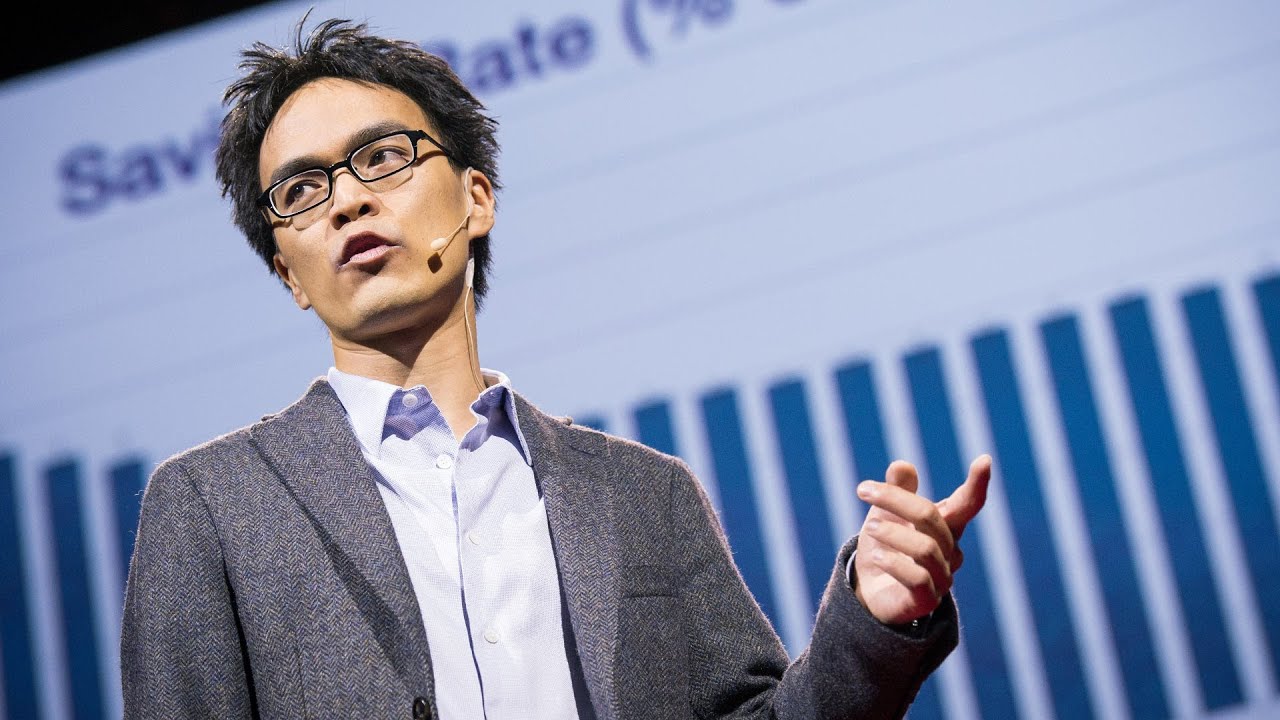
Could your language affect your ability to save money? - Keith Chen
video description
Morphologically, English doesn't even have a proper fututre tense, as both future tenses are formed with present tenses (will/be going to. In comparison to that, French, for instance, uses inflection to form a fututre tense, (J'irai en France) with a stem and suffixes, which can be seen as proper future tense.
In so far, Mr. Chen was either not clear enough in the linguistic part of this talk, as I couldn't follow his idea properly, or he should overthink it again.
Date: 2020-08-22
Related videos


Comments and reviews: 7
Smallpotato1965
He might be an economics professor, but a linguist he is not. In Dutch, one not only uses present and past tenses (het regent vandaag = 'it rains today', 'het regende gisteren' = 'it rained yesterday') but one also uses additional verbs to show that something happened in the past (het heeft gisteren geregend = it has rained yesterday) and another additional verb to show that something will happen in the future (het zal morgen regenen = it will rain tomorrow)
Yes somehow this. brilliant. man claims that Dutch is a 'futureless language' with the equivalent 'it rain today, it rain yesterday, it rain tomorrow'!
reply
He might be an economics professor, but a linguist he is not. In Dutch, one not only uses present and past tenses (het regent vandaag = 'it rains today', 'het regende gisteren' = 'it rained yesterday') but one also uses additional verbs to show that something happened in the past (het heeft gisteren geregend = it has rained yesterday) and another additional verb to show that something will happen in the future (het zal morgen regenen = it will rain tomorrow)
Yes somehow this. brilliant. man claims that Dutch is a 'futureless language' with the equivalent 'it rain today, it rain yesterday, it rain tomorrow'!
reply
VideoNozoki
at 6: 42, that graph looks quite evenly mixed. Of the top 5 saving countries, 2 use Futureless language, and 3 use Future based language. His theory is interesting (and i believe has some truth in it, but it doesn't seem as strong as he makes it sound. It seems more like a theory driving the search for data than vice versa. And China (where he started his speech) isn't even listed here.
reply
at 6: 42, that graph looks quite evenly mixed. Of the top 5 saving countries, 2 use Futureless language, and 3 use Future based language. His theory is interesting (and i believe has some truth in it, but it doesn't seem as strong as he makes it sound. It seems more like a theory driving the search for data than vice versa. And China (where he started his speech) isn't even listed here.
reply
Devon
I am a bit confused, but I think Dr. Chen is saying that the countries that do not distinguish the future as an event that happens in later time tend to save more because the languages of those countries do not denote a dramatic difference between present and future. Thus, they ultimately save more because of their language being in time. if that makes sense. It probably doesn't.
reply
I am a bit confused, but I think Dr. Chen is saying that the countries that do not distinguish the future as an event that happens in later time tend to save more because the languages of those countries do not denote a dramatic difference between present and future. Thus, they ultimately save more because of their language being in time. if that makes sense. It probably doesn't.
reply
Swan
me and my brother are a lot alike, but how we spend are cash is completely different he's a madman if he gets a a couple grand he'll buy new tv, sub woffers, anything really he just start to buy things/stuff. I on the other hand still have my money saved from when i was in elementary believe it or not, i am 21.
reply
me and my brother are a lot alike, but how we spend are cash is completely different he's a madman if he gets a a couple grand he'll buy new tv, sub woffers, anything really he just start to buy things/stuff. I on the other hand still have my money saved from when i was in elementary believe it or not, i am 21.
reply
Kevin
You know what I always hated. In English we say someone is worth 5. 2 million dollars. That's a terrible way to say that. The amount of money you have is an awful measure of someone's worth. It's possible to be rich and be almost worthless. And vice versa.
reply
You know what I always hated. In English we say someone is worth 5. 2 million dollars. That's a terrible way to say that. The amount of money you have is an awful measure of someone's worth. It's possible to be rich and be almost worthless. And vice versa.
reply
Marcos
TOTALLY FALSE ASSUMPTION about German.
As a native German speaker, German IS NOT futureless.
>> Morgen WIRD es regnen. (Tomorrow WILL it rain)
reply
TOTALLY FALSE ASSUMPTION about German.
As a native German speaker, German IS NOT futureless.
>> Morgen WIRD es regnen. (Tomorrow WILL it rain)
reply
bago's
het heeft gisteren geregend
het is aan het regenen
het zal morgen regenen
. and this guy claims dutch is a futureless language?
reply
het heeft gisteren geregend
het is aan het regenen
het zal morgen regenen
. and this guy claims dutch is a futureless language?
reply
Add a review, comment
Other channel videos