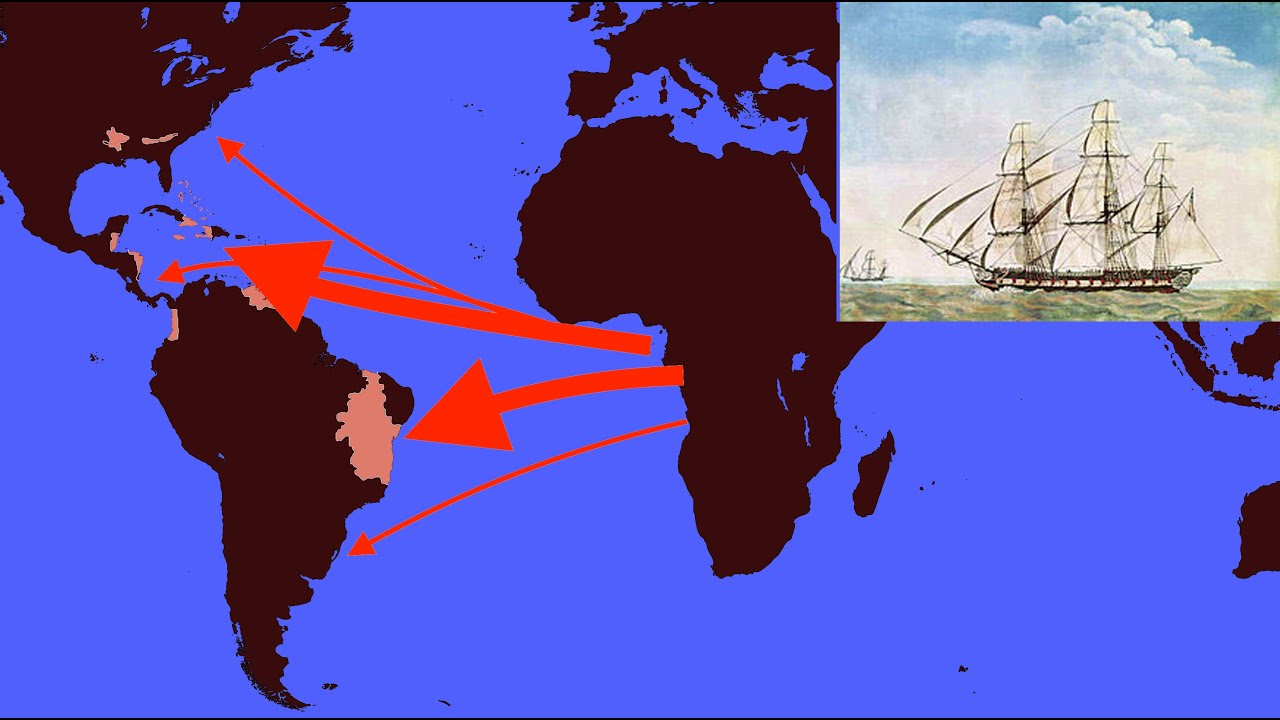
What if the Atlantic Slave Trade Never Happened?
video description
Portugal has always been a tiny country and without slavery would anything resembling Brazil have been feasible? If we're going with a South American superpower, then I'd argue that one based in Argentina/southern Brazil is a lot more likely. In North America the concept of manifest destiny was also not inevitable, if there hadn't been slavery to bring in that sweet, sweet sugar money and boost the population early on then perhaps the native tribes and civilizations would have persevered and the Americas would resemble more Europe or Asia with distinct smaller countries and cultures. This isn't an impossible by any means because this was the favored attitude for dealing with the natives for some European powers, and without the economic boost from slavery at the early stages, would there have been such massive growth in the Americas or such interest from the monarchies in Europe?
2. Portugal was not poor, the matter is the economy and wealth distribution which comes down the economic systems and what the government (read: monarchy) chose to invest in. Spain and Portugal were both very wealthy countries in the early modern period, but they essentially wasted that wealth. If you visit Portugal you'd see a number of very impressive but essentially useless building projects from that period, huge monasteries and cathedrals as the kings cared more about their subjects souls than their standard of living, and the situation was similar in Spain. This is downright hilarious in its hypocrisy considering where they got that wealth, and if there was any justice in their religions then all these monarchs would be burning in a special level of hell just for them! Also worth considering is that for much of its history, Portugal was an informal English colony, in fact it was reliant on English/British support to protect its colonies in many of its colonial wars against the Dutch. To explore this topic better it would be best to look at the decline of Portugal and Spain in Europe, and this is something tied a great deal to European politics, and the relative rise of England, France and the Netherlands (all very successful slaver nations!
3. Your analysis of Europe and the Industrial Revolution is very surface detail. Natural resources do not equal a rich society. You just need to look at Brazil (yes I agree it's a massive disappointment given its potential) and Africa in general. Both are very rich in natural resources, but its necessary to look at the economic systems surrounding them. Follow the money! Much of Africa is still controlled by the West via the World Bank and IMF through neocolonial policies that favor Western economies and a small segment of society. You can say the same about Iraq and lots of countries with oil. To look at the Southern States and say they're poor is to ignore the local aristocracy (including many of the Founding Fathers) who got rich off that, and to ignore the multiple British cities that were literally built on the profits of slavery. Leading onto the Industrial Revolution, just because it (as its traditionally considered) started in other regions of England, it doesn't change the fact that a massive amount of money came into the country that funded massive fleets and colonial adventures, and encouraged further overseas expansion and created the opportunities for mass production. Even back then the world wasn't such a small and isolated place.
4. The Arab slave trade resembled the ancient Roman slave trade, and neither of them experiences an industrial revolution. The key difference is the industrial scale of slavery in the Americas, nowhere in the Middle East or elsewhere in history was there such massive exploitation and transportation of people.
5. Lastly and most importantly, I think your video is very conservative for not exploring any of these options. You ignore many of the butterfly effects. Would European expansion into the Americas have continued without slavery in the Caribbean? Would India have been invaded without the successes of the Americas? Would Europe have developed technologically at the same rate without the Americas (not just speaking of the Industrial Revolution? Would the Industrial Revolution have happened/the same way at the same time? Would the vaccines to protect again Malaria and other diseased in Africa have been developed without the influx in wealth and interest aroused from colonial adventures? Would the Scramble for Africa have occurred without these earlier events?
This could lead to vastly different worlds, so to reduce it to a US-Brazil Cold War is somewhat unadventurous.
Date: 2022-07-15
Related videos


Comments and reviews: 9
OptimalOwl
Lack of slavery would have made the South _even more_ economically backwards. ? I have a hard time seeing why that would be.
In their home country, those same English aristocratic byblows became the modern middle class and seeded the industrial revolution. Just about everywhere else in the world that they've settled has been a success. Our IRL version of the South is already one of the poorer places they've settled, and in fact one of the poorest places in the first world. It just seems way more parsimonious to think that they'd bring their special sauce to the South, just like they did everywhere else.
Consider how their options for investment would be different. Denied the high short-term ROI of slavery, they would have had to settle for the classes of investment with lower ROI, including things like railway, agricultural improvement and industry. These had lower short-term returns, but much greater developmental knock-on effects, such that they are on the whole more conducive to industrialization.
You also pointed out later that resources don't have a huge effect on development. I think it's more true to say that they have an effect, but that the effect differs based on what the country is like. Norway uses its oil to be even more Norway, Venezuela used its oil to be even more communistic, Saudi Arabia uses its oil to have even more nepotism and extravagance, etc. I think non-slave Freedomland would probably spend its oil money on being even more industrious and independent (or possibly just on guns, cars & cheeseburgers)
Finally, we must consider the impact of demographic characteristics. For whatever reason, Subsaharan Africans in the US ended up having a whole lot of problems, which has had negative effects on many areas of development, and which the US is still trying to ameliorate to this day at great expense. If not for the slave trade, the US would never have had to deal with these problems, contributing to an overall better position.
reply
Lack of slavery would have made the South _even more_ economically backwards. ? I have a hard time seeing why that would be.
In their home country, those same English aristocratic byblows became the modern middle class and seeded the industrial revolution. Just about everywhere else in the world that they've settled has been a success. Our IRL version of the South is already one of the poorer places they've settled, and in fact one of the poorest places in the first world. It just seems way more parsimonious to think that they'd bring their special sauce to the South, just like they did everywhere else.
Consider how their options for investment would be different. Denied the high short-term ROI of slavery, they would have had to settle for the classes of investment with lower ROI, including things like railway, agricultural improvement and industry. These had lower short-term returns, but much greater developmental knock-on effects, such that they are on the whole more conducive to industrialization.
You also pointed out later that resources don't have a huge effect on development. I think it's more true to say that they have an effect, but that the effect differs based on what the country is like. Norway uses its oil to be even more Norway, Venezuela used its oil to be even more communistic, Saudi Arabia uses its oil to have even more nepotism and extravagance, etc. I think non-slave Freedomland would probably spend its oil money on being even more industrious and independent (or possibly just on guns, cars & cheeseburgers)
Finally, we must consider the impact of demographic characteristics. For whatever reason, Subsaharan Africans in the US ended up having a whole lot of problems, which has had negative effects on many areas of development, and which the US is still trying to ameliorate to this day at great expense. If not for the slave trade, the US would never have had to deal with these problems, contributing to an overall better position.
reply
David
21: 43 Yes the South dominated by the low country elite has been a conservative region economically and the whole South generally so culturally. However, progressive Democratic strength in the up country south gets overlooked all to frequently. The coalition that supported WJB was very up country south and western and while the low south stuck with him bc of the lingering civil war era resentments, it's at this point that they aren't really in the driver's seat. This is basically the same coalition that supported Truman just with more unions to produce more factory votes and more ethnic votes in the North. It's also very similar to Clinton's base though Clinton added a lot of secular suburbs in the North.
Yes you lose the low country South cavaliers but at the same time the region as a whole is weaker with lower population and as you say later in the video it is likely the US becomes more restrictionist on immigration, this reduces the labor and ethnic vote and the increased competition for workers would drive up wages and expand the northern middle class. This removes the path for the New Deal realignment. The Democrats if they even exist would become characterized by agrarian radicalism and continue to alienate a large piece of the northern working class and scare the pants off the middle and wealthy classes. The latter groups would likely support some kind of nationalist oriented pro-business party though they probably aren't called Republicans. Assuming the Yankees moving west still happens and the development of industry also continues, the economic and demographic basis for this party to exist is present even without the Civil War and slavery.
reply
21: 43 Yes the South dominated by the low country elite has been a conservative region economically and the whole South generally so culturally. However, progressive Democratic strength in the up country south gets overlooked all to frequently. The coalition that supported WJB was very up country south and western and while the low south stuck with him bc of the lingering civil war era resentments, it's at this point that they aren't really in the driver's seat. This is basically the same coalition that supported Truman just with more unions to produce more factory votes and more ethnic votes in the North. It's also very similar to Clinton's base though Clinton added a lot of secular suburbs in the North.
Yes you lose the low country South cavaliers but at the same time the region as a whole is weaker with lower population and as you say later in the video it is likely the US becomes more restrictionist on immigration, this reduces the labor and ethnic vote and the increased competition for workers would drive up wages and expand the northern middle class. This removes the path for the New Deal realignment. The Democrats if they even exist would become characterized by agrarian radicalism and continue to alienate a large piece of the northern working class and scare the pants off the middle and wealthy classes. The latter groups would likely support some kind of nationalist oriented pro-business party though they probably aren't called Republicans. Assuming the Yankees moving west still happens and the development of industry also continues, the economic and demographic basis for this party to exist is present even without the Civil War and slavery.
reply
Joseph
You meant for evil, but God meant it for good. So said one of the greatest stories of the ancient or modern world of slavery. Joseph was sold by his brothers (technically half-brothers) into slavery rather then they kill him or let him die in a well. So, he becomes the second most powerful man in the ancient world, only second to Pharaoh, Zaphnath-Paaneah. If not for his enslavement AND his honorable behavior as a Godly man, Joseph would never have been able to save the FAMILY of Jacob, hence the Israelites.
Say what you want BUT if the slave trade didn't occur, do you realize how FEW native Africans would be in the US or New World? The cost of people to individually make the journey and establish themselves in a new land with extremely limited ability to transport the resources they needed to plant themselves in any new land would have been FAR beyond most native African's means! AND extremely few would have known or cared about the benefits of living in a free society. OR cared to change their centuries old traditions and way of life. just like the American indians struggled to accept the Europeans' ways.
In short, what we see sometimes as a horrible evil turns into a good (somehow) and what we see as something good and wonderful turns into a giant pile of shit! 1 That takes untold generations to unravel to be able to distill anything positive out of it. such is the human experience.
reply
You meant for evil, but God meant it for good. So said one of the greatest stories of the ancient or modern world of slavery. Joseph was sold by his brothers (technically half-brothers) into slavery rather then they kill him or let him die in a well. So, he becomes the second most powerful man in the ancient world, only second to Pharaoh, Zaphnath-Paaneah. If not for his enslavement AND his honorable behavior as a Godly man, Joseph would never have been able to save the FAMILY of Jacob, hence the Israelites.
Say what you want BUT if the slave trade didn't occur, do you realize how FEW native Africans would be in the US or New World? The cost of people to individually make the journey and establish themselves in a new land with extremely limited ability to transport the resources they needed to plant themselves in any new land would have been FAR beyond most native African's means! AND extremely few would have known or cared about the benefits of living in a free society. OR cared to change their centuries old traditions and way of life. just like the American indians struggled to accept the Europeans' ways.
In short, what we see sometimes as a horrible evil turns into a good (somehow) and what we see as something good and wonderful turns into a giant pile of shit! 1 That takes untold generations to unravel to be able to distill anything positive out of it. such is the human experience.
reply
Joseph
wrong on the Mexico War. if no cotton. they take ALL of Mexico. Why? .because the Manifest Destiny idea doesn't offend the Northerners anymore than the Southerners ( just like capturing Canada doesn't offend Southerners in the 1812 War, as slavery isn't the issue that drove the STOP of annexation of the Mexican conquest. better go back and study your history in depth as to why no more was annexed from Mexico. It was almost all of it, or making Mexico City an enclave with access to the seas(trade) controlled by the US (if on on good behavior. that was the original thought to deal with Mexico after the war. The Yucatan would immediately be granted statehood (within a couple years. As soon as gems and gold and silver were discovered in Chihuahua nearly all the Mexican territory would become a state of the US.
You need to consult with Geologists more often. Geology was a PRIME mover of colonialism back then. just as it is today with China wanting into Afghanistan. TRILLIONS worth of rare earth minerals in the Hindu Kush Mountains!
reply
wrong on the Mexico War. if no cotton. they take ALL of Mexico. Why? .because the Manifest Destiny idea doesn't offend the Northerners anymore than the Southerners ( just like capturing Canada doesn't offend Southerners in the 1812 War, as slavery isn't the issue that drove the STOP of annexation of the Mexican conquest. better go back and study your history in depth as to why no more was annexed from Mexico. It was almost all of it, or making Mexico City an enclave with access to the seas(trade) controlled by the US (if on on good behavior. that was the original thought to deal with Mexico after the war. The Yucatan would immediately be granted statehood (within a couple years. As soon as gems and gold and silver were discovered in Chihuahua nearly all the Mexican territory would become a state of the US.
You need to consult with Geologists more often. Geology was a PRIME mover of colonialism back then. just as it is today with China wanting into Afghanistan. TRILLIONS worth of rare earth minerals in the Hindu Kush Mountains!
reply
David
Well, I like your videos, especially when you analise real history and cultures, but in this case, I think you didn't dig deep enough. There were papal bills( bulas papais) against slavery since the XV century, and the Jesuits were one of the fiercest enemies of slavery, at least in Brazil. What happened, actually, was that economic pressures were stronger than morality and religion. The slave trade was too profitable. I think that the only way it didn't happen, was to Portugal become so morally against slavery, as a nation, as to forbid it. It was Portuguese merchants the main catalyst for it in the first place, and it was the only nation with a navy big enough at the time as to prevent anyone else to take it's place, as England would do in the XIX century.
reply
Well, I like your videos, especially when you analise real history and cultures, but in this case, I think you didn't dig deep enough. There were papal bills( bulas papais) against slavery since the XV century, and the Jesuits were one of the fiercest enemies of slavery, at least in Brazil. What happened, actually, was that economic pressures were stronger than morality and religion. The slave trade was too profitable. I think that the only way it didn't happen, was to Portugal become so morally against slavery, as a nation, as to forbid it. It was Portuguese merchants the main catalyst for it in the first place, and it was the only nation with a navy big enough at the time as to prevent anyone else to take it's place, as England would do in the XIX century.
reply
Joseph
Dudelng! Why did the North European become prosperous and the Slave Traders not? Simple. industry. the slave traders and silver miners (Portugal and Spain ) didn't develop industries. they used their cash to buy what they wanted and thus just passed through the wealth. just like the US is now doing by POLITICAL GLOBALIST to de-nude America of it's wealth and capabilities in favor of the CCP. young dudeling. WISE UP! Learn Chinese. the language of YOUR NEW MASTERS. SURELY your children and grandchildren will NOT know a world where America or it's values of liberty are espoused. Even kiddies in high school today would rather VIRTUE SIGNAL wearing a mask down the side of the highway by themselves than be a FREE THINKER and LIVE like a FREE human.
reply
Dudelng! Why did the North European become prosperous and the Slave Traders not? Simple. industry. the slave traders and silver miners (Portugal and Spain ) didn't develop industries. they used their cash to buy what they wanted and thus just passed through the wealth. just like the US is now doing by POLITICAL GLOBALIST to de-nude America of it's wealth and capabilities in favor of the CCP. young dudeling. WISE UP! Learn Chinese. the language of YOUR NEW MASTERS. SURELY your children and grandchildren will NOT know a world where America or it's values of liberty are espoused. Even kiddies in high school today would rather VIRTUE SIGNAL wearing a mask down the side of the highway by themselves than be a FREE THINKER and LIVE like a FREE human.
reply
antiochus87
Your video was interesting but it had some significant holes in it. Personally I think for such a complex topic it would be necessary to take a deeper dive into politics and history of the 15th to 18th century, to look at how the original colonies of these countries came about, the attitudes of the monarchies and others who funded these in Europe and how changes to attitudes to slavery and the resources available to affect colonial expeditions, support and growth in the Americas. I understand this is no simple task and requires significant specialized research so I'll focus my comments on what you did cover.
But because this is long, I'll separate it into different posts to read if you care to.
reply
Your video was interesting but it had some significant holes in it. Personally I think for such a complex topic it would be necessary to take a deeper dive into politics and history of the 15th to 18th century, to look at how the original colonies of these countries came about, the attitudes of the monarchies and others who funded these in Europe and how changes to attitudes to slavery and the resources available to affect colonial expeditions, support and growth in the Americas. I understand this is no simple task and requires significant specialized research so I'll focus my comments on what you did cover.
But because this is long, I'll separate it into different posts to read if you care to.
reply
Luis
Actually a massive part of the Texan-Mexican war was that Mexico was anti-slavery and the american migrants wanted to keep their slaves, so that may not happen and without that spark, and combined with a less populated America, the whole American-Mexican war may not happen ever.
And going further back, canonically the guy that first brought smallpox to Mexico was an african slave during Cortez's expedition, so the conquest of the aztec empire may not happen or may happen further down the line and in different conditions. The consequences would be impossible to predict.
reply
Actually a massive part of the Texan-Mexican war was that Mexico was anti-slavery and the american migrants wanted to keep their slaves, so that may not happen and without that spark, and combined with a less populated America, the whole American-Mexican war may not happen ever.
And going further back, canonically the guy that first brought smallpox to Mexico was an african slave during Cortez's expedition, so the conquest of the aztec empire may not happen or may happen further down the line and in different conditions. The consequences would be impossible to predict.
reply
Bruce
Superpower of Brazil? You stated that the North American southeast region would be poor (almost like Afghanistan) without the plantation culture. I realize that some of the coastal region was swampy, however, the region at least had good farm land and an abundance of good lumber. Appalachia also has some copper and iron ore, and lots of coal (although you need railroads to extract it profitably. Texas and Oklahoma have oil. ? Much of the region is covered with thick jungle and limited mineral recourses.
reply
Superpower of Brazil? You stated that the North American southeast region would be poor (almost like Afghanistan) without the plantation culture. I realize that some of the coastal region was swampy, however, the region at least had good farm land and an abundance of good lumber. Appalachia also has some copper and iron ore, and lots of coal (although you need railroads to extract it profitably. Texas and Oklahoma have oil. ? Much of the region is covered with thick jungle and limited mineral recourses.
reply
Add a review, comment
Other channel videos