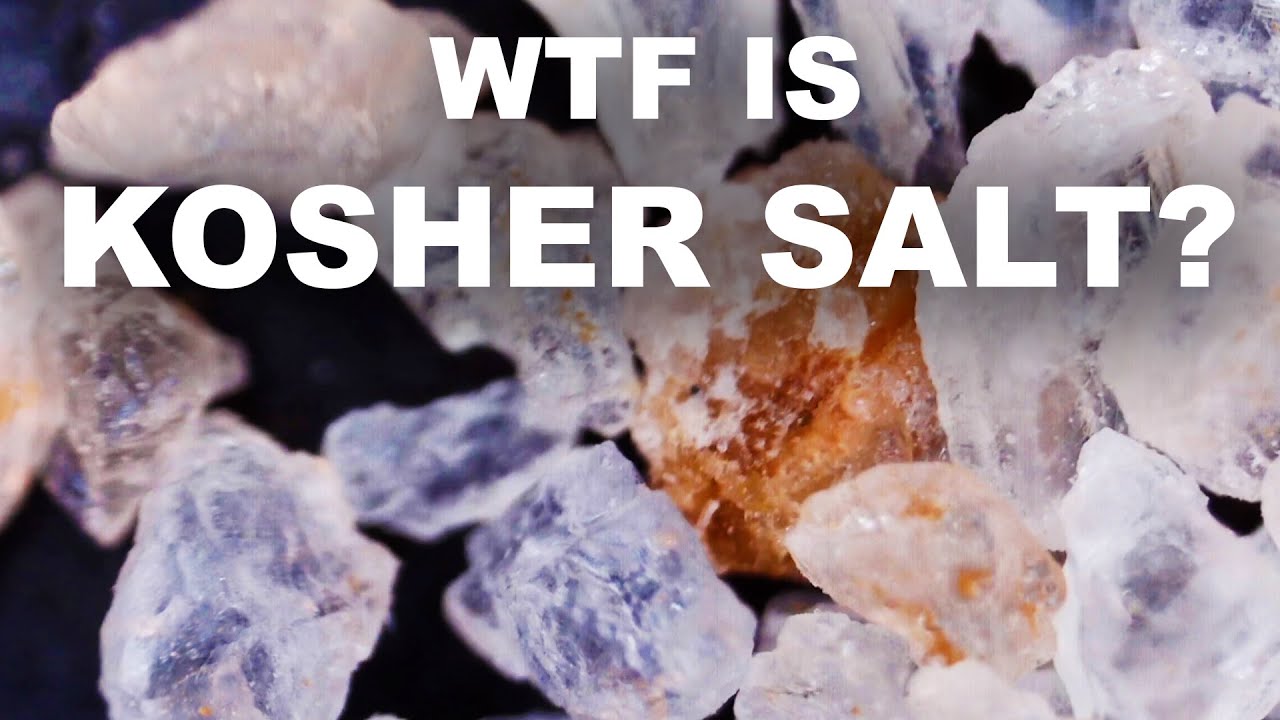
What is kosher salt, and why do (American) chefs love it?
video description
The tl/dr answer is: Morton Iodized salt both is, and is not, Kosher -- depending upon the time of year and your beliefs.
Date: 2021-05-04
Related videos


Comments and reviews: 9
Adam
Hi everybody, I've heard some concerns, so let me make something really clear: Rendering meat kosher is a complicated process of which this salting procedure I demonstrate in the video is simply one phase. As I mentioned in the vid, there's the butchering process to consider, and more. This video is not about how to make meat compliant with Jewish dietary law it only engages with that topic in as much as it is relevant to the historical origins of Kosher salt as a marketing term for coarse salts, which is what the video is about. If you really want to learn how to make food suitable for a religion, I am not your man!
Here's one thing I think I got wrong: OU regards Morton table salt as not Kosher for Passover, which is a much more specific and narrow designation than not Kosher. And certainly iodine is not the only factor they consider there, which is why I said the salt is not Kosher for a few reasons. Writing these videos is always a balancing act between giving enough context to maintain accuracy, and cutting out details that would make the video last forever. I often have to use phrases like one of the reasons or among other things to communicate that what I'm mentioning is part of a much bigger thing, but it's not the particular thing we're talking about today. Regardless, not Kosher for passover is a much more specific thing than not Kosher that much I definitely got wrong.
And certainly, don't come to me looking for authentic Hebrew pronunciations! As always, I generally try to use the most proximate anglicization for non-English words. Whether I got to the closest proximate anglicization on Chabad, I'm not sure! I'm hearing no?
If anybody has more concerns along these lines, I'll try to update this pin accordingly.
reply
Hi everybody, I've heard some concerns, so let me make something really clear: Rendering meat kosher is a complicated process of which this salting procedure I demonstrate in the video is simply one phase. As I mentioned in the vid, there's the butchering process to consider, and more. This video is not about how to make meat compliant with Jewish dietary law it only engages with that topic in as much as it is relevant to the historical origins of Kosher salt as a marketing term for coarse salts, which is what the video is about. If you really want to learn how to make food suitable for a religion, I am not your man!
Here's one thing I think I got wrong: OU regards Morton table salt as not Kosher for Passover, which is a much more specific and narrow designation than not Kosher. And certainly iodine is not the only factor they consider there, which is why I said the salt is not Kosher for a few reasons. Writing these videos is always a balancing act between giving enough context to maintain accuracy, and cutting out details that would make the video last forever. I often have to use phrases like one of the reasons or among other things to communicate that what I'm mentioning is part of a much bigger thing, but it's not the particular thing we're talking about today. Regardless, not Kosher for passover is a much more specific thing than not Kosher that much I definitely got wrong.
And certainly, don't come to me looking for authentic Hebrew pronunciations! As always, I generally try to use the most proximate anglicization for non-English words. Whether I got to the closest proximate anglicization on Chabad, I'm not sure! I'm hearing no?
If anybody has more concerns along these lines, I'll try to update this pin accordingly.
reply
Erik
Why not just call it Course Salt, though? That's what we call it where I'm from - Course Salt & Fine Salt. It even said it right there, on your package at the start of the video Course Salt.
Kosher just seems like a filler word, left there, drifting through time, for no particular reason, other than tradition. It's also confusing for non-english speakers, as it doesn't really translate very well to anything we know. Table salt, cours salt, fine salt, kosher salt, sea salt, himalayan salt etc etc. It shouldn't be rocket science, lol.
Also, course salt makes skin a lot more crispy, if the surface is somewhat dry, compared to fine salt. another benefit, and the number one reason why I've only used it, and not fine salt, for years. It's also much easier to control the saltiness of your food with coarse salt, as fine salt quickly makes everything too salty.
reply
Why not just call it Course Salt, though? That's what we call it where I'm from - Course Salt & Fine Salt. It even said it right there, on your package at the start of the video Course Salt.
Kosher just seems like a filler word, left there, drifting through time, for no particular reason, other than tradition. It's also confusing for non-english speakers, as it doesn't really translate very well to anything we know. Table salt, cours salt, fine salt, kosher salt, sea salt, himalayan salt etc etc. It shouldn't be rocket science, lol.
Also, course salt makes skin a lot more crispy, if the surface is somewhat dry, compared to fine salt. another benefit, and the number one reason why I've only used it, and not fine salt, for years. It's also much easier to control the saltiness of your food with coarse salt, as fine salt quickly makes everything too salty.
reply
Sarah
Thank you for explaining this. In the U. K. we ve several old salt products that have been on the go for absolute centuries. They are just the go to salts that U. K. chefs reach for, such as Maldon or Anglesey. Kosher salt is just not a thing here.
What I would like to know, is from a health perspective, how does all this salting affect the meal. You are supposed to eschew salt for children, as their kidneys can t cope with the salt. In addition, we have family members who are on low salt diets (ie kidney failure. How does the kosher diet affect the health of those forced to use it? Or do children and those required by medical advice, get excused, as young children and some diabetics get excused Ramadan fasting. This is all very interesting to me and I m very curious.
reply
Thank you for explaining this. In the U. K. we ve several old salt products that have been on the go for absolute centuries. They are just the go to salts that U. K. chefs reach for, such as Maldon or Anglesey. Kosher salt is just not a thing here.
What I would like to know, is from a health perspective, how does all this salting affect the meal. You are supposed to eschew salt for children, as their kidneys can t cope with the salt. In addition, we have family members who are on low salt diets (ie kidney failure. How does the kosher diet affect the health of those forced to use it? Or do children and those required by medical advice, get excused, as young children and some diabetics get excused Ramadan fasting. This is all very interesting to me and I m very curious.
reply
Silverpicker
First off, very impressive summary of Kashrut for someone who didn't grow up with it. The only thing that you got (a bit) wrong is the part where you talked about how the requirement to rinse the meat is contrary to food-safety guidelines. That is certainly true, but it's not actually relevant to the typical kosher kitchen. The reason is that this entire process is not done in the home, but rather at the butcher and/or slaughterhouse. As you are now aware, Kashrut is so complex that the process is monitored from farm all the way to the grocery store. By the time you buy it, it's already totally kashered and can simply be prepared and eaten just like a non-kosher piece of meat. Not additional salting or rinsing is necessary.
reply
First off, very impressive summary of Kashrut for someone who didn't grow up with it. The only thing that you got (a bit) wrong is the part where you talked about how the requirement to rinse the meat is contrary to food-safety guidelines. That is certainly true, but it's not actually relevant to the typical kosher kitchen. The reason is that this entire process is not done in the home, but rather at the butcher and/or slaughterhouse. As you are now aware, Kashrut is so complex that the process is monitored from farm all the way to the grocery store. By the time you buy it, it's already totally kashered and can simply be prepared and eaten just like a non-kosher piece of meat. Not additional salting or rinsing is necessary.
reply
Daniel
Dont know if I missed a clarification in the video, but just because you pour salt on the meat doesnt mean it is now kosher. The meat needs to be kosher before, which requires the proper method of slaughtering and handling. Also, im not sure where the salt pouring, blood drawing, koshering process happens, but most of the time its not as presented, i. e. the home cook in the kitchen. The meat you buy from a kosher butcher should be ready to go as is (at least in most places in the US.
reply
Dont know if I missed a clarification in the video, but just because you pour salt on the meat doesnt mean it is now kosher. The meat needs to be kosher before, which requires the proper method of slaughtering and handling. Also, im not sure where the salt pouring, blood drawing, koshering process happens, but most of the time its not as presented, i. e. the home cook in the kitchen. The meat you buy from a kosher butcher should be ready to go as is (at least in most places in the US.
reply
ChaosSwissroIl
Because chefs (that you know the name of) are almost all sheeple and go along with whatever is popular. You would not believe the amount of recipes that call for kosher salt when it is just being dissolved. If your dish has any meaningful amount of moisture, then kosher salt is -a complete- mostly a meme -with zero value-. You can get pretzel salt for half the price and only like 20% larger grains for the one or two recipes that actually warrant it's use.
reply
Because chefs (that you know the name of) are almost all sheeple and go along with whatever is popular. You would not believe the amount of recipes that call for kosher salt when it is just being dissolved. If your dish has any meaningful amount of moisture, then kosher salt is -a complete- mostly a meme -with zero value-. You can get pretzel salt for half the price and only like 20% larger grains for the one or two recipes that actually warrant it's use.
reply
Rich
We've used kosher for years, but my current favorite for cooking is pickling salt. None of the table salt additives, but the tiny grains ensure that it dissolves quickly, it's better for applications like salting popcorn since the grains are smaller, and I've never had the pinching issues that Adam has.
reply
We've used kosher for years, but my current favorite for cooking is pickling salt. None of the table salt additives, but the tiny grains ensure that it dissolves quickly, it's better for applications like salting popcorn since the grains are smaller, and I've never had the pinching issues that Adam has.
reply
Looofa
I think it is important to say that when applying salt in baking or when it is measured in weight or volume you should use a fine table salt, this is because it is what is used when making recipes due to the reliability between brands and not producing air pockets when measured.
reply
I think it is important to say that when applying salt in baking or when it is measured in weight or volume you should use a fine table salt, this is because it is what is used when making recipes due to the reliability between brands and not producing air pockets when measured.
reply
lohphat
It was explained simply by a chef friend of mine that kosher salt by volume is less than table salt due to way it packs when measured by volume -- so it helps reduce salt intake if that's a concern. A tsp of table salt packs way tighter than flakes.
reply
It was explained simply by a chef friend of mine that kosher salt by volume is less than table salt due to way it packs when measured by volume -- so it helps reduce salt intake if that's a concern. A tsp of table salt packs way tighter than flakes.
reply
Add a review, comment
Other channel videos